

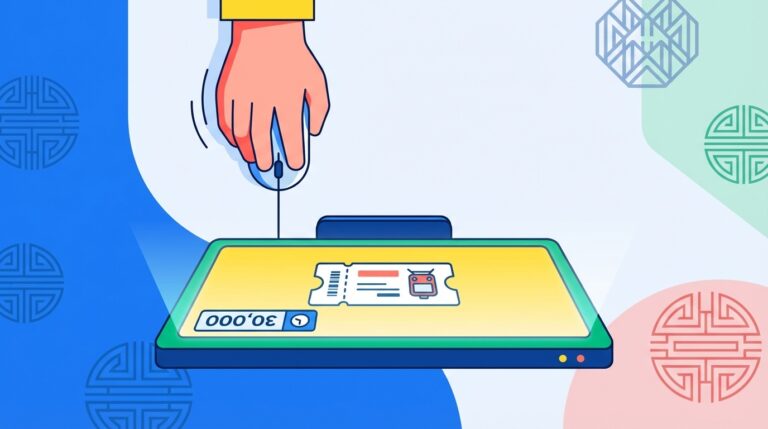
Phase 1: Empathy (The K-Culture Cold Open)
Hello there! I’m your Daily Hangul Editor, your local Korean friend and veteran tutor.
Imagine this scene: It’s a month before Chuseok (Korean Thanksgiving). You walk into a PC Bang (internet cafe) at 6:50 AM. You’d expect to see gamers, but instead, you see office workers, college students, and even grandmothers staring intensely at their monitors, atomic clocks open on their screens. The clock hits 07:00:00. A synchronized symphony of frantic mouse clicks echoes through the room.
Welcome to the real Squid Game of Korea: Holiday Train Ticketing.
If you’ve ever tried to book a KTX or SRT ticket during a major Korean holiday (Seollal or Chuseok), you know the sheer panic when the screen shows “Waiting: 45,000 people.” Standard textbooks will teach you how to say “I would like to buy a train ticket” (기차표를 예매하고 싶어요). But in the real world? That phrase won’t save you when tickets vanish in 30 seconds.
Today, we are diving deep into the advanced, real-life Korean expressions used during the legendary “ticketing wars.” Understanding this isn’t just about language; it’s your survival guide to navigating Korea’s massive holiday migrations like a true insider. Let’s get into it!
Phase 2: Core Expressions Deep Dive
1. 피켓팅 (Piketing)
- Pronunciation: [pi-ket-ting] Sounds like ‘pee-ket-ting’
- Meaning: (Literal) Blood + Ticketing / (Real nuance) A ticketing process so fiercely competitive it feels like a bloodbath.
- K-Culture Moment: This portmanteau originally comes from the K-Pop fandom. When a famous idol group announces a Seoul concert, fans prepare for ‘피켓팅’. The exact same term is now universally used by all Koreans for holiday train tickets.
- Editor’s Insight: This word perfectly captures the dramatic, high-stakes nature of Korean digital life. It’s almost worn as a badge of honor. When you say “피켓팅,” Koreans will immediately nod in deep, traumatized solidarity.
- Situation Spectrum:
- Casual with friends: ✅
- Semi-formal with coworkers: ✅ (Very common in office small talk!)
- Formal to a boss: ⚠️ (Usually okay, but slightly slangy)
- 🤔 Think About It: Why does Korean culture blend English words (ticket) with extreme Korean concepts (blood/bloodbath)? Does your culture have a dramatic term for securing limited items?
2. 취소표를 줍다 (Chwisopyo-reul jup-tta)
- Pronunciation: [chwi-so-pyo-reul jup-tta] ‘chwi’ sounds like ‘tree’ but with a ‘chw’. ‘jup-tta’ sounds like ‘joop-tta’ (sharp t).
- Meaning: (Literal) To pick up a canceled ticket / (Real nuance) To scavenge or obsessively refresh until you snatch a ticket someone else dropped.
- K-Culture Moment: You missed the initial ticketing window. Your Korean friend taps your shoulder and says, “Don’t worry, we can ‘pick up’ canceled tickets at 2 AM.” It’s the midnight hustle of K-Culture.
- Editor’s Insight: Notice the verb 줍다 (to pick up from the ground). It shows the desperation! You aren’t elegantly “booking” (예매하다); you are scavenging the digital floor for whatever falls.
- Situation Spectrum:
- Casual with friends: ✅
- Semi-formal with coworkers: ✅
- Formal to a boss: 🚫 (Use “취소표를 구하다” instead)
- 🤔 Think About It: How does the verb ‘줍다’ (to pick up/scavenge) reflect the power dynamic between the buyer and the extreme scarcity of the product?
3. 입석이라도 끊다 (Ipseog-irado kkeun-ta)
- Pronunciation: [ip-seog-i-ra-do kkeun-ta] ‘ip-seok’ sounds like ‘eep-suck’.
- Meaning: (Literal) To cut a standing seat at least / (Real nuance) To settle for a standing ticket out of sheer desperation.
- K-Culture Moment: The drama protagonist is rushing to Busan to stop their lover from leaving. No seats left! They slam their card on the counter: “입석이라도 주세요!” (Give me a standing ticket at least!)
- Editor’s Insight: “입석” (standing room) is the last resort. The verb “끊다” literally means “to cut,” stemming from the old days when paper tickets were physically cut or punched. It’s still used today for buying digital tickets!
- Situation Spectrum:
- Casual with friends: ✅
- Semi-formal with coworkers: ✅
- Formal to a boss: ✅
- 🤔 Think About It: Standing for 2.5 hours on a KTX to Busan is exhausting. Why do Koreans endure this rather than just staying in Seoul for the holiday?
Phase 3: Textbook vs. Real Korean
| Situation | 📖 Textbook Korean | 🗣️ Real Korean | 💡 Why is it different? |
|---|---|---|---|
| Failing to get a ticket | 기차표가 다 팔렸어요. (The train tickets are all sold out.) | 아, 광탈했어요. (Ah, I got eliminated at the speed of light.) | “광탈” (Light-speed elimination) reflects the 30-second reality of modern server crashes. |
| Booking a ticket | 기차표를 예매했습니다. (I booked a train ticket.) | 티켓팅 성공했어요! (I succeeded in ticketing!) | Booking is no longer a transaction; it’s framed as an achievement or a battle won. |
| Looking for remaining seats | 남은 자리가 있나요? (Are there any seats left?) | 취소표 나온 거 있나요? (Did any canceled tickets come out?) | Realistically, seats don’t “remain”; they only appear when someone cancels. |
Phase 4: Cultural Context — K-Culture Deep Dive
4-1. The Non-Verbal “Nunchi” on the Train
Let’s talk about Nunchi (눈치). If you are riding on an 입석 (standing ticket), you usually stand in the aisle between cars. Sometimes, you’ll see empty assigned seats. Can you sit there? Yes, temporarily. But the moment the rightful owner boards at the next station, you must use your nunchi. You don’t wait for them to say “Get up.” The moment you see them glancing at the seat number and making eye contact with you, you immediately stand up with a quick “아, 죄송합니다” (Ah, sorry). It’s an unspoken, beautifully choreographed dance of public transit.
4-2. The K-Pop Connection: PC Bangs and Atomic Clocks
The skills required to get a KTX ticket for Chuseok are identical to getting VIP tickets for a BTS concert. This is why you will see young people opening “Navyism” (네이비즘) – a server time clock website. They don’t look at their phone clock; they look at the exact server time of the Korail website down to the millisecond. If you want to impress your Korean friends, tell them, “I checked the server time before clicking.” They will look at you with deep respect.
Phase 5: Real-Life Roleplay Scenario
Setting: A bustling cafe in Gangnam. It’s one month before the Lunar New Year (Seollal). You and your Korean coworker, Minji, have your laptops open. You are sweating slightly. The ticketing window opens in 2 minutes.
Characters:
– YOU (The Reader): A foreign professional working in Seoul, trying to visit Busan for the holiday.
– Minji (29): Your coworker. A veteran of 10 K-Pop ticketing wars and 5 Chuseok KTX battles.
Dialogue:
Minji: 준비됐어요? 이제 1분 남았어요. 새로고침 절대 누르지 마세요!
(junbidwaesseoyo? ije ilbun namasseoyo. saerogochim jeoldae nureuji maseyo!)
[Are you ready? 1 minute left. Do NOT press refresh!]
YOU: 네, 네이비즘 서버 시간 켜놨어요. 심장이 너무 뛰어요.
(ne, neibijeum seobeo sigan kyeonwasseoyo. simjangi neomu ttwieoyo.)
[Yes, I turned on the Navyism server clock. My heart is beating so fast.]
(🎭 Stage Direction: The clock hits 07:00:00. You both click furiously.)
Minji: 헐! 대기열 3만 명이에요.
(heol! daegiyeol sam-man myeong-ieyo.)
[OMG! The waiting queue is 30,000 people.]
🔀 YOUR TURN! How do you react to the frozen screen?
– A) “오류 난 것 같아요. 새로고침(F5) 누를게요!” (I think there’s an error. I’ll press refresh!)
– B) “그냥 기다려야겠네요…” (I guess we just have to wait…)
– C) “포기할까요?” (Should we give up?)✅ Best Choice: B — NEVER press refresh (A). If you refresh in a Korean ticketing queue, you get sent to the very back of the line. Minji might actually scream if you press F5. Patience is key!
YOU: (Choosing B) 그냥 기다려야겠네요… 절대 안 건드릴게요.
(geunyang gidaryeoyagenneyo… jeoldae an geondeurilgeyo.)
[I guess we just have to wait… I won’t touch it at all.]
Minji: 맞아요. 창 닫으면 끝이에요. 아… 저는 광탈했어요. 매진이네요.
(majayo. chang dadeumyeon kkeuchieyo. a… jeoneun gwangtalhaesseoyo. maejinineyo.)
[Right. If you close the window, it’s over. Ah… I got instantly eliminated. It’s sold out.]
YOU: 헉, 저도요. 다 매진이에요. 이제 어떡하죠?
(heok, jeodoyo. da maejinieyo. ije eotteokhajo?)
[Gasp, me too. All sold out. What do we do now?]
Minji: 괜찮아요. 우리에겐 새벽 취소표가 있으니까요. 오늘 밤은 줍줍(picking up) 갑니다!
(gwaenchanayo. uriegen saebyeok chwisopyoga isseunikkayo. oneul bameun jupjjup gamnida!)
[It’s okay. We have late-night canceled tickets. Tonight, we go picking!]
Bonus K-Culture Scenario: The Desperate Kiosk
You are at Seoul Station. It’s the day of the holiday. You failed the ticketing war.
YOU: 저기요, 부산행 기차표 남은 거 있나요?
(jeogiyo, busanhaeng gichapyo nameun geo innayo?)
[Excuse me, are there any tickets left for Busan?]
Agent: 전 좌석 매진입니다.
(jeon jwaseok maejinimnida.)
[All seats are sold out.]
YOU: 그럼… 입석이라도 끊을 수 있을까요?
(geureom… ipseogirado kkeuneul su isseulkkayo?)
[Then… could I at least get a standing ticket?]
Phase 6: 10-Second Shadowing Drill
Practice your tone and intonation! Follow the emotion tags and slash marks for pausing.
😤 이번 명절에는 / 기필코 / KTX를 예매할 거야!
(ibeon myeongjeoreneun / gipilko / KTX-reul yemaehal geoya!)
[This holiday / without fail / I will book a KTX ticket!]
🥺 자리 없어요? / 그럼 / 입석이라도 / 한 장만 주세요...
(jari eopseoyo? / geureom / ipseogirado / han jangman juseyo…)
[No seats? / Then / even a standing ticket / please just give me one…]
Phase 7: K-Culture Mini Dictionary
| 한국어 | Romanization | English | Context |
|---|---|---|---|
| 귀성길 | gwiseong-gil | The journey home | The massive migration of Koreans returning to their hometowns during holidays. Expect heavy traffic! |
| 코레일톡 | Korail Talk | Korail App | The official app for booking KTX. A must-have for survival in Korea. |
| 매진 | maejin | Sold out | The word you will see most often during the holidays in red letters. |
| 새로고침 | saerogochim | Refresh (F5) | The forbidden action once you are in the digital queue. |
| 역귀성 | yeok-gwiseong | Reverse homecoming | Parents coming up to Seoul to visit their children to avoid the massive traffic going down to the provinces. |
Phase 8: Traveler Survival Kit 🎒
Whether you are traveling for Chuseok or just planning a weekend getaway to Busan, these are your absolute essentials.
🆘 Survival Phrases TOP 3
– 🇰🇷 “입석 표라도 있나요?” (ipseok pyorado innayo?)
– Meaning: Do you have even a standing ticket?
– 🇰🇷 “다음 기차 취소표 나오면 알려주세요.” (daeum gicha chwisopyo naomyeon allyeojuseyo.)
– Meaning: Please let me know if a canceled ticket for the next train comes out.
– 🇰🇷 “여기 제 자리인 것 같은데요.” (yeogi je jari-in geot gateundeyo.)
– Meaning: I think this is my seat. (Use this politely if someone is sitting in your reserved seat!)📌 Editor’s Travel Note
– The App: Download ‘KorailTalk’ (코레일톡). It has an English version. However, during holiday ticketing periods, special servers are used which might require Korean navigation.
– Scalping is Illegal: Do NOT buy tickets from random people on Twitter (X) or secondary markets like Danggeun Market. KTX scalping (프리미엄 티켓) is strictly monitored and can get your ticket invalidated.
– The KTX vs. SRT: KTX leaves from Seoul Station/Yongsan, while SRT leaves from Suseo Station (Gangnam). Check where your hotel is before booking!
Phase 9: Critical Thinking — “One Step Deeper”
Media vs Reality & Community Identity
If you watch K-Dramas, holidays often look peaceful—families eating Jeon (pancakes) and wearing Hanbok. The reality is that moving 30 million people across a small peninsula in 3 days requires military precision. The “Ticketing War” reflects Korea’s deep-rooted Confucian duty to return to one’s hometown (귀성) to pay respects to ancestors.
However, a shift is happening. Many younger Koreans now experience “명절 스트레스” (holiday stress) and instead opt for “Hocance” (Hotel + Vacance) or overseas travel during Chuseok, leading to a new phenomenon where flights to Japan or Southeast Asia become the new “Piketing” target instead of KTX tickets.
💬 Your Turn: Does your country have a specific holiday where the entire nation travels at once? How does your transit system handle it? Let us know in the comments!
Phase 10: FAQ & Avoiding Misunderstandings
Q: Can I just board the KTX with my T-Money transit card and stand?
NO! This is a huge mistake foreigners make. KTX/SRT are completely separate from the subway system. If you board a KTX without a purchased ticket (either reserved or standing), you will be charged the ticket price PLUS a heavy penalty fee (up to 30x the fare).
Q: Is it okay to use “피켓팅” with older people?
It’s a slang term. While people in their 20s-40s use it daily, a 70-year-old grandmother might not understand it. Stick to “예매하기 너무 어려웠어요” (Booking was too difficult) for elders.
❌ Common Mistake: Leaving the app open on the background and expecting it to keep your place in line.
✅ Do This: Keep the Korail screen active. If your phone goes to sleep, your session might expire, and you’ll be back to waiting behind 40,000 people!
Phase 11: Summary & Action Items
💡 One-Liner Summary: Treat Korean holiday train ticketing like a highly strategic battle; never refresh, hunt for canceled tickets (취소표), and embrace the standing seat (입석) if necessary.
Action Mission 3 Steps:
– 🥉 Bronze: Say “아, 매진이라서 광탈했어요” (Ah, it’s sold out so I got eliminated quickly) out loud 3 times with a dramatic sigh.
– 🥈 Silver: Download the KorailTalk app and switch the language settings to get familiar with the interface.
– 🥇 Gold: Try looking up a KTX ticket to Busan for this weekend. Practice navigating the interface and checking for “입석” options!
🎯 K-Culture Mission:
Go to YouTube and search “아이돌 티켓팅 브이로그” (Idol ticketing vlog) or “KTX 예매 브이로그” (KTX booking vlog). Watch the sheer speed of their clicking—it will help you understand the “Piketing” culture better than any textbook!
Phase 12: Interactive Quiz
1. Situational Judgment:
You are trying to buy a ticket home for Seollal. The screen says “Waiting: 15,403”. What is the WORST thing you can do?
A) Stare at the screen without blinking.
B) Take a screenshot to show your friends.
C) Press F5 (Refresh) to see if the number drops faster.
2. Fill in the Blank:
“자리가 없네요. 결국 _______이라도 끊어야겠어요.”
(There are no seats. I guess I’ll have to buy a _______ ticket at least.)
A) 취소표 (canceled ticket)
B) 입석 (standing)
C) 매진 (sold out)
3. True or False – K-Culture Edition:
You can just get on a KTX without a ticket and pay the conductor later with no extra fees. (T/F)
Click here for Answers!
1. C – Pressing refresh will kick you out of the queue and put you behind another 50,000 people! Never refresh.
2. B – 입석 (Standing ticket). You settle for standing when there are no seats.
3. False – Boarding without a ticket will result in a massive fine. Always buy a ticket before boarding, even if it’s an 입석.
Frequently Asked Questions (FAQ)
Q: What does "피켓팅 (Piketing)" mean in Korean and how do you pronounce it?
A: In Korean, "피켓팅 (Piketing)" is pronounced [pi-ket-ting] and means: (Literal) Blood + Ticketing / (Real nuance) A ticketing process so fiercely competitive it feels like a bloodbath.
Q: What does "취소표를 줍다 (Chwisopyo-reul jup-tta)" mean in Korean and how do you pronounce it?
A: In Korean, "취소표를 줍다 (Chwisopyo-reul jup-tta)" is pronounced [chwi-so-pyo-reul jup-tta] and means: (Literal) To pick up a canceled ticket / (Real nuance) To scavenge or obsessively refresh until you snatch a ticket someone else dropped.
Q: What does "입석이라도 끊다 (Ipseog-irado kkeun-ta)" mean in Korean and how do you pronounce it?
A: In Korean, "입석이라도 끊다 (Ipseog-irado kkeun-ta)" is pronounced [ip-seog-i-ra-do kkeun-ta] and means: (Literal) To cut a standing seat at least / (Real nuance) To settle for a standing ticket out of sheer desperation.







