

Phase 1: Empathy (Immersive Open)
Hello! I’m the Lead Editor of Daily Hangul.
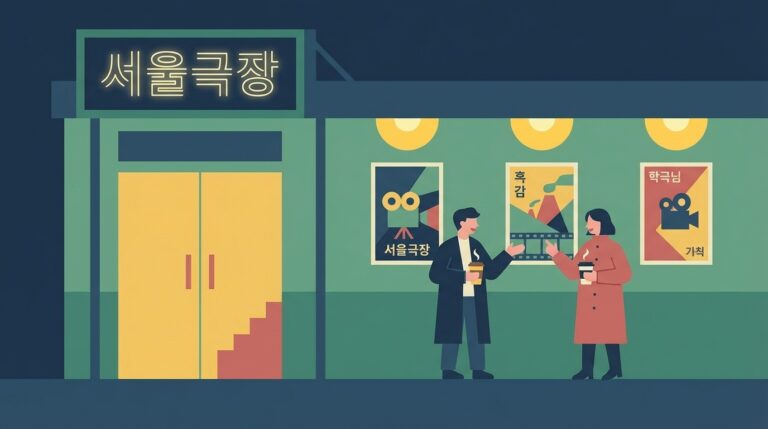
Picture this: It’s a rainy Friday evening in Seoul. You just stepped out of a small, cozy independent cinema in Hongdae after watching a Korean indie film like House of Hummingbird (벌새) or Broker (브로커). You’re sitting at a nearby retro cafe with your Korean friends, sipping on an Americano.
Someone asks, “영화 어땠어?” (How was the movie?). Your mind is racing with complex emotions. You want to say it was thought-provoking, beautifully paced, and incredibly realistic. But when you open your mouth, the only thing that comes out is…
“음… 재미있었어요.” (Um… it was fun.)
Sigh. We’ve all been there! Korean indie films (독립 영화) are masters of subtle emotions, gritty realism, and capturing the everyday struggles of ordinary people. Saying “재미있다” (fun) simply doesn’t do them justice. If you want to dive deep into Korean Cinema and discuss films like a true Seoulite cinephile, you need vocabulary that matches your B2 (Intermediate) level.
Today, we’re going to upgrade your movie vocabulary so you can express those deep, lingering feelings exactly how locals do. Ready? Let’s dive in! 🎬
Phase 2: Core Expressions Deep Dive
Here are the top 3 expressions you need to sound like an indie film critic in Korea.
1. 여운이 남다
- Pronunciation: yeouni namda [Yuh-oon-ee nahm-da] (The ‘여’ sounds like the ‘yu’ in ‘yuck’, and ‘운’ sounds like ‘oon’ in ‘moon’)
- Meaning: (Literal) A lingering sound/aftertaste remains. / (Real Nuance) The movie leaves a deep, lasting emotional impact; it stays with you.
- K-Culture Moment: You’re at a pojangmacha (street tent) having soju after a really heavy, beautifully sad movie. Everyone is quiet for a moment. Then someone stares at their glass and says, “아, 이번 영화 진짜 여운이 남네…” (Ah, this movie really leaves a lingering feeling…)
- Editor’s Insight: This is the ultimate compliment for a Korean drama or indie film. We don’t just want a happy ending; we want an ending that makes us think for days.
- Situation Spectrum:
- Casual (Friends): ✅ (여운 대박이야)
- Semi-formal (Colleagues): ✅ (여운이 남네요)
- Formal (Boss/Elders): ✅ (여운이 깊게 남습니다)
- 🤔 Think About It: Korean culture often embraces “한” (Han) – a profound sense of sorrow, resilience, and unresolved feeling. Why do you think Korean audiences often prefer “open endings” that leave a yeoun over neatly tied-up happy endings?
2. 뻔하지 않다
- Pronunciation: ppeonhaji anta [Ppun-ha-jee ahn-tah] (Make a strong, tense ‘P’ sound for ‘뻔’)
- Meaning: (Literal) It is not obvious. / (Real Nuance) It’s not cliché, predictable, or formulaic.
- K-Culture Moment: You know those classic K-Dramas where the rich CEO falls for the poor girl, and there’s a sudden amnesia plot? That is “뻔하다” (cliché). Indie films are loved precisely because they are 뻔하지 않아서.
- Editor’s Insight: Use this when a movie breaks stereotypes or takes a plot twist that feels earned, not cheap.
- Situation Spectrum:
- Casual (Friends): ✅ (결말 진짜 뻔하지 않아서 좋았어)
- Semi-formal (Colleagues): ✅ (스토리가 뻔하지 않네요)
- Formal (Boss/Elders): ⚠️ (Slightly informal tone; use 식상하지 않다 instead for highly formal settings)
- 🤔 Think About It: What is the most “뻔한” (cliché) trope in the movies from your home country?
3. 잔잔하다
- Pronunciation: janjanhada [Jahn-jahn-ha-da]
- Meaning: (Literal) To be calm/tranquil. / (Real Nuance) Slow-paced, atmospheric, subtle (in a good way).
- K-Culture Moment: Think of Jeju Island cafes, acoustic indie music, and movies where characters just cook, eat, and talk quietly (like Little Forest).
- Editor’s Insight: Foreigners often mistake a slow movie for being “지루하다” (boring). But “잔잔하다” is a compliment! It means it’s peaceful and healing to watch.
- Situation Spectrum:
- Casual (Friends): ✅
- Semi-formal (Colleagues): ✅
- Formal (Boss/Elders): ✅
- 🤔 Think About It: In a fast-paced “빨리빨리” (Ppal-li Ppal-li) society like Korea, why is there such a huge demand for “잔잔한” (calm) content?
Phase 3: Textbook vs. Real Korean
Let’s see how native speakers actually talk about films compared to what textbooks teach.
| Situation | 📖 Textbook Korean | 🗣️ Real Korean | 💡 Why is it different? |
|---|---|---|---|
| Expressing deep emotion | 이 영화는 매우 감동적입니다. | 여운이 장난 아니에요. (The lingering feeling is no joke) | “장난 아니다” (no joke) is the go-to conversational amplifier in Korea. |
| Praising the plot | 이야기가 예측할 수 없습니다. | 뻔하지 않아서 진짜 좋았어요. (I loved it because it wasn’t cliché) | Koreans prefer negating a negative (not cliché) to sound more natural and critical. |
| Relatability | 저의 이야기와 비슷합니다. | 완전 공감 갔어요. (I completely related to it) | “공감” (empathy/relating) is a core keyword in modern Korean social life and internet culture. |
Bottom Note: At the B2 level, start using “완전” (completely) and “장난 아니다” (no joke) with friends to sound much more natural, but stick to adverbs like “정말” or “매우” in business settings!
Phase 4: Cultural Context — K-Culture Deep Dive
4-1. Non-verbal: The Art of “Nunchi” in Debates
When discussing indie films, opinions can clash. In Korean culture, flat-out saying “아니요, 그건 틀렸어요” (No, that’s wrong) is considered aggressive, even among friends.
Instead, use the “Nunchi Buffer”. Nod your head (맞장구 – matching the rhythm) and say:
* “아, 그렇게 볼 수도 있겠네요. 근데 저는…” (Ah, you could see it that way. But I…)
This shows respect for their perspective before offering your own.
4-2. K-Culture Link: The “GV” (Guest Visit) Culture
If you love Korean indie films, you must know about GV (Guest Visit). In Korea, independent cinemas frequently host GVs where the director and actors sit in the theater after the movie to answer questions from the audience.
Fans bring notebooks, ask incredibly deep philosophical questions, and even give small gifts or letters to indie actors. Knowing words like “여운” or “잔잔하다” will give you the courage to raise your hand at a GV and ask a question directly to the director!
Phase 5: Real-Life Roleplay Scenario
Setting: Saturday night, 9 PM. A dimly lit craft beer pub in Hapjeong-dong. You and two Korean friends, Minsu and Jiwon, just finished watching a heavily awarded Korean indie film at the KT&G Sangsangmadang cinema.
Characters:
– YOU: A foreign professional working in Seoul, a big fan of Korean cinema.
– Minsu (30): A local film buff who loves to over-analyze movies.
Dialogue:
Minsu: 아, 맥주 시원하다! 🍻 너 아까 그 영화 어땠어? 난 솔직히 좀 지루했는데.
(A, maekju siwonhada! Neo akka geu yeonghwa eottaesseo? Nan soljikhi jom jiruhaenneunde.)
[Ah, this beer is refreshing! How was that movie to you? Honestly, I was a bit bored.]
(🎭 Stage Direction: Minsu takes a big gulp of his IPA and looks at you expectantly)
YOU: 진짜? 나는 뻔하지 않아서 너무 좋았는데.
(Jinjja? Naneun ppeonhaji anaseo neomu joanneunde.)
[Really? I loved it because it wasn’t cliché.]
Minsu: 결말이 너무 답답하지 않았어? 아무것도 해결된 게 없잖아.
(Gyeolmari neomu dapdaphaji anasseo? Amugeotdo haegyeoldoen ge eopjana.)
[Wasn’t the ending too frustrating? Nothing was resolved.]
YOU: 그래서 더 현실적인 거 아니야? 나는 오히려 여운이 길게 남던데.
(Geuraeseo deo hyeonsiljeogin geo aniya? Naneun ohiryeo yeouni gilge namdeonde.)
[Isn’t that why it’s more realistic? For me, the lingering feeling stayed for a long time.]
Minsu: 하긴, 주인공이 울 때 나도 모르게 감정 이입은 되더라.
(Hagin, juingongi ul ttae nado moreuge gamjeong iibeun doedeora.)
[I guess so, I found myself emotionally attached when the main character cried.]
🔀 Your Turn! How do you respond to Minsu?
– A) “거봐! 내 말이 맞지?” (See! I’m right, aren’t I?)
– B) “맞아, 그 장면 진짜 공감 갔어.” (Right, I really related to that scene.)
– C) “영화 다시 봐야겠다, 너.” (You need to watch the movie again.)✅ Best Choice: B — Reason: It builds consensus. “공감 가다” (to relate/empathize) is the perfect phrase to share a mutual emotional connection in Korean conversations.
⚠️ Choice A & C Analysis: These are a bit too aggressive or sarcastic. While fine with super close friends, B is the most natural way to keep a good vibe flowing in a Korean conversation.
Bonus Scenario: At the Indie Cinema Ticket Booth
(You are buying a ticket at a small indie theater like Cinecube)
YOU: 안녕하세요, 오늘 7시 ‘벌새’ 표 있나요?
[Hello, are there tickets for ‘House of Hummingbird’ at 7 PM today?]
Staff: 네, 두 자리 남아있습니다.
[Yes, there are two seats left.]
YOU: 혹시 이 영화 영문 자막 나오나요?
[By any chance, does this movie have English subtitles?]
Staff: 네, 금요일 저녁 상영은 영문 자막이 제공됩니다.
[Yes, the Friday evening screening provides English subtitles.]
Phase 6: 10-Second Shadowing Drill
Practice saying this like a true Seoulite who just walked out of a masterpiece.
🥺 아... / 이 영화는 / 진짜 / 여운이 / 길~~~게 남네요.
(Ah… / i yeonghwaneun / jinjja / yeouni / gil~~~ge namneyo.)
[Ah… this movie really leaves such a loooong lingering impression.]
Tip: Drag out the “길~~~게” (long) slightly to emphasize how deep the feeling is. Keep your voice slightly soft and breathy (잔잔하게)!
Phase 7: K-Culture Mini Dictionary
Must-know keywords for Korean indie film lovers:
| Korean | Romanization | English | Context |
|---|---|---|---|
| 다양성 영화 | dayangseong yeonghwa | Diversity Film | The official Korean term used for indie/art-house films. |
| 상업 영화 | sangeop yeonghwa | Commercial Film | Blockbusters or mainstream movies (the opposite of indie films). |
| GV | ji-beu-i | Guest Visit | A post-screening Q&A session with the director and cast. |
| N포세대 | N-po sedae | N-po Generation | A generation that has given up on “N” things (marriage, housing, etc.). A very common theme in Korean indie films portraying youth struggles. |
| 관크 | gwan-keu | Audience Critical (Nuisance) | Slang for someone who ruins the movie experience (e.g., kicking seats, using phones). Indie audiences are VERY sensitive to this! |
Phase 8: Traveler’s Survival Kit
If you’re visiting Seoul and want to experience the local cinema culture (highly recommended!), here are your survival phrases.
🆘 Survival Expression #1: Asking for subtitles
– 🇰🇷 “혹시 영문 자막 있나요?” (hoksi yeongmun jamak innayo?)
– 🗣️ Sound: [Hok-shee young-moon jah-mak een-nah-yo?]
– 📍 Where to use: Independent theaters, film festivals (BIFF, JIFF).
– 💡 Pro Tip: Big chains (CGV, Megabox) rarely have English subtitles for Korean films, but indie theaters in Seoul sometimes have dedicated “English Subtitle Days.”📌 Editor’s Travel Note
– Best Indie Cinemas in Seoul: KT&G Sangsangmadang (Hongdae), Cinecube (Gwanghwamun), Emu Cinema (Jongno).
– Apps to use: Download the ‘CGV’ or ‘Megabox’ app to check for “English Subtitles” (usually marked as [ENG SUB] next to the title).
– Theater Etiquette: Koreans stay extremely quiet during movies, especially indie films. Wait until the end credits fully roll before turning on your phone or talking loudly!
Phase 9: Critical Thinking — “One Step Deeper”
🧠 Think Deeper: Media vs Reality (미디어와 현실)
When most foreigners think of “Korea,” they picture the glittering world of K-Dramas: handsome chaebols (conglomerate heirs), luxury apartments, and dramatic romance. However, Korean independent cinema tells a completely different story. Films like Parasite (which started from indie roots) or Microhabitat (소공녀) show the gritty, exhausting reality of the working class, soaring housing prices, and the intense pressure on the youth.
By learning to talk about indie films, you aren’t just learning a language; you are acknowledging the real Korea behind the shiny K-Pop/K-Drama curtain. You’re showing locals that you see and respect their actual, everyday lives.
💬 Your Turn: Does the mainstream media in your country accurately reflect reality, or does it only show the glamorous side? How does your country’s indie cinema differ from blockbusters? Share in the comments!
Phase 10: FAQ & Mistake Prevention
❌ Common Mistake #1: Saying “재미없다” (It’s not fun) when you mean “잔잔하다” (It’s slow/calm).
✅ Fix: “재미없다” means the movie was terrible or badly made. If it was just slow and peaceful, say “영화가 되게 잔잔하네요” (The movie is very calm/peaceful).
❌ Common Mistake #2: Using “뻔하지 않다” to older people or bosses.
✅ Fix: While it’s great for friends, “뻔하다” is slightly informal slang. With a boss, use “스토리가 예측하기 어렵네요” (The story is hard to predict) or “신선하네요” (It’s fresh).
K-Culture FAQ:
– Q: “Can I take a picture of the director during a GV?”
– A: Yes! Unlike during the movie, photos and videos are highly encouraged during a GV. Fans often bring professional DSLR cameras (called “대포카메라” – cannon cameras).
– Q: “Do Koreans eat popcorn during indie films?”
– A: Technically yes, but in very small, quiet indie theaters, the crunching noise might earn you some serious Nunchi. Stick to soft drinks or coffee!
Phase 11: Summary & Action Items
One-Liner Summary: To talk about Korean indie films like a local, swap out “재미있어요” for deep, emotional phrases like “여운이 남다” (leaves a lingering feeling) and “뻔하지 않다” (not cliché).
Your Action Missions:
– 🥉 Bronze (Solo): Stand in front of a mirror and practice the 10-second shadowing drill with your best emotional indie-actor face.
– 🥈 Silver (Online): Go to a Korean film trailer on YouTube (like Past Lives or Broker) and leave a comment: “이 영화 진짜 여운이 남을 것 같아요!”
– 🥇 Gold (Real Life): Next time you watch a movie with a Korean friend, use “뻔하지 않아서 좋았어” to describe your favorite part.
🎬 K-Culture Mission:
Log into Netflix or your local VOD platform, search for a “Korean Independent Movie,” and watch 15 minutes of it. Notice how the dialogue pacing and lighting are different from standard K-Dramas!
Phase 12: Interactive Quiz
Test your B2 Korean Cinema skills!
1. Situational Judgment: You just watched a beautiful, slow-paced movie about a girl cooking in the countryside. Your friend asks how it was. What is the most natural native-like response?
– A) 너무 지루했어요. (It was too boring.)
– B) 스토리가 너무 뻔해요. (The story is too cliché.)
– C) 되게 잔잔하고 여운이 남네요. (It was very calm and left a lingering feeling.)
2. Fill in the Blank:
“재벌 2세가 나오는 드라마는 이제 너무 ______. (Dramas with 2nd-generation Chaebols are too _______ now.)”
3. True or False – K-Culture Edition:
In Korean indie cinemas, it is considered polite to clap and cheer loudly while the movie is playing to support the director. (T/F)
(Answers: 1. C / 2. 뻔해요 / 3. False – Koreans watch movies in near-absolute silence. Clapping is only for the GV or end credits at a film festival!)
Did you find this lesson useful? What’s your favorite Korean indie film? Drop your answers in the comments below! 👇
Frequently Asked Questions (FAQ)
Q: What does "여운이 남다" mean in Korean and how do you pronounce it?
A: In Korean, "여운이 남다" is pronounced [yeouni namda [Yuh-oon-ee nahm-da] and means: (Literal) A lingering sound/aftertaste remains. / (Real Nuance) The movie leaves a deep, lasting emotional impact; it stays with you.
Q: What does "뻔하지 않다" mean in Korean and how do you pronounce it?
A: In Korean, "뻔하지 않다" is pronounced [ppeonhaji anta [Ppun-ha-jee ahn-tah] and means: (Literal) It is not obvious. / (Real Nuance) It's not cliché, predictable, or formulaic.
Q: What does "잔잔하다" mean in Korean and how do you pronounce it?
A: In Korean, "잔잔하다" is pronounced [janjanhada [Jahn-jahn-ha-da] and means: (Literal) To be calm/tranquil. / (Real Nuance) Slow-paced, atmospheric, subtle (in a good way).







