

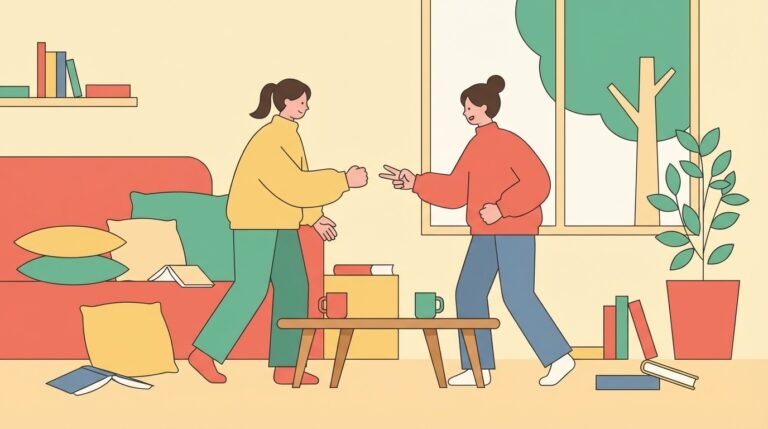
Hello! I’m your Daily Hangul Editor. Have you ever watched a Korean variety show like I Live Alone (나 혼자 산다) or a cozy K-Drama featuring a bustling sharehouse? The roommates are eating ramen, laughing, having a great time… until suddenly, a heavy silence falls over the living room. Someone mentions the bathroom.
Living in a sharehouse or dormitory in Korea is an incredible way to experience the culture and make lifelong friends. But it also comes with the universal challenge: Chores. Specifically, deciding who cleans the bathroom. If you don’t know how to navigate this conversation in Korean, you might end up either doing all the dirty work or accidentally sounding rude to your roommate.
Today, I’m sharing real-life, insider expressions my students have used to successfully (and peacefully!) divide household chores in Korea. Let’s dive into the fine art of Korean sharehouse diplomacy!
Phase 2: Core Expressions – The Sharehouse Survival Kit
Here are the top 3 expressions you need when it’s time to talk about the dreaded bathroom duty.
1. 우리 당번 정하자 (Let’s decide on our turns)
- Pronunciation: [uri dangbeon jeonghaja]
- 당 (dang) sounds like the English word “dang!”
- 정 (jeong) sounds like “jung” in jungle.
- Meaning: Literal = “Let’s decide the duty person.” / Real nuance = “We need a schedule for chores before this place becomes a disaster.”
- K-Culture Moment: You’ll hear this in college dorms or MT (Membership Training) trips when everyone is sitting in a circle, realizing the cleanup won’t do itself.
- Editor’s Insight: 당번 (dangbeon) is a magical word in Korea. It means “the person on duty.” It takes the personal blame away and makes the chore an official, objective system. It’s polite but firm!
- Situation Spectrum:
- Casual with friends/roommates: ✅
- Co-workers (Semi-formal): ⚠️ (Use ‘정해요’ instead)
- Boss/Elders (Formal): 🚫
- 🤔 Think About It: Why does Korean culture rely heavily on “당번” (duty rosters) from elementary school all the way to corporate offices? How do people in your culture divide shared responsibilities?
2. 이번엔 네 차례야 (It’s your turn this time)
- Pronunciation: [ibeonen ne charyeya]
- 네 (ne) sounds like “nay” but short.
- 차례 (charye) sounds like “cha-rye” (cha like cha-cha, rye like rye bread).
- Meaning: Literal & Real nuance = “It’s your turn now.”
- K-Culture Moment: Picture a roommate pointing at the calendar on the fridge, crossing their arms with a playful smirk.
- Editor’s Insight: This is perfect for holding someone accountable without starting a fight. It focuses on fairness (차례 = turn/order) rather than accusing them of being lazy.
- Situation Spectrum:
- Casual with friends: ✅
- Semi-formal: 🚫 (Too direct)
- Formal: 🚫
- 🤔 Think About It: Notice how the pronoun 네 (you) is used here. In Korean, using “you” is often avoided, but between close roommates, it establishes casual intimacy.
3. 가위바위보 진 사람이 하기! (The loser of rock-paper-scissors does it!)
- Pronunciation: [gawibawibo jin sarami hagi!]
- 가위 (gawi) sounds like “gah-wee”.
- 바위 (bawi) sounds like “bah-wee”.
- Meaning: Literal = “The person who loses rock-paper-scissors does it!”
- K-Culture Moment: If you watch K-Pop idol reality shows, you know that EVERYTHING—from getting the best bed to doing the dishes—is decided by 가위바위보 (rock-paper-scissors).
- Editor’s Insight: This is the ultimate Korean conflict resolution tool. If you suggest this, your Korean friends will immediately respect you as a true insider!
- Situation Spectrum:
- Casual with friends: ✅
- Semi-formal: ⚠️ (Only at casual team dinners)
- Formal: 🚫
Phase 3: Textbook vs. Real Korean
Let’s see how the textbook differs from the messy, real-life sharehouse chat.
| Situation | 📖 Textbook Korean | 🗣️ Real Korean | 💡 Why the difference? |
|---|---|---|---|
| Suggesting a schedule | “누가 화장실을 청소할 것입니까?” (Who will clean the bathroom?) | “야, 우리 청소 당번 좀 정하자.” (Hey, let’s set a cleaning duty schedule.) | Real Korean uses collective words like “우리” (we) and “당번” to soften the directness. |
| Pointing out a mess | “화장실이 더럽습니다.” (The bathroom is dirty.) | “화장실 상태 실화냐?” (Is the state of the bathroom real right now?) | “실화냐?” (Is it real?) is a popular slang to express disbelief at a mess! |
| Claiming innocence | “저는 지난주에 청소했습니다.” (I cleaned last week.) | “나 저번에 했잖아~” (I did it last time, you know~) | Adding “~잖아” (you know/as you know) creates a conversational, persuasive tone. |
Bottom Note: Stick to “당번 정하자” and “~잖아” for a natural B1 level. Save “실화냐” for when you are very close with your roommates!
Phase 4: Cultural Context — K-Culture Deep Dive
4-1. Non-verbal Element: The Power of Nunchi (눈치)
When living in a Korean sharehouse, Nunchi (the subtle art of gauging others’ moods) is your best friend. You don’t just walk up to a roommate who is stressed about midterms and demand they scrub the toilet. You wait for a relaxed moment—maybe while eating delivery chicken together—to gently bring up the 당번 (schedule).
4-2. K-Culture Link: The Almighty Rock-Paper-Scissors (가위바위보)
In many Western cultures, chores are strictly divided by a rigid contract or lease agreement. In Korea, while schedules exist, spontaneous chores (like throwing out the heavy recycling or cleaning a sudden bathroom spill) are almost universally settled by Gawi-Bawi-Bo (가위바위보).
It is deeply embedded in the culture of fairness. K-Pop idols use it to decide who pays for the team meal, and roommates use it to decide who cleans the drain.
– Pro tip: Korean Gawi-Bawi-Bo happens fast! There is no “rock, paper, scissors, shoot!” It’s just a rapid “ga-wi-ba-wi-bo!” and you throw on “bo”.
Phase 5: Real-world Roleplay Scenario
Setting: A Sunday afternoon in a small, sunny sharehouse in Hongdae. The bathroom needs serious attention. You are sitting in the living room with your Korean roommate, Min-su.
Characters:
– YOU: An international student, tired of cleaning the drain by yourself.
– Min-su (24): Your Korean roommate. Friendly, loves video games, but tends to “forget” his chores.
Dialogue:
YOU: 민수야, 우리 화장실 청소 당번 좀 다시 정하자.
(Minsu-ya, uri hwajangsil cheongso dangbeon jom dasi jeonghaja.)
[Min-su, let’s set up the bathroom cleaning duties again.]
Min-su: 어? 화장실? 아직 괜찮지 않아?
(Eo? Hwajangsil? Ajik gwaenchanchi ana?)
[Huh? The bathroom? Isn’t it still fine?]
YOU: 안 괜찮아. 물이 안 내려가.
(An gwaenchana. Muri an naeryeoga.)
[It’s not fine. The water isn’t draining.]
Min-su: 아, 진짜? 내가 뚫을까?
(A, jinjja? Naega ttureulkka?)
[Oh, really? Should I unclog it?]
YOU: 응. 그리고 이번엔 네 차례잖아.
(Eung. Geurigo ibeonen ne charyejana.)
[Yeah. And it’s your turn this time anyway.]
Min-su: (Looking nervous, putting his controller down) 아… 내가 저번에 하지 않았나?
(A… naega jeobeone haji ananna?)
[Ah… didn’t I do it last time?]
🔀 Your Turn! How will you respond?
– A) “거짓말 하지 마! 네가 해!” (Don’t lie! You do it!)
– B) “아니야, 내가 저번에 했잖아. 헷갈린 거 아니야?” (No, I did it last time. Aren’t you confused?)
– C) “진짜? 그럼 가위바위보로 정할까?” (Really? Then should we decide by rock-paper-scissors?)✅ Best Choice: B or C.
Choice B is polite but firm, correcting his memory using “~잖아”.
Choice C is the ultimate K-style defusal. It turns a potential argument into a game. Let’s proceed with C!
YOU: 진짜? 그럼 깔끔하게 가위바위보로 정하자. 진 사람이 하기!
(Jinjja? Geureom kkalkkeumhage gawibawiboro jeonghaja. Jin sarami hagi!)
[Really? Then let’s make it clean and decide by rock-paper-scissors. Loser does it!]
Min-su: 오, 좋아! 나 가위바위보 진짜 잘해.
(O, joa! Na gawibawibo jinjja jalhae.)
[Oh, deal! I’m really good at rock-paper-scissors.]
Together: 가위! 바위! 보!
(Gawi! Bawi! Bo!)
[Rock! Paper! Scissors!]
(🎭 Stage Direction: Min-su throws scissors, you throw rock!)
Min-su: 아… 망했다. 내가 청소할게…
(A… manghaetda. Naega cheongsohalge…)
[Ah… I’m doomed. I’ll clean it…]
Phase 6: 10-Second Shadowing Drill
Let’s practice the most important line. Focus on the pauses (/) and the playful tone!
😉 우리 / 깔끔하게 / 가위바위보로 / 정하자!
(uri / kkalkkeumhage / gawibawiboro / jeonghaja!)
“Let’s make it clean (fair) and decide by rock-paper-scissors!”
Phase 7: K-Culture Mini Dictionary
| Korean | Romanization | English | Contextual Meaning |
|---|---|---|---|
| 당번 | dangbeon | Person on duty | Used for chores, tasks, or even taking out trash. |
| 눈치 | nunchi | Social intuition | The ability to read the room (e.g., knowing when your roommate is too tired to clean). |
| 룸메 | rumme | Roommate | Short for 룸메이트. Extremely common slang among students. |
| 가위바위보 | gawibawibo | Rock-Paper-Scissors | The ultimate Korean decision-maker. |
| 자취 | jachwi | Living alone | Living independently away from family, usually in a studio or sharehouse. |
Phase 8: Traveler Survival Kit
Even if you aren’t living in a sharehouse, you might stay in a Korean Guesthouse (게스트하우스) or Hostel! Here are essential phrases for shared travel spaces.
🆘 Survival Phrases for Guesthouses
– 🇰🇷 “세탁기 써도 되나요?” (setakgi sseodo doenayo?)
– 🗣️ Meaning: Can I use the washing machine?
– 🇰🇷 “수건 한 장 더 주실 수 있나요?” (sugeon han jang deo jusil su innayo?)
– 🗣️ Meaning: Can I get one more towel?
– 🇰🇷 “샤워실은 언제까지 쓸 수 있어요?” (syawosireun eonjekkaji sseul su isseoyo?)
– 🗣️ Meaning: Until what time can I use the shower room?📌 Editor’s Travel Note:
Many Korean guesthouses have “Manner Time” (매너타임), usually starting around 10 PM or 11 PM. During this time, you should avoid using the washing machine or showering loudly!
Phase 9: Critical Thinking — “One Step Deeper”
Media vs Reality: The Glamorous K-Drama vs. Real “Jachi” (자취) Life
🧠 Think Deeper:
In K-Dramas, young people living alone always seem to have massive, spotless apartments with sparkling bathrooms. However, real-life jachwi (living alone) in Korea often involves tiny “One-rooms” (원룸) or cramped sharehouses where chores build up quickly. The rise of shows like I Live Alone (나 혼자 산다) became popular exactly because they shattered the K-Drama illusion, showing celebrities struggling with moldy bathrooms, piling laundry, and eating delivery food alone. It reflects a very real socio-economic shift in Korea, where single-person households are now the most common demographic.💬 Your Turn: Does media in your country accurately portray what it’s like for young people to live alone? Share in the comments!
Phase 10: FAQ & Avoiding Common Mistakes
Q: Can I just say “청소해!” (Clean up!) to my roommate?
A: 🚫 No! Even if you are close friends, giving a direct command like “청소해” sounds aggressive. Always use suggestion forms like “청소하자” (Let’s clean) or “네 차례야” (It’s your turn).
Q: What if my roommate is older than me? Can I still use “당번 정하자”?
A: ⚠️ If they are older, you should use polite form (존댓말). Say: “OOO형/누나/언니, 우리 당번 정할까요?” (Shall we decide on duties?)
❌ Common Mistake #1: Pointing fingers. Saying “네가 안 했잖아” (You didn’t do it) can start a fight.
✅ Do this instead: Use “우리” (We) to soften the blow. “우리 청소할 때 되지 않았어?” (Isn’t it time for us to clean?)
Phase 11: Summary & Action Items
- One-Liner Summary: To survive sharehouse chores in Korea gracefully, suggest a “당번” (duty roster) or settle it with a quick game of “가위바위보” (rock-paper-scissors)!
Your Action Missions:
– 🥉 Bronze (Solo): Stand in front of your bathroom mirror and say “이번엔 네 차례야!” (It’s your turn!) with confident intonation.
– 🥈 Silver (Online): Post a picture of your cleaned room or bathroom on social media with the hashtag #청소당번.
– 🥇 Gold (Real-world): Next time you need to decide something with a friend, challenge them to 가위바위보!
K-Culture Mission:
Go watch an episode of I Live Alone (나 혼자 산다) on YouTube. Try to spot moments where the cast members are doing chores or struggling with a messy house. Notice how relatable it is!
Phase 12: Quiz — Interactive Challenge
1. Situational Judgment:
Your roommate forgot to clean the bathroom. You want to remind them nicely without sounding angry. What’s the best phrase?
– A) “화장실 진짜 더럽다. 너 왜 안 해?”
– B) “우리 이번 주 화장실 청소 당번 누구지?”
– C) “내가 화장실 청소 다 할게!”
👉 Click to see the answer
Answer: B. “Who is the bathroom cleaning duty this week?” It’s an indirect, polite way to remind them using “당번” without directly accusing them!
2. True or False – K-Culture Edition:
“In Korea, rock-paper-scissors is only considered a game for young children.”
👉 Click to see the answer
Answer: False! Adults, co-workers, and roommates use it daily to make fair, quick decisions for everything from chores to paying for coffee.
Engagement: Have you ever had a funny misunderstanding with a roommate? How did you resolve it? Let me know below! 👇
Frequently Asked Questions (FAQ)
Q: What does "우리 당번 정하자 (Let's decide on our turns)" mean in Korean and how do you pronounce it?
A: In Korean, "우리 당번 정하자 (Let's decide on our turns)" is pronounced [uri dangbeon jeonghaja] and means: a key conversational Korean expression covered in this lesson.
Q: What does "이번엔 네 차례야 (It's your turn this time)" mean in Korean and how do you pronounce it?
A: In Korean, "이번엔 네 차례야 (It's your turn this time)" is pronounced [ibeonen ne charyeya] and means: a key conversational Korean expression covered in this lesson.
Q: What does "가위바위보 진 사람이 하기! (The loser of rock-paper-scissors does it!)" mean in Korean and how do you pronounce it?
A: In Korean, "가위바위보 진 사람이 하기! (The loser of rock-paper-scissors does it!)" is pronounced [gawibawibo jin sarami hagi!] and means: a key conversational Korean expression covered in this lesson.







