

Phase 1: Empathy (Immersive Opening)
Hello! This is your Daily Hangul Editor.
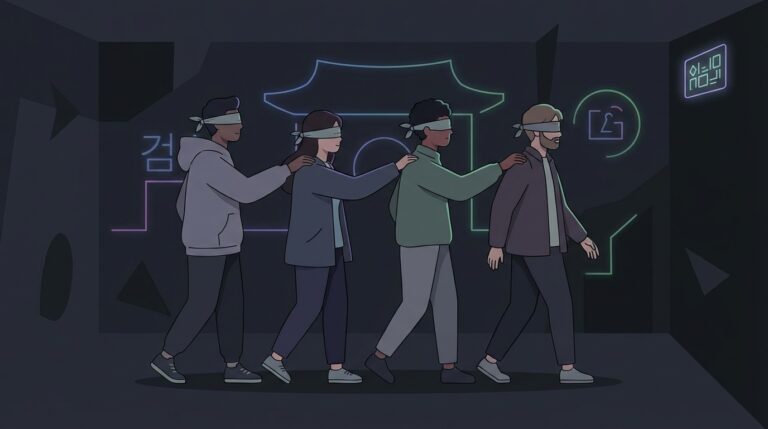
Have you ever watched a K-Pop idol variety show like Run BTS or Going Seventeen? There’s almost always that one hilarious episode where the members visit a Korean Escape Room (방탈출, Bangtalchul). They are handed a blindfold, forced to hold onto each other’s shoulders, and walk into the pitch black like a nervous little train, screaming at every small noise.
Now, imagine you are in the vibrant streets of Hongdae or Gangnam. You and your friends just booked a high-tech, premium Korean escape room. The game is about to start. The staff walks in holding black blindfolds and says something rapidly in Korean. What do you do? If you don’t understand, you might step out of line, take off the blindfold too early, and ruin the magical, immersive intro!
Don’t panic! This guide is based on real experiences from my students who love Korean escape rooms but felt nervous about the staff’s instructions. Let’s learn the essential survival Korean for the ‘blindfold train’ so you can enjoy K-Culture like a true insider!
Phase 2: Core Expressions Deep Dive
1. 안대 쓰세요 (Put on your blindfold)
- Pronunciation: andae sseuseyo + [ahn-deh seu-seh-yo] (Tip: For ‘eu/으’, make the disgusted ‘ugh’ sound when you step in gum, but keep your teeth together!)
- Meaning: Literal: Please wear the blindfold. / Real nuance: Put the blindfold on now, the game is starting.
- K-Culture Moment: The moment the staff hands you the blindfold, the atmosphere instantly shifts from a friendly cafe to a thriller K-Drama.
- Editor’s Insight: The word 쓰다 (sseuda) is a magic verb in Korean. We use it for things we wear on our heads or faces (hats, glasses, masks, and blindfolds!).
- Situation Spectrum:
- Friends (Casual): 🚫 (Too formal for friends)
- Escape Room Staff to you (Polite): ✅
- You to Staff: 🚫 (You don’t tell them to wear it!)
- 🤔 Think About It: Notice the ~세요 (~seyo) at the end? Why does Korean have a specific ending just for politely commanding or requesting someone to do something? Does your native language have a polite command form?
2. 앞사람 어깨 잡으세요 (Hold the front person’s shoulder)
- Pronunciation: apsaram eokkae jabeuseyo + [ap-sah-ram uh-ggae ja-beu-seh-yo]
- Meaning: Literal: Please grab the front person’s shoulder. / Real nuance: Form a single-file line and hold onto the person in front of you so you don’t fall in the dark.
- K-Culture Moment: This is the classic “Escape Room Train” formation. You have to rely entirely on the Nunchi (social sense) of the person leading the line. If they stop, you stop!
- Editor’s Insight: It sounds a bit like a military drill, but it’s essential for safety. “앞” (ap) means front, “사람” (saram) means person, and “어깨” (eokkae) means shoulder.
- Situation Spectrum:
- Staff instructing the group: ✅
- Friends joking around: ✅ (Sometimes used playfully)
- 🤔 Think About It: Korean spaces are often tight and efficiently designed. Following group instructions quickly ensures everyone’s safety. How do you feel about moving blindly while trusting a friend?
3. 눈 뜨세요 (Open your eyes)
- Pronunciation: nun tteuseyo + [noon tteu-seh-yo]
- Meaning: Literal: Please open your eyes. / Real nuance: The intro is over, you may remove the blindfold and begin!
- K-Culture Moment: The door locks with a clack. The spooky music starts. The staff’s voice echoes through a speaker: “눈 뜨세요!” This is the moment the timer starts ticking.
- Editor’s Insight: Even though you are taking off the blindfold, the staff will usually say “open your eyes” rather than “take off the blindfold”.
- Situation Spectrum:
- Voice through the speaker: ✅
- Waking up a sleepy friend: ✅
- 🤔 Think About It: We say “눈(eye) 뜨다(open/float)” instead of “열다(open a door)”. In Korean, body parts often have their own specific verbs!
Phase 3: Textbook vs. Real Korean
| Situation | 📖 Textbook Korean | 🗣️ Real Service Korean | 💡 Why is it different? |
|---|---|---|---|
| Telling you to wear the blindfold | 안대를 착용해 주십시오. (Please wear the blindfold) | 안대 쓰실게요~ (We will have you wear the blindfold) | Modern Korean service workers often use ~실게요, a soft, friendly way to give instructions without sounding bossy. |
| Asking if everyone is ready | 준비되셨습니까? (Are you ready?) | 다 쓰셨나요? (Has everyone put it on?) | Shorter, more practical, and focuses on the immediate action required. |
| Starting the game | 시작합니다. (It begins.) | 입장하실게요~ (You will now enter~) | Emphasizes the experience of entering the room together. |
- Bottom Note: As an A2 learner, you don’t need to speak using ~실게요, but you will absolutely hear it in cafes, clinics, and escape rooms. Just recognize it as a polite “Please do this step now.”
Phase 4: Cultural Context — K-Culture Deep Dive
4-1. Non-verbal Nunchi (눈치) in the Dark
When you are blindfolded in a Korean escape room, you can’t use words to see if your friends are okay. You have to use your Nunchi. If the person whose shoulders you are holding suddenly freezes or shuffles their feet nervously, you know they are scared! Also, shuffle your feet slowly instead of taking big steps; Korean escape rooms often have small stairs or uneven floors to match the theme.
4-2. The “Jjolbo” vs. “Tanker” Dynamic (K-Variety Show Trope)
If you watch K-Pop idols play escape rooms, you will notice fans dividing them into two types:
1. 쫄보 (Jjolbo): The scaredy-cat. They scream at everything and refuse to be the first in line.
2. 탱커 (Tanker): The brave one. They walk in front, protect the team, and solve the puzzles while the others are hiding.
When forming your line before putting on the blindfold, you must decide who your “Tanker” is! They MUST go first. If you are a “Jjolbo,” make sure you are safely in the middle of the train!
Phase 5: Real-life Roleplay Scenario
Setting: A Friday night in Gangnam. You and your Korean friend, Minsu, are standing in the dimly lit hallway of a horror-themed Escape Room. The air conditioning is freezing. A staff member wearing a black uniform approaches you with blindfolds.
Characters:
– YOU: An A2 Korean learner, excited but slightly terrified of horror themes.
– Minsu: Your Korean friend. He claims to be brave, but his voice is shaking.
– Staff: Polite but strictly stays in character.
Dialogue:
Staff: 짐은 캐비닛에 다 넣으셨나요?
(jimeun kaebinise da neoeusyeonnayo?)
[Did you put all your belongings in the cabinet?]
Minsu: 네, 다 넣었어요.
(ne, da neoeosseoyo.)
[Yes, we put them all in.]
Staff: 이제 게임 시작합니다. 안대 쓰실게요.
(ije geim sijakhamnida. andae sseusilgeyo.)
[The game will start now. Please put on your blindfolds.]
(🎭 Stage Direction: The staff hands you a thick black blindfold. You put it on. It is completely dark.)
Staff: 이제 앞사람 어깨 잡으세요.
(ije apsaram eokkae jabeuseyo.)
[Now, please hold the front person’s shoulder.]
Minsu: (Grabbing the staff’s shoulder) 아, 캄캄해서 아무것도 안 보여요.
(a, kamkamhaeseo amugeotdo an boyeoyo.)
[Ah, it’s pitch black, I can’t see anything.]
Staff: 천천히 입장하실게요. 바닥 조심하세요.
(cheoncheonhi ipjanghasilgeyo. badak josimhaseyo.)
[We will enter slowly. Please watch your step.]
(🎭 Stage Direction: You shuffle into the room. A door slams shut behind you. Minsu whispers to you in the dark.)
Minsu: 야… 너 괜찮아? 너무 무서운데?
(ya… neo gwaenchana? neomu museounde?)
[Hey… are you okay? This is too scary?]
🔀 Your Turn! How do you answer Minsu?
– A) “눈 뜨세요!” (Open your eyes!)
– B) “저 안 무서워요. 제가 앞에 갈까요?” (I’m not scared. Shall I go in front?)
– C) “저도 너무 무서워요!” (I’m so scared too!)✅ Best Choice: B or C!
If you are the “Tanker,” choose B to show off your bravery! If you are a “Jjolbo,” choose C to share the fear.
⚠️ Choice A Analysis: Do NOT say A! Only the staff is allowed to tell you to open your eyes. If you open them too early, you ruin the game!
Staff (through the speaker): 삐-. 눈 뜨세요.
(ppi-. nun tteuseyo.)
[Beep-. Open your eyes.]
Phase 6: 10-Second Shadowing Drill
Practice these lines so you can react naturally in the dark!
- 😤 (Bravely): 저 / 안 무서워요! / 제가 앞에 / 갈게요!
(jeo / an museowoyo! / jega ape / galgeyo!)
[I am not scared! I will go in the front!] -
🥺 (Scared): 너무 / 무서워요… / 천천히 / 가세요…
(neomu / museowoyo… / cheoncheonhi / gaseyo…)
[It’s so scary… Please go slowly…]
Phase 7: K-Culture Mini Dictionary
| Korean | Romanization | English | Context |
|---|---|---|---|
| 방탈출 | bangtalchul | Escape Room | “Bang” means room, “Talchul” means escape. A massive trend in Korean youth culture. |
| 안대 | andae | Blindfold / Eye mask | Used in games, or when sleeping on an airplane. |
| 쫄보 | jjolbo | Scaredy-cat | Slang. A person who gets scared very easily. Often used affectionately among friends. |
| 힌트 | hinteu | Hint | The English word “hint.” You will use this a lot when you are stuck! |
Phase 8: Traveler Survival Kit
Even outside the escape room, these expressions are lifesavers when you are traveling in Korea and need help or find yourself in a dark, confusing situation.
🆘 Survival Phrases #1
– 🇰🇷 “힌트 주세요!” (hinteu juseyo!)
– 🗣️ English Guide: [hin-teu joo-seh-yo!]
– 📍 Where to use: Inside the escape room via the intercom, or even jokingly when playing guessing games with Korean friends.
– 💡 Pro Tip: Most Korean escape rooms give you a smart device or a walkie-talkie. If you are stuck for more than 10 minutes, just press the button and yell this!📌 Editor’s Travel Note
– Translating the Story: Korean escape rooms are heavy on story and text. If your Korean is A2 level, use the Papago app’s image translation feature to scan the clues quickly!
– Booking: Most popular escape rooms require advance booking via their websites, and you usually pay a deposit via bank transfer. If you don’t have a Korean bank account, try visiting early in the day to book in person.
Phase 9: Critical Thinking — “One Step Deeper”
Media vs. Reality & The “Pali-Pali” Culture in Gaming
Why are Korean escape rooms so intense, with complex storylines, elaborate sets, and strict blindfold rules? It reflects Korea’s “Pali-Pali” (hurry hurry) culture mixed with a high standard for entertainment. Koreans don’t just want to solve puzzles; they want a cinematic experience. The blindfold isn’t just to hide the room; it serves as a psychological transition, forcibly removing you from the busy streets of Seoul and dropping you instantly into a new reality.
🧠 Think Deeper:
The language used by the staff before you enter is polite but highly efficient. They manage time strictly because another group is right behind you.💬 Your Turn: Does your country have escape rooms? Are they story-driven and immersive, or just simple puzzle rooms? Share your experiences below!
Phase 10: FAQ & Avoiding Mistakes
Q: Can I take off the blindfold if I feel dizzy or too scared?
Yes! While the game rules say wait until “눈 뜨세요,” your safety is the priority. If you must take it off, say to your friends or the staff: “잠시만요, 너무 어지러워요” (Just a moment, I’m too dizzy).
Q: Do I say “눈 닫으세요” to tell someone to close their eyes?
❌ Common Mistake #1: Saying “눈 닫으세요” (Close your eyes – using the verb for closing a door).
✅ Do this instead: To say “close your eyes,” use 눈 감으세요 (nun gameuseyo). Remember, body parts have special verbs!
Q: Can I use “~실게요” when I speak?
❌ Common Mistake #2: A foreigner trying to use the service Korean “~실게요” to a friend.
✅ Do this instead: Leave “~실게요” to the staff. With your friends, just use the standard “~아/어” or “~할게” (I will do it).
Phase 11: Summary & Action Items
- One-Liner Summary: When entering a Korean escape room, put on your mask (안대 쓰세요), grab the shoulder in front of you (어깨 잡으세요), and wait for the signal to open your eyes (눈 뜨세요).
-
Action Mission 3 Steps:
- 🥉 Bronze (Solo): Close your eyes right now and say “눈 뜨세요!” before opening them.
- 🥈 Silver (Online): Comment below: Are you a “Jjolbo(쫄보)” or a “Tanker(탱커)”?
- 🥇 Gold (Real World): Visit an escape room in Korea with a friend and successfully follow the blindfold train without asking for English translations!
- K-Culture Mission: Go to YouTube and search “Going Seventeen Escape Room” or “Run BTS Escape Room.” Try to catch the moment they are handed the blindfolds (안대)!
Phase 12: Quiz — Interactive Challenge
1. Situational Judgment:
The staff hands you a blindfold and says “안대 쓰실게요~”. What should you do?
– A) Say “No, thank you” and walk in.
– B) Put the blindfold over your eyes immediately.
– C) Put the blindfold on the staff’s head.
(Answer: B. It’s service Korean telling you to wear it!)
2. Fill in the Blank:
You are terrified in the dark. You want to hold your friend’s shoulder.
“앞사람 ______ 잡으세요.”
(Answer: 어깨 – eokkae – shoulder)
3. True or False — K-Culture Edition:
In Korean escape rooms, if you don’t know the answer, you can ask for a ‘hint’ by yelling “힌트 주세요!” (T/F)
(Answer: True! Don’t suffer in silence, use your hints!)
4. Roleplay Consequence:
In Phase 5, if you opened your eyes BEFORE the staff said “눈 뜨세요”, what would likely happen?
(Answer: You would see the staff sneaking out the door or setting up a jump scare, completely ruining the magic of the game! Always wait for the cue!)
Frequently Asked Questions (FAQ)
Q: What does "안대 쓰세요 (Put on your blindfold)" mean in Korean and how do you pronounce it?
A: In Korean, "안대 쓰세요 (Put on your blindfold)" is pronounced [andae sseuseyo + [ahn-deh seu-seh-yo] and means: Literal: Please wear the blindfold. / Real nuance: Put the blindfold on now, the game is starting.
Q: What does "앞사람 어깨 잡으세요 (Hold the front person's shoulder)" mean in Korean and how do you pronounce it?
A: In Korean, "앞사람 어깨 잡으세요 (Hold the front person's shoulder)" is pronounced [apsaram eokkae jabeuseyo + [ap-sah-ram uh-ggae ja-beu-seh-yo] and means: Literal: Please grab the front person's shoulder. / Real nuance: Form a single-file line and hold onto the person in front of you so you don't fall in the dark.
Q: What does "눈 뜨세요 (Open your eyes)" mean in Korean and how do you pronounce it?
A: In Korean, "눈 뜨세요 (Open your eyes)" is pronounced [nun tteuseyo + [noon tteu-seh-yo] and means: Literal: Please open your eyes. / Real nuance: The intro is over, you may remove the blindfold and begin!







