

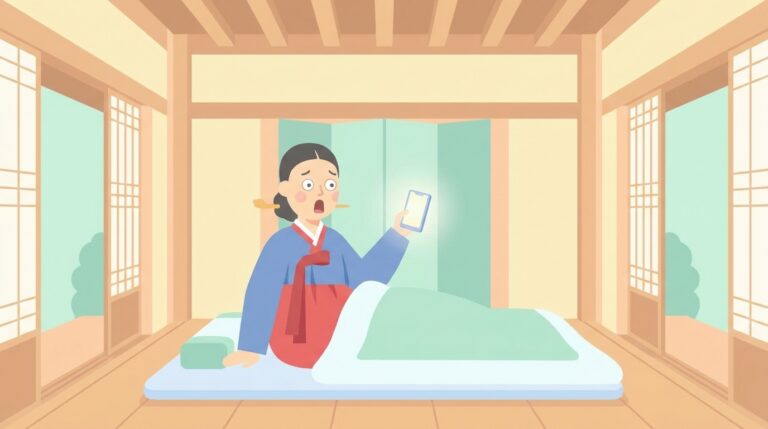
Phase 1: Why Textbook Korean Fails Inside a K-Webtoon
안녕하세요! 매일한글 에디터입니다. (Annyeonghaseyo! Maeil Hangeul editeoimnida. — Hello! I’m the Daily Hangul editor.) Have you ever stayed up until 3 AM binge-reading a K-Webtoon, only to hit an untranslated raw chapter where the heroine wakes up inside a novel and mutters, “이거 완전 빙의 각인데?” (Igeo wanjeon bingui gaginde? — This is totally a possession setup, isn’t it?)? Suddenly, your intermediate Korean textbook feels completely useless! As a 10-year cultural navigator, I’ve heard from dozens of Level 4 learners who ace polite office talk yet freeze at bingui (possession) tropes. Mastering these nuanced expressions will unlock witty K-Drama banter and meta-humor—without constantly reaching for a translator.
Phase 2: Top 3 Core Expressions Deep Dive
1. 빙의되다 (bing-uidoeda — to possess / wake up inside someone else’s body)
- Pronunciation: bing-uidoeda (Sounds like: “bing” as in bingo + “ui” like a quick wuh-ee glide + “dweh-da” like dwell without the L + da)
- Meaning: Literally means “to have a spirit/soul enter a body.” In modern K-Pop culture and web novels, it specifically means a modern reader’s consciousness transmigrating into a fictional character—often a doomed villainess—so they can rewrite the plot.
- K-Culture Moment: Imagine a stressed-out Seoul office worker falling asleep on the subway after reading a brutal fantasy novel, only to open her eyes in a gilded European-style palace mirror and whisper, “내가 악녀한테 빙의된 건가?” (Naega angnyeohante bing-uidoen geonga? — Did I get possessed into the villainess?).
- Editor’s Insight: Unlike the spooky Western concept of demonic possession, bingui (빙의) in Korean pop culture is upbeat, strategic, and almost always a chance for a “do-over”! In everyday slang, Koreans also say someone is “빙의했다” (bing-uihaetda — possessed) when they passionately mimic a celebrity or act totally out of character.
- Situation Spectrum: Casual ✅ / Semi-formal ✅ / Formal ⚠️ (Avoid in stiff business reports, unless you are pitching a creative media project!)
- 🤔 Think About It: In English, “being possessed” usually sounds terrifying and implies losing control. Why do you think Korean web culture turned bingui into an empowering fantasy about gaining control over an unfair fate?
2. 원작 파괴 (wonjak pagoe — destroying the original plot / going off-script)
- Pronunciation: wonjak pagoe (Sounds like: “won” as in one + “jak” like jock + “pa” as in pasta + “gweh” like gway)
- Meaning: Literally “original work destruction.” In daily conversation, it describes any adaptation or action that completely derails the established storyline.
- K-Culture Moment: When a supposedly cruel noblewoman refuses to bully the heroine and instead starts a booming dessert business using her modern Korean baking skills, stunned fans in the comment section cheer, “원작 파괴 제대로 하네!” (Wonjak pagoe jedaero hane! — She’s seriously wrecking the original plot!).
- Editor’s Insight: Notice the nuance shift! Outside of bingui stories, “원작 파괴” (wonjak pagoe) is actually a sharp criticism used when a K-Drama ruins a beloved webtoon. Inside a bingui story, however, it’s the ultimate goal!
- Situation Spectrum: Casual ✅ / Semi-formal ✅ / Formal ⚠️ (Common in media reviews and casual team brainstorming, less so in formal speeches.)
- 🤔 Think About It: Do readers in your home country celebrate characters who completely ignore the original story, or do they prefer staying faithful to canon?
3. 사망 플래그를 꺾다 (samang peullaegeureul kkeokda — to break a death flag)
- Pronunciation: samang peullaegeureul kkeokda (Sounds like: “sa” as in salsa + “mang” like mahng + “peul-lae-geu” like plague + “reul” + “kkeok-da” with a tense, sharp kk sound like holding your breath before saying kuhk)
- Meaning: Literally “to snap/break a death flag.” A “death flag” (사망 플래그 — samang peullaegeu) is any cliché warning sign that a character is about to be executed or killed off.
- K-Culture Moment: The moment the crown prince invites the villainess to a suspiciously quiet tea party in the garden, she mutters under her breath, “이대로 가다간 꼼짝없이 죽겠네. 무슨 수를 써서라도 사망 플래그를 꺾어야 해!” (Idaero gadagan kkomjjageopsi jukgenne. Museun sureul sseoseorado samang peullaegeureul kkeokkeoya hae! — At this rate I’m dead for sure. I have to break this death flag no matter what!)
- Editor’s Insight: The verb “꺾다” (kkeokda — to snap/bend/break) adds visceral satisfaction—like snapping a branch in half so it can never poke you again. Intermediate learners often mistakenly use “부수다” (busuda — to smash), which sounds clunky here. Stick to “꺾다” (kkeokda) or “피하다” (pihada — to dodge)!
- Situation Spectrum: Casual ✅ / Semi-formal ⚠️ / Formal 🚫 (Purely pop-culture and gamer/reader slang—save it for friends!)
- 🤔 Think About It: English gamers also use “death flag,” yet Korean speakers pair it with physical verbs like “세우다” (seuda — to raise/plant) and “꺾다” (kkeokda — to snap). How does visualizing a physical flag change how dramatic the phrase feels?
Phase 3: Textbook Korean vs. Real Korean
Situation 1: Realizing your doomed fate is unfolding right in front of you
- 📖 Textbook Korean (교과서 한국어): 제 운명이 매우 위험한 상황에 처했습니다. (Je unmyeongi maeu wiheomhan sanghwange cheohaetseumnida. — My fate has fallen into a very dangerous situation.)
- 🗣️ Real Korean (진짜 한국어): 이대로 가다간 완전 망한 각인데? (Idaero gadagan wanjeon manghan gaginde? — At this rate, it’s totally a doomed angle/situation, isn’t it?)
- 💡 Why the difference? (왜 다를까?): Korean textbooks love Sino-Korean formal nouns like “처하다” (cheohada — to face a situation), which make you sound like a 9 PM news anchor. Real modern Koreans—especially a 20-something reader trapped inside a villainess’s body—use “각” (gak — angle/likelihood) to quickly size up whether a situation is heading toward disaster.
Situation 2: When NPCs notice the possessed villainess acting weirdly nice
- 📖 Textbook Korean (교과서 한국어): 아가씨의 성격이 어제와 다르게 갑자기 변하셨군요. (Agassiui seonggyeogi eojewa dareuge gapjagi byeonhasyeotgunyo. — Young lady, your personality has suddenly changed differently from yesterday.)
- 🗣️ Real Korean (진짜 한국어): 아가씨, 오늘따라 완전 딴사람이 되신 것 같아요! (Agassi, oneulttara wanjeon ttansarami doesin geot gatayo! — Young lady, today of all days you seem like a completely different person!)
- 💡 Why the difference? (왜 다를까?): Instead of clinically analyzing someone’s “성격” (seonggyeok — personality), Koreans naturally use “딴사람” (ttansaram — a completely other person) paired with “오늘따라” (oneulttara — especially today) to express genuine shock with a touch of warmth or suspicion.
Phase 4: K-Culture Deep Dive & Non-Verbal Manners
4-1. Nunchi (눈치) & Gestures in a Possession Scene
If you want to survive as a possessed villainess in a Korean drama or webtoon, your nunchi (눈치 — social situational awareness) is your greatest weapon! Look closely at the body language contrasts:
* The Modern Sigh & Eye-Roll: When an arrogant duke starts monologuing, a possessed heroine won’t cower; she drops her shoulders, gives a deadpan stare, and exhales a silent “하…” (ha… — sigh) while rubbing her temples—a classic Korean office-worker stress gesture.
* The Fan Snap (부채 펴기 — buchae pyeogi): Before dropping a devastatingly polite comeback (사이다 — saida), aristocratic characters snap their folding fan open with one flick of the wrist to hide their smirk, signaling total emotional control.
4-2. Cultural Code Analysis: Why Korea Loves “Bingui” (빙의)
Korea’s fierce academic and corporate competition (치열한 경쟁 — chiyeolhan gyeongjaeng) often leaves young adults feeling boxed in by rigid specs and social hierarchies. That’s why K-Webtoons and hit dramas (like time-slip palace comedies or second-chance revenge series) adore bingui. Unlike pure fantasy escapism, Korean bingui heroines rarely rely on magic alone—they win using practical modern Korean life skills: negotiating contracts, brewing iced Americano, spotting workplace gaslighting, and outsmarting toxic nobles with sheer nunchi. It’s a thrilling mirror of modern Korean resilience!
Phase 5: Interactive Roleplay Scenario
Setting: Velvet drapes filter the morning sun inside a grand marble bedroom. You—formerly Min-ji, a tired marketing assistant from Gangnam—have just woken up inside the body of Lady Serina, the infamous villainess who gets poisoned in Chapter 12. Suddenly, the door creaks open. Your sharp-eyed, fiercely loyal maid Yeon-hee (연희) steps inside carrying a steaming silver teacup.
- 연희 (Yeon-hee): 아가씨, 드디어 깨어나셨군요. 어젯밤 내내 열이 심하셔서 제가 따뜻한 차를 우려 왔습니다. (Agassi, deudieo kkaeeonasyeotgunyo. Eojetbam naenae yeori simhasyeoseo jega ttatteuthan chareul uryeo watseumnida. — Young lady, you’re finally awake. You had a high fever all last night, so I brewed some warm tea for you.) 🎭 Gently sets the teacup down while watching your reaction closely.
- 나 (You): 아… 고마워, 연희야. 그런데 이 차, 혹시 누가 보내라고 한 거니? (A… gomawo, Yeon-heeya. Geureonde i cha, hoksi nuga bonaerago han geoni? — Ah… thanks, Yeon-hee. By the way, this tea—did someone happen to tell you to bring it?) 🎭 Squints suspiciously at the cup, remembering Chapter 12’s poison plot.
- 연희 (Yeon-hee): 어머, 공작 부인께서 직접 챙겨 주신 귀한 찻잎이에요. 평소엔 늘 단숨에 드셨잖아요. (Eomeo, gongjak buinkkeseo jikjeop chaenggyeo jusin gwihan channipieyo. Pyeongsoen neul dansume deusyeotjanayo. — Oh my, these are precious tea leaves prepared personally by the Duchess. Usually you always drink it in one gulp, don’t you?) 🎭 Tilts her head in confusion at your sudden caution.
- 나 (You): (속마음: 아, 맞다! 저 계모가 보낸 독차였지! 이대로 마셨다간 꼼짝없이 당할 뻔했네.) (Sokmaeum: A, matda! Jeo gyemoga bonaen dokchayeotji! Idaero masyeotdagan kkomjjageopsi danghal ppeonhaenne. — Inner thought: Oh right! That was the poisoned tea sent by the stepmother! If I drank this, I would’ve been helplessly done for!) 🎭 Freezes mid-reach, forcing a casual smile.
- 연희 (Yeon-hee): 아가씨, 얼굴빛이 갑자기 안 좋으신데 어디 불편하세요? (Agassi, eolgulbichi gapjagi an joeusinde eodi bulpyeonhaseyo? — Young lady, your complexion suddenly looks pale—are you feeling unwell anywhere?) 🎭 Steps closer with genuine worry.
- 나 (You): 아니, 괜찮아. 다만 오늘부터는 맹물 말고는 입에도 안 대려고. 입맛이 싹 변했거든. (Ani, gwaenchana. Daman oneulbuteoneun maengmul malgoneun ibedo an daeryeogo. Immassi ssak byeonhaetgeodeun. — No, I’m fine. It’s just that starting today, I’m not putting anything in my mouth except plain water. My taste buds changed completely.) 🎭 Waves a hand dismissively like a seasoned Seoul boss.
- 연희 (Yeon-hee): 네? 어제까지 제일 좋아하시던 홍차인데요? 오늘따라 정말 딴사람 같으세요. (Ne? Eojekkaji jeil joahasideon hongchaindeyo? Oneulttara jeongmal ttansaram gateuseyo. — What? Until yesterday it was your favorite black tea! Today you really seem like a different person.) 🎭 Blinks rapidly, totally baffled.
- 나 (You): 사람 쉽게 변할 수도 있지. 자, 이제 본격적으로 사망 플래그 좀 꺾어 볼까? (Saram swipge byeonhal sudo itji. Ja, ije bongyeokjeogeuro samang peullaegeu jom kkeokkeo bolkka? — People can change easily, you know. Now, shall we seriously start breaking some death flags?) 🎭 Smirks at the mirror with pure determination.
🔀 Interactive Branching Point: The Duchess storms in and demands to know why you didn’t drink her tea! What do you say?
- A) “어머니, 제가 감히 이 귀한 차를 혼자 마실 수 있나요? 어머니 먼저 드시죠.” (Eomeoni, jega gamhi i gwihan chareul honja masil su innayo? Eomeoni meonjeo deusijyo. — Mother, how dare I drink this precious tea alone? Please drink it first.)
- Feedback (Best! ✅): Absolute saida (cathartic) perfection! By flipping the Confucian politeness card (“I dare not drink before my elder”), you trap the villainess without breaking character!
- B) “당신이 여기에 독 탄 거 다 알아요! 당장 경찰 불러!” (Dangsini yeogie dok tan geo da arayo! Dangjang gyeongchal bulleo! — I know you put poison in this! Call the police right now!)
- Feedback (Bad! 🚫): Whoops! There’s no modern “경찰” (gyeongchal — police) in a medieval fantasy empire, and exposing your knowledge too fast ruins your cover!
- C) “사실 저 빙의됐어요. 이 세계는 소설 속이에요!” (Sasil jeo bing-uidwaesseoyo. I segyeneun soseol sogieyo! — Actually, I’m possessed. This world is inside a novel!)
- Feedback (Risk! ⚠️): Bold move, but in 99% of K-Webtoons, shouting that you’re possessed gets you locked in a tower as a lunatic! Keep your secret tight!
Phase 6: 10-Second Emotion Shadowing Drill
Read these aloud, pausing at each / and leaning hard into the emotion!
- [😱 Shocked & panicked]
내가 지금 / 소설 속 악녀한테 / 빙의된 건가? / 이대로 가다간 / 진짜 망하는데!
(Naega jigeum / soseol sok angnyeohante / bing-uidoen geonga? / Idaero gadagan / jinjja manghaneunde! — Did I just get possessed into the novel’s villainess? At this rate, I’m seriously doomed!) -
[😏 Sly & determined]
어차피 원작은 / 내가 다 외웠으니까 / 이번 생엔 / 사망 플래그 꺾고 / 꽃길만 걸을 거야.
(Eochapi wonjageun / naega da oewosseunikka / ibeon saengen / samang peullaegeu kkeokgo / kkotgilman georeul geoya. — Since I’ve memorized the whole original story anyway, in this life I’ll break the death flags and only walk a flower path.) -
[😤 Fed up & modern]
하… / 내가 전생에 무슨 죄를 지어서 / 휴일도 없이 / 이 고생을 하는 거지?
(Ha… / naega jeonsaenge museun joereul jieoseo / hyuildo eopsi / i gosaengeul haneun geoji? — Sigh… what sin did I commit in my past life to suffer like this without even a day off?)
Phase 7: K-Culture Mini Dictionary
- 회빙환 (hoebinghwan) | Regression, Possession, Reincarnation | The holy trinity of Korean web novel genres! Short for 회귀 (hoegui — time regression), 빙의 (bingui — possession), and 환생 (hwansaeng — reincarnation). Used constantly in media marketing and publishing pitches.
- 먼치킨 (meonchikin) | Overpowered (OP) Character | Borrowed from tabletop gaming, it describes an insanely strong protagonist who crushes every obstacle effortlessly. In Korean workplaces, a super-competent coworker who solves every crisis is playfully called “일잘러 먼치킨” (iljalleo meonchikin).
- 사이다 전개 (saida jeongae) | Cathartic, Refreshing Plot Development | Named after fizzy Korean lemon-lime soda (Chilsung Cider), this describes moments when the good guy delivers instant, satisfying karma to a villain. Great for praising bold, decisive problem-solving in real life!
- 고구마 전개 (goguma jeongae) | Frustrating, Stuffy Plot Development | The opposite of saida! Eating dry roasted sweet potatoes (goguma) without water feels like choking—just like watching a clueless hero fall into an obvious trap for 10 episodes straight.
Phase 8: Survival Kit for Travelers
Planning a Seoul pilgrimage to webtoon pop-up stores in Seongsu-dong or comic cafes (만화카페 — manhwa kape) in Hongdae? Pack these phrases!
- 요즘 제일 잘나가는 회빙환 웹툰이 뭐예요? (Yojeum jeil jallaganeun hoebinghwan webtuni mwoyeyo? — What’s the hottest regression/possession webtoon these days?) — Pro Tip: Ask this at a comic cafe counter or bookstore staff desk to get instant local recommendations!
- 여기 사이다 장면 진짜 대박이에요! (Yeogi saida jangmyeon jinjja daebagieyo! — The cathartic scenes here are seriously awesome!) — Pro Tip: Instant bonding line with Korean friends or pop-up store fans.
- 단행본 1권 재고 남아 있나요? (Danhaengbon ilgwon jaego nama innayo? — Do you still have Volume 1 of the printed book in stock?) — Pro Tip: Many hit webtoons get gorgeous physical print editions (단행본) sold at major bookstores.
Editor’s Travel Note: To find hidden webtoon theme cafes in Yeonnam-dong or Seongsu, skip Google Maps and download the Naver Map app for accurate Seoul transit before you fly. When buying physical webtoon merchandise or limited-edition volumes at Kyobo Book Centre online and offline stores, international credit cards work smoothly at kiosks, and you can pair your T-money transit card with Kakao T for late-night rides back to your hotel!
Phase 9: One Step Deeper — Why Do We Crave a Second Chance?
In traditional Korean culture, fate was often called “팔자” (palja — destiny), something fixed at birth that you simply had to endure. Yet modern Korea’s hyper-competitive society sparked a quiet rebellion in pop culture: if the system feels rigged from the start, why not wake up with insider knowledge and rewrite the rules? Through bingui stories, Korean readers aren’t just escaping reality—they are rehearsing the courage to say “no” to toxic expectations and claim the life they deserve. Even as an intermediate learner, noticing how “팔자” gave way to “원작 파괴” (wonjak pagoe) lets you feel the pulse of young Koreans today.
💬 Your Turn: If you woke up inside your favorite K-Drama or webtoon tomorrow, which character would you possess—and what is the very first thing you’d change? Drop your answer in the comments!
Phase 10: FAQ & Common Mistakes
Q: Is “빙의” (bingui) only used for webtoons and novels?
A: Not at all! While it dominates web novels, Koreans also use “빙의하다” (binguihada) humorously in daily life—for example, when someone sings a K-Pop ballad with such intense emotion that you joke, “가수 빙의했네!” (Gasu binguihaenne! — You’re totally possessed by the singer!).
Q: What is the difference between “빙의” (bingui) and “환생” (hwansaeng)?
A: “빙의” (bingui) means your modern soul enters an existing character’s body (often midway through their messy life). “환생” (hwansaeng — reincarnation) means being reborn as a brand-new baby in another world while keeping your past memories.
Q: Can I use “사이다” (saida) in a formal business presentation?
A: In casual team meetings, saying “사이다 같은 해결책” (saida gateun haegyeolchaek — a refreshing solution) adds charm, but in strict executive reports, stick to “시원하고 명쾌한 해결책” (siwonhago myeongkwaehan haegyeolchaek — a clear and decisive solution).
🚨 Common Mistakes (TOP 3) & Correct Action
- Mistake: Saying “사망 플래그를 부쉈어요” (samang peullaegeureul buswosseoyo — smashed the death flag).
- Correct Action: Use the natural collocation “사망 플래그를 꺾었어요” (kkeokkeosseoyo — snapped/broke) or “피했어요” (pihaesseoyo — dodged).
- Mistake: Confusing “각” (gak — angle/likely outcome) with literal geometry.
- Correct Action: Remember that in slang like “빙의 각” (bingui gak) or “망한 각” (manghan gak), “각” means “a clear sign that X is about to happen.”
- Mistake: Treating “고구마” (goguma) purely as food during a movie review.
- Correct Action: If a Korean friend says “이 드라마 너무 고구마야” (I deurama neomu gogumaya), don’t look for sweet potatoes—they mean the plot is painfully frustrating!
Phase 11: Action Mission & Engagement
- 🥉 Bronze Mission (Solo Practice): Stand in front of your mirror tonight and perform the 3 sentences from Phase 6’s 10-Second Emotion Drill using full facial expressions!
- 🥈 Silver Mission (Share Online): Screenshot your favorite webtoon panel or K-Drama cliffhanger and post it with the Korean caption: “이거 완전 사망 플래그 각인데?” (Igeo wanjeon samang peullaegeu gaginde?).
- 🥇 Gold Mission (Real-World Use): Next time you chat with a Korean language partner, describe a frustrating plot twist in a show as “고구마 전개” (goguma jeongae) and a satisfying comeback as “사이다 전개” (saida jeongae)!
- 🎮 K-Culture Mission: Open Naver Webtoon or your favorite K-Drama with Korean subtitles and hunt for at least two instances of “딴사람” (ttansaram) or “빙의” (bingui) in the top viewer comments!
Phase 12: Interactive Quiz Challenge
1. Situational Judgment: Your Korean friend watches a K-Drama villain finally get exposed in front of the whole company and cheers, “와, 진짜 대박!” Which term best describes that scene?
* A) 고구마 전개 (goguma jeongae)
* B) 사이다 전개 (saida jeongae)
* C) 원작 파괴 (wonjak pagoe)
2. Fill-in-the-Blank: Complete the sentence with the most natural verb!
“이대로 가다간 꼼짝없이 죽겠네. 무슨 수를 써서라도 사망 플래그를 ( ______ ) 해!”
* A) 부숴야 (buswoya)
* B) 꺾어야 (kkeokkeoya)
* C) 먹어야 (meogeoya)
3. True or False (Cultural Check): In Korean pop culture, “빙의” (bingui) always refers to terrifying horror movies about evil spirits.
Click here to reveal Answers & Explanations!
- Answer: B) 사이다 전개 (saida jeongae). Explanation: A refreshing, cathartic moment where a villain gets their well-deserved karma is always called saida! (If you picked A, goguma is the exact opposite—frustrating and stuffy!)
- Answer: B) 꺾어야 (kkeokkeoya). Explanation: In Korean webtoon slang, death flags are physically “snapped/broken” using the verb 꺾다 (kkeokda), not smashed (부수다).
- Answer: False! Explanation: While traditional exorcism dramas use possession in a scary way, in modern K-Webtoons and web novels, bingui is an empowering, often comedic trope about waking up in a story to rewrite a doomed fate!
🎬 Watch Our Daily Videos! (Daily Hangul Official Instagram)
Review the expressions you learned in this article with our fun daily short videos! Check out native pronunciation and real-life nuances in action.
- Instagram @dailyhangul_en







