

Phase 1: Why “It’s Pretty” Isn’t Enough Anymore
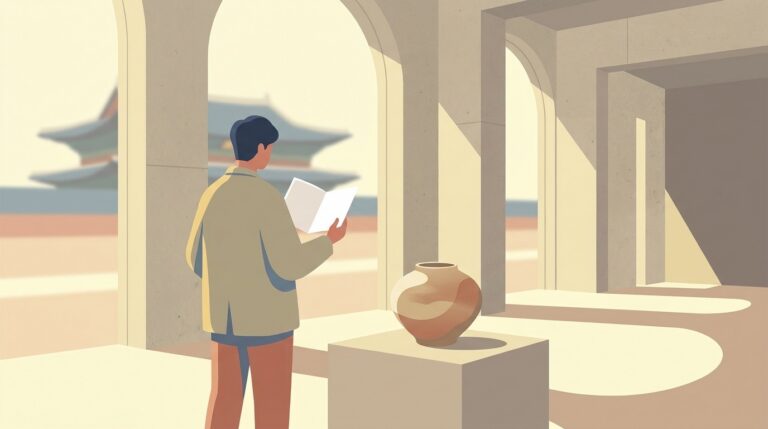
안녕하세요! 매일한글 에디터입니다. (Annyeonghaseyo! Welcome back, it’s your Daily Hangul editor.) Picture yourself wandering through Seoul’s National Museum of Modern and Contemporary Art (MMCA) on a quiet Friday afternoon. You fall in love with a minimalist ceramic piece, grab the exhibition catalog—the 도록 (dorok)—and flip to the critic’s essay. Suddenly, your TOPIK 5 confidence vanishes under waves of dense Sino-Korean aesthetics! You know what you feel, yet translating those sensory impressions into sharp Korean feels impossible. After coaching dozens of advanced learners through this exact wall, I built this guide to turn passive museum visits into expressive, articulate Korean criticism.
Phase 2: Deep Dive into 3 Essential Aesthetic Expressions
When you read Korean exhibition catalogs or architecture columns, critics rarely rely on simple adjectives like 예쁘다 (yeppeuda – pretty) or 멋있다 (meositda – cool). Instead, they bridge physical materials, human senses, and philosophical stillness. Let’s unpack three powerhouse expressions that will immediately elevate your reading comprehension and critical vocabulary.
1. 물성이 도드라지다 (물성이 도드라지다)
- Pronunciation: Mulseongi dodeurajida (mool-suhng-ee doh-deu-rah-jee-dah — think mool like moon, suhng like sung, and rah crisp like opera)
- Meaning: Literally “the physical property stands out.” Nuance: The raw materiality, tactile texture, and intrinsic nature of a medium (clay, hanji paper, concrete, bronze) command visual attention rather than being hidden by ornament.
- K-Culture Moment: You will see this constantly in essays on Korean Dansaekhwa (단색화 – monochrome painting) or Lee Ufan retrospectives at Leeum Museum of Art, as well as architecture reviews of raw exposed concrete (노출 콘크리트) buildings in Seongsu-dong.
- Editor’s Insight: Beginners say 질감이 좋아요 (jilgami joayo – the texture is nice). Critics say 물성이 도드라지다 (mulseongi dodeurajida) because 물성 (mulseong) implies the philosophical weight and truth of the material itself, not just how it feels to touch.
- Situation Spectrum: Casual ⚠️ (Used among art-loving friends) | Semi-formal ✅ | Formal ✅
- 🤔 Think About It: In English, we often treat materials as passive tools an artist manipulates. Why do Korean art essays so frequently make “the material itself” (물성) the grammatical subject of the sentence? How does that shift who—or what—has agency in the artwork?
2. 감각을 환기하다 (감각을 환기하다)
- Pronunciation: Gamgageul hwangihada (gahm-gah-geul hwahn-gee-hah-dah — hwahn rhymes with swan, gee is hard like geese)
- Meaning: Literally “to ventilate/stir up the senses.” Nuance: To awaken dormant sensory perceptions, evoke visceral memories, or gently refresh the viewer’s awareness through subtle artistic cues.
- K-Culture Moment: Think of those quiet, atmospheric scenes in K-dramas like My Liberation Notes or Our Blues, or curator notes for immersive light-and-sound installations at Kukje Gallery where scent, shadow, and acoustics merge.
- Editor’s Insight: Unlike 자극하다 (jageukhada – to stimulate), which can sound harsh, loud, or commercial, 환기하다 (hwangihada) feels like opening a window in a stuffy room. It suggests refinement, subtlety, and intellectual resonance.
- Situation Spectrum: Casual ⚠️ | Semi-formal ✅ | Formal ✅
- 🤔 Think About It: Notice how Korean uses the verb “to air out” (환기하다) for waking up human senses and memories. What metaphors does your native language use for aesthetic awakening—light, fire, electricity, or breath?
3. 관조적 시선으로 포착하다 (관조적 시선으로 포착하다)
- Pronunciation: Gwanjojeok siseoneuro pochakhada (gwahn-joh-juhk shee-suh-neu-roh poh-chahk-hah-dah — shee like sheep, chahk crisp with a soft stop)
- Meaning: Literally “to capture with a contemplative gaze.” Nuance: Observing life, landscape, or human emotion with calm, unhurried distance—neither overly sentimental nor coldly judgmental.
- K-Culture Moment: Frequently appears in reviews of Korean architectural photography (like Koo Bohnchang’s white porcelain series), arthouse films by Hong Sang-soo, or essays on traditional hanok courtyards framing the changing seasons.
- Editor’s Insight: Pair this with 비판적 시선 (bipanjeok siseon – critical gaze) and you get the yin and yang of Korean art writing. 관조적 (gwanjojeok) shows empathy through quiet stillness—a hallmark of Korean aesthetic appreciation.
- Situation Spectrum: Casual 🚫 (Too literary for small talk) | Semi-formal ⚠️ | Formal ✅
- 🤔 Think About It: In Western criticism, “distance” often implies detachment or skepticism. In Korean aesthetics, how can keeping a contemplative distance (관조) actually create deeper intimacy with an artwork?
Phase 3: Textbook Korean vs. Real Korean
Even at Level 5, learners often sound like they swallowed a dictionary when discussing exhibitions over coffee. Here is how cultured Koreans actually express critical thoughts in real life versus stiff textbook prose.
Situation 1: Describing an artwork that left a lasting impression
- 📖 Textbook Korean: 이 작품은 저에게 매우 깊은 인상을 주었습니다. (I jakpumeun jeoege maeu gipeun insangeul jueotseumnida. — This artwork gave me a very deep impression.)
- 🗣️ Real Korean: 전시장을 나와서도 잔상이 꽤 오래 남더라고요. (Jeonsijangeul nawaseodo jansangi kkwae orae namdeoragoyo. — Even after leaving the gallery, the afterimage lingered for quite a while.)
- 💡 Why the difference? Real Korean critics and art lovers avoid flat phrases like 깊은 인상을 주다. Using 잔상 (jansang – afterimage) or 여운 (yeoun – lingering resonance) with the retrospective ending -더라고요 (-deoragoyo) feels natural, reflective, and emotionally authentic.
Situation 2: Pointing out that a building or stage feels overly crowded
- 📖 Textbook Korean: 이 건축물은 장식이 너무 많아서 복잡해 보입니다. (I geonchungmureun jangsigi neomu manaseo bokjapae boimnida. — This building has too many decorations, so it looks complicated.)
- 🗣️ Real Korean: 힘을 좀 뺐으면 여백의 미가 훨씬 살았을 텐데 아쉬워요. (Himeul jom ppaesseumyeon yeobaek-ui miga hwolssin sarasseul tende aswiwoyo. — It’s a shame; if they had eased off a bit, the beauty of empty space would’ve really come alive.)
- 💡 Why the difference? 힘을 빼다 (himeul ppaeda – literally “to take strength out” / ease off on trying too hard) is one of the coolest insider expressions in Korean music, acting, fashion, and architecture critiques!
Phase 4: K-Culture Deep Dive & Non-Verbal Etiquette
4-1. Nunchi & Gallery Gestures in Korea
In Korean museums and indie galleries, nunchi (눈치 – social awareness) shapes how your body occupies the room. Visitors typically clasp their hands gently behind their backs—뒷짐을 지다 (dwitjimeul jida)—or cradle their exhibition catalog (도록) with both hands against their chest. Avoid sweeping arm gestures near installations; Korean gallery guards are famously attentive. When reading wall texts (전시 서문) or listening to a docent (도슨트), slow, quiet nodding signals deep engagement, whereas loud “Ooh!” or “Wow!” reactions can disrupt the meditative atmosphere prized in Korean exhibition spaces.
4-2. Cultural Code: From “RM-Tour” to Architectural Essays
Why are exhibition catalogs (도록) practically collector’s items in Korea right now? Look at the “RM-Tour” phenomenon—when BTS’s RM shares photos from small Korean galleries along with thoughtful captions on Korean modern masters like Yun Hyong-keun or Kwon Jin-kyu, thousands of young Koreans line up to read the exact essays he read. Add to that superstar architects like Yoo Hyun-joon (유현준), whose books and TV appearances translate concrete, light, and hanok courtyards into poetic everyday Korean. In Korea, art criticism isn’t locked in ivory towers; it lives in weekend café conversations, neatly folded inside a gallery tote bag.
Phase 5: Real-Life Roleplay Scenario
Setting: A sunlit concrete café in Samcheong-dong, Seoul, right beside a contemporary craft and architecture gallery. Raindrops tap against the floor-to-ceiling glass. You’re sitting with Jiyeon (지연), a sharp yet warm editor at a Seoul culture magazine, with two open exhibition catalogs resting between your iced lattes.
- Jiyeon: 오늘 전시 어땠어요? 저는 공간 연출이 꽤 인상적이더라고요. (Oneul jeonsi eottaesseoyo? Jeoneun gonggan yeonchuri kkwae insangjeogideoragoyo. — How was today’s exhibition? I found the spatial staging quite impressive.) 🎭 Resting her chin on her hand while flipping the catalog page.
- You: 저는 무엇보다 백자 작품의 물성이 도드라져서 한참을 바라봤어요. (Jeoneun mueotboda baekja jakpumui mulseongi dodeurajyeoseo hanchameul barabwasseoyo. — More than anything, the materiality of the white porcelain stood out so much that I stared at it for ages.) 🎭 Tracing the edge of a ceramic texture photo in the catalog.
- Jiyeon: 맞아요, 자연광이 흙의 거친 질감을 고스란히 살려내더라고요. (Majayo, jayeongwangi heulgui geochin jilgameul goseuranhi sallyeonaedeoragoyo. — Right? The natural light brought out the raw texture of the clay intact.) 🎭 Nodding enthusiastically and taking a sip of coffee.
- You: 도록 평론에서 언급한 ‘비워냄의 미학’이 바로 이런 감각을 환기하는 거였네요. (Dorok pyeongnoneseo eongeuphan ‘biwonaemui mihak’i baro ireon gamgageul hwangihaneun geoyeonneyo. — So the ‘aesthetics of emptying out’ mentioned in the catalog essay really was meant to awaken this exact sensation.) 🎭 Smiling with an “aha!” realization.
- Jiyeon: 와, 표현력이 정말 정교하시네요! 가장 여운이 남았던 대목은 뭐였어요? (Wa, pyohyeollyeogi jeongmal jeonggyohasineyo! Gajang yeouni namatdeon daemogeun mwoyeosseoyo? — Wow, your phrasing is so precise! What part left the deepest lingering impression on you?)
- You: 화려한 기교를 덜어내고 관조적 시선으로 일상을 포착한 점이 마음에 와닿았어요. (Hwaryeohan gigyoreul deoreonaego gwanjojeok siseoneuro ilsangeul pochakhan jeomi maeume wadahatseoyo. — Stripping away flashy technique and capturing everyday life through a contemplative gaze really resonated with me.) 🎭 Leaning in slightly, speaking calmly.
- Jiyeon: 역시 보는 눈이 남다르세요. 사실 저희 웹진에 짧은 전시 단상을 실어볼까 하는데, 혹시 기고해 보실래요? (Yeoksi boneun nuni namdareuseyo. Sasil jeohui wepjine jjalbeun jeonsi dansangeul sireobolkka haneunde, hoksi gigohae bosillaeyo? — You really do have a special eye. Actually, we’re thinking of publishing short exhibition reflections in our webzine—would you like to contribute?)
- You: (Choose your response below!)
🔀 Interactive Branching Point: How do you reply to Jiyeon’s offer?
- Option A: “제가 느낀 감각을 정교한 문장으로 옮길 수 있다면 정말 영광이죠!” (Jega neukkin gamgageul jeonggyohan munjangeuro omgil su itdamyeon jeongmal yeonggwangijyo! — If I can translate the sensations I felt into precise sentences, it would truly be an honor!)
- Feedback (🏆 Best): Smooth, humble, and uses the exact high-level register (감각을 문장으로 옮기다) that a Korean magazine editor adores! You sound confident yet respectful.
- Option B: “대박! 저 그런 거 완전 찢을 수 있어요. 바로 쓸게요!” (Daebak! Jeo geureon geo wanjeon jjijeul su isseoyo. Baro sseulgeyo! — Awesome! I can totally crush that. I’ll write it right now!)
- Feedback (⚠️ Risk): 완전 찢다 (totally slay/crush it) is fun variety-show slang for K-pop performances, not an editorial pitch! With a close peer it gets a laugh, but in semi-formal cultural spaces it breaks the refined mood.
- Option C: “아니요, 저는 외국인이라서 한국어 비평은 절대 못 씁니다.” (Aniyo, jeoneun oeguginiraseo hangugeo bipyeongeun jeoldae mot sseumnida. — No, because I’m a foreigner, I definitely cannot write Korean criticism.)
- Feedback (🚫 Bad): Too abrupt and self-defeating! Even if you want to decline politely, Korean social grace favors soft expressions like 부족하지만 열심히 써 보겠습니다 (I’m still lacking, but I’ll try my best) or 다음 기회에 도전해 볼게요 (I’ll try next time).
Phase 6: 10-Second Emotion Shadowing Drill
Read these lines aloud, pausing at each / mark, and let your voice match the mood!
[😌 Calmly and contemplatively]
거친 질감이 / 고스란히 / 살아 숨 쉬네요. (Geochin jilgami / goseuranhi / sara sum swineyo. — The rough texture / breathes alive / completely intact.)[✨ Awed by subtle beauty]
화려함보다는 / 절제된 여백이 / 더 큰 울림을 줍니다. (Hwaryeohambodaneun / jeoljidoen yeobaegi / deo keun ullimeul jumnida. — More than splendor, / restrained empty space / gives a greater resonance.)[🧐 Thoughtfully analyzing]
작가의 시선이 / 관객의 내면과 / 조용히 맞닿아 있어요. (Jakgaui siseoni / gwangaegui naemyeongwa / joyonghi matdaa isseoyo. — The artist’s gaze / quietly touches / the viewer’s inner world.)
Phase 7: K-Culture Mini Dictionary (4 Key Terms)
- 도록 (Dorok) | Exhibition Catalog | Not just a brochure! In Korea, museum dorok are beautifully bound art books containing curatorial essays (평론), artist interviews, and high-res plates that locals collect like vinyl records.
- 도슨트 (Doseonteu) | Docent / Exhibition Guide | Huge part of Korean museum culture. Major exhibitions host scheduled 도슨트 투어 (docent tours) where guides unpack symbolism—often requiring advance booking!
- 여백 (Yeobaek) | Negative / Empty Space | Originally from East Asian ink painting, Koreans apply 여백의 미 (beauty of emptiness) to everything from concrete museums and film pacing to minimalist K-beauty packaging.
- 단상 (Dansang) | Brief Reflections / Fragmentary Thoughts | Softer and more personal than 비평 (criticism) or 논문 (thesis). Perfect word to use when posting your own museum thoughts on Instagram or a blog!
Phase 8: Traveler’s Survival Kit for Korean Museums
Top 3 Survival Phrases
- 이 전시 도록은 아트숍에서 구매할 수 있나요? (I jeonsi dorogeun ateusyobeseo gumaehal su innayo? — Can I buy this exhibition catalog at the art shop?)
- Pro Tip: Big shows sell out fast! Ask as soon as you enter if the 도록 is still in stock.
- 오늘 도슨트 해설 시간이 언제인가요? (Oneul doseonteu haeseol sigani eonjeingayo? — What time is today’s docent tour?)
- Pro Tip: Even if you don’t catch every word, hearing live Korean art explanations trains your ear brilliantly.
- 오디오 가이드 대여는 어디서 하나요? (Odio gaideu daeyeoneun eodiseo hanayo? — Where can I rent an audio guide?)
- Pro Tip: Many Korean museums now offer free smartphone QR guides—check the front desk!
Editor’s Travel Note
Before heading to Samcheong-dong or Hannam-dong for gallery hopping, grab the official Naver Map mobile app since global map apps don’t always show smaller indie gallery entrances in Seoul’s alleyways. For major shows, always check the National Museum of Modern and Contemporary Art reservation page in advance, as popular weekends sell out online. Transport tip: Tap a T-money card or Seoul’s Climate Card on buses connecting Bukchon and Euljiro, and bring a physical credit card or Apple Pay—almost every museum café and art shop is 100% cashless!
Phase 9: One Step Deeper — The Humanities Behind the Language
Have you noticed how Korean art criticism blends heavy Sino-Korean nouns—like 물성 (materiality), 서사 (narrative), and 관조 (contemplation)—with soft, poetic native Korean verbs like 스며들다 (to seep in), 번지다 (to spread like ink), and 머무르다 (to linger)? That linguistic marriage isn’t an accident. Traditional Korean aesthetics rarely sees beauty as a cold specimen pinned under a microscope; instead, beauty happens in the quiet meeting between space, material, and human breath. When you translate sensory impressions into Korean prose, you aren’t just labeling objects—you are tracing how an artwork gently alters the air around you.
💬 Your Turn: Think about the last exhibition, concert, or film that moved you. How would you describe its lingering mood in one Korean sentence using today’s vocabulary? Drop your draft in the comments—I’d love to read and cheer you on!
Phase 10: FAQ & Common Mistakes
Q: Do I need to memorize every difficult Hanja art term to understand Korean exhibition catalogs?
A: Not at all! Even native Koreans pause over dense academic jargon in 전시 서문 (exhibition prefaces). Focus first on high-frequency anchor verbs like 환기하다 (evoke), 도드라지다 (stand out), and 포착하다 (capture)—once you grasp the verb’s motion, the nouns around it fall into place naturally.
Q: What is the difference between 감상문 (gamsangmun) and 평론 (pyeongnon)?
A: 감상문 is a personal appreciation essay focusing on your subjective emotions (“I felt moved because…”). 평론 is critical prose that situates an artwork within broader artistic, historical, or architectural discourse using analytical vocabulary.
Q: Where can I practice reading short, authentic Korean art columns every week without feeling overwhelmed?
A: Follow major Korean museums like Leeum or MMCA on Instagram, browse the “Culture/Design” section of Korean online magazines like 월간 디자인 (Monthly Design), or read curator wall captions right inside gallery spaces.
🚨 Common Mistakes Warning Board
- Overusing 너무 / 진짜 in critical writing: Saying “질감이 너무 좋아요” (The texture is so good) sounds casual in a written review. Correct Action: Swap in 정교하다 (refined), 절제되어 있다 (restrained), or 도드라지다 (stands out).
- Confusing 감상 (appreciation) with 감동 (touching emotion): Writing “작품을 감동했어요” is grammatically awkward. Correct Action: Use 작품을 감상하다 (to appreciate/view an artwork) or 작품에서 깊은 울림을 받다 (to feel deep resonance from an artwork).
- Translating “abstract” or “deep” literally as 어렵다 (difficult): Calling an artwork 어렵다 can sound dismissive or unprepared. Correct Action: Try 다층적인 의미를 품고 있다 (holds multi-layered meaning) or 사유의 여지를 남긴다 (leaves room for contemplation).
Phase 11: Action Missions & K-Culture Quest
- 🥉 Bronze Mission (Solo Practice): Pick a photo of your favorite artwork or building on your phone. Write three sentences describing it in Korean using 물성이 도드라지다, 감각을 환기하다, or 여운이 남다.
- 🥈 Silver Mission (Share It): Post a picture of an exhibition or architectural spot you love on social media with a two-line Korean caption (전시 단상) and tag your favorite Korean learning buddy!
- 🥇 Gold Mission (Real-World Use): Visit a local museum (or virtual Korean museum archive), read one Korean exhibition blurb from start to finish, and summarize its core aesthetic argument aloud in 30 seconds.
🎮 K-Culture Mission: Look up an interview clip of Korean architect Yoo Hyun-joon (유현준) or an MMCA exhibition teaser on YouTube with Korean subtitles on. Spot how often words like 공간 (space), 시선 (gaze), and 여백 (empty space) pop up—you’ll recognize them instantly now!
Phase 12: Interactive Quiz Challenge
Test your critic’s instinct before you hit the galleries!
Quiz 1 (Situational Judgment): You’re writing a thoughtful review of a minimalist wooden furniture exhibition where the grain and knots of the wood are left raw and unpainted. Which sentence sounds most like an authentic Korean catalog essay?
A. 나무가 그냥 그대로 있어서 신기했어요.
B. 불필요한 장식을 덜어내어 나무 본연의 물성이 도드라집니다.
C. 의자가 비싸 보이지만 앉기에 조금 딱딱해요.
👉 Click to reveal Quiz 1 Answer & Feedback
Answer: B! 불필요한 장식을 덜어내어 나무 본연의 물성이 도드라집니다 (By stripping away unnecessary ornament, the wood’s inherent materiality stands out) hits the exact tone of Korean critical prose. Option A sounds like casual chat, and Option C sounds like an online shopping review rather than aesthetic criticism!
Quiz 2 (Fill in the Blank): Complete the sentence: “조명과 어우러진 빗소리가 관객의 잠든 (________)을/를 부드럽게 환기한다.” (The rain sound harmonized with the lighting gently awakens the viewer’s dormant senses.)
👉 Click to reveal Quiz 2 Answer & Explanation
Answer: 감각 (gamgak – senses)! Paired with 환기하다 (to awaken/evoke), 잠든 감각을 환기한다 is a classic poetic collocation in exhibition and performance reviews.
Quiz 3 (True / False Cultural Quiz): True or False: In Korean art criticism, describing an artwork as viewed through a “관조적 시선” (contemplative gaze) usually means the critic thinks the artist was cold and uncaring.
👉 Click to reveal Quiz 3 Answer & Explanation
Answer: False! In Korean aesthetics, 관조적 시선 is high praise—it celebrates calm, unhurried observation that respects both the subject and the viewer’s quiet space for reflection.
🎬 Watch Our Daily Videos! (Daily Hangul Official Instagram)
Review the expressions you learned in this article with our fun daily short videos! Check out native pronunciation and real-life nuances in action.
- Instagram @dailyhangul_en







