

Phase 1: Empathy
Hello! I’m your Daily Hangul Editor.
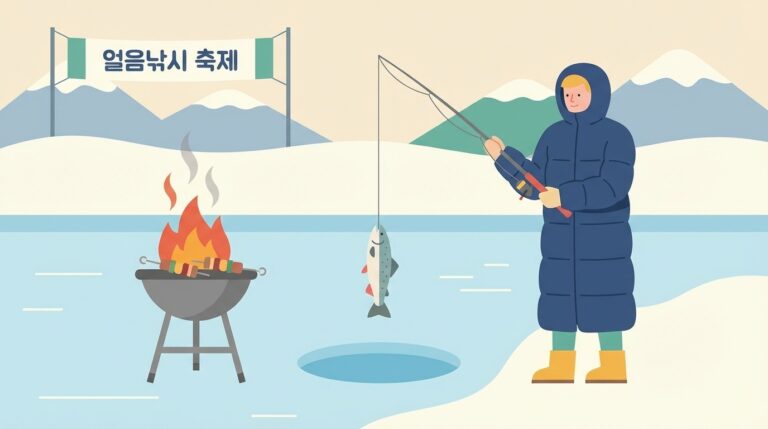
Imagine this: You are standing on a massive frozen river in Gangwon-do. Everyone around you is wearing giant, sleeping-bag-like coats called ‘Long Padding’ (롱패딩). Suddenly, you pull a real, flapping trout out of a tiny hole in the ice! People around you cheer. It feels like a scene straight out of a Korean variety show or a winter K-Drama special.
But now reality hits… your hands are freezing, your nose is red, and you really want to eat the fish you just caught. You walk up to the bustling food tent filled with smoke and delicious smells. The busy grill master looks at you. What do you say? If you just stand there, you’ll freeze!
Don’t worry. This guide is based on real experiences from my expat students who bravely navigated the Hwacheon Sancheoneo (Mountain Trout) Ice Festival. Today, we’re going to learn exactly how to survive the cold, get your tickets, and most importantly, get that fish grilled like an insider!
Phase 2: Core Expressions Deep Dive
1. 표 두 장 주세요.
- Pronunciation: pyo du jang juseyo. (pyo sounds like ‘pyo’ in Pyong, jang rhymes with ‘sang’)
- Meaning: Literal = Ticket two pieces give me. / Real nuance = Two tickets, please.
- K-Culture Moment: Before you step on the ice, you need a ticket. You’ll use this phrase at the festival ticket booth, at the movie theater, or when taking a bus.
- Editor’s Insight: The counter ‘장’ (jang) is specifically used for flat, paper-like objects. While you could just say ‘두 개’ (two things), using ‘장’ makes you sound remarkably fluent!
- Situation Spectrum:
- Friends (Casual): ⚠️ (Friends don’t usually sell each other tickets)
- Ticket Staff (Semi-formal): ✅
- Boss/Elders (Formal): ✅
- 🤔 Think About It: Korean has specific ‘counter words’ for different objects (paper, animals, machines). Does your native language have special ways to count specific items?
2. 너무 추워요!
- Pronunciation: neomu chuwoyo! (chu-wo-yo sounds like you are chewing on something freezing cold)
- Meaning: Literal = Too cold! / Real nuance = It’s freezing!
- K-Culture Moment: Picture a K-Drama heroine blowing on her hands, stomping her feet, and looking up at the male lead with puppy eyes while saying this. It’s the ultimate winter survival phrase.
- Editor’s Insight: This isn’t just a statement about the weather; it’s often used to get sympathy or suggest going inside. Say it while shivering for maximum effect!
- Situation Spectrum:
- Friends (Casual): ✅ (Say ‘너무 추워!’)
- Co-workers (Semi-formal): ✅
- Boss/Elders (Formal): ⚠️ (Better to say ‘날씨가 많이 춥네요’ – The weather is quite cold)
- 🤔 Think About It: Koreans often express their physical discomfort loudly (Too cold! Too hot! Too spicy!) as a way to bond and share the experience. Do people in your culture share discomfort openly?
3. 이거 구워 주세요.
- Pronunciation: igeo guwo juseyo. (gu-wo rhymes with ‘two-oh’)
- Meaning: Literal = This grill give me. / Real nuance = Please grill this for me.
- K-Culture Moment: At the Hwacheon Ice Festival, there’s a giant ‘Grill Center’. You bring your freshly caught Sancheoneo in a plastic bag, hand it over, and say this magic phrase.
- Editor’s Insight: ‘주세요’ (juseyo) doesn’t just mean ‘give me an item’. When attached to a verb like ‘구워’ (grill), it means ‘please do this action for me’. It’s the most powerful grammar structure for travelers!
- Situation Spectrum:
- Friends (Casual): ⚠️ (Say ‘이거 구워 줘’)
- Grill Master/Staff (Semi-formal): ✅
- Boss/Elders (Formal): 🚫 (Too direct)
- 🤔 Think About It: Why does Korean rely so heavily on the word ‘주세요’ (please give) even for favors? It reflects a culture of mutual assistance and service.
Phase 3: Textbook vs. Real Korean
| Situation | 📖 Textbook Korean | 🗣️ Real Korean | 💡 Why the difference? |
|---|---|---|---|
| Buying tickets | 티켓을 두 장 구매하고 싶습니다. | 표 두 장이요. | ‘이요’ is a magical ending that makes a simple noun polite and efficient. |
| Feeling cold | 날씨가 매우 춥습니다. | 아우, 너무 추워요! | Real life includes sound effects (‘아우’) and emotional emphasis (‘너무’). |
| Requesting service | 이 생선을 요리해 주시겠습니까? | 사장님, 이거 구워 주세요. | Textbooks sound like robots. Koreans use ‘Sajangnim’ (Boss) to get attention respectfully. |
Phase 4: Cultural Context — K-Culture Deep Dive
4-1. Non-Verbal Cues: The Art of the ‘Hot Pack’
When saying ‘너무 추워요’, don’t just stand still. Hunch your shoulders, rub your hands together, and make a shivering sound like ‘으으으’ (eu-eu-eu). Also, a key to surviving Korean winter is the 핫팩 (Hot Pack). If you see someone shivering, handing them a warm Hot Pack is the ultimate display of ‘Nunchi’ (reading the room) and affection.
4-2. K-Food Connection: Survival by Broth
At any Korean winter festival, you will see steam rising from food tents. The ultimate street food is 어묵 (Eomuk – Fish Cake) on a skewer, sitting in a hot, savory broth. When you order Eomuk, drinking the paper cup of free broth is mandatory to unfreeze your soul. In Korea, fighting the cold isn’t about wearing more layers; it’s about putting hot food into your stomach together with others!
Phase 5: Real-Life Roleplay Scenario
Setting: It is -10°C at the Hwacheon Ice Festival. You are holding a plastic bag with one shiny mountain trout you just caught. You walk into the smoky, bustling Grill Center tent.
Characters:
– YOU: An adventurous expat whose hands are freezing.
– Ahjumma (Stall Owner): A busy, loud, but warm-hearted grill master.
Dialogue:
YOU: (Approaching the busy stall) 저기요!
(jeogiyo!)
[Excuse me!]
Owner: 네! 많이 잡았어요? 🐟
(ne! mani jabasseoyo?)
[Yes! Did you catch a lot?]
YOU: 아니요, 한 마리요.
(aniyo, han mariyo.)
[No, just one.]
Owner: 여기서 드실 거예요?
(yeogiseo deusil geoyeyo?)
[Are you going to eat it here?]
🔀 Your Turn! How do you answer?
– A) 네. 이 생선을 요리해 주시겠습니까? (Yes. Could you please cook this fish?)
– B) 네. 이거 구워 주세요! (Yes. Please grill this!)
– C) 네. 물 주세요. (Yes. Water please.)
✅ Best Choice: B — It is natural, polite, and exactly what the grill master needs to hear.
⚠️ Choice A Analysis: It sounds like a Google Translate robot in a busy tent. Too formal and slow!
Owner: 네, 15분 걸려요. 번호표 받으세요.
(ne, sibobun geollyeoyo. beonhopyo badeuseyo.)
[Okay, it takes 15 minutes. Please take a number ticket.]
YOU: 으으, 너무 추워요!
(eu-eu, neomu chuwoyo!)
[Brrr, it’s too cold!]
Owner: (Laughs) 이쪽 난로 옆으로 오세요. 어묵 국물 좀 줄까요?
(ijjok nallo yeopeuro oseyo. eomuk gungmul jom julkkayo?)
[Come here next to the heater. Shall I give you some fish cake broth?]
YOU: 아, 네! 감사합니다! 🍲
(a, ne! gamsahamnida!)
[Ah, yes! Thank you!]
Phase 6: 10-Second Shadowing Drill
Follow the rhythm and pausing! Read it out loud:
😤 (Loudly in a busy tent) 사장님! / 이거 / 구워 주세요!
(sajangnim! / igeo / guwo juseyo!)
🥶 (Shivering playfully) 으으~ / 밖은 / 너무 추워요!
(eu-eu~ / bakkeun / neomu chuwoyo!)
Phase 7: K-Culture Mini Dictionary
| Korean | Romanization | English | Context |
|---|---|---|---|
| 산천어 | sancheoneo | Mountain Trout | The star of the Hwacheon Ice Festival. Native to pure, cold rivers. |
| 얼음낚시 | eoreumnaksi | Ice Fishing | The main activity of winter festivals in Korea. |
| 롱패딩 | rongpaeding | Long Puffer Jacket | The unofficial winter uniform of South Korea. Everyone owns a black one. |
| 핫팩 | hatpaek | Hot Pack / Hand Warmer | A chemical pouch that generates heat. A winter survival essential. |
Phase 8: Traveler Survival Kit
🆘 Survival Phrases for Winter Festivals
– 🇰🇷 화장실 어디예요? (hwajangsil eodiyeyo?)
– 🗣️ Guide: [hwa-jang-shil uh-di-ye-yo?]
– 📍 Meaning: Where is the restroom? (Crucial when drinking hot broth!)
- 🇰🇷 이거 얼마예요? (igeo eolmayeyo?)
- 🗣️ Guide: [ee-guh ull-ma-ye-yo?]
- 📍 Meaning: How much is this?
📌 Editor’s Travel Note
– Hot Pack Hack: You can buy Hot Packs at any CU, GS25, or 7-Eleven. Buy the ones labeled ‘흔드는 핫팩’ (Shaking hot pack) for your pockets, and ‘붙이는 핫팩’ (Sticky hot pack) to stick on your clothes over your stomach or back!
– Cash is King: While Korea is a card-centric country, festival food stalls and small street vendors often prefer or only accept cash. Bring 10,000 KRW bills!
Phase 9: Critical Thinking Corner — ‘A Step Deeper’
🧠 Think Deeper: Food & Identity in Korea
Why do Koreans love to eat outside in the freezing winter? Gathering around a small street food cart, sharing steaming cups of Odeng broth, and huddling near a heater is a core Korean experience. It connects deeply to the concept of 정 (Jeong)—a feeling of communal bonding, warmth, and shared affection. Surviving the harsh cold together by sharing warm food creates a sense of instant community, even among strangers at a festival.
💬 Your Turn: Does your culture have a special winter food or tradition that brings people together in the cold? Share it in the comments!
Phase 10: FAQ & Avoiding Mistakes
Q: Can I use ‘아줌마’ (Ahjumma) to call the female stall owner?
No! This is a very common mistake. While ‘Ahjumma’ means middle-aged woman, it can sound slightly disrespectful in a service setting today.
❌ Mistake: 아줌마, 이거 주세요! (Ahjumma, give me this!)
✅ Do this instead: 사장님, 이거 주세요! (Sajangnim [Boss], give me this!)
Q: Do I need to tip the grill master at the festival?
No! There is absolutely no tipping culture in Korea. Just a bright ‘감사합니다’ (Thank you) and returning your tray is the best tip you can give.
Phase 11: Summary & Action Items
One-Liner Summary: Survive the Korean winter by asking for exactly what you need with ‘주세요’ (juseyo) and staying warm with a hearty ‘너무 추워요!’
Action Mission:
– 🥉 Bronze: Stand in front of a mirror, pretend to shiver, and say ‘너무 추워요’ 3 times.
– 🥈 Silver: Leave a comment below using the word ‘주세요’ with your favorite Korean food! (e.g., 라면 주세요!)
– 🥇 Gold: Next time you visit a Korean restaurant, ask the staff to grill your meat or cook something by saying ‘이거 구워 주세요!’
❄️ K-Culture Mission: Search ‘Hwacheon Sancheoneo Ice Festival’ on YouTube and spot how many people are wearing black ‘Long Padding’ jackets!
Phase 12: Interactive Quiz
1. You want to buy 3 tickets for the ice fishing zone. What do you say?
A) 티켓 쓰리 주세요.
B) 표 세 장 주세요.
C) 표 세 개 주세요.
2. Fill in the blank: You want the chef to grill your fish. “사장님, 이거 _____ 주세요.”
A) 먹어
B) 추워
C) 구워
3. True or False: If the female staff member looks older, it’s polite to yell ‘Ahjumma!’ to get her attention.
A) True
B) False
(Answers: 1: B – ‘장’ is the proper counter for tickets. 2: C – ‘구워’ means grill. 3: False – Always use ‘사장님’ or ‘저기요’!)
Frequently Asked Questions (FAQ)
Q: What does "표 두 장 주세요." mean in Korean and how do you pronounce it?
A: In Korean, "표 두 장 주세요." is pronounced [pyo du jang juseyo. (pyo sounds like 'pyo' in Pyong, jang rhymes with 'sang'] and means: Literal = Ticket two pieces give me. / Real nuance = Two tickets, please.
Q: What does "너무 추워요!" mean in Korean and how do you pronounce it?
A: In Korean, "너무 추워요!" is pronounced [neomu chuwoyo! (chu-wo-yo sounds like you are chewing on something freezing cold] and means: Literal = Too cold! / Real nuance = It's freezing!
Q: What does "이거 구워 주세요." mean in Korean and how do you pronounce it?
A: In Korean, "이거 구워 주세요." is pronounced [igeo guwo juseyo. (gu-wo rhymes with 'two-oh'] and means: Literal = This grill give me. / Real nuance = Please grill this for me.






