

Phase 1: Empathy (Immersive Open)
Hello! I’m the Lead Editor of Daily Hangul.
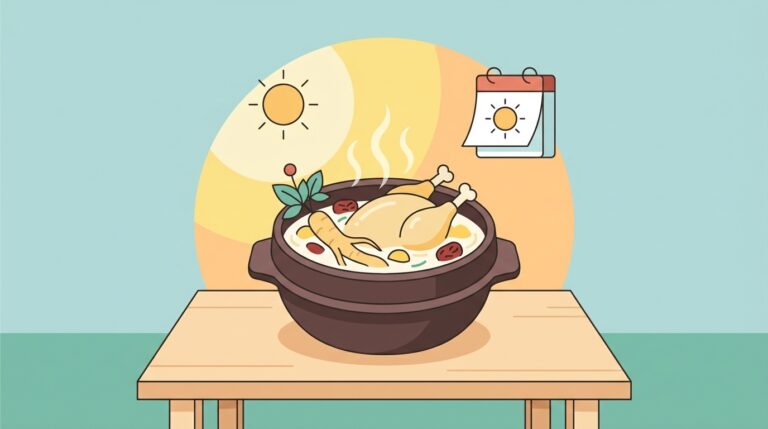
Imagine this: It’s mid-July in Seoul. The temperature is hitting 35°C (95°F), the humidity is at 80%, and the asphalt feels like it’s melting your sneakers. You’re walking down the street, desperately looking for an air-conditioned cafe. But then, you see a massive line of people outside a traditional restaurant. They are sweating, fanning themselves, and waiting for… boiling hot chicken soup?
If you’ve ever watched a K-Drama or lived in Korea during the summer, you’ve probably seen this exact scene. Your Korean friends might suddenly grab you on a scorching hot day and insist on eating Samgyetang (삼계탕, ginseng chicken soup). Your brain is screaming, “Why are we eating boiling soup when I’m already sweating to death?!”
Welcome to Boknal (복날), the hottest days of the Korean summer.
Understanding this unique culture isn’t just about food; it’s a masterclass in Korean psychology, traditional medicine, and communal bonding. If you know how to react when a boiling bowl is placed in front of you, you won’t just be an expat—you’ll be treated as a true insider. Let’s dive into the fascinating world of Korean summer survival!
Phase 2: Core Expressions Deep Dive
Here are the top three expressions you absolutely need when navigating a Korean summer and surviving a Samgyetang dinner.
1. 이열치열 (Fighting fire with fire)
- Pronunciation: [I-yeol-chi-yeol] (Sounds like: Eee-yul-chee-yul)
- Meaning: (Literal) Heat controls heat. / (Real nuance) Fighting fire with fire; overcoming the summer heat by eating hot food.
- K-Culture Moment: You’ll hear this as a proud battle cry from a middle-aged Korean man (Ahjussi) right before he dives into a bubbling stone pot of soup on a sweltering August day.
- Editor’s Insight: This is a traditional philosophy based on Eastern medicine. The idea is that in summer, your blood rushes to your skin to cool you down, leaving your internal organs cold and weak. Eating hot, nutritious food warms your core and gives you energy.
- Situation Spectrum:
- Casual with friends: ✅
- Semi-formal with coworkers: ✅
- Formal with elders: ✅ (Elders will love that you know this four-character idiom!)
- 🤔 Think About It: Does your culture have a counter-intuitive way to deal with extreme weather? How do people react when they hear about the Korean method of eating boiling soup in summer?
2. 아, 시원하다! (Ah, that hits the spot!)
- Pronunciation: [A, si-won-ha-da!] (Sounds like: Ah, shee-won-ha-da!)
- Meaning: (Literal) Ah, it’s cool/refreshing! / (Real nuance) Ah, this hot soup is clearing my stomach and making my body feel relieved!
- K-Culture Moment: In K-Dramas, whenever a character drinks hot soup, eats spicy ramen, or steps into a boiling hot sauna, they let out a deep sigh and say, “Ah, siwonhada!” For a foreigner, this is the most confusing moment ever.
- Editor’s Insight: This word doesn’t just mean temperature-cold. It means “feeling unblocked, relieved, or cleansed.” When you sweat out the toxins while eating hot soup, your body feels refreshed.
- Situation Spectrum:
- Casual with friends: ✅
- Semi-formal with coworkers: ✅
- Formal with elders: ⚠️ (Say “시원합니다” [siwonhamnida] instead to be polite)
- 🤔 Think About It: Why do you think Koreans use the same word for “a cool ocean breeze” and “a boiling pot of garlic soup”? What does this say about the Korean concept of physical relief?
3. 몸보신 좀 해야겠어요 (I need to nourish my body)
- Pronunciation: [Mom-bo-sin jom hae-ya-ge-sseo-yo]
- Meaning: (Literal) I guess I need to do some body preservation. / (Real nuance) I’m exhausted from the heat, I need to eat some highly nutritious food to get my energy back.
- K-Culture Moment: Coworkers sighing at their desks around 11:30 AM in July, trying to decide what to eat for lunch. Someone will inevitably say this, which is the universal cue to go eat Samgyetang or eel.
- Editor’s Insight: Koreans are very serious about food as medicine. “Mombosin” foods are usually high in protein, cooked with medicinal herbs (like ginseng and jujube), and served very hot.
- Situation Spectrum:
- Casual with friends: ✅ (몸보신 좀 하자!)
- Semi-formal with coworkers: ✅
- Formal with elders: ✅
- 🤔 Think About It: How often do you actively think about “nourishing” your body with specific traditional foods when you feel tired? Is food viewed mainly as fuel, pleasure, or medicine in your country?
Phase 3: Textbook vs. Real Korean
Let’s see how native speakers actually talk about the summer heat and food.
| Situation | 📖 Textbook Korean | 🗣️ Real Korean | 💡 Why the difference? |
|---|---|---|---|
| Expressing extreme heat | 너무 더워요. (It’s very hot.) | 쪄 죽겠어요. (I’m going to steam to death.) | Koreans love dramatic, expressive language. Extreme weather calls for extreme verbs! |
| Reacting to a deep, rich soup | 국물이 맛있어요. (The broth is delicious.) | 국물이 끝내줘요! / 진국이네요. (The broth is killer! / It’s a real deep broth.) | Commending the depth and effort of boiling bones/herbs for hours is the ultimate compliment. |
| Suggesting lunch | 점심 먹으러 가요. (Let’s go eat lunch.) | 오늘 초복인데 삼계탕 고? (Today is Chobok, Samgyetang go?) | Slang. Adding “고” (Go) at the end of a noun means “Are you down to do this?” |
Phase 4: Cultural Context — K-Culture Deep Dive
4-1. Non-Verbal Cues (The “Ahjussi” Sound)
When eating Samgyetang, it’s culturally acceptable—even expected—to make a little noise. Slurping the hot broth slightly, letting out a deep sigh of satisfaction (“Kkya~” or “Aaaa”), and wiping the sweat from your forehead with a napkin are all signs that you are truly enjoying the meal. If you eat it quietly without breaking a sweat, the restaurant owner might worry it wasn’t hot enough!
4-2. K-Food Connection: The Three “Boknal” Days
Koreans don’t just eat Samgyetang randomly. There are three specific days in the lunar calendar called Boknal (복날)—Chobok (First dog day), Jungbok (Middle), and Malbok (Last).
On these days, the entire country collectively decides to eat chicken. Delivery apps crash, poultry sales skyrocket, and long lines form everywhere. It’s a massive, unspoken national event. Eating Samgyetang on these days is an act of communal resilience—we are all surviving this brutal summer together!
Phase 5: Real-Life Roleplay Scenario
Setting: It’s a Friday at 12:00 PM. The sun is beating down on Seoul. You are standing in front of a famous Samgyetang restaurant in Bukchon Hanok Village. The line is 20 people deep.
Characters:
– YOU: An expat working in Korea. You are currently sweating through your shirt.
– Minsu (32, your Korean coworker): Energetic, always knows the best local restaurants.
Dialogue:
Minsu: 으아, 오늘 진짜 쪄 죽겠네요! 🥵
(Eua, oneul jinjja jjyeo jukgenneyo!)
[Wow, I feel like I’m going to steam to death today!]
YOU: 맞아요. 에어컨 있는 곳으로 도망가고 싶어요.
(Majayo. E-eo-keon inneun goseuro domanggago sipeoyo.)
[Right. I want to escape to somewhere with AC.]
Minsu: 에이, 오늘 초복이잖아요! 몸보신 제대로 해야죠.
(Ei, oneul chobogijanayo! Mombosin jedaero haeyajyo.)
[Hey, it’s Chobok today! We need to properly nourish our bodies.]
YOU: 그래서 이 더운 날에 뜨거운 삼계탕을 먹는 거예요?
(Geuraeseo i deoun nare tteugeoun samgyetangeul meongneun geoyeyo?)
[So that’s why we’re eating hot Samgyetang on this hot day?]
Minsu: 당연하죠! 한국에서는 이열치열이에요.
(Dangyeonhajyo! Hangugeseoneun iyeolchiyeorieyo.)
[Of course! In Korea, it’s fighting fire with fire.]
(🎭 Stage Direction: After 20 minutes, you both finally sit down inside. The bubbling stone pots arrive.)
Minsu: 와, 국물 진짜 진해 보인다. 먼저 한 입 드셔보세요!
(Wa, gungmul jinjja jinhae boinda. Meonjeo han ip deusyeoboseyo!)
[Wow, the broth looks really deep. Try a bite first!]
YOU: 조심해야겠어요. 너무 뜨거워요!
(Josimhaeyagesseoyo. Neomu tteugeowoyo!)
[I should be careful. It’s too hot!]
Minsu: 자, 여기 인삼주도 한 잔 받으세요. 삼계탕 먹기 전에 마시는 거예요. 🍶
(Ja, yeogi insamjudo han jan badeuseyo. Samgyetang meokgi jeone masineun geoyeyo.)
[Here, take a glass of ginseng wine too. You drink it before eating the Samgyetang.]
🔀 YOUR TURN! How do you reply?
– A) “아, 저는 술 안 마셔요. 그냥 국물에 부어주세요.” (Oh, I don’t drink. Just pour it into the soup.)
– B) “이열치열! 원샷 할게요!” (Fighting fire with fire! I’ll do a one-shot!)
– C) “인삼주요? 너무 쓴 거 아니에요?” (Ginseng wine? Isn’t it too bitter?)✅ Best Choice: A — Surprise! In many traditional Samgyetang restaurants, they give you a tiny shot glass of ginseng wine. While some older folks drink it like a shot, many Koreans actually pour the wine directly into the boiling soup! It cooks off the alcohol and gets rid of any chicken smell while enhancing the herbal flavor.
⚠️ Choice B Analysis: Doing a “one-shot” of hard liquor in the middle of a scorching workday lunch might make your boss raise an eyebrow!
YOU: 아, 저는 국물에 부어서 먹어볼게요!
(A, jeoneun gungmure bueoseo meogeobolgeyo!)
[Ah, I’ll try pouring it into the broth and eating it!]
Minsu: 오~ 역시 먹을 줄 아시네요!
(O~ yeoksi meogeul jul asineyo!)
[Oh~ as expected, you know how to eat!]
🎭 Bonus K-Food Roleplay (At the Restaurant)
Need more side dishes? Here’s how to ask gracefully:
YOU: 사장님, 여기 깍두기 좀 더 주시겠어요?
(Sajangnim, yeogi kkakdugi jom deo jusigesseoyo?)
[Boss, could we get some more diced radish kimchi here?]
Staff: 네~ 소금 부족하시면 테이블 옆에 있어요!
(Ne~ sogeum bujokhasimyeon teibeul yeope isseoyo!)
[Yes~ if you lack salt, it’s next to the table!]
YOU: 감사합니다! 아, 그리고 앞치마 하나만 주세요.
(Gamsahamnida! A, geurigo apchima hanaman juseyo.)
[Thank you! Ah, and please give me one apron.]
Phase 6: 10-Second Shadowing Drill
Practice this sentence so you can sound like a true local at the lunch table!
😊 와~ / 국물이 끝내줘요! / 속이 쫙~ / 풀리는 기분이에요!
(Wa~ / gungmuri kkeunnaejwoyo! / sogi jjak~ / pullineun gibunieyo!)
Wow~ / the broth is amazing! / I feel like my insides are completely / relieved!
(Tip: Emphasize “쫙~” (jjak) to really convey that feeling of total refreshment!)
Phase 7: K-Culture Mini Dictionary
| Korean | Romanization | English | Contextual Explanation |
|---|---|---|---|
| 복날 | Boknal | Dog Days of Summer | The three hottest days in the lunar calendar (Chobok, Jungbok, Malbok). |
| 이열치열 | Iyeolchiyeol | Fighting heat with heat | The traditional philosophy of eating hot food in summer to balance internal body temperature. |
| 눈치 | Nunchi | Social awareness / Tact | Knowing when your coworkers are too hot and tired, and tactfully suggesting a refreshing lunch. |
| 인삼주 | Insam-ju | Ginseng liquor | A small shot of herbal wine served with Samgyetang. Can be drunk or poured into the soup. |
| 뚝배기 | Ttukbaegi | Earthenware pot | The heavy stone bowl Samgyetang is served in, which keeps the soup literally boiling at the table. |
Phase 8: Traveler Survival Kit
If you are traveling in Korea during July or August, these phrases are lifesavers!
🆘 Survival Phrases for Summer
– 🇰🇷 “에어컨 좀 세게 틀어주시겠어요?” (E-eo-keon jom sege teureojusigesseoyo?)
– 🗣️ Meaning: Could you turn up the air conditioner a bit stronger?
– 🇰🇷 “이거 포장되나요?” (Igeo pojangdoenayo?)
– 🗣️ Meaning: Can I get this to go? (If it’s too hot to eat at the restaurant)
– 🇰🇷 “얼음 컵 하나 주세요.” (Eoreum keop hana juseyo.)
– 🗣️ Meaning: Please give me an ice cup. (Vital for buying iced coffee at convenience stores!)📌 Editor’s Travel Note
– Waiting in Line: On Boknal, popular places like Tosokchon or Korea Samgyetang will have crazy lines. Download the “CatchTable” (캐치테이블) or “Tableling” (테이블링) apps. Many restaurants use these kiosk systems to manage queues virtually!
– Eating Etiquette: The chicken in Samgyetang comes whole. Use your chopsticks to pull the meat apart (it’s so tender it will fall off the bone) and dip it lightly in the salt provided on your table.
Phase 9: Critical Thinking — “One Step Deeper”
Food & Identity: The Shared Endurance
🧠 Think Deeper:
Why do Koreans make such a big deal out of eating exactly the same food on the exact same three days of the year? Eating Samgyetang on Boknal is more than just a dietary choice; it’s a profound expression of Jeong (정 – collective bonding).By standing in a hot line together, sweating over boiling pots together, and enduring the brutal summer heat together, Koreans reinforce their sense of community. The shared phrase “이열치열” isn’t just about the food; it’s a collective mindset of overcoming hardship through endurance and unity. It’s a culinary ritual that says, “This summer is tough, but we will get through it together.”
💬 Your Turn: Does your culture have a specific food that everyone eats at the same time for a cultural or seasonal reason? Share it in the comments!
Phase 10: FAQ & Avoiding Misunderstandings
Q: Do I eat the ginseng and the date (jujube) inside the chicken?
A: Yes and no! You can eat the ginseng, but many Koreans leave the jujube (대추). There’s an old wives’ tale that the jujube absorbs all the bad toxins from the chicken, though chefs say it’s perfectly safe to eat. It’s up to you!
Q: Should I put rice in the soup right away?
A: Wait! Samgyetang chicken is actually stuffed with sticky rice (찹쌀) inside its belly. Eat the chicken meat first, then use your spoon to break open the chicken to release the delicious sticky rice into the broth to make a porridge.
❌ Common Mistake:
Taking a bite of boiling hot soup and saying “시원하다” (It’s cool/refreshing) when talking to a non-Korean speaker, expecting them to understand.
✅ Do this instead:
Remember that “시원하다” in the context of hot food refers to the internal feeling of relief, not the physical temperature. Don’t use it to describe ice cream!
Phase 11: Summary & Action Items
One-Liner Summary: On the hottest days of summer (Boknal), Koreans fight fire with fire (이열치열) by eating boiling Samgyetang to nourish their bodies (몸보신).
Action Mission:
– 🥉 Bronze: Say “아, 시원하다!” out loud the next time you take a sip of hot tea or soup.
– 🥈 Silver: Leave a comment below using the word “이열치열” to describe how you handle heat.
– 🥇 Gold: Go to a Korean restaurant, order a hot stew or soup, and tell the waiter “국물이 끝내줘요!” (The broth is amazing!).
K-Culture Mission:
Open YouTube and search for “K-Drama Samgyetang scene” or “BTS eating Samgyetang.” Notice how they pull the chicken apart and how they react to the hot broth!
Phase 12: Quiz — Interactive Challenge
1. Fill in the Blank:
Your coworker says, “It’s so hot today, I have no energy.” You want to suggest eating highly nutritious food.
“우리 오늘 점심에 ________ 좀 해야겠어요!”
(Hint: It means to nourish the body)
2. True or False – K-Culture Edition:
In Korea, it is considered rude to sweat or make a satisfied sighing sound while eating Samgyetang. (T/F)
3. Situational Judgment:
You finally take your first sip of the boiling, rich Samgyetang broth. What is the most culturally authentic thing to say to impress your Korean friends?
– A) 너무 더워요. (It’s too hot.)
– B) 아, 시원하다! (Ah, it’s refreshing/relieving!)
– C) 달콤하네요. (It’s sweet.)
(Answers: 1. 몸보신, 2. False – It shows you are enjoying it!, 3. B)
Frequently Asked Questions (FAQ)
Q: What does "이열치열 (Fighting fire with fire)" mean in Korean and how do you pronounce it?
A: In Korean, "이열치열 (Fighting fire with fire)" is pronounced [I-yeol-chi-yeol] and means: (Literal) Heat controls heat. / (Real nuance) Fighting fire with fire; overcoming the summer heat by eating hot food.
Q: What does "아, 시원하다! (Ah, that hits the spot!)" mean in Korean and how do you pronounce it?
A: In Korean, "아, 시원하다! (Ah, that hits the spot!)" is pronounced [A, si-won-ha-da!] and means: (Literal) Ah, it's cool/refreshing! / (Real nuance) Ah, this hot soup is clearing my stomach and making my body feel relieved!
Q: What does "몸보신 좀 해야겠어요 (I need to nourish my body)" mean in Korean and how do you pronounce it?
A: In Korean, "몸보신 좀 해야겠어요 (I need to nourish my body)" is pronounced [Mom-bo-sin jom hae-ya-ge-sseo-yo] and means: (Literal) I guess I need to do some body preservation. / (Real nuance) I'm exhausted from the heat, I need to eat some highly nutritious food to get my energy back.







