

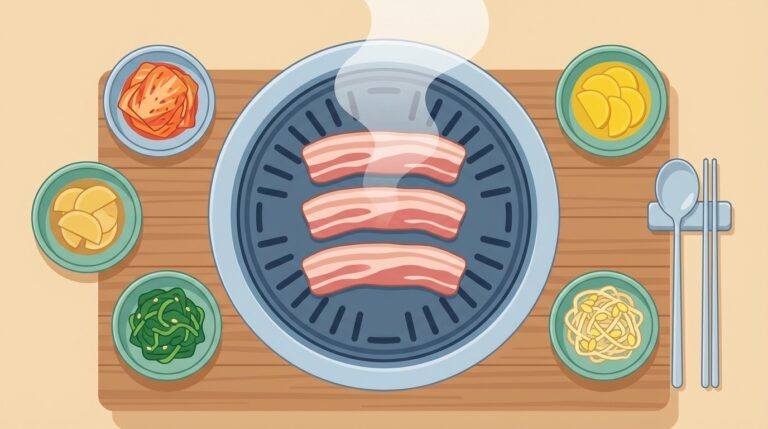
Phase 1: The Empathy Cold Open
Hello there! This is your Daily Hangul Editor.
Picture this: You are watching a classic K-Drama. The male lead, sporting a fresh buzz cut and a crisp military uniform, sits at a bustling K-BBQ restaurant. He looks at the sizzling pork belly like it’s the most precious thing in the world. His friend pours him a shot of Soju, pats him on the back, and says something with a deeply sympathetic look. The subtitles simply read, “Good job.”
But was it really just a simple “Good job”?
If you have Korean male friends, or if you plan to make some, you will inevitably encounter this cultural milestone: Military Leave (휴가, Hyuga). In South Korea, mandatory military service is a shared rite of passage. When a soldier comes out on leave—especially his very first leave—it’s a huge deal. Friends and family drop everything to feed him, comfort him, and make him feel appreciated.
If you only know textbook Korean, you might end up sounding like a commanding officer. But if you know the real expressions, you won’t just be a foreign friend; you’ll be the ultimate insider who truly understands the Korean soul. Let’s dive into how to treat a Korean soldier on leave like a true local!
Phase 2: Core Expressions Deep Dive
Here are the top phrases you need to show your empathy and hospitality.
1. 고생 많았어 (You’ve been through a lot / You worked hard)
- Pronunciation: [go-saeng man-ass-eo] -> Sounds like “Go-sang man-ah-sso”
- Meaning: Literal: “You had a lot of hardship.” / Real nuance: “I acknowledge your suffering and hard work. You did great.”
- K-Culture Moment: This is the ultimate phrase of empathy in Korea. When a soldier drops his heavy duffel bag and sits down, this is the very first thing you say while giving him a warm pat on the shoulder.
- Editor’s Insight: Forget the dictionary definition of “Good job.” The word 고생 (gosaeng) carries a deep cultural weight. It means acknowledging someone’s physical and mental fatigue. It’s not about achieving a goal; it’s about surviving a tough time.
- Situation Spectrum:
- Close friends (Casual): ✅ (고생 많았어 / 고생했다)
- Co-workers (Semi-formal): ⚠️ (Use 요: 고생 많으셨어요)
- Elders/Superiors (Formal): 🚫 (Do not use this to elders; it sounds condescending.)
- 🤔 Think About It: Why does Korean have so many phrases acknowledging another person’s suffering (like 수고 and 고생)? What does this tell us about the collective nature of Korean society?
2. 먹고 싶은 거 다 말해, 내가 살게 (Tell me everything you want to eat, it’s on me)
- Pronunciation: [meok-go si-peun geo da mal-hae, nae-ga sal-ge]
- Meaning: Literal: “Say everything you want to eat, I will buy.” / Real nuance: “Today is your day. Order whatever you crave, I’m treating you.”
- K-Culture Moment: Soldiers eat base food (짬밥) for months. When they come out, they crave “civilian food” (사제 음식). In K-Dramas, you always see soldiers stuffing their faces with fried chicken, pizza, or BBQ. As a friend, treating them to a meal is an unwritten law.
- Editor’s Insight: The phrase “내가 살게” (I’ll buy/treat) is a magical key to Korean relationships. It shows affection and takes the financial burden off the soldier, who receives a very modest military salary.
- Situation Spectrum:
- Close friends (Casual): ✅
- Co-workers (Semi-formal): ⚠️ (내가 살게요 / 제가 살게요)
- Elders/Superiors (Formal): 🚫 (You wouldn’t usually say this to a superior, though you might offer to pay formally: 제가 대접하겠습니다.)
- 🤔 Think About It: In your culture, do friends usually split the bill (Dutch pay) even for special occasions, or is there a strong “treating” culture like in Korea?
3. 언제 복귀해? (When do you return to base?)
- Pronunciation: [eon-je bok-gwi-hae?] -> Sounds like “Uhn-jeh bo-kki-hae?”
- Meaning: Literal/Real nuance: “When do you have to go back to the military base?”
- K-Culture Moment: This is the most dreaded question for any soldier on leave. In K-Pop fandoms, fans track the exact discharge date of their idols, but for regular leaves, soldiers constantly count down the hours until they must return (복귀).
- Editor’s Insight: Ask this with a tone of sympathy, not excitement! Time flies incredibly fast for a soldier on leave. Knowing their return time helps you plan the day so you can drop them off at the station on time.
- Situation Spectrum:
- Close friends (Casual): ✅
- Co-workers (Semi-formal): ⚠️ (언제 복귀하세요?)
- Elders/Superiors (Formal): 🚫
Phase 3: Textbook vs. Real Korean
Let’s see how textbook Korean compares to the vibrant, emotional language spoken on the streets of Hongdae.
| Situation | 📖 Textbook Korean | 🗣️ Real Korean | 💡 Why the difference? |
|---|---|---|---|
| Greeting them | 군 복무를 하느라 수고하셨습니다. (Thank you for your service.) | 아유, 고생했다! 얼굴이 반쪽이 됐네. (Man, you’ve suffered! You lost so much weight.) | Textbook is too formal. Real Korean emphasizes emotional empathy and noticing their physical changes. |
| Offering food | 무엇을 먹고 싶습니까? (What would you like to eat?) | 야, 사제 음식 당기는 거 다 말해. (Hey, tell me whatever civilian food you’re craving.) | The slang “사제 음식” (civilian food) shows you deeply understand their current desires. |
| Saying goodbye | 조심히 가세요. (Go carefully.) | 몸 건강히 잘 들어가라! (Go back well and stay healthy!) | Health (건강) is the absolute priority when sending someone back to a physically demanding environment. |
Bottom Note: For B2 learners, using words like 사제 음식 (saje eumsik – civilian food) or 짬밥 (jjambap – military food) will instantly make Koreans’ jaws drop. It shows you don’t just know the language; you know the life.
Phase 4: Cultural Context — K-Culture Deep Dive
4-1. Non-Verbal Nunchi (눈치) for Soldiers
When a soldier is eating, do not rush them. Korean food culture is fast-paced, but for a soldier on leave, let them savor the meal. Use your Nunchi (situational awareness): continuously grill the meat for them, push the best side dishes toward their side of the table, and keep their water or Soju glass full. It’s an act of silent, profound care.
4-2. The K-Food Connection: The Holy Trinity of Leave Food
Why does every Korean soldier want K-BBQ (Samgyeopsal), Fried Chicken, or a hearty home-cooked stew?
Inside the military, meals are strictly rationed and heavily institutionalized. Eating outside is a symbol of freedom. When you take a soldier out, you aren’t just feeding them calories; you are feeding them a taste of normal life. This is why you will often see older restaurant owners (이모님 – Aunties) secretly giving extra portions (서비스 – service) when they see a young man in a military uniform. It’s a beautiful reflection of Korean Jeong (정 – deep communal affection).
Critical Point: Why is food so tied to Korean identity? Historically, Korea went through periods of poverty and war. Offering a full, warm meal is the ultimate expression of love and worry.
Phase 5: Practical Roleplay Scenario
Setting: Friday night, 7:00 PM. A smoky, bustling Samgyeopsal (pork belly) restaurant near Hongdae. The sound of sizzling meat and clinking glasses fills the air.
Characters:
– YOU: An expat living in Korea. You are treating your Korean friend who just came out for his first military leave.
– Min-su (22): Your Korean friend. He is wearing casual clothes but still has his very short military haircut. He looks incredibly happy but slightly tired.
Dialogue:
YOU: 민수야, 진짜 오랜만이다! 고생 많았어!
(Min-su-ya, jinjja oraenmanida! gosaeng man-ass-eo!)
[Min-su, it’s been so long! You’ve been through a lot!]
Min-su: 와, 진짜 밖의 공기 너무 좋다. 고마워, 여기까지 와줘서.
(Wa, jinjja bakk-ui gong-gi neomu jota. gomawo, yeogikkaji wajwoseo.)
[Wow, the outside air is so good. Thanks for coming all this way.]
YOU: 에이, 당연하지! 첫 휴가인데. 배고프지? 먹고 싶은 거 다 골라.
(Ei, dang-yeonhaji! cheot hyuga-inde. baegopeuji? meokgo sipeun geo da golla.)
[Hey, of course! It’s your first leave. You’re hungry, right? Pick whatever you want to eat.]
Min-su: 나 진짜 삼겹살 너무 먹고 싶었어. 군대 짬밥은 고기가 너무 적어.
(Na jinjja samgyeopsal neomu meokgo sipeosseo. gundae jjambabeun gogiga neomu jeogeo.)
[I really wanted to eat Samgyeopsal so much. The military food doesn’t have enough meat.]
YOU: 그래? 그럼 오늘 내가 삼겹살 쏜다! 이모님, 여기 삼겹살 4인분 주세요!
(Geurae? geureom oneul naega samgyeopsal ssonda! imonim, yeogi samgyeopsal sa-inbun juseyo!)
[Really? Then today I’m treating you to Samgyeopsal! Auntie, 4 servings of Samgyeopsal here, please!]
(🎭 Stage Direction: You confidently start grilling the meat for Min-su.)
Min-su: 야, 고마워. 근데 나 월급 모아둔 거 있어서 오늘 내가 살게!
(Ya, gomawo. geunde na wolgeup moadun geo isseoseo oneul naega salge!)
[Hey, thanks. But I saved up some of my military salary, so I’ll buy today!]
🔀 Your Turn! How should you respond?
– A) “그래? 그럼 네가 사! 잘 먹을게!” (Really? Then you buy! Thanks for the food!)
– B) “무슨 소리야! 첫 휴가 나온 군인 돈을 어떻게 써. 무조건 내가 사!” (What are you talking about! How can I let a soldier on his first leave spend money. I’m definitely paying!)
– C) “더치페이 하자!” (Let’s split the bill!)✅ Best Choice: B — Why? In Korean culture, it is practically a crime to let a soldier pay on their first leave! Their salary is very small. Assertively offering to pay (내가 사!) shows you are a true, caring friend.
⚠️ Choice A & C Analysis: While logical in Western cultures, accepting his offer or suggesting Dutch pay here will make you look slightly cold or unaware of the cultural context. Let him treat you after he finishes his entire military service!
YOU: 무슨 소리야! 넌 돈 아껴. 오늘은 무조건 내가 사!
(Museun soriya! neon don akkyeo. oneureun mujogeon naega sa!)
[What are you talking about! Save your money. Today I’m definitely paying!]
Min-su: 감동이다… 진짜 잘 먹을게!
(Gamdongida… jinjja jal meogeulge!)
[I’m touched… I will really eat well!]
YOU: 많이 먹어. 근데 언제 복귀해?
(Mani meogeo. geunde eonje bokgwihae?)
[Eat a lot. By the way, when do you return to base?]
Min-su: 모레 저녁 8시… 생각만 해도 우울하다.
(More jeonyeok yeodeolsi… saenggangman haedo uulhada.)
[The day after tomorrow at 8 PM… Just thinking about it makes me depressed.]
Phase 6: 10-Second Shadowing Drill
Let’s practice the ultimate welcoming combo. Say it with warmth and a big smile!
😊 야, / 진짜 고생 많았다! / 많이 먹어, / 오늘 내가 쏠게!
(Ya, / jinjja gosaeng manatda! / mani meogeo, / oneul naega ssolge!)
Pro Tip: Pause briefly at the slashes (/). Put the emphasis on “진짜” (really) and “내가” (I). It makes you sound confident and generous!
Phase 7: K-Culture Mini Dictionary
| 한국어 (Korean) | Romanization | English Meaning | Cultural Context |
|---|---|---|---|
| 휴가 | hyuga | Leave / Vacation | For soldiers, this is the most precious time. They often count the days until their next hyuga. |
| 첫 휴가 | cheot hyuga | First leave | Usually happens about 3-4 months after enlisting. Highly emotional milestone. |
| 전역 | jeonyeok | Discharge / End of service | The glorious day a soldier officially finishes their mandatory service. |
| 피엑스 (PX) | pi-ek-seu | Post Exchange (Base Store) | The military convenience store where soldiers buy cheap snacks and cosmetics. |
| 사제 음식 | saje eumsik | Civilian food | Slang for any food made outside the military. Soldiers dream about this. |
| 짬밥 | jjambap | Military rations | Slang for food served in the military mess hall. Usually used negatively. |
Phase 8: Traveler’s Survival Kit
If you travel around South Korea, especially on weekends, you will see train stations (like Seoul Station or Yongsan Station) and bus terminals flooded with young men in military uniforms. They are either heading home for leave or tragically heading back to base.
🆘 Station Survival Phrases (When navigating around busy terminals)
– 🇰🇷 “서울역 가는 기차표 있나요?” (seoul-yeok ganeun gichapyo innayo? – Are there train tickets to Seoul Station?)
– 🇰🇷 “이 기차 부산행 맞나요?” (i gicha busanhaeng mannayo? – Is this train heading to Busan?)
– 🇰🇷 “실례합니다, 지나갈게요.” (sillyehamnida, jinagalgeyo. – Excuse me, coming through.)
– 📍 Where to use: KTX stations, Express Bus Terminals.📌 Editor’s Travel Note
– Discounts: If you travel with a Korean soldier friend, they often get massive discounts on KTX tickets or movies!
– Respect: You might see soldiers carrying very heavy green duffel bags. Be mindful of space on crowded subways.
Phase 9: Critical Thinking — “One Step Deeper”
Language & Power: The Vocabulary of Shared Hardship
In many Western cultures, military service is a chosen career, often met with formal phrases like “Thank you for your service.” However, in South Korea, conscription is mandatory for all able-bodied men, usually interrupting their college years or early twenties. Because nearly every Korean family has a son, brother, or father who has served, the military is viewed as a collective, inevitable hardship.
This is why formal congratulations feel out of place for a short leave. Instead, the language shifts to deep empathy. Words like 고생 (gosaeng – suffering/hardship) and actions like buying them warm food reflect a societal understanding: “You are doing something difficult that we all must endure, and I feel your pain.” The language strips away formal power dynamics and brings people together through the solidarity of shared struggle.
💬 Your Turn: Does your culture have a mandatory service or a shared coming-of-age hardship? How do people use language to comfort each other during those times? Share your thoughts in the comments!
Phase 10: FAQ & Mistake Prevention
Q: Can I ask them about their military rank or what they do exactly?
A: Yes, it’s totally fine to ask! You can ask “지금 계급이 뭐야?” (What is your rank right now?). However, keep in mind that some soldiers might not want to talk about the military the whole time. They want to escape it for a few days!
Q: Should I salute them as a joke?
A: You can, and they might laugh! The standard Korean military salute is accompanied by the word “충성!” (Chung-seong – Loyalty!). Doing this playfully is a great icebreaker.
❌ Common Mistake #1: Saying “축하해!” (Congratulations!) when they come out for a short leave.
✅ Do this instead: Save “축하해” for their absolute final discharge (전역, jeonyeok). For a short leave, always use “고생 많았어” (You worked hard / suffered).❌ Common Mistake #2: Making them pay for their own food on their first leave.
✅ Do this instead: Insist on paying with “내가 살게!” (I’ll treat!). They will remember your kindness forever.
Phase 11: Summary & Action Items
One-Liner Summary: When treating a Korean soldier on leave, ditch the formal textbooks, feed them well, and show deep empathy with the magic phrase “고생 많았어!”
Action Mission:
– 🥉 Bronze (Solo): Stand in front of a mirror and practice saying “고생 많았어, 내가 살게!” with a warm, caring facial expression.
– 🥈 Silver (Online): Find a YouTube vlog of a Korean soldier’s “첫 휴가” (First Leave). Leave a comment in Korean: “군 복무 파이팅! 고생 많으십니다!”
– 🥇 Gold (Real World): If you have a Korean friend currently serving, send them a message: “휴가 나오면 연락해, 맛있는 거 사줄게!” (Call me when you’re on leave, I’ll buy you something delicious!)
K-Culture Special Mission:
Next time you watch a K-Drama like D.P. or Crash Landing on You, pay close attention to the scenes where soldiers eat. Observe the Nunchi and the silent affection shown through the sharing of food. You’ll see the culture in a whole new light!
Phase 12: Quiz — Interactive Challenge
Let’s test your Nunchi and cultural knowledge!
1. Situational Judgment: Your friend Min-su just walked into the cafe for his first military leave. He looks tired but happy. What is the BEST first thing to say?
– A) 군 복무를 하느라 수고하셨습니다.
– B) 언제 복귀해?
– C) 민수야, 진짜 고생 많았다!
2. Fill in the Blank:
Soldiers get tired of base food. You want to ask your friend what civilian food he wants.
“야, ( ____ ) 음식 먹고 싶은 거 다 말해!”
– A) 사제 (Saje)
– B) 짬밥 (Jjambap)
– C) 교과서 (Gyogwaseo)
3. True or False – K-Culture Edition:
It is culturally expected to let a Korean soldier pay for his own meal during his first military leave to teach him independence. ( T / F )
👀 Click here for the answers!
1. Answer: C. Option A is too robotic and textbook-like. Option B is a terrible first question—don’t remind him of going back before he even sits down! C is warm and perfect.
2. Answer: A (사제). Saje eumsik means civilian/outside food. Jjambap is the military food he wants to escape!
3. Answer: False. It is an unwritten cultural rule that friends, family, or seniors will pay for a soldier’s meal, especially on their first leave, as a sign of empathy and support.
How did you do? Ready to treat your Korean friend to some Samgyeopsal? Let me know in the comments below!
Frequently Asked Questions (FAQ)
Q: What does "고생 많았어 (You've been through a lot / You worked hard)" mean in Korean and how do you pronounce it?
A: In Korean, "고생 많았어 (You've been through a lot / You worked hard)" is pronounced [go-saeng man-ass-eo] and means: Literal: "You had a lot of hardship." / Real nuance: "I acknowledge your suffering and hard work. You did great."
Q: What does "먹고 싶은 거 다 말해, 내가 살게 (Tell me everything you want to eat, it's on me)" mean in Korean and how do you pronounce it?
A: In Korean, "먹고 싶은 거 다 말해, 내가 살게 (Tell me everything you want to eat, it's on me)" is pronounced [meok-go si-peun geo da mal-hae, nae-ga sal-ge] and means: Literal: "Say everything you want to eat, I will buy." / Real nuance: "Today is your day. Order whatever you crave, I'm treating you."
Q: What does "언제 복귀해? (When do you return to base?)" mean in Korean and how do you pronounce it?
A: In Korean, "언제 복귀해? (When do you return to base?)" is pronounced [eon-je bok-gwi-hae?] and means: Literal/Real nuance: "When do you have to go back to the military base?"







