

Phase 1: Empathy & K-Culture Cold Open
Hello! I’m your Daily Hangul Editor.
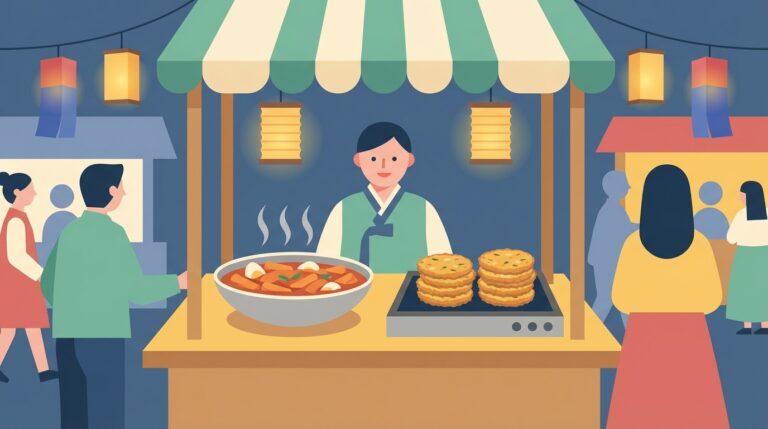
Picture this: It’s a rainy Friday evening in Seoul. You’re walking through the bustling alleys of Gwangjang Market (광장시장). The sizzling sound of oil hitting the griddle echoes through the air, and the rich, savory aroma of mung bean pancakes (Bindaetteok) mixed with the spicy kick of Tteokbokki makes your mouth water. You’ve seen this exact K-Drama scene a hundred times—the protagonist standing under a cozy tent, sharing a plate of vibrant red rice cakes and crispy pancakes with a friend, laughing over a bowl of Makgeolli.
Now, you step up to the stall. You know the words for Tteokbokki and Bindaetteok. But how do you ask the vendor to mix your fried snacks into the spicy sauce just like the locals do? How do you compliment the food to earn that legendary Korean Jeong (정) and maybe score an extra dumpling?
If you’re at a C1 level, you don’t just want to order food; you want to interact. You want to feel the heartbeat of the market. Let’s upgrade your market survival Korean from textbook-stiff to perfectly street-smart.
This guide is based on real questions from advanced learners who wanted to go beyond “Hello, give me this please,” and truly connect with the amazing Aunties running these stalls.
Phase 2: Deep Dive into Key Expressions
To sound like a local foodie, you need to master the art of market vocabulary. Let’s look at three essential expressions.
1. 이모님, 튀김은 떡볶이 국물에 버무려 주세요.
- Pronunciation: [Imo-nim, twigim-eun tteokbokki gungmul-e beomuryeo juseyo] / ‘beomuryeo’ sounds like the bubbling sound of a thick stew.
- Meaning: Literal: Auntie, please coat the fried food in the tteokbokki broth. / Real Nuance: Auntie, please mix the fried snacks in the spicy tteokbokki sauce.
- K-Culture Moment: In Korea, fried food (twigim) or blood sausage (sundae) is rarely eaten dry. Dipping it is fine, but asking the vendor to toss and mix it entirely in the thick red sauce before serving is the ultimate insider move.
- Editor’s Insight: Forget the word “섞다” (to mix). The verb “버무리다” (to toss/coat evenly) is what native speakers use for dishes like kimchi or street food. It shows you deeply understand Korean culinary texture.
- Situation Spectrum:
- Casual Market Stalls: ✅
- Formal Restaurants: 🚫
- 🤔 Think About It: Why do Koreans love mixing different dishes into one sauce (like the Bibim culture)? Does your culture prefer keeping food items strictly separated on the plate?
2. 겉바속촉으로 구워 주실 수 있나요?
- Pronunciation: [Geot-ba-sok-chok-euro guwo jusil su innayo?] / ‘Geot-ba’ has a sharp, crispy sound, while ‘sok-chok’ sounds soft and chewy.
- Meaning: Literal: Can you grill it crispy on the outside and moist on the inside? / Real Nuance: Please make it perfectly crispy!
- K-Culture Moment: Geot-ba-sok-chok is a very popular culinary buzzword (slang). When ordering Bindaetteok, you want the edges fried to a crisp while the mung bean center stays soft. Saying this to a vendor will definitely earn you a surprised, approving smile.
- Editor’s Insight: Using modern slang appropriately bridges the gap between a foreigner and a local. It proves you consume modern Korean media, not just old language textbooks.
- Situation Spectrum:
- Friendly vendors & friends: ✅
- High-end traditional dining: ⚠️ (A bit too casual)
- 🤔 Think About It: Korean has countless specific words describing food texture (쫄깃쫄깃, 바삭바삭). Why is texture so heavily emphasized in the Korean language compared to others?
3. 사장님, 인심이 너무 좋으세요! (단골 할게요!)
- Pronunciation: [Sajang-nim, insim-i neomu joeuseyo! (Dangol halgeyo!)]
- Meaning: Literal: Boss, your heart/generosity is so good! (I will be a regular!) / Real Nuance: You’re incredibly generous! I’ll definitely come back!
- K-Culture Moment: You order one portion, but the vendor heaps a mountain of food onto your plate. This extra portion is called Deom (덤) or Service (서비스). Acknowledging their generosity by praising their Insim (인심 – warm-heartedness) is the polite and culturally rich way to say thank you.
- Editor’s Insight: A simple “Thank you” (감사합니다) is fine, but acknowledging their Insim taps directly into the Korean cultural psyche. It’s the highest compliment you can give a market vendor.
- Situation Spectrum:
- Market Vendors / Local Restaurants: ✅
- Corporate Settings: 🚫
Phase 3: Textbook vs Real Korean
| Situation | 📖 Textbook Korean | 🗣️ Real Korean | 💡 Why the Difference? |
|---|---|---|---|
| Calling the vendor | 저기요 (Excuse me) / 아줌마 (Middle-aged woman) | 이모님 (Auntie) / 사장님 (Boss) | “아줌마” can be perceived as slightly disrespectful today. “이모님” creates instant family-like affection (Jeong). |
| Asking for a recommendation | 메뉴를 추천해 주세요. (Please recommend a menu.) | 이모님, 오늘 뭐가 제일 맛있어요? (Auntie, what’s the most delicious thing today?) | It shifts the dynamic from a business transaction to a personal, trusting conversation. |
| Paying at the stall | 현금으로 낼게요. (I will pay with cash.) | 계좌이체 할게요. 번호가 어떻게 되나요? (I’ll do a bank transfer. What’s the number?) | Korean markets are heavily digitized. Instant bank transfers via mobile apps are the norm, even for a $3 snack. |
Phase 4: Cultural Context — K-Culture Deep Dive
4-1. Non-Verbal Cues: The Art of Standing and Sharing
When you eat at a traditional market stall, you rarely sit. You stand around the cart.
– Nunchi (눈치) at the Stall: If the stall gets crowded, Nunchi dictates that you don’t linger for an hour chatting. You eat relatively quickly to make room for the next person.
– Communal Odeng Broth: The warm fish cake (Odeng) broth is usually self-serve. You grab a paper cup and scoop it yourself. It’s an unspoken rule: drink the broth while waiting for your Tteokbokki!
4-2. K-Food & K-Drama Connection: Rain, Makgeolli, and Bindaetteok
If you watch K-Dramas like Hometown Cha-Cha-Cha or Reply 1988, you’ll notice a distinct trope: When it rains, Koreans crave Bindaetteok (pancakes) and Makgeolli (rice wine).
Why? Some say the sound of rain hitting the pavement mimics the sizzling sound of pancakes in hot oil. Others say it’s an old agricultural tradition. If you visit Gwangjang Market on a rainy day, getting a seat is like winning the lottery. Mentioning this to a Korean friend (“비 오니까 빈대떡에 막걸리 당기지 않아?” – Doesn’t the rain make you crave Bindaetteok and Makgeolli?) will absolutely blow their mind with how culturally fluent you are.
Phase 5: Interactive Roleplay Scenario
Setting: Friday, 7:30 PM. Gwangjang Market. The glowing yellow lights of the food stalls reflect on the wet pavement. It just stopped raining. You and your Korean coworker, Min-soo, are standing at a popular corner stall. The smell of frying oil is intoxicating.
Characters:
– YOU: A foreign expat living in Seoul, determined to show off your market skills.
– Min-soo (32): Your friendly Korean coworker who usually guides you, but today you’re taking the lead.
– Imonim (60s): The warm but fast-paced stall owner.
Dialogue:
YOU: 이모님! 여기 떡볶이 1인분이랑 빈대떡 하나 주세요.
(Imo-nim! yeogi tteokbokki irinbun-irang bindaetteok hana juseyo.)
[Auntie! One serving of tteokbokki and one bindaetteok here, please.]
Imonim: 네, 금방 해줄게. 빈대떡은 바삭하게?
(Ne, geumbang haejulge. Bindaetteok-eun basakhage?)
[Sure, coming right up. Do you want the bindaetteok crispy?]
YOU: 네! 완전 겉바속촉으로 부탁드려요.
(Ne! wanjeon geot-ba-sok-chok-euro butakdeuryeoyo.)
[Yes! Please make it perfectly crispy outside and soft inside.]
(🎭 Min-soo looks at you with wide eyes, impressed by your vocabulary)
Min-soo: 와, 너 겉바속촉이라는 말도 알아? 대박인데.
(Wa, neo geot-ba-sok-chok-iraneun maldo ara? Daebag-inde.)
[Wow, you even know the word ‘geot-ba-sok-chok’? That’s awesome.]
Imonim: 아이구, 외국인이 한국말을 나보다 잘하네! 자, 떡볶이 나왔어. 튀김은 서비스!
(Aigu, oegugin-i hangungmar-eul naboda jalhane! Ja, tteokbokki nawasseo. Twigim-eun seobiseu!)
[Oh my, the foreigner speaks Korean better than me! Here’s the tteokbokki. The fried snacks are on the house!]
(🎭 Imonim hands you a plate overflowing with food)
🔀 Your Turn! How do you respond to her generosity?
– A) “아, 아닙니다. 튀김 값도 낼게요.” (Oh, no. I will pay for the fried snacks too.)
– B) “우와! 이모님, 인심이 너무 좋으세요! 감사합니다, 단골 할게요!” (Wow! Auntie, you are so generous! Thank you, I’ll be a regular!)
– C) “진짜요? 개이득!” (Really? Score! / Total profit!)✅ Best Choice: B — By complimenting her Insim (generosity) and promising to be a regular, you show deep respect for market culture.
⚠️ Why A is bad: While polite in the West, refusing Service (덤) in a Korean market can actually hurt the vendor’s feelings. It rejects their Jeong.
🚫 Why C is bad: “개이득” is fun internet slang among teenagers, but highly disrespectful to an elder.
YOU: (Choosing B) 우와! 이모님, 인심이 너무 좋으세요! 감사합니다, 단골 할게요!
(Uwa! Imo-nim, insim-i neomu joeuseyo! Gamsahamnida, dangol halgeyo!)
Imonim: 허허, 그래 많이 먹어. 국물 모자라면 말하고.
(Heoheo, geurae mani meogeo. Gungmul mojaramyeon malhago.)
[Haha, yeah eat up. Let me know if you need more sauce.]
YOU: 이모님, 튀김은 무조건 떡볶이 국물에 푹 버무려 먹어야죠!
(Imo-nim, twigim-eun mujogeon tteokbokki gungmul-e puk beomuryeo meogeoyajyo!)
[Auntie, fried snacks absolutely must be thoroughly mixed in the tteokbokki sauce!]
Min-soo: (Laughing) 너 진짜 한국 사람 다 됐구나. 결제는 내가 할게.
(Neo jinjja hanguk saram da dwaetguna. Gyeoljeneun naega halge.)
[You’ve truly become fully Korean. I’ll pay for this.]
Phase 6: 10-Second Shadowing Drill
Practice your tone! When speaking to market vendors, use a bright, slightly higher pitch to sound friendly and approachable.
😊 이모님! / 튀김은 / 떡볶이 국물에 / 버무려 주세요~!
(Imo-nim! / twigim-eun / tteokbokki gungmul-e / beomuryeo juseyo~!)
Tip: Lengthen the ‘~요’ slightly at the end for a softer, friendlier vibe.🥺 사장님, / 인심이 / 너~~~무 좋으세요!
(Sajang-nim, / insim-i / neo~~~mu joeuseyo!)
Tip: Emphasize ‘너~~~무’ (soooo) to show genuine gratitude.
Phase 7: K-Culture Mini Dictionary
| Korean Word | Romanization | English | Cultural Context |
|---|---|---|---|
| 이모님 | Imo-nim | Auntie (Mother’s sister) | Used to respectfully but affectionately address middle-aged female workers in restaurants or markets. |
| 겉바속촉 | Geot-ba-sok-chok | Crispy outside, soft inside | An abbreviation widely used to describe perfect textures, especially for fried chicken, pancakes, and pastries. |
| 덤 (서비스) | Deom (Service) | Extra / On the house | A small extra amount of food given for free to show appreciation or Jeong to a customer. |
| 계좌이체 | Gyejwa-iche | Bank Transfer | The most common way to pay at small stalls if you don’t have physical cash. Look for a paper with a bank name and account number. |
| 버무리다 | Beomurida | To toss/mix in sauce | A culinary term used instead of ‘mix’ when coating ingredients completely in a thick sauce or seasoning. |
Phase 8: Traveler Survival Kit
While this guide is C1 level, sometimes you just need the quick, practical survival phrases when navigating a loud, crowded market.
🆘 Market Survival Expressions TOP 3
– 🇰🇷 “이거 1인분에 얼마예요?” (Igeo irinbun-e eolmayeyo? – How much is one serving of this?)
– 🇰🇷 “계좌이체 할게요. 은행이 어디예요?” (Gyejwa-iche halgeyo. Eunhaeng-i eodiyeyo? – I’ll do a bank transfer. Which bank is it?)
– 🇰🇷 “너무 매워요? 덜 맵게 해 주실 수 있어요?” (Neomu maewoyo? Deol maepge hae jusil su isseoyo? – Is it very spicy? Can you make it less spicy?)📌 Editor’s Travel Note
– Payment: While Korea is a “cashless society,” traditional market stalls are the exception. Always carry around 20,000 KRW in cash, or be prepared to use your Korean banking app for Gyejwa-iche (Transfer).
– Hygiene: Many stalls have a communal soy sauce bowl with a brush for Bindaetteok. Never double-dip! Use the brush to paint the sauce onto your pancake, or ask for a small personal dish.
– Trash: There are very few public trash cans in Korea. Usually, you hand your empty paper cups or skewers back to the vendor you bought them from.
Phase 9: Critical Thinking Corner — “Going Deeper”
🧠 Think Deeper: Food & Identity (The Philosophy of ‘Bibim’)
Have you noticed how Korean cuisine loves to mix things together? Whether it’s mixing fried squid into spicy Tteokbokki sauce, tossing rice and vegetables in Bibimbap, or rolling various ingredients into Gimbap. This culinary habit reflects Korea’s collective social identity. Rather than highlighting individual ingredients separately (like a steak with sides), Korean food philosophy believes that distinct flavors should blend to create a new, unified harmony. When you ask the Auntie to “버무려 주세요” (Mix it up), you aren’t just ordering food; you are participating in a communal culinary philosophy.💬 Your Turn: Does your home culture prefer mixing foods together, or keeping flavors strictly isolated? Share your thoughts in the comments!
Phase 10: FAQ & Avoiding Misunderstandings
Q: Is it okay to call the vendor “아줌마 (Ajumma)”?
No! While it technically means “middle-aged woman,” it has taken on a slightly condescending or rude nuance in modern times. Always use “이모님” (Auntie) or “사장님” (Boss).
Q: Can I haggle for food prices at the market?
No. Haggling (깎아주세요 – Please give me a discount) is acceptable when buying clothes at Dongdaemun or souvenirs, but never for prepared street food. The margins are small, and the prices are fixed. Instead of haggling, use compliments to get Service (덤)!
Q: Can I ask them to warm up the food?
Yes! If the Bindaetteok looks like it’s been sitting out, politely ask: “사장님, 이거 조금 데워 주실 수 있나요?” (Boss, could you warm this up a bit?).
❌ Common Mistake: Ordering by saying “이거 하나, 이거 하나” (One of this, one of this) while pointing.
✅ Do This Instead: Say “1인분” (Irinbun – one serving). Market food is portioned by servings, not by individual pieces. “떡볶이 1인분 주세요” (One serving of tteokbokki, please).
Phase 11: Summary & Action Items
One-Liner Summary: Master the traditional market by using “이모님” to build rapport, asking to “버무리다” (mix) your snacks in sauce, and praising their “인심” (generosity).
Action Mission 3-Step:
– 🥉 Bronze (Solo): Read the Shadowing Drill (Phase 6) out loud three times, focusing on the enthusiastic, friendly tone.
– 🥈 Silver (Online): Go to YouTube, search for “광장시장 브이로그” (Gwangjang Market Vlog), and write a comment using “겉바속촉” or “인심이 좋으세요.”
– 🥇 Gold (Real Life): Visit a local Korean restaurant or market, order something fried, and politely ask them: “국물에 버무려 주실 수 있나요?”
K-Culture Mission:
The next time it rains in your city, play some K-Drama OSTs, fry up some savory pancakes (even if it’s just a western pancake!), and experience the emotional connection Koreans have with rain and sizzling food.
Phase 12: Quiz — Interactive Challenge
Test your street-smart Korean!
1. Fill in the Blank (Situational)
You want the vendor to mix your fried dumplings into the spicy rice cake sauce.
“이모님, 튀김은 떡볶이 국물에 __________ 주세요.”
a) 섞어
b) 버무려
c) 닦아
Click for Answer
Correct Answer: b) 버무려. While ‘섞어’ means mix, ‘버무려’ is the natural culinary term for thoroughly tossing food in a sauce.
2. True or False: K-Culture Edition
“When buying street food like Tteokbokki, you should try to negotiate the price down to show you are a smart traveler.”
Click for Answer
False! Never haggle over street food in Korea. It’s considered rude. Instead, praise the food to receive extra portions (덤).
3. Roleplay Application
You take a bite of the Bindaetteok. It’s perfectly crispy on the outside and soft on the inside. What C1-level slang can you use to impress the vendor?
a) 진짜 매워요! (It’s really spicy!)
b) 완전 겉바속촉이에요! (It’s totally geot-ba-sok-chok!)
c) 개이득! (Score!)
Click for Answer
Correct Answer: b! It perfectly describes the texture and shows you know modern Korean trends.
Frequently Asked Questions (FAQ)
Q: What does "이모님, 튀김은 떡볶이 국물에 버무려 주세요." mean in Korean and how do you pronounce it?
A: In Korean, "이모님, 튀김은 떡볶이 국물에 버무려 주세요." is pronounced [Imo-nim, twigim-eun tteokbokki gungmul-e beomuryeo juseyo] and means: Literal: Auntie, please coat the fried food in the tteokbokki broth. / Real Nuance: Auntie, please mix the fried snacks in the spicy tteokbokki sauce.
Q: What does "겉바속촉으로 구워 주실 수 있나요?" mean in Korean and how do you pronounce it?
A: In Korean, "겉바속촉으로 구워 주실 수 있나요?" is pronounced [Geot-ba-sok-chok-euro guwo jusil su innayo?] and means: Literal: Can you grill it crispy on the outside and moist on the inside? / Real Nuance: Please make it perfectly crispy!
Q: What does "사장님, 인심이 너무 좋으세요! (단골 할게요!)" mean in Korean and how do you pronounce it?
A: In Korean, "사장님, 인심이 너무 좋으세요! (단골 할게요!)" is pronounced [Sajang-nim, insim-i neomu joeuseyo! (Dangol halgeyo!] and means: Literal: Boss, your heart/generosity is so good! (I will be a regular!) / Real Nuance: You're incredibly generous! I'll definitely come back!






