

Phase 1: Empathy & Hook (The K-Culture Cold Open)
Hello, language enthusiasts! This is your Lead Editor at Daily Hangul.
Picture this: You’re watching a V-Live of your favorite K-Pop idol. They’re doing a “What’s in my bag?” segment, and suddenly, instead of a luxury perfume, they pull out a reusable tumbler, a bamboo toothbrush, and start talking about how they’ve switched to washing their clothes with “Soapnuts” to save the turtles from microplastics. Wait, what? Are we still watching a K-Pop stream, or did we accidentally tune into a National Geographic documentary?
Welcome to the “Eco-MZ” era of South Korea. While the world knows Korea for rapid trends, K-Beauty, and fast-paced Palli-Palli culture, a massive counter-movement is brewing. From chic Zero-Waste shops in Mangwon-dong to K-Drama protagonists carrying their own food containers, 환경 실천 (Eco Action) is the new standard of cool.
At the C2 (Advanced) level, you already know how to say “Please give me a bag.” But to truly connect with environmentally conscious locals, you need to understand the socio-cultural language behind 미세 플라스틱 (Microplastics) and natural alternatives like 소프넛 (Soapnuts). Let’s dive deep into the vocabulary that will elevate you from a tourist to an enlightened global citizen in Korea!
Phase 2: Core Expressions Deep Dive
Let’s unpack the advanced vocabulary that Korean eco-warriors use daily.
1. 미세 플라스틱 (Microplastics)
- Pronunciation: [mi-se peul-la-seu-tik] / Sounds like: mee-seh pool-lah-suh-teek
- Meaning: Literal: Micro plastic. Real nuance: The invisible enemy in our water, food, and clothes that Koreans are becoming hyper-aware of.
- K-Culture Moment: You’ll hear this constantly in K-Beauty marketing. Brands now boast about “Clean Beauty” that is free from mi-se peul-la-seu-tik in their exfoliators.
- Editor’s Insight: This isn’t just a scientific term; it’s a lifestyle buzzword. When someone says “미세 플라스틱 걱정돼서요” (I’m worried about microplastics), it instantly signals that they are a highly conscious, educated consumer.
- Situation Spectrum:
- Close Friends (Casual): ✅
- Colleagues (Semi-formal): ✅
- Boss/Elders (Formal): ✅ (It’s a universal socio-scientific term)
- 🤔 Think About It: Why do you think K-Beauty and K-Food industries adapted to the “microplastic-free” trend so quickly? Could it be tied to Korea’s hyper-sensitive trend-following culture?
2. 천연 세제, 소프넛 (Natural Detergent, Soapnuts)
- Pronunciation: [cheon-yeon se-je, so-peu-neot] / Sounds like: chun-yun seh-jeh, soap-nut
- Meaning: Natural detergent, Soapnuts.
- K-Culture Moment: Zero-waste vloggers on Korean YouTube feature aesthetically pleasing glass jars filled with these brown berries. They emphasize that regular synthetic detergents leave microplastics on clothes.
- Editor’s Insight: Using so-peu-neot is the ultimate flex of slow living in a fast-paced country. It says, “I am taking the time to boil natural nuts to wash my clothes because I care about the earth.”
- Situation Spectrum:
- Friends/Eco-communities: ✅
- Traditional Elders: ⚠️ (They might just tell you to use normal detergent because it’s faster!)
3. 가치 소비 (Value-based Consumption)
- Pronunciation: [ga-chi so-bi] / Sounds like: gah-chee soh-bee
- Meaning: Literal: Value consumption. Real nuance: Voting with your wallet; buying products that align with your ethical and environmental beliefs.
- K-Culture Moment: Corporate news and MZ generation analysis articles use this term endlessly. When an idol group releases an album using eco-friendly, biodegradable materials, fans praise it as gachi sobi.
- Editor’s Insight: This is a high-level (C2) socio-economic term. Using it in a conversation proves you understand modern Korean societal trends perfectly.
- 🤔 Think About It: Does the concept of “Value Consumption” exist in your culture, or is it considered a luxury?
Phase 3: Textbook vs. Real Korean
| Situation | 📖 Textbook Korean | 🗣️ Real Korean | 💡 Why the difference? |
|---|---|---|---|
| Bringing your own container for takeout | 플라스틱 용기 대신 제 그릇에 주세요. (Please put it in my bowl instead of plastic.) | 저 용기내 하려고요! (I’m doing the “Yong-gi-nae” challenge!) | “용기(Yong-gi)” means both ‘container’ and ‘courage’. It’s a brilliant MZ generation pun for the zero-waste movement! |
| Declining a plastic bag | 비닐봉지는 필요 없습니다. (I don’t need a plastic bag.) | 봉투는 괜찮아요. (A bag is fine/I’m good without it.) | Koreans prefer indirect, softer refusals (“It’s fine”) over blunt rejections. |
| Buying eco-friendly goods | 저는 환경 친화적인 제품을 삽니다. (I buy environmentally friendly products.) | 요즘 가치 소비에 꽂혔어요. (I’m totally into value consumption lately.) | “가치 소비” is the trendy, sophisticated way to express ethical consumerism. |
Phase 4: Cultural Context — K-Culture Deep Dive
4-1. The Ultimate Nunchi Test: Korean Recycling (분리수거)
If you thought learning Korean grammar was hard, wait until you face the Korean trash sorting system (분리수거 – Bunlisugeo). In Korea, recycling isn’t just an eco-action; it’s a civic duty monitored by the powerful force of Nunchi (social sensing).
If you try to throw away a PET bottle without peeling off the plastic label and crushing it, you will feel the piercing gaze of your neighbors. This intense collective responsibility is exactly why the fear of microplastics and the shift towards soapnuts gained traction so quickly. When Koreans do something, they do it together, and they go all in.
4-2. The “Yong-gi-nae” Challenge in K-Food
Korea is the undisputed king of food delivery (배달 – Baedal). But the mountain of plastic containers left behind caused a massive guilt wave among the MZ generation. Enter the 용기내 챌린지 (Yong-gi-nae Challenge). People started bringing their own pots (용기) to local Tteokbokki stands and K-BBQ joints. At first, restaurant owners (often older generations) were bewildered. “You want me to put hot soup in your Tupperware?” But now, thanks to K-Drama actors and idols participating, it’s widely accepted and praised!
Phase 5: Real-Life Roleplay Scenario
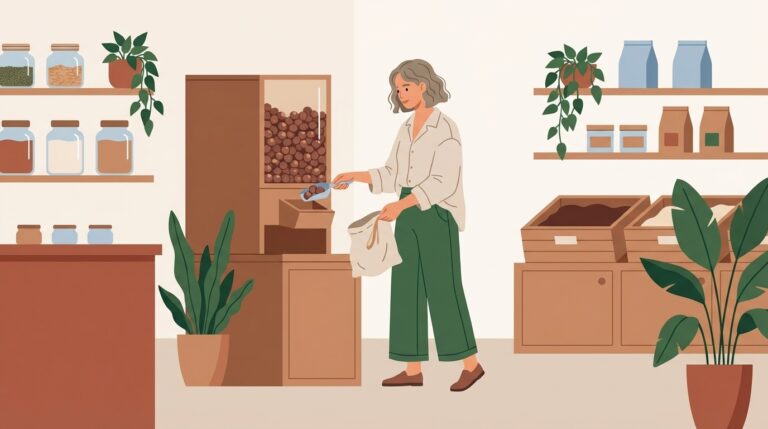
Setting: A sunny Saturday afternoon at a Zero-Waste Shop in Seongsu-dong. The shop smells like eucalyptus and cedar. You are browsing the laundry section with your Korean friend, Ji-ah.
Characters:
– YOU: An expat living in Seoul, trying to upgrade your eco-routine.
– Ji-ah (29, Female): Your trendy, socially conscious Korean friend who always knows the latest lifestyle trends.
Dialogue:
Ji-ah: 우와, 여기 소프넛 진짜 크고 실하다. 너도 이거 써봤어? 🌿
(Uwa, yeogi so-peu-neot jinjja keugo silhada. Neodo igeo sseobwasseo?)
[Wow, the soapnuts here are really big and good quality. Have you tried these?]
(🎭 Stage Direction: Ji-ah picks up a handful of brown soapnuts and sniffs them)
YOU: 아직. 근데 일반 세제 쓰면 미세 플라스틱이 옷에 남는다고 하더라고. 👕
(Ajik. Geunde ilban seje sseumyeon mi-se peul-la-seu-tigi ose namneundago hadeorago.)
[Not yet. But I heard that if you use regular detergent, microplastics remain on your clothes.]
Ji-ah: 맞아! 그게 결국 세탁기 물 타고 바다로 흘러가잖아. 나도 그 기사 읽고 바로 천연 세제로 바꿨지.
(Maja! Geuge gyeolguk setakgi mul tago badaro heulleogajana. Nado geu gisa ilkko baro cheon-yeon sejero bakkwotji.)
[Exactly! And that eventually flows into the ocean through the washing machine water. I changed to natural detergent right after reading that article.]
YOU: 소프넛은 거품이 잘 나? 뭔가 덜 닦일 것 같은 느낌인데.
(So-peu-neoseun geopumi jal na? Mweonga deol dakkil geot gateun neukkiminde.)
[Do soapnuts lather well? It feels like things might not get as clean.]
Ji-ah: 에이, 전혀 아니야. 망에 넣고 돌리면 천연 사포닌 성분 때문에 세정력 엄청 좋아.
(Ei, jeonhyeo aniya. Mange neoko dollimyeon cheon-yeon sa-po-nin seongbun ttaemune sejeongnyeok eomcheong joa.)
[Oh, not at all. If you put them in a net and run the machine, the cleaning power is great because of the natural saponin.]
YOU: 오, 듣고 보니까 완전 가치 소비의 끝판왕이네.
(O, deukko bonikka wanjeon ga-chi so-bi-ui kkeutpanwang-ine.)
[Oh, hearing that, it’s the ultimate boss of value consumption.]
Ji-ah: 그렇지? 게다가 화학 잔여물이 없어서 피부에도 훨씬 좋아. 너도 오늘 하나 사볼래?
(Geureotchi? Gedaga hwahak janyeomuri eopseoseo pibuedo hwolssin joa. Neodo oneul hana sabollae?)
[Right? Plus, there’s no chemical residue, so it’s much better for your skin. Want to buy one today?]
🔀 Your Turn! How do you respond?
– A) 네, 하나 주세요. (Yes, give me one. -> Too robotic/textbook for a friend!)
– B) 그래, 나도 오늘부터 제로 웨이스트에 동참해야겠다! (Sure, I should join the zero-waste movement starting today!)
– C) 아유, 귀찮아서 그냥 하던 대로 할래. (Ugh, it’s annoying, I’ll just stick to what I do. -> Honest, but kills the vibe.)✅ Best Choice: B — It uses trendy vocabulary natively and matches the enthusiastic vibe of the conversation.
⚠️ Choice A Analysis: It sounds like you are ordering food from a waiter, not talking to a friend!
YOU (Choice B): 그래, 나도 오늘부터 제로 웨이스트에 동참해야겠다!
(Geurae, nado oneulbuteo je-ro we-i-seu-te-e dongchamhaeyagetda!)
[Sure, I should join the zero-waste movement starting today!]
Ji-ah: 대박! 그럼 이따가 망원시장 가서 용기내 챌린지도 같이 할래? 나 반찬통 챙겨왔거든!
(Daebak! Geureom ittaga Mangwon-sijang gaseo yong-gi-nae chaellinjido gachi hallae? Na banchantong chaeng-gyeowatgeodeun!)
[Awesome! Then later, want to go to Mangwon Market and do the Yong-gi-nae challenge together? I brought my side-dish containers!]
YOU: 콜! 시장 떡볶이 용기에 담아오자.
(Kol! Sijang tteokbokki yonggie damaoja.)
[Deal! Let’s get market Tteokbokki in our containers.]
Phase 6: 10-Second Shadowing Drill
Read this out loud with the right emotion and pacing!
😤 단호하게 (Firmly, like an eco-campaigner):
미세 플라스틱이 / 우리 식탁으로 / 돌아온다잖아요. / 이제는 정말 / 가치 소비를 / 해야 할 때예요.
(mi-se peul-la-seu-tigi / uri siktageuro / doraondajanayo. / ijeneun jeongmal / ga-chi sobireul / haeya hal ttaeyeyo.)
“They say microplastics return to our dining tables. Now is really the time we must practice value consumption.”
Phase 7: K-Culture Mini Dictionary
| 한국어 | Romanization | English | Context |
|---|---|---|---|
| 가치 소비 | gachi sobi | Value Consumption | Buying based on personal values (eco-friendly, ethical). A major MZ trend. |
| 제로 웨이스트 | jero weiseuteu | Zero Waste | The lifestyle of minimizing trash. Often paired with ‘실천하다’ (to practice). |
| 분리수거 | bunlisugeo | Trash Sorting / Recycling | The strict Korean system of separating paper, plastic, vinyl, etc. |
| 용기내 | yongginae | Courage / Container Challenge | A punny social campaign encouraging people to bring their own containers. |
| 텀블러 할인 | teombeulleo halin | Tumbler Discount | A small discount (usually 300-500 won) given by cafes if you bring your own cup. |
Phase 8: Traveler & Resident Survival Kit
Navigating Korea’s strict waste management can be terrifying for newcomers. Here is your eco-survival kit!
🆘 Survival Expression #1: Declining Plastic Bags
– 🇰🇷 “봉투는 괜찮아요. 가방에 넣을게요.” (Bongtuneun gwaenchanayo. Gabange noeulgeyo.)
– 🗣️ English meaning: I don’t need a bag. I’ll put it in my backpack.
– 📍 Where to use: Convenience stores, Olive Young, bakeries.🆘 Survival Expression #2: Buying the Right Trash Bag
– 🇰🇷 “종량제 봉투 20리터짜리 한 장 주세요.” (Jongnyangje bongtu isib-niteo-jjari han jang juseyo.)
– 🗣️ English meaning: Please give me one 20-liter standard garbage bag.
– 📍 Where to use: Convenience stores (You CANNOT throw regular trash in any random plastic bag in Korea!).📌 Editor’s Local Note
– Food Waste (음식물 쓰레기): Never throw food waste in the regular trash bag! It must go into a specific food waste bag or a designated RFID bin. Animal bones, eggshells, and onion skins, however, are regular trash because they can’t be processed into animal feed. Yes, there’s a quiz on this when you move to Korea!
Phase 9: Critical Thinking Corner — “A Step Deeper”
🧠 Think Deeper: MZ Generation’s “Value Consumption” & Collective Nunchi
Korea has historically been a collectivist society where adapting to the group’s norm is crucial for social harmony. Interestingly, the modern “Eco-trend” (like zero-waste and avoiding microplastics) blends this collectivism with the MZ generation’s desire for individual self-expression.
When an actor posts a “Yong-gi-nae” challenge on Instagram, it goes viral not just because of environmental awareness, but because participating in Gachi Sobi (Value Consumption) elevates one’s social status as an educated, conscious citizen. The strictness of Korean recycling isn’t just about the law; it’s about social accountability. You recycle properly because you are constantly aware of your neighbors’ Nunchi. This powerful mix of peer pressure and civic duty makes environmental movements scale incredibly fast in Korea.💬 Your Turn: In your culture, are environmental actions driven more by individual guilt, governmental laws, or social pressure from peers? Share your thoughts below!
Phase 10: FAQ & Avoiding Misunderstandings
Q: Can I use the term “가치 소비” in a business meeting?
Yes! In fact, it’s highly recommended. If you are discussing marketing strategies or product launches, mentioning how your brand aligns with the MZ generation’s “가치 소비” will make you sound like an absolute industry expert.
Q: Do Korean cafes get annoyed if I bring my own tumbler?
Not at all. Most franchise cafes (like Starbucks, Mega Coffee, Twosome Place) actively encourage it and will give you a 텀블러 할인 (Tumbler discount) of around 300 to 400 won!
❌ Common Mistake #1: Throwing away a plastic bottle with the label still attached.
✅ Do this instead: You must peel off the vinyl label (비닐) and throw it in the vinyl recycling, crush the plastic bottle, and throw the cap away separately or leave it attached depending on the local district rules.
Phase 11: Summary & Action Items
One-Liner Summary: Mastering advanced eco-terms like 미세 플라스틱 (microplastics) and 가치 소비 (value consumption) will instantly connect you with Korea’s socially conscious MZ generation!
Action Mission:
– 🥉 Bronze (Solo): Look at your laundry detergent right now and practice saying “미세 플라스틱이 없는 천연 세제로 바꿔야지” (I should switch to a natural detergent without microplastics).
– 🥈 Silver (Online): Find a Korean zero-waste vlog on YouTube, leave a comment: “영상 보고 저도 가치 소비에 동참하기로 했어요!” (After watching the video, I decided to join in value consumption too!)
– 🥇 Gold (Real World): Next time you go to a Korean cafe, bring a reusable cup and proudly say: “텀블러에 담아주세요!” (Please put it in my tumbler!)
K-Culture Mission: Search for the hashtag #용기내챌린지 on Instagram. Look at how Koreans are bringing their pots to buy Tteokbokki and Jjamppong!
Phase 12: Quiz — Interactive Challenge
1. Situational Judgment: You are at Olive Young and the cashier asks if you need a bag. You want to sound natural and eco-friendly. What do you say?
– A) 비닐봉지 금지입니다. (Plastic bags are forbidden.)
– B) 봉투는 괜찮아요. 가방에 넣을게요. (A bag is fine. I’ll put it in my bag.)
– C) 플라스틱을 죽입시다. (Let’s kill plastic.)
2. True or False – K-Culture Edition:
In Korea, chicken bones and eggshells must be thrown away in the yellow Food Waste (음식물 쓰레기) bag. (T/F)
3. Fill in the Blank:
요즘 MZ세대들은 물건을 살 때 환경을 생각하는 ( _____ )를 중요하게 생각합니다.
(Hint: Voting with your wallet / Value consumption)
👀 Click here for Answers!
1. B (A is too aggressive, C is grammatically correct but sounds like a supervillain’s eco-manifesto.)
2. False (Animal bones and eggshells cannot be processed into animal feed, so they MUST go in the regular garbage bag! Many foreigners get fined for this mistake.)
3. 가치 소비 (gachi sobi)
Frequently Asked Questions (FAQ)
Q: What does "미세 플라스틱 (Microplastics)" mean in Korean and how do you pronounce it?
A: In Korean, "미세 플라스틱 (Microplastics)" is pronounced [mi-se peul-la-seu-tik] and means: Literal: Micro plastic. Real nuance: The invisible enemy in our water, food, and clothes that Koreans are becoming hyper-aware of.
Q: What does "천연 세제, 소프넛 (Natural Detergent, Soapnuts)" mean in Korean and how do you pronounce it?
A: In Korean, "천연 세제, 소프넛 (Natural Detergent, Soapnuts)" is pronounced [cheon-yeon se-je, so-peu-neot] and means: Natural detergent, Soapnuts.
Q: What does "가치 소비 (Value-based Consumption)" mean in Korean and how do you pronounce it?
A: In Korean, "가치 소비 (Value-based Consumption)" is pronounced [ga-chi so-bi] and means: Literal: Value consumption. Real nuance: Voting with your wallet; buying products that align with your ethical and environmental beliefs.







