

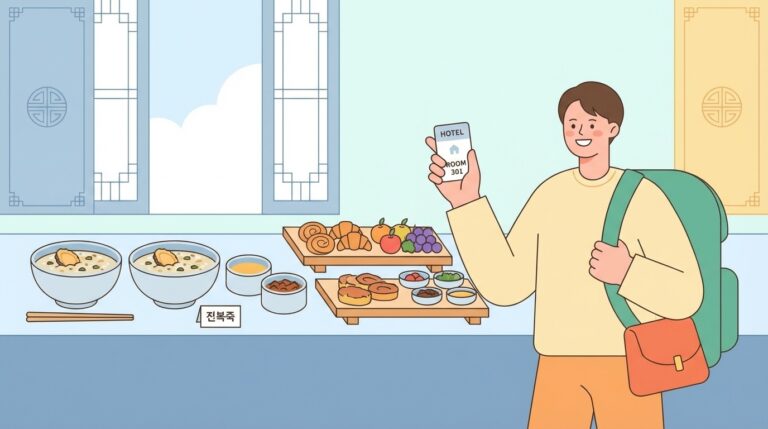
Don’t Miss the Hotel Buffet! How to Ask About Breakfast in Korean
Hello! I’m your Daily Hangul Editor, your local Korean friend who knows exactly where you might get stuck while traveling in Seoul.
Imagine this: You’ve just arrived in Korea. You walk into the glittering lobby of a beautiful hotel in Myeongdong or Gangnam, dragging your suitcase. It looks just like a scene from the K-Drama King the Land. You finally make it to the front desk, and you’re dreaming about tomorrow morning’s legendary Korean hotel buffet—the abalone porridge, the warm pastries, the endless coffee. But wait… did you actually book the room with breakfast? How do you ask the staff without making it awkward?
If you don’t know the magic phrase, you might end up paying a hefty extra fee or, even worse, missing out on the best meal of your trip! Don’t worry. Today, we’re going to learn exactly how to ask about breakfast at a Korean hotel. This guide is built from the real experiences of beginner learners just like you, so let’s dive right into the magic of hotel Korean!
Phase 2: Core Expressions – The Magic Words
Let’s look at the most important phrase you will need at the front desk. We are keeping it super simple for A1 beginners!
1. 조식 포함인가요?
- Pronunciation: [josik pohamingayo?]
- Sound-alike guide: ‘jo’ sounds like Joe, ‘sik’ sounds like sick. ‘po-ham’ sounds like Poe-ham, ‘in-ga-yo’ sounds like in-guy-yo.
- Meaning: Literal: “Is morning meal included?” / Real Nuance: “Does my booking include the breakfast buffet?”
- K-Culture Moment: Picture a scene in a K-Drama where the main characters go on a spontaneous trip to Jeju Island. The confident male lead hands over his black credit card and casually asks the receptionist, “조식 포함인가요?” It sounds smooth, professional, and very natural.
- Editor’s Insight: You might have learned the word ‘아침’ (achim) for ‘morning’ or ‘breakfast’ in your textbook. But in hotels, Koreans use the fancy word ‘조식’ (josik). It simply means ‘hotel breakfast’. Adding ‘인가요?’ (in-ga-yo) at the end makes it a very soft, polite question.
- Situation Spectrum:
- Casual with friends: 🚫 (Friends don’t run hotels!)
- Hotel Front Desk / Staff: ✅ (Perfect and polite!)
- Formal / Older people: ✅
- 🤔 Think About It: Why do hotels use ‘조식’ instead of the everyday word ‘아침’? In Korean, words derived from Chinese characters (Sino-Korean words like ‘조식’) sound more formal and professional than pure Korean words. Does your language have “fancy” words used only in hospitality?
2. 조식 추가할 수 있어요?
- Pronunciation: [josik chugahal su isseoyo?]
- Sound-alike guide: ‘chu-ga’ sounds like choo-gah, ‘hal su’ sounds like hal soo, ‘i-sseo-yo’ sounds like ee-saw-yo.
- Meaning: Literal: “Can I add breakfast?” / Real Nuance: “I booked room-only, but I want to pay to eat the breakfast buffet. Can I add it now?”
- K-Culture Moment: You wake up, smell the bacon from the lobby, and suddenly realize you need to eat. You run down to the reception and use this phrase.
- Editor’s Insight: ‘추가’ (chu-ga) means ‘addition’. It’s a lifesaver word! You can use ‘추가’ at Korean BBQ restaurants too, when you want to add more meat!
- Situation Spectrum:
- Hotel Front Desk / Staff: ✅
- 🤔 Think About It: The phrase ends with ‘요’ (yo). In Korean, ending your sentence with ‘요’ is the golden rule for beginners to sound polite. Never drop the ‘요’ when speaking to staff!
Phase 3: Textbook vs. Real Korean
| Situation | 📖 Textbook Korean | 🗣️ Real Korean | 💡 Why different? |
|---|---|---|---|
| Asking if breakfast is included | 아침 식사는 포함되어 있습니까? (achim siksaneun pohamdoeeo isseumnikka?) | 조식 포함인가요? (josik pohamingayo?) | Textbooks use the rigid “-mnikka” form. Real life uses the softer “-yo” form, and ‘조식’ is the industry standard word! |
| Asking the time for breakfast | 아침 식사 시간은 언제입니까? (achim siksa siganeun eonjeimnikka?) | 조식 몇 시부터예요? (josik myeot sibuteoyeyo?) | Real spoken Korean prefers dropping unnecessary words for speed and efficiency. |
Phase 4: Cultural Context — K-Culture Deep Dive
4-1. Non-verbal Tips: The “Two-Hand” Rule
When you ask “조식 포함인가요?” at the front desk, you will likely be handing the staff your passport or credit card. In Korea, handing things over with two hands (or lightly supporting your right elbow with your left hand) is a sign of deep respect. If you do this while speaking Korean, the hotel staff will be absolutely amazed by your manners!
4-2. The “Hocance” (호캉스) Phenomenon
Have you heard of Hocance? It’s a blend of “Hotel” + “Vacance” (French for vacation). In Korea, staying at a luxury hotel in your own city just to enjoy the facilities has become a massive trend among young people and K-Pop idols on their days off.
The absolute highlight of a Hocance? You guessed it—the 조식 (breakfast buffet)! Korean hotel buffets are famous worldwide. You won’t just find toast and eggs. You’ll find a massive feast: Dim sum, fresh sashimi, bulgogi, and the ultimate hangover cure, Jeonbokjuk (abalone porridge). So, asking about your breakfast isn’t just a practical question; it’s the start of a true Korean cultural experience!
Phase 5: Real-life Roleplay Scenario
Let’s put you in the spotlight!
Setting: 3:00 PM, a sleek 4-star hotel in Myeongdong. The lobby smells like expensive citrus perfume. You are tired from your flight, but excited.
Characters:
– YOU: A traveler visiting Korea for the first time.
– Ji-min (28, Front Desk Staff): Very polite, wearing a sharp uniform, typing quickly on her keyboard.
Ji-min: 안녕하세요. 체크인 도와드릴까요? 🏨
(an-nyeong-ha-se-yo. che-keu-in do-wa-deu-ril-kka-yo?)
[Hello. May I help you check in?]
(🎭 Stage Direction: Ji-min smiles warmly and waits for your passport)
YOU: 네, 제 이름은 [Your Name]입니다. 여권 여기 있어요. 🛂
(ne, je i-reum-eun [Your Name] im-ni-da. yeo-gwon yeo-gi i-sseo-yo.)
[Yes, my name is [Your Name]. Here is my passport.]
Ji-min: 네, 확인되었습니다. 3박 예약하셨네요. 객실 키 여기 있습니다. 🔑
(ne, hwa-gin-doe-eot-seum-ni-da. sam-bak ye-yak-ha-syeon-ne-yo. gaek-sil ki yeo-gi it-seum-ni-da.)
[Yes, confirmed. You booked for 3 nights. Here is your room key.]
🔀 Your Turn! You really want to know about the breakfast buffet. What do you say?
- A) “아침 밥 줘요?” (achim bap jwo-yo? – Give me morning rice?)
- B) “배고파요.” (bae-go-pa-yo – I’m hungry.)
- C) “조식 포함인가요?” (jo-sik po-ham-in-ga-yo? – Is breakfast included?)
✅ Best Choice: C — It is the standard, polite, and perfect way to ask!
⚠️ Choice A & B Analysis: Choice A is way too demanding and a bit rude for a hotel! Choice B is cute, but Ji-min might just point you to the nearest convenience store instead of explaining the hotel breakfast policy.
Ji-min: 네, 조식 포함입니다! 아침 7시부터 1층 뷔페에서 드실 수 있어요. 🥐
(ne, jo-sik po-ham-im-ni-da! a-chim il-gop-si-bu-teo il-cheung bwi-pe-e-seo deu-sil su i-sseo-yo.)
[Yes, breakfast is included! You can eat at the 1st-floor buffet from 7 AM.]
YOU: 아, 감사합니다!
(a, gam-sa-ham-ni-da!)
[Ah, thank you!]
Phase 6: 10-Second Shadowing Drill
Time to practice! Follow the slashes (/) to pause slightly, and mimic the emotion.
😊 저기요, / 조식 / 포함인가요?
(jeo-gi-yo, / jo-sik / po-ham-in-ga-yo?)
Excuse me, / is breakfast / included?
(Pro tip: Raise your pitch slightly at the end of ‘가요?’ to make it sound like a friendly question!)
Phase 7: K-Culture Mini Dictionary
Here are some keywords you will see a lot when booking hotels in Korea:
| Korean | Romanization | English | Context |
|---|---|---|---|
| 호캉스 | ho-kang-seu | Staycation | Hotel + Vacance. Enjoying hotel facilities as a vacation. |
| 조식 | jo-sik | Breakfast | Specifically refers to breakfast provided by a hotel. |
| 룸온리 | rum-on-ri | Room Only | Konglish! It means you booked the room without breakfast. |
| 뷔페 | bwi-pe | Buffet | Koreans love buffets. Pronounced “bwi-pe”, not “buff-ay”. |
| 가성비 | ga-seong-bi | Cost-effective | Used when a hotel offers amazing service for a low price! |
Phase 8: Traveler Survival Kit (Hotel Edition)
Beside breakfast, here are the TOP 3 survival phrases you will definitely need at a Korean hotel!
🆘 Survival Phrase #1: Storing Luggage
– 🇰🇷 “짐 보관해 주실 수 있나요?” (jim bo-gwan-hae ju-sil su in-na-yo?)
– 🗣️ Meaning: Can you store my luggage?
– 📍 Where to use: Before check-in or after check-out at the front desk.🆘 Survival Phrase #2: Checking Out
– 🇰🇷 “체크아웃 몇 시예요?” (che-keu-a-ut myeot si-ye-yo?)
– 🗣️ Meaning: What time is check-out?
– 📍 Where to use: When you want to know how long you can sleep in!🆘 Survival Phrase #3: Asking for Water
– 🇰🇷 “물 한 병 더 주세요.” (mul han byeong deo ju-se-yo.)
– 🗣️ Meaning: Please give me one more bottle of water.
– 📍 Where to use: Calling the front desk from your room phone.📌 Editor’s Travel Note
– Tipping: There is absolutely NO tipping culture in Korea! Do not leave cash on the bed for housekeeping, and do not tip the bellboy. They will run after you to return your “lost” money!
– Slippers: Your room will have white slippers. Never wear them outside your room (like to the lobby or the breakfast buffet). It is considered a major fashion and cultural faux pas!
Phase 9: Think Deeper — Language & Power
🧠 Think Deeper: Why are there two words for “Breakfast”?
In Korean, the vocabulary often shifts depending on the level of formality and respect required. At home with your family, you eat “아침” (achim – pure Korean word for morning/breakfast). But in a professional hospitality setting like a luxury hotel, the staff uses “조식” (josik – a Sino-Korean word).Words derived from Chinese characters traditionally carry a sense of elevated formality, authority, and professionalism. By using “조식”, the hotel isn’t just offering you a morning meal; they are signaling that they are providing a premium, highly respectful service.
💬 Your Turn: Does your native language have different words for the exact same thing depending on how “fancy” the situation is? Let us know in the comments!
Phase 10: FAQ & Mistake Prevention
Q: Can I just say “Breakfast included?” in English?
A: Yes! Most hotel staff in Seoul speak basic English. But using “조식 포함인가요?” will instantly earn you their utmost respect and a huge smile!
Q: Can I use “조식” at a normal restaurant outside the hotel?
A: No, that would sound weird! If you go to a local cafe or a McDonald’s in the morning, just use “아침” (achim).
❌ Common Mistake #1: Trying to give a tip after the hotel breakfast.
✅ Do this instead: Just say “잘 먹었습니다!” (jal meo-geot-seum-ni-da – I ate well!) as you leave the restaurant. Your polite words are the best tip!
Phase 11: Summary & Action Items
One-Liner Summary: Remember the magic word 조식 (jo-sik) instead of ‘achim’ when asking about your hotel breakfast!
🚀 Your Action Missions:
– 🥉 Bronze (Solo): Stand in front of a mirror and say “조식 포함인가요?” three times with a confident smile.
– 🥈 Silver (Online): Leave a comment on this post typing the phrase you learned today!
– 🥇 Gold (Real Life): Use this exact phrase at the front desk the next time you check into a hotel in Korea!
🌟 Special K-Culture Mission:
Go to Agoda, Booking.com, or Naver right now. Search for a popular hotel in Seoul (like the Shilla Hotel or Signiel). Look at the Korean reviews or room descriptions and try to spot the word “조식”!
Phase 12: Interactive Quiz!
Test your knowledge before you pack your bags! (Answers at the bottom)
1. Situation Judgment: You booked a room online but forgot if you added the buffet. You walk up to the receptionist. What do you say?
– A) 배고파요. 밥 주세요! (bae-go-pa-yo. bap ju-se-yo!)
– B) 조식 포함인가요? (jo-sik po-ham-in-ga-yo?)
– C) 아침 식사는 언제입니까? (a-chim sik-sa-neun eon-je-im-nik-ka?)
2. True or False – K-Culture Edition:
“After enjoying the amazing hotel breakfast buffet, you should leave a $5 tip on the table for the staff.”
– True / False
3. Fill in the Blank:
The popular Korean trend of taking a vacation at a local luxury hotel is called: [ ________ ] (Hint: Hotel + Vacance)
*
…
…
Answers: 1) B (A is rude, C is too robotic textbook style), 2) False (No tipping in Korea!), 3) 호캉스 (Hocance)*
Frequently Asked Questions (FAQ)
Q: What does "조식 포함인가요?" mean in Korean and how do you pronounce it?
A: In Korean, "조식 포함인가요?" is pronounced [josik pohamingayo?] and means: a key conversational Korean expression covered in this lesson.
Q: What does "조식 추가할 수 있어요?" mean in Korean and how do you pronounce it?
A: In Korean, "조식 추가할 수 있어요?" is pronounced [josik chugahal su isseoyo?] and means: a key conversational Korean expression covered in this lesson.






