

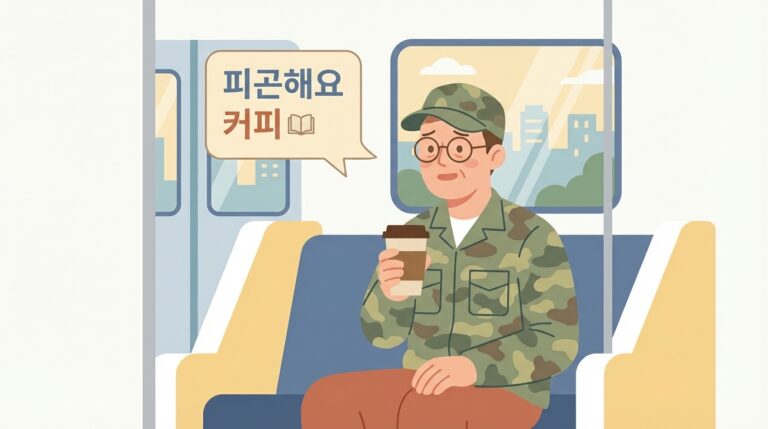
Phase 1: Empathy (Immersive Open)
Hello! Daily Hangul Editor here. 👋
Imagine this: You’re riding the Seoul subway on a random Tuesday morning. You look up, and suddenly, you see groups of young Korean men wearing slightly faded military camouflage uniforms. Some are holding iced americanos, others are taking a nap with their mouths slightly open.
If your only reference to the Korean military is Captain Yoo Si-jin from the K-Drama Descendants of the Sun, you might be a bit confused. Is there an emergency? Are we going to war?!
Don’t panic! Korea is perfectly safe. These men are just heading to 예비군 (Yebigun), which means Reserve Forces Training. Understanding this specific situation not only prevents a mini heart attack but also unlocks a huge part of Korean culture. This post is based on real questions from my expat students who thought a war had broken out while on their way to work! Let’s dive into the secret world of Yebigun.
Phase 2: Core Expressions Deep Dive
Here are the top 3 expressions you need to know when your Korean friend or colleague suddenly shows up in camo.
1. 예비군 가요 (I’m going to reserve training)
- Pronunciation: [yebigun gayo] + [YEH-bee-goon gah-yo]
- Meaning: Literal: I go to reserve forces. / Real: I have mandatory reserve military training today.
- K-Culture Moment: You will see your favorite K-Pop idols post a selfie in their military uniform on Instagram or Weverse with this exact caption once a year after they finish their active duty. Fans usually comment, “Come back safely!”
- Editor’s Insight: The word “가요” (go) sounds very casual. When Korean men say this, they usually say it with a deep sigh because it means a tiring day of training instead of their normal routine.
- Situation Spectrum:
- Friends (Casual): ✅ (예비군 가. – yebigun ga.)
- Co-workers (Semi-formal): ✅ (예비군 가요. – yebigun gayo.)
- Boss/Elders (Formal): ⚠️ (예비군 훈련 다녀오겠습니다. – yebigun hullyeon danyeo-ogetseumnida.)
- 🤔 Think About It: Why is military service such a shared bond in Korea? How does mandatory conscription shape the way Korean men interact with each other in society?
2. 군복 입었어요 (I wore a military uniform)
- Pronunciation: [gunbok ibeosseoyo] + [GOON-bok ee-buh-ssuh-yo]
- Meaning: Literal/Real: I am wearing a military uniform.
- K-Culture Moment: In K-Dramas, the moment the male lead puts on his 군복 (gunbok), romantic background music plays, and he looks incredibly handsome. In reality, Korean men joke that the uniform is “cursed” because the moment they put it on, they instantly feel lazy and hungry.
- Editor’s Insight: “입었어요” comes from the verb “입다” (to wear). In Korean, we use the past tense (wore) to describe the state of currently wearing something.
- Situation Spectrum:
- Friends (Casual): ✅
- Co-workers (Semi-formal): ✅
- Boss/Elders (Formal): 🚫 (Use a more formal ending)
- 🤔 Think About It: Does your country have a specific uniform or outfit that changes how people behave when they wear it?
3. 충성! (Loyalty! / Salute!)
- Pronunciation: [chungseong] + [CHOONG-sung]
- Meaning: Literal: Loyalty. / Real: The standard military salute greeting in the Korean army.
- K-Culture Moment: On variety shows, when a male celebrity who just finished his military service is introduced, he will stand up straight and shout “충성!” to the camera.
- Editor’s Insight: This is technically formal military language, but civilians and friends use it jokingly with each other to say “Yes, sir!” or “I’ll do my best!”
- Situation Spectrum:
- Friends (Casual): ✅ (As a joke)
- Co-workers (Semi-formal): ⚠️ (Only if you are very close)
- Boss/Elders (Formal): 🚫 (Unless you are actually in the military)
- 🤔 Think About It: Different branches of the Korean military use different salute words like “필승” (Certain Victory) or “단결” (Unity). Why do you think language is used to build military morale?
Phase 3: Textbook vs. Real Korean
| Situation | 📖 Textbook Korean | 🗣️ Real Korean | 💡 Why is it different? |
|---|---|---|---|
| Telling someone you have training | 저는 예비군 훈련을 받으러 갑니다. | 저 오늘 예비군 가요. | Koreans love dropping particles (을/를) and shortening long nouns for efficiency in daily speech. |
| Complaining about the uniform | 군복을 입으면 피곤해집니다. | 아, 군복만 입으면 피곤해… | Adding “아…” (sigh) adds real emotion, which is a big part of spoken Korean. |
| Greeting a friend in uniform | 군대에 다시 가는군요! | 웬 군복이야? (What’s with the uniform?) | Textbook is too formal. Close friends use casual banter. |
Phase 4: Cultural Context — K-Culture Deep Dive
4-1. The “Ahjussi” Transformation (Non-verbal cues)
When Korean men go to Yebigun, their body language completely changes. A guy who usually sits up straight in a tailored suit at the office will suddenly slouch, spread his legs wide, and walk very slowly while dragging his combat boots. This is a nationwide inside joke called the “Ahjussi (Middle-aged man) Effect” of the reserve uniform. When talking to a friend in this state, don’t expect high energy!
4-2. K-Beauty Link: The Legendary “PX Shopping”
You might wonder, what does military training have to do with K-Beauty? Everything!
Inside military bases, there is a tax-free supermarket called the PX (Post Exchange). The PX sells high-quality Korean skincare products (especially the famous 달팽이 크림 – Snail Cream) at incredibly cheap prices. When men go to Yebigun, their wives, girlfriends, or mothers often give them a “shopping list.”
Pro Tip: If your Korean male friend is going to Yebigun, jokingly ask him, “PX에서 달팽이 크림 좀 사다 줄래요?” (Can you buy me some snail cream from the PX?). He will be shocked by how well you know Korean culture!
Phase 5: Real-world Roleplay Scenario
Setting: A trendy cafe near your university or workplace in Seoul. It’s 8:30 AM. You are drinking coffee when your Korean friend, Minho (28, a graphic designer), walks in wearing a full military camouflage uniform. He looks exhausted.
Characters:
– YOU: An expat living in Korea for 6 months.
– Minho: Your friendly Korean buddy.
Dialogue:
YOU: 민호 씨! 오늘 옷이 왜 그래요? 군대 가요? 😲
(Minho ssi! oneul osi wae geuraeyo? gundae gayo?)
[Minho! What’s with your clothes today? Are you going to the army?]
Minho: 아… 저 오늘 예비군 가요.
(A… jeo oneul yebigun gayo.)
[Ah… I’m going to reserve training today.]
YOU: 예비군이요? 그게 뭐예요?
(Yebigun-iyo? geuge mwoyeyo?)
[Yebigun? What is that?]
Minho: 전역하고 1년에 한 번씩 받는 훈련이에요.
(Jeonyeok-hago il-nyeone han beonssik banneun hullyeonieyo.)
[It’s a training we get once a year after being discharged.]
YOU: 아, 그렇군요. 많이 힘들어요?
(A, geureokunyo. mani himdeureoyo?)
[Ah, I see. Is it very hard?]
Minho: 훈련보다… 이상하게 군복만 입으면 너무 피곤해요. 하아…
(Hullyeon-boda… isanghage gunbokman ibeumyeon neomu pigonhaeyo. Haa…)
[Rather than the training… weirdly, I just get so tired whenever I put on the uniform. Sigh…]
🔀 YOUR TURN! How should you react?
– A) “와, 멋있어요! 사진 찍어요!” (Wow, cool! Let’s take a picture!)
– B) “커피 마실래요? 제가 살게요!” (Do you want coffee? I’ll buy!)
– C) “전쟁 났어요?!” (Did a war break out?!)✅ Best Choice: B — A tired Yebigun soldier needs caffeine more than anything! Offering a coffee shows great empathy.
⚠️ Choice A Analysis: While K-Pop idols look cool in uniform, regular guys in Yebigun feel sweaty and messy. They usually avoid photos!
(Assuming you chose B)
YOU: 하하! 커피 마실래요? 제가 살게요. ☕
(Haha! keopi masillaeyo? jaega salgeyo.)
[Haha! Do you want coffee? I’ll buy.]
Minho: 진짜요? 그럼 아이스 아메리카노 부탁해요. 생명의 은인이네요!
(Jinjjayo? geureom aiseu amerikano butakaeyo. saengmyeong-ui eunin-ineyo!)
[Really? Then an iced americano, please. You’re a lifesaver!]
YOU: 네, 잠시만요. 파이팅!
(Ne, jamsimanyo. paiting!)
[Okay, just a moment. Cheer up!]
Minho: 고마워요. 잘 마실게요! 충성!
(Gomawoyo. jal masilgeyo! Chungseong!)
[Thank you. I’ll enjoy it! Salute!]
(🎭 Stage Direction: Minho does a lazy but grateful military salute)
Phase 6: 10-Second Shadowing Drill
Let’s practice sounding like a real Korean! Pay attention to the pauses (/) and the emotion.
😫 아... / 오늘 / 예비군 가요.
(Ah… / oneul / yebigun gayo.)
Sigh… I’m going to reserve training today.
Tip: Make the “아…” long and breathy to show how tired you are.
Phase 7: K-Culture Mini Dictionary
| Korean | Romanization | English | Context |
|---|---|---|---|
| 예비군 | yebigun | Reserve forces | Mandatory training for men who finished active duty. |
| 군대 | gundae | Military / Army | The general term for the military. |
| 군복 | gunbok | Military uniform | Camouflage clothing. |
| 피엑스 | pi-ek-seu | PX (Post Exchange) | The military supermarket famous for cheap snacks and K-Beauty. |
| 곰신 | gom-sin | “Rubber shoes” | Slang for a girlfriend waiting for her boyfriend to finish military service. |
Phase 8: Traveler Survival Kit
Since you’ll see Yebigun soldiers on the subway, here are survival phrases for navigating public transport!
🆘 Survival Phrases for the Subway
– 🇰🇷 “이거 서울역 가요?” (igeo seoullyeok gayo?)
– 🗣️ Guide: [ee-guh seoul-yeok gah-yo?]
– 📍 Meaning: Does this go to Seoul Station?
– 💡 Pro Tip: If you’re lost, asking a guy in a military uniform is actually a great idea! They are young, usually speak some English, and are legally obligated to be helpful citizens!📌 Editor’s Travel Note
– Useful Apps: KakaoMetro, Naver Map.
– Don’t Stare: It’s normal to see guns (unloaded) during Yebigun season on the streets. Don’t panic or stare too much; it’s just a routine Tuesday for them.
Phase 9: Critical Thinking — “One Step Deeper”
Media vs. Reality (미디어와 현실)
🧠 Think Deeper:
If you watch K-Dramas like Crash Landing on You, Korean soldiers are portrayed as flawlessly groomed, intensely romantic, and always ready for action. However, the reality of Yebigun is quite different. It consists of everyday people—your local barista, your office manager, or the university student next door—pausing their normal lives to fulfill a civic duty. They are tired, they want to go home, and they are mostly thinking about lunch. This contrast shows how media romanticizes military service, while for actual Koreans, it’s an ordinary, somewhat annoying, but deeply shared life experience.💬 Your Turn: Does the media in your country romanticize certain professions (like police, doctors, or soldiers) differently from reality? Share in the comments!
Phase 10: FAQ & Avoiding Misunderstandings
Q: Is Korea at war right now? Why are there so many soldiers?
No! Korea has mandatory conscription, and men must complete active duty, followed by years of “Reserve” training (Yebigun) for a few days a year. It’s just a routine drill.
Q: Should I salute them or say “Thank you for your service”?
In Korea, we don’t typically say “Thank you for your service” to strangers in uniform on the street. It might make them feel awkward. A simple nod or treating them like a normal citizen is best.
Q: Can I ask a Korean man about his military service?
Yes! For many Korean men, military stories are their favorite topic. If you ask, “군대 어디 다녀왔어요?” (Where did you serve?), be prepared for a 30-minute story!
❌ Common Mistake #1: Taking photos of soldiers without permission.
✅ Do this instead: Treat them like any other pedestrian. If you really want a photo for cultural reasons, always ask politely first, though they might decline because they feel they look “messy.”
Phase 11: Summary & Action Items
One-Liner Summary: Yebigun (예비군) is the mandatory reserve training for Korean men, and seeing them in uniform on the streets is a normal, everyday part of Korean life!
Action Mission:
– 🥉 Bronze: Say “저 오늘 예비군 가요” out loud with a big sigh 3 times.
– 🥈 Silver: Next time you watch a K-Drama, look closely at the military uniforms. Are they active duty or Yebigun?
– 🥇 Gold (K-Culture Mission): Go to YouTube or Weverse and search for your favorite male K-Pop idol + “예비군” (Yebigun). You’ll definitely find photos of them looking surprisingly normal and tired!
Have you ever seen soldiers on the street in Korea and gotten confused? Tell me your story in the comments below! 👇
Phase 12: Quiz — Interactive Challenge
1. Situational Judgment: Your Korean male co-worker comes to the office wearing a military uniform. He says he has Yebigun today. What is the BEST thing to say?
– A) “전쟁 났어요?” (Is there a war?)
– B) “오늘 피곤하겠네요. 파이팅!” (You must be tired today. Cheer up!)
– C) “충성! 감사합니다!” (Salute! Thank you!)
(Answer: B. Acknowledging their tiredness is the most culturally empathetic response!)
2. True or False – K-Culture Edition:
Korean men usually feel incredibly cool and energetic when they put on their Yebigun reserve uniform.
(Answer: False. The “Ahjussi Effect” makes them feel instantly lazy and exhausted!)
3. Fill in the Blank:
The military supermarket where you can buy very cheap K-Beauty products like snail cream is called the ____.
(Answer: PX / 피엑스)
Frequently Asked Questions (FAQ)
Q: What does "예비군 가요 (I'm going to reserve training)" mean in Korean and how do you pronounce it?
A: In Korean, "예비군 가요 (I'm going to reserve training)" is pronounced [yebigun gayo] and means: Literal: I go to reserve forces. / Real: I have mandatory reserve military training today.
Q: What does "군복 입었어요 (I wore a military uniform)" mean in Korean and how do you pronounce it?
A: In Korean, "군복 입었어요 (I wore a military uniform)" is pronounced [gunbok ibeosseoyo] and means: Literal/Real: I am wearing a military uniform.
Q: What does "충성! (Loyalty! / Salute!)" mean in Korean and how do you pronounce it?
A: In Korean, "충성! (Loyalty! / Salute!)" is pronounced [chungseong] and means: Literal: Loyalty. / Real: The standard military salute greeting in the Korean army.







