

Hello! I’m the Lead Editor at Daily Hangul.
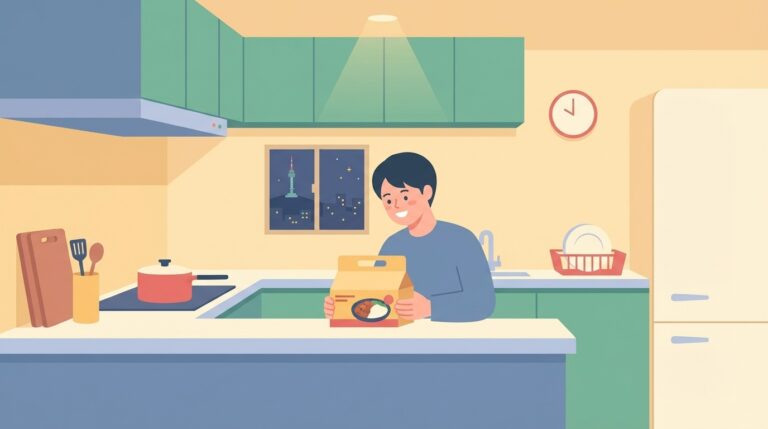
Picture this: You’re watching a K-Drama. The main character just had a long, exhausting day at work. They walk into a brightly lit convenience store, grab a neatly packaged plastic container, microwave it, and sit by the window looking out at the neon lights of Seoul. It looks so peaceful, doesn’t it?
If you’ve ever lived in or visited Korea—or even just wandered the aisles of an H-Mart—you might have noticed something fascinating. The giant, family-sized bulk items of the past are being replaced. Now, everywhere you look, there are perfectly portioned vegetables, half-loaves of bread, and sleek little boxes containing exactly one serving of Kimchi Jjigae.
Welcome to the era of the 1인 가구 (il-in gagu, single-person household).
As more young Koreans move to cities and live alone, the culture of eating has dramatically shifted. Knowing how to navigate this world of small-packaged groceries and meal kits won’t just save you money and fridge space; it will make you sound like a true Seoulite. Let’s dive into the essential survival Korean for your solo culinary adventures!
Phase 2: Core Expressions Deep Dive
1. 1인분 포장되나요? (Can I get one portion to go?)
- Pronunciation: [il-inbun pojangdoenayo?] (Sound analogy: Think of “il-in-bun” as saying “Eel in bun” really fast!)
- Meaning: Literal: “Is 1-person portion packaging possible?” / Real nuance: “Can I get a single serving for takeout?”
- K-Culture Moment: You’re walking past a delicious Tteokbokki stand or a local restaurant. Usually, Korean stews or meats are meant for sharing (2+ people). Asking this bravely allows you to enjoy restaurant-quality food in your own cozy studio apartment.
- Editor’s Insight: This is the golden key for solo dwellers. It sounds polite but direct. It’s not a demand; it’s a gentle inquiry, acknowledging that packing a single portion might be an extra favor.
- Situation Spectrum:
- Friends (Casual): 🚫 (You wouldn’t ask a friend this)
- Store Owner (Semi-formal): ✅
- High-end Restaurant (Formal): ⚠️ (High-end places rarely do 1-person takeout, but it’s polite enough to ask)
- 🤔 Think About It: Why does Korean specify “1-person portion” (1인분) instead of just saying “one” (하나)? How does this reflect the traditional Korean mindset of eating as a group activity?
2. 이거 소포장된 건 없나요? (Do you have this in a smaller package?)
- Pronunciation: [igeo sopojangdoen geon eomnayo?] (Sound analogy: “So-po-jang” sounds like “So poor John” but with a soft ‘j’.)
- Meaning: Literal: “Is there not a small-packaged version of this?” / Real nuance: “This is way too big for me, do you have a smaller one?”
- K-Culture Moment: You’re at an Emart or Homeplus. You want to make a simple salad, but the onions only come in a 2kg mesh bag. If you buy it, 1.8kg will rot in your fridge. This phrase saves your life.
- Editor’s Insight: So-po-jang literally means “small packaging.” Using this specific vocabulary shows you aren’t just a tourist; you’re someone who understands modern Korean retail trends.
- Situation Spectrum:
- Mart Staff (Semi-formal): ✅
- Traditional Market (Casual/Semi-formal): ⚠️ (Market vendors might just tell you to buy the whole basket!)
3. 밀키트 어디 있어요? (Where are the meal kits?)
- Pronunciation: [milgiteu eodi isseoyo?] (Sound analogy: “Meal kit” but add a tiny “eu” sound at the end: Meal-kit-eu.)
- Meaning: Literal/Real nuance: “Where are the meal kits?”
- K-Culture Moment: Meal kits are huge in Korea right now. From famous K-BBQ restaurant collabs to basic stews, they have everything chopped, measured, and ready to boil in 5 minutes. It’s the ultimate hack for busy young professionals in Seoul.
- Editor’s Insight: Very simple, very effective. Koreans adopted the English word “meal kit,” so you just need to Koreanize your pronunciation slightly.
Phase 3: Textbook vs. Real Korean
| Situation | 📖 Textbook Korean | 🗣️ Real Korean | 💡 Why the Difference? |
|---|---|---|---|
| Ordering one serving | 한 사람 분량을 포장해 주시겠습니까? | 1인분 포장돼요? (il-inbun pojangdoeyo?) | The textbook version sounds like a robot from the Joseon Dynasty. Modern Koreans prefer quick, efficient communication. |
| Looking for small veggies | 작은 크기의 채소가 있습니까? | 소포장 채소 있어요? (sopojang chaeso isseoyo?) | “Sopojang” is a widely accepted industry term that has become everyday vocabulary due to single households. |
| Asking to buy just one | 이것을 하나만 사도 됩니까? | 이거 낱개로도 팔아요? (igeo natgaerodo parayo?) | “Nat-gae” (individual pieces) is the exact term used in retail when breaking up a bundled package. |
Phase 4: Cultural Context — K-Culture Deep Dive
4-1. Non-verbal Context & Nunchi
When you ask for “1인분” (1 portion) at a busy restaurant during peak lunch hours, you might need a little bit of Nunchi (reading the room). Traditionally, taking up a 4-person table to eat alone during rush hour is frowned upon. Pro Tip: If you’re doing takeout, stand near the counter rather than sitting at a table while you wait.
4-2. The “Convenience Store Dinner” Trope in K-Dramas
Have you ever noticed how often K-Drama characters meet at convenience stores? From Itaewon Class to My Mister, the convenience store (편의점) is a sanctuary for the modern single Korean. It’s brilliantly lit, always open, and offers an endless array of single-serving meals (도시락) and 1+1 deals.
Critical View: While dramas make eating ramen alone on a convenience store patio look incredibly romantic and reflective, the reality is often born out of extreme work hours (야근) and the high cost of living. It’s an intersection of convenience, loneliness, and survival.
Phase 5: Real-life Roleplay Scenario
Setting: It’s 7 PM on a Thursday at a large supermarket (like Homeplus) in Mapo-gu. You want to make Kimchi Fried Rice tonight, but you live alone and your fridge is tiny. You’re looking at a mountain of green onions.
Characters:
– YOU: An expat living in a small studio apartment, tired but craving home-cooked food.
– Ahjumma (Store Staff): Friendly, energetic, wearing a brightly colored apron, currently restocking vegetables.
Dialogue:
YOU: 저기요, 혹시 대파 소포장된 건 없나요? 🧅
(Jeogiyo, hoksi daepa sopojangdoen geon eomnayo?)
[Excuse me, do you happen to have green onions in smaller packages?]
Ahjumma: 아유, 학생! 소포장은 저쪽 끝에 있는데, 오늘 이거 큰 단으로 사면 1+1 (원플러스원)이야! 이거 가져가!
(Ayu, haksaeng! Sopojangeun jeojjok kkeute inneunde, oneul igeo keun daneuro samyeon wonpeulleoseuwoniya! Igeo gajyeoga!)
[Oh, student! The small packages are at the far end, but if you buy this big bunch today, it’s buy-one-get-one-free! Take this!]
(🎭 Stage Direction: She enthusiastically pushes two massive bundles of green onions toward your shopping cart)
🔀 Your Turn! How should you respond?
– A) “아, 싫어요. 너무 많아요.” (Ah, I hate it. It’s too much.)
– B) “제가 1인 가구라서요… 다 못 먹어요. 소포장 살게요. 감사합니다!” (I’m a single household… I can’t eat it all. I’ll buy the small pack. Thank you!)
– C) “진짜요? 대박! 그냥 이거 주세요!” (Really? Awesome! Just give me this!)
✅ Best Choice: B — Reason: It’s polite, explains your situation perfectly using a cultural keyword (1인 가구), and firmly declines the offer without offending her warmth (Jeong/정).
⚠️ Choice A Analysis: Saying “싫어요” (I hate it / I don’t want it) directly to an older person is considered very rude and aggressive in Korean culture.
Phase 6: 10-Second Shadowing Drill
Let’s practice the flow and intonation. Repeat after me out loud!
😊 저기요, / 혹시 / 1인분 밀키트는 / 어디 있나요?
(jeogiyo, / hoksi / il-inbun milgiteneun / eodi innayo?)
Tone: Polite, slightly rising at the end, soft and friendly.
Phase 7: K-Culture Mini Dictionary
| Korean | Romanization | English | Context |
|---|---|---|---|
| 혼밥 | honbap | Solo dining | A portmanteau of 혼자 (alone) and 밥 (rice/meal). It used to be a taboo, but now it’s a massive cultural trend. |
| 1인 가구 | il-in gagu | Single household | The demographic term for people living alone. Companies specifically target this group now. |
| 1+1 | won-peul-leo-seu-won | Buy 1 Get 1 Free | Pronounced literally in Konglish. The biggest enemy of the single household (so much wasted food!). |
| 소포장 | sopojang | Small packaging | Buying exactly what you need. Slightly more expensive per gram, but saves waste. |
| 밀키트 | milgiteu | Meal kit | Pre-measured, pre-chopped ingredients for cooking. Very popular for camping or solo dinners. |
Phase 8: Traveler’s Survival Kit
Even if you’re just visiting Korea for a week, you’ll likely visit a convenience store or a mart. Here is your cheat sheet.
🆘 Survival Expressions
– 🇰🇷 “이거 전자레인지에 데워주시나요?” (igeo jeonjareinjie dewojusinayo?)
– 🗣️ Pronunciation: [i-geo jeon-ja-re-in-ji-e de-wo-ju-si-na-yo?]
– 📍 Where to use: Convenience stores when you buy a bento box (도시락).
– 💡 Pro Tip: Many convenience stores have microwaves for you to use yourself, but sometimes the staff will do it for you behind the counter!
📌 Editor’s Travel Note:
– Self-Checkout (키오스크): Large marts (Emart, Lotte Mart) heavily rely on self-checkout kiosks now. Look for the button that says “English” on the top right corner.
– Bags (봉투): Plastic bags are heavily regulated. You must buy a reusable bag or a government-mandated garbage bag (종량제 봉투 – jongnyangje bongtu) at checkout. It’s actually a great hack to buy the garbage bag so you can use it for trash in your Airbnb later!
Phase 9: Critical Thinking Corner — “A Step Deeper”
🧠 Think Deeper: Food & Identity (음식과 정체성)
For centuries, Korean food culture has been defined by Jeong (정)—a deep, communal affection. This was physically represented by everyone dipping their spoons into one large central pot of Doenjang Jjigae. Sharing food wasn’t just about eating; it was the ultimate proof of “We are one family” (식구 – literally ‘mouths that eat together’).
However, the explosion of 1인 가구 (single households) and the 혼밥 (honbap) culture seems to contradict this history. But look closely: even when young Koreans eat their single-portion meal kits alone in their apartments, they often turn on YouTube Mukbangs (eating broadcasts) to feel like they are eating with someone. The physical pot has been replaced by a digital one, showing how a culture adapts its core identity (togetherness) into a modern, isolated lifestyle.
💬 Your Turn:
How does your home country view eating alone in a restaurant? Is it completely normal, or do people feel self-conscious? Share your thoughts below!
Phase 10: FAQ & Common Mistakes
Q: “Can I order 1인분 (one portion) at a Korean BBQ restaurant?”
A: Usually, NO. Traditional K-BBQ places require a minimum order of 2 portions (2인분) for meat because setting up the charcoal fire and side dishes for just one person isn’t profitable. However, a new wave of “solo K-BBQ” restaurants is popping up in areas like Sinchon and Gangnam!
Q: “Can I ask for more side dishes (banchan) if I’m eating alone?”
A: YES! Even if you’re eating a single portion meal at a restaurant, side dish refills are still free and a fundamental right in Korea. Just politely say: “반찬 좀 더 주시겠어요?” (Could I get some more side dishes?)
❌ Common Mistake: Confusing “하나” (One item) with “1인분” (One portion).
✅ How to fix it: If you want one apple, say “사과 하나 주세요.” But if you want a serving of Tteokbokki meant to fill one human stomach, say “떡볶이 1인분 주세요.”
Phase 11: Summary & Action Items
✨ One-Liner Summary: Master the art of solo-living in Korea by asking for “1인분” (1 portion), finding “소포장” (small packaging), and utilizing “밀키트” (meal kits).
🎯 Action Mission:
– 🥉 Bronze (Solo): Look at your own fridge. Pick an ingredient and say “이거 소포장된 건 없나요?” out loud to yourself 3 times.
– 🥈 Silver (Online): Go to a Korean online supermarket (like Emart Mall or Market Kurly) and search the keyword “1인 가구” or “밀키트” to see what amazing dishes pop up.
– 🥇 Gold (Real Life): Next time you visit a Korean restaurant or H-Mart, successfully order “1인분” or ask the staff where the “밀키트” section is!
Phase 12: Interactive Quiz
1. Situational Judgment: You are buying groceries and only want a small amount of garlic, but you only see huge bags. What is the most natural thing to say to the staff?
– A) 마늘 한 개 주세요. (Give me one garlic.)
– B) 마늘 소포장된 거 있어요? (Do you have small-packaged garlic?)
– C) 저는 혼밥합니다. (I eat alone.)
2. True or False – K-Culture Edition:
– In Korea, it is universally accepted and easy to order a 1-person portion (1인분) of raw pork belly (Samgyeopsal) at a traditional BBQ restaurant. (T/F)
(Answers: 1. B – ‘A’ means you literally want one single clove of garlic. ‘C’ is random information! / 2. False – You usually need to order at least 2 portions for BBQ due to the table setting costs, unless it’s a specific solo-dining restaurant!)
Frequently Asked Questions (FAQ)
Q: What does "1인분 포장되나요? (Can I get one portion to go?)" mean in Korean and how do you pronounce it?
A: In Korean, "1인분 포장되나요? (Can I get one portion to go?)" is pronounced [il-inbun pojangdoenayo?] and means: Literal: "Is 1-person portion packaging possible?" / Real nuance: "Can I get a single serving for takeout?"
Q: What does "이거 소포장된 건 없나요? (Do you have this in a smaller package?)" mean in Korean and how do you pronounce it?
A: In Korean, "이거 소포장된 건 없나요? (Do you have this in a smaller package?)" is pronounced [igeo sopojangdoen geon eomnayo?] and means: Literal: "Is there not a small-packaged version of this?" / Real nuance: "This is way too big for me, do you have a smaller one?"
Q: What does "밀키트 어디 있어요? (Where are the meal kits?)" mean in Korean and how do you pronounce it?
A: In Korean, "밀키트 어디 있어요? (Where are the meal kits?)" is pronounced [milgiteu eodi isseoyo?] and means: Literal/Real nuance: "Where are the meal kits?"







