

Phase 1: Empathy (Immersive Opening)
Hello! Daily Hangul Editor here.
Picture this: You’re watching an intense K-Drama. The main character is sitting at a Pojangmacha (tent bar), staring at a shot of Soju. Suddenly, their phone rings. The music swells. They answer with a trembling voice, expecting the villain or a long-lost lover…
Now, cut to reality. You arrive at Incheon Airport, excitedly install your brand-new Korean tourist SIM card, and head to a cafe. Your phone rings! Is it a new Korean friend? You pick up, only to hear a robotic voice: “Hello, customer. We have a special loan offer for you…”
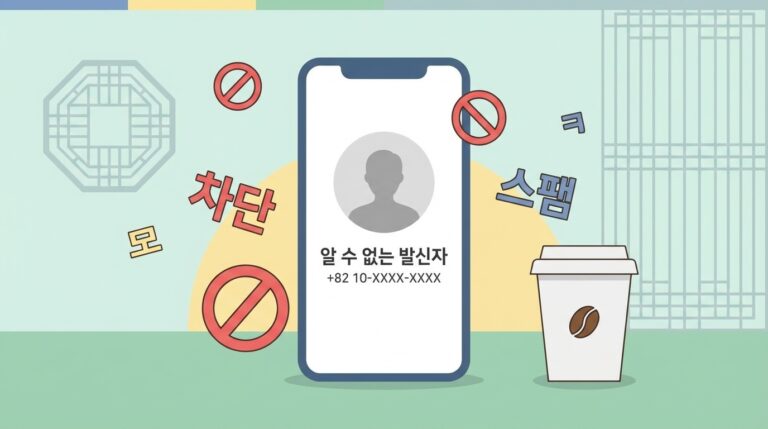
Welcome to the real-life Korean phone experience! If you live in or visit Korea, dealing with spam calls (스팸 전화) is practically a rite of passage. Because tourist SIM numbers are frequently recycled, your new Korean phone number might be incredibly popular with telemarketers and scammers.
If you don’t know how to handle this, you might end up politely listening to a 5-minute automated speech or, worse, falling for a phishing scam. Today, we’ll learn how to express your frustration, handle these calls like a true local, and use your Nunchi (Korean social sense) to filter the good calls from the bad. This guide is inspired by the countless panicked texts I’ve received from my foreign students asking, “Teacher, why does 070 keep calling me?!”
Phase 2: Core Expressions Deep Dive
Let’s look at the survival phrases you need when your phone won’t stop buzzing.
1. 스팸 전화가 너무 많이 와요. (I get too many spam calls.)
- Pronunciation: seupaem jeonhwaga neomu mani wayo. (For ‘eu’ in seupaem, make the disgusted sound you make when stepping in gum: uhh.)
- Meaning: Literal: Spam calls come too much. / Real nuance: My phone is blowing up with spam and I’m so annoyed.
- K-Culture Moment: You’re at a Samgyeopsal (pork belly) restaurant with your coworkers. Your phone rings for the third time during dinner. You aggressively hit ‘decline’, let out a deep sigh, and say this phrase to the table. Everyone will nod in deep sympathy.
- Editor’s Insight: Notice that Koreans use the English word “spam” (스팸) for annoying calls, just like the canned meat (which is highly prized in Korea, ironically!). We say the calls “come” (오다) rather than “I receive” them, focusing on the phone ringing rather than your action.
- Situation Spectrum:
- Casual with friends: ✅ (Say: 스팸 전화 너무 많이 와!)
- Semi-formal with coworkers: ✅
- Formal with bosses: ⚠️ (A bit too casual for a serious meeting, but fine in small talk.)
- 🤔 Think About It: Why do you think the Korean language prefers to say “calls come to me” instead of “I receive calls”? It reflects a worldview where situations happen to us, placing less emphasis on the “I” (the subject) and more on the event itself.
2. 아, 괜찮습니다. (Ah, I’m fine / No thanks.)
- Pronunciation: a, gwaenchanseumnida. (gwaen-chan-seum-ni-da)
- Meaning: Literal: Ah, it is okay. / Real nuance: I’m not interested, please stop talking so I can hang up.
- K-Culture Moment: You accidentally pick up a call from a real telemarketer selling high-speed internet. They speak at the speed of an underground rapper. You interject with this phrase, followed immediately by hanging up.
- Editor’s Insight: “괜찮다” is one of the most magical words in Korean. Depending on the tone, it means “I’m good,” “Don’t worry,” or in this case, a polite but firm “No, thank you.” The “Ah” at the beginning softens the blow but signals that you are cutting them off.
- Situation Spectrum:
- Casual with friends: 🚫 (Don’t use this formal tone with friends)
- Telemarketers/Strangers: ✅
- Formal settings: ✅
- 🤔 Think About It: Many cultures have direct words for “No.” Why do Koreans often use “I’m okay” to reject an offer? It’s rooted in preserving harmony and saving face for both parties.
3. 차단할게요. (I’m going to block it.)
- Pronunciation: chadanhalgeyo. (cha-dan-hal-ge-yo)
- Meaning: Literal: I will block. / Real nuance: This number is going straight to the shadow realm.
- K-Culture Moment: A friend is complaining about a stalker-ish ex or a relentless marketing number. You sip your iced Americano, look them in the eye, and give them this simple, life-saving advice: “그냥 차단해” (Just block them).
- Editor’s Insight: ‘차단’ (Chadan) literally means blockade or interception. It’s the standard term used on Korean smartphones for blocking a number or a social media profile.
- Situation Spectrum:
- Casual with friends: ✅
- Semi-formal with coworkers: ✅
- Formal with bosses: 🚫 (Not usually something you declare to a boss)
- 🤔 Think About It: Blocking is a universal digital action, but how does the ease of “blocking” people change the way we handle relationships in modern society compared to the past?
Phase 3: Textbook vs. Real Korean
| Situation | 📖 Textbook Korean | 🗣️ Real Korean | 💡 Why is it different? |
|---|---|---|---|
| Rejecting an ad call | 광고 전화 안 받습니다. (I do not accept ad calls.) | 아, 안 사요~ (Ah, I’m not buying~) / 뚝 (Sound of hanging up immediately) | Koreans value speed (Palli-palli culture). Engaging with spam wastes precious time. |
| Realizing it’s spam | 이것은 스팸 전화입니다. (This is a spam call.) | 또 스팸이네. (It’s spam again.) / 아, 또 070… (Ah, 070 again…) | Numbers starting with 070 are notorious in Korea for being telemarketers. |
| Warning a friend | 보이스피싱을 조심하십시오. (Please be careful of voice phishing.) | 너 그거 피싱이야. 끊어! (That’s phishing. Hang up!) | Casual urgency dictates dropping formal endings when a friend is in ‘danger’. |
Bottom Note: For B1 learners, just hanging up without a word might feel rude in your culture, but in Korea, it is completely acceptable and expected when dealing with automated spam or aggressive telemarketers.
Phase 4: Cultural Context — K-Culture Deep Dive
4-1. Non-verbal Communication: The Art of the Hang Up
In Korea, dealing with spam isn’t just about what you say; it’s about what you do.
– The Quick Glance & Tap: Koreans can identify a spam call in 0.5 seconds. If the area code is unknown or starts with 070 or 1588, they will often press the volume button to mute the ringing and place the phone face down.
– No “Goodbye”: If you accidentally answer and realize it’s an ad, you do not need to say “Goodbye” (안녕히 계세요). A simple “괜찮습니다” (I’m fine) followed by the immediate click of the end-call button is the standard procedure.
4-2. K-Travel & K-Culture Connection: The Notorious ‘070’
If you travel to Korea, understanding caller ID prefixes is your best defense mechanism.
– 010: Regular mobile phones. (Could be a friend, or a delivery driver!) 🛵
– 02: Seoul landlines. (Could be your hotel, a restaurant you reserved, or spam.)
– 070: VoIP (Internet phones). 99% of the time, this is spam or marketing.
In K-Dramas, you might see a character staring nervously at an unknown number, wondering if it’s their secret crush. In reality, if a Korean sees a 070 number, there is zero romantic tension. They just roll their eyes and ignore it.
Phase 5: Real-Life Roleplay Scenario
Setting: It’s 2 PM on a sunny Saturday. You are sitting at a trendy, minimalist cafe in Seongsu-dong (성수동) with your Korean friend, Minji. You’re enjoying a decadent croffle, but your phone keeps vibrating on the table.
Characters:
– YOU: A foreign student who just got a new Korean phone number 3 days ago. You are expecting a call from a courier delivery.
– Minji (26): Your Korean language exchange partner. Very street-smart and has zero patience for spam.
Dialogue:
Minji: 야, 너 전화 오는데? 안 받아?
(Ya, neo jeonhwa oneunde? an bada?)
[Hey, you’re getting a call? Aren’t you going to answer?]
(🎭 Stage Direction: Minji points at your buzzing phone with her fork.)
YOU: 아, 모르는 번호예요. 택배 기사님인가?
(a, moreuneun beonhoyeyo. taekbae gisaniminga?)
[Ah, it’s an unknown number. Is it the delivery driver?]
Minji: 번호가 뭔데? 어? 070이잖아. 그거 백프로 스팸이야.
(beonhoga mwonde? eo? gong-chil-gong-ijana. geugeo baekpeuro seupaemiya.)
[What’s the number? Huh? It’s 070. That’s 100% spam.]
YOU: 아, 진짜요? 어제부터 스팸 전화가 너무 많이 와요.
(a, jinjjayo? eojebuteo seupaem jeonhwaga neomu mani wayo.)
[Ah, really? Since yesterday, I’ve been getting too many spam calls.]
Minji: 외국인들 처음 개통하면 번호 돌려써서 그래. 그냥 받지 마.
(oegugindeul cheoeum gaetonghamyeon beonho dollyeosseoseo geurae. geunyang batji ma.)
[It’s because they recycle numbers when foreigners first activate them. Just don’t answer.]
(🎭 Stage Direction: The phone stops ringing, but immediately rings again. It’s a 010 number this time!)
YOU: 어! 이번엔 010 번호예요! 택배 맞나 봐요. 여보세요?
(eo! ibeonen gong-il-gong beonhoyeyo! taekbae manna bwayo. yeoboseyo?)
[Oh! This time it’s a 010 number! It must be the delivery. Hello?]
Phone (Automated Voice): 고객님~ 당황하지 마시고 제 말을 들어보세요. 특별 대출 상품 안내입니다…
(gogaengnim~ danghwanghaji masigo je mareul deureoboseyo. teukbyeol daechul sangpum annaeimnida…)
[Customer~ Do not panic and listen to my words. This is a special loan product information…]
🔀 Your Turn! How do you respond to the robotic voice?
– A) “아, 죄송합니다. 안녕히 계세요.” (Ah, I’m sorry. Goodbye.)
– B) “아, 괜찮습니다. (Click!)” (Ah, I’m fine. Hangs up)
– C) “대출 안 필요해요!!” (I don’t need a loan!!)✅ Best Choice: B — Reason: It’s fast, polite enough if it were a real person, but efficient for a robot.
⚠️ Choice A Analysis: You never need to apologize to a spam caller or a robot. It’s unnecessary in Korean culture.
⚠️ Choice C Analysis: Yelling at a robot is just a waste of your croffle-eating energy!
YOU: (Hangs up) 아… 대출 광고였어요.
(a… daechul gwang-goyeosseoyo.)
[Ah… it was a loan advertisement.]
Minji: 거봐. 010으로 오는 스팸도 많아. 그냥 그 번호 차단해버려.
(geobwa. gong-il-gong-euro oneun seupaemdo mana. geunyang geu beonho chadanhaebeoryeo.)
[See? There’s a lot of spam from 010 numbers too. Just completely block that number.]
YOU: 네, 당장 차단할게요. 내 크로플 다 식겠네!
(ne, dangjang chadanhalgeyo. nae keuropeul da sikgenne!)
[Yes, I’ll block it right now. My croffle is going to get cold!]
Phase 6: 10-Second Shadowing Drill
Let’s practice the ultimate natural Korean reaction when you get a spam call.
Follow the slashes (/) for pausing, and pay attention to the emotion tags!
😤 아 진짜 / 또 스팸이야. / 바로 / 차단해야지!
(a jinjja / tto seupaemiya. / baro / chadanhaeyaji!)
[Ah seriously / it’s spam again. / I must block it / right away!]
Voice Note: Put a little annoyance into “진짜” (jinjja) to sound like a true local!
Phase 7: K-Culture Mini Dictionary
Here are some keywords related to our topic today to boost your vocabulary:
| Korean | Romanization | English | Context |
|---|---|---|---|
| 보이스피싱 | boiseupising | Voice Phishing | Scams over the phone. A serious issue in Korea. Never give out your bank details over the phone! |
| 무음 | mueum | Silent mode | How most Koreans keep their phones in public to avoid disturbing others (and to ignore spam). |
| 차단 | chadan | Block | Used for phone numbers, KakaoTalk contacts, and social media. |
| 택배 기사님 | taekbae gisanim | Delivery Driver | The only unknown numbers Koreans actually want to answer! |
| 눈치 | nunchi | Social awareness | Knowing instantly that a brief pause on the line means it’s an auto-dialer. |
Phase 8: Traveler Survival Kit
As a traveler or expat in Korea, dealing with phone calls can be intimidating. Here is your survival kit!
🆘 Survival Phrases for Calls
– 🇰🇷 “한국말 잘 못해요.” (hangungmal jal mothaeyo.)
– 🗣️ English: “I can’t speak Korean well.”
– 📍 Usage: Use this immediately if a real person starts speaking fast Korean to you. Usually, they will apologize and hang up if it’s marketing.
- 🇰🇷 “이거 스팸 번호 같아요?” (igeo seupaem beonho gatayo?)
- 🗣️ English: “Does this look like a spam number?”
- 📍 Usage: Show your ringing screen to a Korean friend or a hotel receptionist before answering.
📌 Editor’s Travel Note:
– Important Apps: Install apps like ‘Whoscall’ or ‘T전화’ (T-Phone). These are incredibly popular in Korea because they use a community database to display caller ID on your screen (e.g., “Insurance Ad,” “Scam,” or “Delivery”).
– Emergency Alerts: If your phone suddenly screams with a loud alarm and a text pops up, don’t panic! That is an 안전안내문자 (Emergency Alert Text) for things like heavy rain, fine dust, or missing persons in your area. It’s not a virus!
Phase 9: Critical Thinking Corner — “One Step Deeper”
🧠 Think Deeper: Media vs. Reality
If you learn about Korea strictly through K-Dramas, you might think every phone call is a matter of life and death, dramatic corporate takeovers, or tearful confessions. In reality, the modern Korean phone experience is heavily saturated with automated telemarketing, delivery notifications, and KakaoTalk messages. The fact that Koreans prefer texting over calling, and often view unexpected phone calls as an intrusion (or “phone phobia” – 콜포비아), shows a shift in modern communication culture. Convenience and personal boundaries are becoming more highly valued than traditional direct contact.💬 Your Turn: Does your country have a lot of spam calls? How do people in your culture usually react to telemarketers? Tell me in the comments!
Phase 10: FAQ & Avoiding Misunderstandings
Q: Is it rude to hang up on a real person without saying goodbye?
Yes, if it’s a normal call! But if it is clearly a telemarketer or a scam, Korean etiquette rules change. It is completely socially acceptable to say “괜찮습니다” (I’m fine) and immediately hang up. You do not need to wait for them to say goodbye.
Q: Should I practice my Korean with the scammers?
I love your enthusiasm for learning, but NO!
❌ Common Mistake #1: Trying to hold a conversation with a telemarketer because you want free listening practice.
✅ Do this instead: Hang up! Engaging with them signals that your number is active, and they will sell your number to other marketing lists. You will get 10x more calls tomorrow!
Q: I answered, and no one spoke for 3 seconds. What is this?
If you answer and there is a dead silence before you hear a click and a person (or robot) starts talking, it is an auto-dialer. Hang up immediately.
Phase 11: Summary & Action Items
One-Liner Summary: When your Korean phone rings with an unknown number, check the prefix, and don’t be afraid to say “괜찮습니다” and confidently tap ‘Block’ (차단)!
Action Mission 3 Steps:
– 🥉 Bronze (Solo): Look at your phone’s call history, imagine they are spam, and practice saying “아, 또 스팸이야. 차단할게요!” out loud 3 times.
– 🥈 Silver (Online): Go to your favorite Korean learning community (or the comments below) and write one sentence about your experience with spam calls in Korea using today’s words.
– 🥇 Gold (Real World): The next time an unknown number calls you and you confirm it’s spam, confidently say “괜찮습니다” and hang up. You are now officially a local!
K-Culture Mission:
Next time you watch a modern K-Drama, pay close attention to how the characters answer their phones. Do they check the screen first? Do they sigh? See if you can spot the realistic phone habits we discussed today!
Phase 12: Quiz — Interactive Challenge
Test your new K-Phone survival skills!
1. Situational Judgment: You are sitting in a quiet library in Seoul. Your phone screen lights up with an incoming call from 070-1234-5678. What is the most culturally accurate reaction?
– A) Answer it and loudly say, “여보세요! 스팸이에요?”
– B) Quickly press the volume button to mute the vibration, ignore it, and later block the number.
– C) Answer it, whisper “괜찮습니다,” and wait for them to hang up.
(Answer: B. 070 is almost certainly spam, and ignoring it silently is the best library etiquette!)
2. Fill in the Blank:
You want to tell your coworker that your phone is blowing up with annoying marketing calls.
“어제부터 _____ 전화가 너무 많이 와요!”
(Answer: 스팸 – Spam)
3. True or False — K-Culture Edition:
“If a Korean friend gets a call from a 010 number, it is 100% definitely a friend or family member.”
(Answer: False. While 010 is for mobile phones, many spammers and delivery drivers also use 010 numbers. Koreans are cautious with ALL unknown numbers!)
Frequently Asked Questions (FAQ)
Q: What does "스팸 전화가 너무 많이 와요. (I get too many spam calls.)" mean in Korean and how do you pronounce it?
A: In Korean, "스팸 전화가 너무 많이 와요. (I get too many spam calls.)" is pronounced [seupaem jeonhwaga neomu mani wayo. (For 'eu' in seupaem, make the disgusted sound you make when stepping in gum: uhh.] and means: Literal: Spam calls come too much. / Real nuance: My phone is blowing up with spam and I'm so annoyed.
Q: What does "아, 괜찮습니다. (Ah, I'm fine / No thanks.)" mean in Korean and how do you pronounce it?
A: In Korean, "아, 괜찮습니다. (Ah, I'm fine / No thanks.)" is pronounced [a, gwaenchanseumnida. (gwaen-chan-seum-ni-da] and means: Literal: Ah, it is okay. / Real nuance: I'm not interested, please stop talking so I can hang up.
Q: What does "차단할게요. (I'm going to block it.)" mean in Korean and how do you pronounce it?
A: In Korean, "차단할게요. (I'm going to block it.)" is pronounced [chadanhalgeyo. (cha-dan-hal-ge-yo] and means: Literal: I will block. / Real nuance: This number is going straight to the shadow realm.







