

How to Throw Away Trash at a Korean Gas Station Without Panicking
Hello! I’m your Daily Hangul Editor.
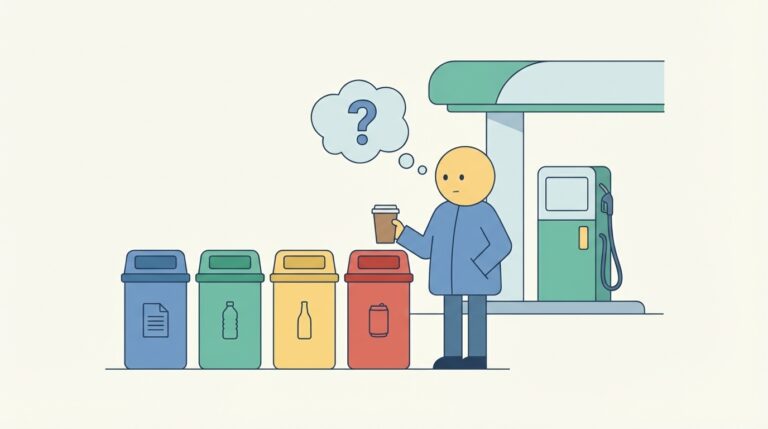
Have you ever watched a K-Drama where the main character is sighing while sorting out plastic bottles and food waste late at night? Or maybe you’ve rented a car for a road trip to Jeju Island or Gangneung. You stop at a gas station (주유소), finish your mandatory iced americano, and walk up to the trash cans… only to freeze. Why are there four different bins? And why is the gas station attendant looking at you?
Korea’s strict recycling culture (Bunlisugeo) is a massive culture shock for many foreigners. Knowing how to politely ask about throwing away trash at a gas station won’t just save you from awkward stares—it will instantly earn you the respect of the locals. Today, based on real questions from our A2 beginner students, we will learn how to navigate the Korean trash system like a true insider!
Phase 2: Core Expressions Deep Dive
1. 쓰레기통 어디에 있어요? (Where is the trash can?)
- Pronunciation: sseu-re-gi-tong eo-di-e is-seo-yo? / ‘sseu’ sounds like the hissing ‘ss’ plus the disgusted ‘eu’ when stepping in gum.
- Meaning: Literal: Trash can where is it? / Real nuance: Where can I throw this away?
- K-Culture Moment: You’re at a self-gas station (셀프 주유소). In Korea, public trash cans are rare on the streets! So, you often have to politely ask the attendant where the hidden bin is.
- Editor’s Insight: This is your survival phrase. Adding a polite “저기요” (Excuse me) before asking works like magic. It shows you’re not just wandering around but actively trying to follow their system.
- Situation Spectrum:
- 친구 사이 (Casual): ⚠️ (Drop the ‘yo’: 쓰레기통 어디 있어?)
- 직장 동료 (Semi-formal): ✅
- 낯선 사람/직원 (Formal): ✅
- 🤔 Think About It: Why are there so few public trash cans on Korean streets? (Hint: It relates to a pay-as-you-throw garbage tax system!)
2. 이거 여기에 버려도 돼요? (Can I throw this away here?)
- Pronunciation: i-geo yeo-gi-e beo-ryeo-do dwae-yo? / ‘dwae’ sounds like “dweh”.
- Meaning: Literal: This here to throw away is it okay? / Real nuance: Can I throw this trash in this specific bin?
- K-Culture Moment: Picture a K-Drama where a rookie employee asks their boss if they can throw away a specific document. The “-아/어도 돼요?” (Is it okay to…?) grammar is the ultimate Nunchi (social tact) tool. You use it to check the vibe and softly ask for permission.
- Editor’s Insight: Rather than declaring “I will throw this away,” Koreans prefer to ask for permission. It shows immense respect for shared spaces, especially in a gas station where the owner personally manages the waste.
- Situation Spectrum:
- 친구 사이 (Casual): ⚠️ (이거 버려도 돼?)
- 직장 동료 (Semi-formal): ✅
- 직장 상사·어른 (Formal): ✅
- 🤔 Think About It: In your culture, do you ask permission before using a store’s trash can, or is it considered a public right?
3. 일반 쓰레기예요? (Is it general waste?)
- Pronunciation: il-ban sseu-re-gi-ye-yo?
- Meaning: Literal: Is it general trash? / Real nuance: Does this go in the general waste bin (not recycling)?
- K-Culture Moment: You’re finishing your K-BBQ, and you want to throw away a used, greasy napkin. You look at the bins: Plastic, Paper, Cans… and “Ilban Sseuregi” (General Waste). This phrase saves you from the wrath of Korean recycling laws!
- Editor’s Insight: Recycling (분리수거) is practically a national sport. If it’s dirty or not recyclable, it’s “general waste.”
- Situation Spectrum:
- 친구 사이 (Casual): ✅ (일반 쓰레기야?)
- 직장 동료 (Semi-formal): ✅
- 직장 상사·어른 (Formal): ✅
- 🤔 Think About It: Does your country have strict rules about separating plastic from general waste? How does it compare to Korea’s system?
Phase 3: Textbook vs. Real Korean
| 상황 | 📖 교과서 한국어 | 🗣️ 진짜 한국어 | 💡 왜 다를까? |
|---|---|---|---|
| Looking for a bin | 쓰레기를 버리고 싶습니다. (I want to throw away trash.) | 저기요, 쓰레기통 어딨어요? (Excuse me, where is the trash can?) | Koreans drop the object particle (를) in speech and ask directly instead of stating their desire. |
| Asking to throw something away | 여기에 쓰레기를 버려도 됩니까? (May I dispose of trash here?) | 이거 버려도 돼요? (Is it okay to throw this away?) | “-됩니까” is too stiff for daily life. “-아/어도 돼요” is the friendly, natural choice! |
Phase 4: Cultural Context — K-Culture Deep Dive
Non-verbal Nunchi (눈치)
Language isn’t just spoken; it’s physical! When asking “이거 버려도 돼요?”, hold the trash up slightly to show the attendant exactly what it is. This helps them quickly judge which bin it goes into. That’s Nunchi in action!
K-Travel & The Recycling Reality
Self-gas stations (셀프 주유소) are incredibly common in Korea, but there is almost always a small office (사무실) with an attendant. You will rarely find a giant, open dumpster. Why? Because historically, people would secretly dump their household trash there! Therefore, holding up your small travel wrapper and asking politely proves you are just a considerate traveler, not an illegal dumper.
Phase 5: Real-Life Roleplay Scenario
Setting: A breezy Saturday morning. You’ve stopped at a self-gas station in Gapyeong on your way to a K-Pop concert. You have an empty iced americano cup and a buttery pastry wrapper.
Characters:
– YOU: A traveler trying to be polite.
– Ahjussi (아저씨): The 60-year-old gas station attendant. Wearing a reflective vest, looks busy but is secretly friendly.
Ahjussi: 어서 오세요! 주유하세요? ⛽
(eoseo oseyo! juyuhaseyo?)
(Welcome! Are you getting gas?)
YOU: 네! 아, 저기요… 쓰레기통 어디에 있어요?
(ne! a, jeogiyo… sseuregitong eodie isseoyo?)
(Yes! Ah, excuse me… where is the trash can?)
Ahjussi: 저쪽 사무실 옆에 있어요.
(jeojjok samusil yeope isseoyo.)
(It’s over there next to the office.)
(🎭 Stage Direction: You walk over to the bins and see 4 different colors.)
YOU: 감사합니다. 이거 여기에 버려도 돼요? ☕
(gamsahamnida. igeo yeogie beoryeodo dwaeyo?)
(Thank you. Can I throw this away here?)
Ahjussi: 플라스틱 컵이네요. 컵은 저기 노란 통에 넣으세요.
(peullaseutik keobineyo. keobeun jeogi noran tonge neoeuseyo.)
(It’s a plastic cup. Put the cup in that yellow bin over there.)
🔀 Your Turn! What should you do with the leftover ice inside the cup?
– A) Throw the whole cup, ice included, into the plastic bin.
– B) Ask “이 얼음은 일반 쓰레기예요?” (Is this ice general waste?)
– C) Look for a sink or drain to empty the ice first.✅ Best Choice: C! In Korea, all liquids and ice must be emptied before recycling plastics. If you do this, the Ahjussi will be incredibly impressed!
YOU: 아, 네! 그럼 이 빵 봉지는 일반 쓰레기예요? 🥐
(a, ne! geureom i ppang bongjineun ilban sseuregiyeyo?)
(Ah, okay! Then is this bread wrapper general waste?)
Ahjussi: 맞아요. 일반 쓰레기통에 버리세요.
(majayo. ilban sseuregitonge beoriseyo.)
(That’s right. Throw it in the general waste bin.)
Phase 6: 10-Second Shadowing Drill
Read these out loud! Follow the pauses (/) and the emotion tags.
😊 저기요, / 쓰레기통 / 어디에 있어요?
(jeo-gi-yo, / sseu-re-gi-tong / eo-di-e is-seo-yo?)
🥺 이거 / 여기에 버려도 / 돼요?
(i-geo / yeo-gi-e beo-ryeo-do / dwae-yo?)
Phase 7: K-Culture Mini Dictionary
| 한국어 | Romanization | English | 맥락 설명 |
|---|---|---|---|
| 쓰레기통 | sseu-re-gi-tong | Trash can | Hard to find on the streets, usually hidden inside stores or stations! |
| 분리수거 | bun-ri-su-geo | Recycling | The strict Korean system of separating waste by material. |
| 일반 쓰레기 | il-ban sseu-re-gi | General waste | Anything that cannot be recycled (like dirty napkins). |
| 주유소 | ju-yu-so | Gas station | Often split into self-service (셀프) and full-service. |
| 휴게소 | hyu-ge-so | Rest stop | The ultimate Korean road trip destination, famous for street food! |
Phase 8: Traveler Survival Kit
Gas stations and rest stops are the heart of Korean road trips. Here are your top survival phrases!
🆘 Survival Phrases for the Road
– 🇰🇷 “화장실 어디에 있어요?” (hwajangsil eodie isseoyo?)
– 🗣️ English: Where is the restroom?
– 📍 Context: Gas station restrooms are usually free and open to the public!
- 🇰🇷 “가득 채워주세요.” (gadeuk chaewojuseyo.)
- 🗣️ English: Please fill it up.
- 📍 Context: Use this at full-service gas stations.
🇰🇷 “영수증 주세요.” (yeongsujeung juseyo.)
- 🗣️ English: Please give me the receipt.
📌 Editor’s Travel Note:
– Maps: Do NOT use Google Maps for driving in Korea! Download Naver Map or KakaoMap for accurate navigation.
– Payment: Korean self-gas stations only accept credit cards. Keep a physical card handy!
Phase 9: Critical Thinking — “One Step Deeper”
Global Era & Environment (Civic Duty)
Why is Korea’s recycling system (Bunlisugeo) so intense? Korea is a geographically small country with a very large population. Landfill space ran out decades ago. Therefore, strictly separating trash isn’t just an annoying rule—it’s a deeply ingrained civic duty and a survival strategy for the nation. It reflects the collective mindset of Korean society: minor personal inconveniences (like washing out a plastic cup) are accepted for the greater good of the community.
💬 Your Turn: How is recycling handled in your home country? Is it an individual choice or a strict community rule? Let us know in the comments!
Phase 10: FAQ & Avoiding Misunderstandings
Q: Can I dump a big bag of trash from my car at the gas station?
A: NO! Gas stations only accept small, incidental trash (like a coffee cup or a snack wrapper). Dumping big bags of “house trash” (생활 쓰레기) is illegal and extremely frowned upon.
Q: What if I can’t read the Korean recycling labels on the bins?
A: Look at the shapes or English icons! PET means plastic bottles, 비닐 means soft plastics/wrappers, and 캔 is for cans. When in doubt, ask: “일반 쓰레기예요?”
❌ Common Mistake #1: Leaving liquids or ice inside a plastic cup before recycling it.
✅ Do this instead: Always look for a drain to pour out the ice/water, or politely ask the staff where you can empty it first!
Phase 11: Summary & Action Items
One-Liner Summary: Softly asking “이거 버려도 돼요?” before tossing your trash will make you the most polite and respected traveler on the Korean highways!
Action Mission:
– 🥉 Bronze (Solo): Stand in front of your mirror holding a cup and say, “쓰레기통 어디에 있어요?” 3 times.
– 🥈 Silver (Online): Share a photo of your local recycling bins in our community and write “일반 쓰레기” next to the general waste!
– 🥇 Gold (Real Life): Next time you visit a Korean cafe, convenience store, or gas station, actually ask the staff “이거 버려도 돼요?”
K-Culture Mission:
Watch a K-Drama episode this week and spot a scene where someone is taking out the recycling (Bunlisugeo) or standing near the community bins!
Phase 12: Quiz — Interactive Challenge
1. You have a dirty, greasy napkin from eating K-BBQ. Which bin does it go into?
a) 플라스틱 (Plastic)
b) 일반 쓰레기 (General Waste)
c) 종이 (Paper)
2. True or False: It is completely fine to throw away a large, full bag of trash from your hotel room at a local gas station because trash cans are public.
3. Fill in the blank: To politely ask for the trash can, you should say “__________, 쓰레기통 어디에 있어요?”
a) 야! (Hey!)
b) 저기요 (Excuse me)
c) 안녕 (Bye)
(Answers: 1: b – Food-soiled paper cannot be recycled! / 2: False – Dumping large trash is illegal and rude. / 3: b – ‘저기요’ is the perfect polite attention-grabber.)
Frequently Asked Questions (FAQ)
Q: What does "쓰레기통 어디에 있어요? (Where is the trash can?)" mean in Korean and how do you pronounce it?
A: In Korean, "쓰레기통 어디에 있어요? (Where is the trash can?)" is pronounced [sseu-re-gi-tong eo-di-e is-seo-yo? / 'sseu' sounds like the hissing 'ss' plus the disgusted 'eu' when stepping in gum.] and means: Literal: Trash can where is it? / Real nuance: Where can I throw this away?
Q: What does "이거 여기에 버려도 돼요? (Can I throw this away here?)" mean in Korean and how do you pronounce it?
A: In Korean, "이거 여기에 버려도 돼요? (Can I throw this away here?)" is pronounced [i-geo yeo-gi-e beo-ryeo-do dwae-yo? / 'dwae' sounds like "dweh".] and means: Literal: This here to throw away is it okay? / Real nuance: Can I throw this trash in this specific bin?
Q: What does "일반 쓰레기예요? (Is it general waste?)" mean in Korean and how do you pronounce it?
A: In Korean, "일반 쓰레기예요? (Is it general waste?)" is pronounced [il-ban sseu-re-gi-ye-yo?] and means: Literal: Is it general trash? / Real nuance: Does this go in the general waste bin (not recycling)?







