

Phase 1: Empathy (The K-Culture Cold Open)
Hello! This is your Daily Hangul Editor.
Imagine you are watching a popular historical K-Drama (사극 – Sageuk) like The Crowned Clown or Mr. Queen. The scene is set in a bustling marketplace during the Joseon Dynasty. A masked dancer (탈춤꾼) is performing a hilarious, exaggerated routine, pretending to be a clumsy nobleman. The peasants in the drama are roaring with laughter. The subtitles simply say, “Look at this foolish man!”
But as a C1 level learner, you might notice something deeper. The Korean viewers aren’t just laughing at physical comedy; they are experiencing a profound sense of catharsis. That dancer isn’t just making a joke—he is delivering a devastating social critique right under the noses of the corrupt officials.
Welcome to the world of 고전 문학의 해학 풍자 (Humor and Satire in Classical Literature).
If you want to truly understand Korean humor—why Koreans love “diss” tracks, why office workers use certain slang to vent about their bosses, and how Koreans historically survived oppression with a smile—you need to understand this concept. This isn’t just textbook literature; it’s the DNA of modern Korean wit. Let’s dive into the hidden layers of Korean sarcasm.
Phase 2: Core Expressions Deep Dive
To grasp Korean satire, you need these three essential concepts.
1. 해학 (Humor with Empathy)
- Pronunciation: [haehak] – Sounds like ‘heh-hak’. Make the ‘h’ sound crisp.
- Meaning: Compassionate humor; finding joy and laughter in the midst of sorrow and hardship.
- K-Culture Moment: You see this in modern K-Dramas like Reply 1988. The characters are poor, life is hard, but they sit together, share a cheap meal, and laugh at their own misery. It’s not mocking; it’s healing through shared laughter.
- Editor’s Insight: Haehak is about laughing with someone’s struggle. It’s a warm, optimistic type of humor that says, “Life is tough, but we will smile anyway.”
- Situation Spectrum: [🚫 절대 금지] ———— [⚠️ 주의] ———— [✅ 자유롭게]
- Casual/Friends: ✅ (Discussing a movie or book)
- Semi-formal: ✅
- Formal/Elders: ✅ (It’s a high-level academic and cultural term)
- 🤔 Think About It: Why did a culture that went through so much historical turmoil develop a specific word for “optimistic humor amid sorrow”? Does your culture have a similar coping mechanism through language?
2. 풍자 (Satire / Sharp Sarcasm)
- Pronunciation: [pungja] – The ‘pung’ rhymes with ‘hung’, ‘ja’ as in ‘jar’.
- Meaning: Satire; criticizing the powerful, wealthy, or corrupt by making them look foolish.
- K-Culture Moment: Think of the Oscar-winning movie Parasite (기생충). The entire film is a masterpiece of modern Pungja, mocking the absurdities of class division without giving a direct lecture.
- Editor’s Insight: If Haehak is a warm hug, Pungja is a sharp dagger hidden behind a smile. It is the art of roasting someone politely.
- Situation Spectrum: [🚫 절대 금지] ———— [⚠️ 주의] ———— [✅ 자유롭게]
- Casual/Friends: ✅
- Semi-formal: ⚠️ (Be careful when pointing out satire in a sensitive workplace)
- Formal/Elders: ✅ (When used in an academic/analytical context)
- 🤔 Think About It: Direct confrontation was dangerous in hierarchical Joseon society. How does Pungja reflect the survival tactics of the lower class?
3. 뼈가 있다 (Having a bone in the words)
- Pronunciation: [ppyeoga itda] – ‘Ppyeo’ sounds like a sharp, tense ‘pyuh’.
- Meaning: Literal: “There is a bone.” Real nuance: Words that sound polite or casual on the surface but contain a hidden, often critical or sarcastic meaning.
- K-Culture Moment: In a corporate K-Drama, a boss smiles and says, “You sure do leave exactly at 6:00 PM every day, you must be so efficient!” The junior employee instantly freezes. That compliment? 뼈가 있는 말 (Words with a bone).
- Editor’s Insight: This is the ultimate phrase to describe indirect Korean communication. When someone gives you a backhanded compliment, you say, “말에 뼈가 있네” (There’s a bone in those words).
- Situation Spectrum: [🚫 절대 금지] ———— [⚠️ 주의] ———— [✅ 자유롭게]
- Casual/Friends: ✅
- Semi-formal: ⚠️ (You can say it behind the boss’s back, but never to their face!)
- Formal/Elders: 🚫
- 🤔 Think About It: Why do Koreans often prefer to hide their true critiques behind polite words (뼈 있는 말) rather than giving direct feedback?
Phase 3: Textbook vs. Real Korean
How do we express “satire” and “hidden meaning” in daily life? Let’s compare.
| 상황 (Situation) | 📖 교과서 한국어 (Textbook) | 🗣️ 진짜 한국어 (Real Korean) | 💡 왜 다를까? (Why the difference?) |
|---|---|---|---|
| Criticizing indirectly | 이 작품은 사회를 풍자합니다. (This work satirizes society.) | 이거 완전 돌려 까는 거네. (This is totally mocking them indirectly.) | “돌려 까다” (To peel/cut around) is a vivid slang used by younger generations to mean “backhanded insult.” |
| Delivering a harsh truth | 현실을 예리하게 비판하네요. (It sharply criticizes reality.) | 완전 팩폭이네요. (Total Fact-Bomb.) | “팩폭” (팩트 폭력 – Fact Violence) shows the modern preference for aggressive but truthful humor. |
| Realizing a hidden insult | 그 말에는 숨은 의도가 있군요. (There is a hidden intention in those words.) | 와, 방금 뼈 때렸어요. (Wow, that just hit the bone.) | Evolved from “뼈가 있다”, meaning the hidden truth hit them where it hurts. |
Bottom Note for C1 Learners: “돌려 까다” and “팩폭” are brilliant for showing off your natural Korean with friends, but keep “풍자” and “해학” for your university essays or formal debates!
Phase 4: Cultural Context — K-Culture Deep Dive
4-1. The Non-Verbal “Mask” (탈 – Tal)
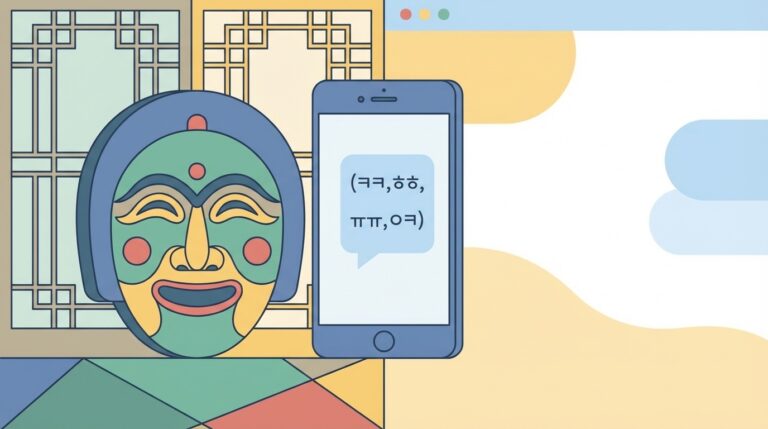
When discussing Haehak and Pungja, we must talk about the physical manifestation of Korean satire: The Mask Dance (탈춤 – Talchum). The traditional Hahoe mask has a fascinating feature. If you tilt the mask slightly forward, it looks like it is smiling brightly. Tilt it back, and it looks furious.
This perfectly embodies Korean indirectness. You present a smiling face (politeness, respect to hierarchy) while hiding your true feelings (critique, anger). When you say a “뼈 있는 농담” (joke with a bone), your face should maintain a polite, almost innocent smile.
4-2. Satire in K-Dramas (사극 – Sageuk)
Have you noticed that in almost every historical K-Drama, there is a “foolish” character? A beggar, a clown, or a drunken scholar? In Korean classical literature, these characters are the ultimate vehicles for Pungja. Because they are considered “fools,” the Yangban (nobles) ignore them. This gives them the ultimate freedom of speech to roast the king and the corrupt officials.
Critical Viewpoint: While modern K-Dramas often romanticize the Joseon Dynasty as a time of beautiful Hanboks and romantic princes, traditional Korean literature was actually incredibly rebellious, constantly mocking that very ruling class!
Phase 5: Real-Life Roleplay Scenario
Setting: A Friday night in a traditional tavern (주막 – Jumak style) in Insadong. The smell of seafood pancakes (해물파전) fills the air, and you are drinking Makgeolli out of brass bowls with two of your Korean university friends after watching a critically acclaimed satirical movie.
Characters:
– YOU: An international student with a deep interest in Korean cinema and literature.
– Minho (25): Your outspoken Korean friend who loves analyzing society.
– Jiyeon (24): A witty friend who works a tough part-time job under a bad boss.
Dialogue:
Minho: 오늘 영화 진짜 대박 아니었어? 감독이 한국 사회를 아주 제대로 풍자했더라.
(Oneul yeonghwa jinjja daebak anieosseo? Gamdogi hanguk sahoereul aju jedaero pungjahaetdeora.)
[Translation: Wasn’t the movie amazing today? The director really satirized Korean society properly.]
Jiyeon: 내 말이. 그 악덕 사장 캐릭터, 완전 우리 알바 점장님인 줄 알았잖아.
(Nae mari. Geu akdeok sajang kaerikteo, wanjeon uri alba jeomjangnimin jul aratjana.)
[Translation: Tell me about it. That evil boss character, I totally thought it was my part-time job manager.]
YOU: 특히 마지막에 주인공이 웃으면서 사장한테 수고하셨다고 할 때… 와, 소름 돋았어.
(Teukhi majimage juingongi useumyeonseo sajanghante sugohasyeotdago hal ttae… wa, soreum dodasseo.)
[Translation: Especially at the end when the main character smiled and told the boss ‘good job’… wow, I got goosebumps.]
Minho: 맞아! 칭찬하는 척하면서 완전 돌려 깐 거잖아.
(Maja! Chingchanhaneun cheokhamyeonseo wanjeon dollyeo kkan geojana.)
[Translation: Right! He completely mocked him indirectly while pretending to praise him.]
Jiyeon: 우리 점장님도 맨날 나한테 “지연 씨는 참 여유로워서 좋겠어~” 이러거든. 그거 칭찬 아니지?
(Uri jeomjangnimdo maennal nahante “Jiyeon ssineun cham yeoyurowoseo jokgesseo~” ireogeodeun. Geugeo chingchan aniji?)
[Translation: My manager always says to me, “Jiyeon, it must be nice to be so relaxed/slow~” That’s not a compliment, right?]
🔀 Your Turn! How should you respond to Jiyeon?
– A) “응, 칭찬 아니야. 점장님 나빠!” (Simple, a bit childish for C1)
– B) “완전 뼈 있는 말이네. 지연 씨가 행동이 느리다고 돌려 까는 거 아냐?” (Using the advanced expressions perfectly)
– C) “해학적인 표현이네요!” (Grammatically correct, but totally the wrong context. This is insult, not warm humor!)
✅ Best Choice: B — Reason: You successfully identify the manager’s comment as a “뼈 있는 말” (words with a bone) and use the slang “돌려 까다” to empathize with your friend.
⚠️ Choice C Analysis: You must distinguish between literary terms and real-life insults. Using “Haehak” here sounds like you are analyzing her misery for an essay!
Phase 6: 10-Second Shadowing Drill
Let’s practice delivering a high-level critique like a true Korean film critic. Pay attention to the pauses (/) and the tone!
😏 단호하고 지적으로 (Firmly and intellectually):
이 작품의 / 진짜 매력은, / 권력자를 향한 / 뼈 있는 풍자에 / 있죠.
(i jakpum-ui / jinjja maeryeog-eun, / gwollyeokja-reul hyanghan / ppyeo inneun pungja-e / itjyo.)
[The true charm of this work lies in its biting satire toward those in power.]
Phase 7: K-Culture Mini Dictionary
| 한국어 (Korean) | Romanization | 영어 (English) | 맥락 설명 (Context) |
|---|---|---|---|
| 양반 | Yangban | Nobleman | Historically aristocrats. Today, used sarcastically for someone acting entitled. (예: “아주 양반 나셨네” – Look at this lord over here.) |
| 마당놀이 | Madangnori | Traditional Outdoor Yard Play | The historical stage for Haehak and Pungja. It broke the barrier between actors and the audience. |
| 눈치 | Nunchi | Social situational awareness | Essential for understanding Pungja. Without Nunchi, you won’t realize you are being mocked. |
| 갑질 | Gapjil | Abuse of power | The modern behavior of the wealthy/powerful that is often the target of today’s satirical K-Dramas. |
Phase 8: Traveler’s Survival Kit
Even if you are an advanced learner, navigating traditional cultural sites can be tricky. If you visit the Korean Folk Village (한국민속촌) to see traditional satire in action, here is what you need.
🆘 Survival Phrases for Cultural Sites
– 🇰🇷 “탈춤 공연은 몇 시에 시작하나요?” (Talchum gongyeoneun myeot sie sijakanayo?)
– 🗣️ Meaning: What time does the mask dance performance start?
– 📍 Where to use: Information desks at palaces or folk villages.
- 🇰🇷 “이 탈은 어떤 의미가 (사연이) 있나요?” (I tareun eotteon uimiga innayo?)
- 🗣️ Meaning: What meaning (or backstory) does this mask have?
- 📍 Where to use: Souvenir shops in Insadong or museums. Koreans love explaining the deep lore behind their crafts!
📌 Editor’s Travel Note
– Pro Tip: At the Korean Folk Village, actors play traditional characters (like beggars, greedy officials, and merchants) and roam around interacting with tourists. If an actor playing a “beggar” (거지) makes a sarcastic joke at you, play along! It’s a live, modern version of traditional Haehak.
Phase 9: Critical Thinking Corner — “One Step Deeper”
🧠 Think Deeper: Language & Power (언어와 권력)
Why did Pungja (satire) become such a highly developed art form in Korea? In the heavily stratified Joseon society, speaking directly against a Yangban (nobleman) or the King could literally cost you your life. Therefore, the lower classes had to invent a language of duplicity. They used metaphors, animal comparisons, and masked dances to voice their grievances safely.
Interestingly, we still see this dynamic in modern corporate Korea. Because of strict age and rank hierarchies, direct confrontation with a CEO or a senior manager is taboo. Instead, employees use blind apps (like the app ‘Blind’), subtle slang, and “뼈 있는 농담” (jokes with a bone) to release stress and critique the system.
💬 Your Turn:
Does your culture rely on direct confrontation to solve social issues, or do you use humor and satire to critique the powerful? Share how your country handles “roasting the boss” in the comments!
Phase 10: FAQ & Avoiding Misunderstandings
Q1: Can I tell my professor or boss, “방금 그 말씀 뼈 때리네요” (Your words just hit the bone/fact-bombed me)?
No! Even if they gave you a very accurate critique, “뼈 때리다” or “팩폭” is internet slang. To a superior, say, “정확한 지적이십니다” (That is a precise point).
Q2: Is “돌려 까다” the same as “풍자하다”?
Conceptually, yes. But register matters. “풍자하다” is formal and literary (used in essays and news). “돌려 까다” is very informal and slightly vulgar slang (used over drinks with friends).
❌ Common Mistake #1: Confusing 비하 (Belittling) with 풍자 (Satire)
Foreign learners sometimes try to make a “sarcastic Korean joke” but end up just insulting someone. True Korean Pungja always “punches up” (criticizing the powerful), not “punches down” (mocking the weak). If you mock someone’s appearance or poverty, that is simply 비하 (belittling) and will offend people.
Phase 11: Summary & Action Items
One-Liner Summary:
Mastering Korean satire means understanding Haehak (warm humor to survive sorrow) and Pungja (sharp wit to critique the powerful behind a polite smile).
Action Mission 3 Steps:
– 🥉 Bronze (Solo): Read a short plot summary of the Korean classic “The Tale of Hong Gildong” (홍길동전) and identify the Pungja elements.
– 🥈 Silver (Online): Leave a comment on a K-Drama YouTube clip using the phrase, “감독의 뼈 있는 풍자가 돋보이네요” (The director’s biting satire stands out).
– 🥇 Gold (Real Life): Next time your Korean friend makes a sarcastic but true observation, react with, “와, 방금 완전 뼈 때렸어!” (Wow, that hit the bone!)
🎬 K-Culture Mission:
Watch one episode of a satirical K-Drama (like Vincenzo or The Fiery Priest). Can you spot the moment when a character uses a polite, smiling tone to deliver a devastating threat or critique?
Phase 12: Quiz — Interactive Challenge
Q1. Situational Judgment:
You are writing a university essay analyzing the movie Parasite. Which sentence is most appropriate to describe the director’s style?
1) 봉준호 감독은 자본주의를 아주 잘 돌려 깠습니다.
2) 봉준호 감독은 자본주의의 모순을 날카롭게 풍자했습니다.
3) 봉준호 감독은 부자들에게 팩폭을 날렸습니다.
Q2. Fill in the Blank:
A: 과장님이 아까 웃으면서 하신 말씀… 칭찬 아니지?
B: 응. 완전 ( ) 있는 농담이더라. 조심해.
Q3. True or False – K-Culture Edition:
Historically, the Mask Dance (Talchum) was strictly performed for the King inside the royal palace, and peasants were not allowed to watch it. (T/F)
(Answers)
Q1: 2 (Options 1 and 3 use slang inappropriate for an essay).
Q2: 뼈 (A joke with a bone).
Q3: False. Mask dances were deeply rooted in commoner (peasant) culture as a way to relieve stress and mock the ruling Yangban class!
Frequently Asked Questions (FAQ)
Q: What does "해학 (Humor with Empathy)" mean in Korean and how do you pronounce it?
A: In Korean, "해학 (Humor with Empathy)" is pronounced [haehak] and means: Compassionate humor; finding joy and laughter in the midst of sorrow and hardship.
Q: What does "풍자 (Satire / Sharp Sarcasm)" mean in Korean and how do you pronounce it?
A: In Korean, "풍자 (Satire / Sharp Sarcasm)" is pronounced [pungja] and means: Satire; criticizing the powerful, wealthy, or corrupt by making them look foolish.
Q: What does "뼈가 있다 (Having a bone in the words)" mean in Korean and how do you pronounce it?
A: In Korean, "뼈가 있다 (Having a bone in the words)" is pronounced [ppyeoga itda] and means: Literal: "There is a bone." Real nuance: Words that sound polite or casual on the surface but contain a hidden, often critical or sarcastic meaning.







