

Phase 1: Empathy (Welcome to the Digital Line)
Hello! I’m your Daily Hangul Editor.
Imagine this: You’ve finally arrived at that viral K-BBQ spot in Seongsu-dong. You see a crowd of people outside, but surprisingly, there’s no actual line. Everyone is just chatting, taking selfies, or staring at their phones. You think, “Great, no line! I’ll just walk right in!”
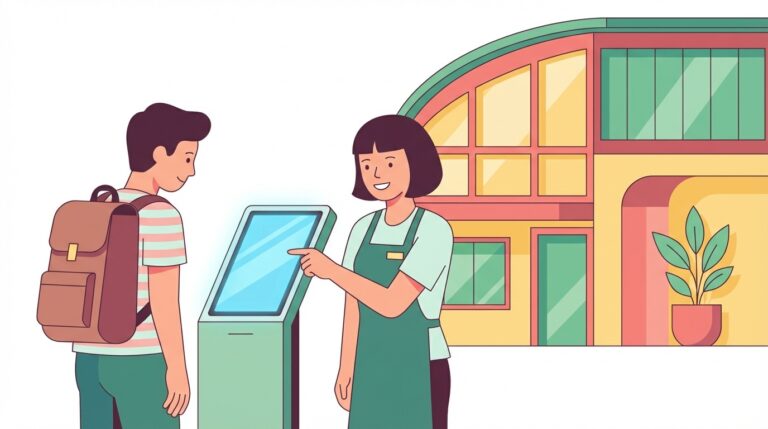
But suddenly, the host politely blocks your path and points to a glowing tablet next to the door. You tap it, and it asks for a “010” phone number. Panic sets in. You don’t have a Korean phone number. Do you just leave?
Welcome to the final boss of modern Korean dining: The Digital Waiting App (like CatchTable or Tableling). In Korea, standing in a physical line is becoming a thing of the past. If you don’t know how to navigate these kiosks, you might miss out on the best meals of your trip! Don’t worry, this guide is built from the real tears and triumphs of foreign travelers. Let’s get you that table!
Phase 2: Core Expressions Deep Dive
1. 웨이팅 걸다 (To put oneself on the waitlist)
- Pronunciation: wae-i-ting geol-da [Sounds like “waiting” + “gull-da” (like seagull without the sea)]
- Meaning: Literal: To hang a wait. / Real nuance: To register on the digital waitlist.
- K-Culture Moment: You’ll hear this constantly among Korean friends planning a night out. “Hey, I’ll go ahead and ‘hang a wait’ at the restaurant while you guys park the car!”
- Editor’s Insight: We borrowed the English word “waiting” but turned it into a uniquely Korean verb by adding “걸다” (to hang/initiate). It feels much more active and tech-savvy than the traditional “기다리다” (to wait).
- Situation Spectrum:
[🚫 Strictly Forbidden] ———— [⚠️ Use with Caution] ———— [✅ Feel Free to Use]- Friends (Casual): ✅ (웨이팅 걸었어? – Did you register for the wait?)
- Co-workers (Semi-formal): ✅ (웨이팅 걸어 놓을게요 – I’ll put us on the waitlist.)
- Elders/Bosses (Formal): ⚠️ (Better to say: 대기 등록했습니다 – I have registered us for the wait.)
- 🤔 Think About It: Why do Koreans mix English nouns with Korean verbs (like ‘웨이팅 걸다’) instead of just using native Korean words? How does this reflect Korea’s fast-paced trend adoption?
2. 외국인이라서 한국 번호가 없는데요… (I’m a foreigner, so I don’t have a Korean number…)
- Pronunciation: oe-gug-in-i-ra-seo han-guk beon-ho-ga eom-neun-de-yo…
- Meaning: Literal: Because I am a foreigner, a Korean number does not exist… / Real nuance: I don’t have a local number to use this machine, can you help me?
- K-Culture Moment: You are staring helplessly at the CatchTable tablet. A staff member walks by. You hit them with this line, and immediately, their “hospitality mode” activates.
- Editor’s Insight: The magic here is the ending “~는데요” (…so…). It leaves the sentence slightly open-ended. You aren’t demanding help; you are stating your situation and implicitly inviting them to offer a solution. It’s the ultimate polite “damsel/dude in distress” phrase.
- Situation Spectrum:
[🚫 Strictly Forbidden] ———— [⚠️ Use with Caution] ———— [✅ Feel Free to Use]- Friends (Casual): 🚫 (Doesn’t make sense contextually)
- Restaurant Staff (Formal/Polite): ✅
- 🤔 Think About It: Korean communication relies heavily on reading the room (Nunchi). Why is hinting at a problem often preferred over directly saying “Help me register”?
3. 앞에 몇 팀 남았어요? (How many teams are ahead of us?)
- Pronunciation: a-pe myeot tim na-ma-sseo-yo?
- Meaning: Literal: In front, how many teams are left? / Real nuance: How much longer is the wait?
- K-Culture Moment: You’ve been waiting for 40 minutes. The smell of grilled pork belly is driving you crazy. You pop your head into the restaurant and ask the staff this question.
- Editor’s Insight: We count waiting groups as “팀” (teams). It highlights the communal aspect of Korean dining—you rarely eat alone at these famous spots; you eat as a “team.”
- Situation Spectrum:
[🚫 Strictly Forbidden] ———— [⚠️ Use with Caution] ———— [✅ Feel Free to Use]- Restaurant Staff (Formal/Polite): ✅
Phase 3: Textbook vs. Real Korean
| Situation | 📖 Textbook Korean | 🗣️ Real Korean | 💡 Why the difference? |
|---|---|---|---|
| Joining the waitlist | 식당 대기 명단에 이름을 적어 주세요. (Please write your name on the waiting list.) | 캐치테이블로 웨이팅 걸어주세요. (Please “hang a wait” via CatchTable.) | Digital platforms have completely replaced paper lists in hot spots. |
| Asking about the wait | 얼마나 기다려야 합니까? (How long must I wait?) | 앞에 몇 팀 있어요? (How many teams are ahead?) | Koreans measure wait time by the number of groups, not just minutes. |
| Being notified | 차례가 되면 알려드리겠습니다. (We will inform you when it’s your turn.) | 카톡 알림톡 확인해 주세요. (Please check your KakaoTalk notification.) | Automation! Staff rely on automated KakaoTalk messages rather than shouting names. |
Bottom Note: As a B2 learner, start replacing “기다리다” (to wait) with “웨이팅 하다/걸다” when talking about popular cafes and restaurants. You’ll sound instantly more like a Seoulite!
Phase 4: Cultural Context — K-Culture Deep Dive
4-1. Non-verbal Cue: The “Hovering” Nunchi
When you ask the staff for help with the kiosk, don’t just shove your phone in their face. Stand slightly to the side of the tablet, make eye contact, and softly say “저기요…” (Excuse me…). When they look, point to the screen and explain you don’t have a number. Looking a bit apologetic goes a long way!
4-2. The “Ppalli-Ppalli” Culture Meets Tech (K-Food & K-Travel)
If you’ve watched any K-Drama featuring a restaurant scene, you rarely see people waiting in long, miserable lines outside anymore. Why? Korea’s famous 빨리빨리 (Ppalli-Ppalli / Hurry-Hurry) culture evolved into extreme efficiency.
Instead of wasting time in line, Koreans “hang a wait” on an app, then go shopping nearby, grab a quick coffee, or take photos in a photo booth (인생네컷). The app sends a KakaoTalk message when there are 2-3 teams left. It’s brilliant, but for tourists without a local SIM card, this high-tech wall can feel like being locked out of the cool kids’ club. Don’t worry—most places have a backup plan for tourists if you know how to ask!
Phase 5: Real-life Roleplay Scenario
Setting: A Friday afternoon in Yeonnam-dong. You are at a trendy cafe famous for its “flat croissants.” There is a tablet outside, but it requires a Korean phone number. You catch the eye of a staff member who is clearing a table near the door.
Characters:
– YOU: A traveler whose feet are tired and who desperately needs a sugar rush.
– Ji-hoon: (25, Cafe Staff, moving quickly but looks friendly).
Dialogue:
YOU: 저기요, 웨이팅 하려고 하는데요…
(jeo-gi-yo, wae-i-ting ha-ryeo-go ha-neun-de-yo…)
[Excuse me, I’m trying to get on the waitlist…]
(🎭 Stage Direction: You point at the tablet with a confused expression)
Ji-hoon: 아, 네! 태블릿에 번호 입력해 주시면 카톡으로 알림 보내드려요.
(a, ne! tae-beul-li-se beon-ho im-nyeok-hae ju-si-myeon ka-to-geu-ro al-lim bo-nae-deu-ryeo-yo.)
[Ah, yes! If you enter your number on the tablet, we’ll send you a KakaoTalk notification.]
🔀 Your Turn! How do you respond?
– A) “카톡 싫어요. 그냥 기다릴게요.” (I hate KakaoTalk. I’ll just wait.)
– B) “저는 외국인이라서 한국 번호가 없는데요… 어떻게 해야 돼요?” (I don’t have a Korean number because I’m a foreigner… What should I do?)
– C) “이 기계 고장 났어요!” (This machine is broken!)✅ Best Choice: B — Reason: It explains your exact situation politely and asks for their guidance.
⚠️ Choice A & C Analysis: A sounds rude and ignores their system. If you aren’t in the system, you don’t get a table. C is overly aggressive and incorrect.
(Continuing with Choice B)
Ji-hoon: 아, 번호가 없으세요? 그럼 제가 종이 영수증으로 대기 번호표 뽑아드릴게요.
(a, beon-ho-ga eop-seu-se-yo? geu-reom je-ga jong-i yeong-su-jeung-eu-ro dae-gi beon-ho-pyo ppo-ba-deu-ril-ge-yo.)
[Ah, you don’t have a number? Then I’ll print out a physical waiting ticket for you with a receipt.]
YOU: 감사합니다! 혹시 앞에 몇 팀 남았어요?
(gam-sa-ham-ni-da! hok-si a-pe myeot tim na-ma-sseo-yo?)
[Thank you! By the way, how many teams are ahead of us?]
Ji-hoon: 지금 앞에 세 팀 있어요. 매장 앞에서 기다려 주시면 번호 불러드릴게요.
(ji-geum a-pe se tim i-sseo-yo. mae-jang a-pe-seo gi-da-ryeo ju-si-myeon beon-ho bul-leo-deu-ril-ge-yo.)
[There are three teams ahead right now. If you wait in front of the store, I will call your number.]
Phase 6: 10-Second Shadowing Drill
Practice this until it flows naturally. Pay attention to the pauses!
🥺 저기요, / 저는 외국인이라서 / 한국 번호가 / 없는데요…
(jeo-gi-yo, / jeo-neun oe-gug-in-i-ra-seo / han-guk beon-ho-ga / eom-neun-de-yo…)
Tip: Say the end “없는데요…” trailing off slightly, with a soft, questioning tone. You are inviting them to save the day!
Phase 7: K-Culture Mini Dictionary
| Korean | Romanization | English | Context |
|---|---|---|---|
| 캐치테이블 / 테이블링 | kae-chi-te-i-beul / te-i-beul-ring | CatchTable / Tableling | The two dominant restaurant waiting/reservation apps in Korea. |
| 알림톡 | al-lim-tok | Notification message | The automated KakaoTalk message telling you it’s your turn. |
| 핫플 | hat-peul | Hot place | Slang for a trendy, popular location (which always requires a wait). |
| 노쇼 | no-syo | No-show | Failing to show up. Apps will penalize you if you “no-show” too often! |
| 대기 확정 코드를 입력하다 | dae-gi hwak-jeong ko-deu-reul im-nyeok-ha-da | Enter the waiting confirmation code | Sometimes apps require you to type a 6-digit code displayed on the physical store’s kiosk to prove you actually arrived. |
Phase 8: Traveler Survival Kit
🆘 Survival Phrases for Kiosk Battles
– 🇰🇷 “이메일로 등록할 수 있어요?” (i-me-il-lo deung-nok-hal su i-sseo-yo?)
– 🗣️ Meaning: Can I register with my email?
– 📍 Where to use: At global CatchTable kiosks (they recently added an email option for tourists!).
– 💡 Pro Tip: Look for the “English” button on the top right of the tablet. Many updated kiosks now allow you to enter an email address instead of a phone number and will send you a QR code!📌 Editor’s Travel Note
– The “Ghosting” Rule: If you miss your turn (usually you have 3 to 5 minutes to enter after they call you or message you), your reservation is automatically canceled. Do not wander too far!
– Pre-booking: You can download the global version of “CatchTable” on your phone before you travel. You can reserve some high-end restaurants weeks in advance!
Phase 9: Critical Thinking — “One Step Deeper”
🧠 Think Deeper: Technology vs. Accessibility
Korea is a hyper-digitized society where efficiency is king. These waiting apps prevent the physical exhaustion of standing in line and keep neighborhood streets clear. However, this convenience comes at a cost. It creates a “digital divide.” Foreign tourists without local numbers, or elderly Koreans who aren’t comfortable with smartphones, often find themselves unable to eat at popular restaurants. As a learner of Korean, navigating these apps isn’t just about food—it’s a direct encounter with Korea’s relentless drive toward technological efficiency and the social questions it raises.
💬 Your Turn: Does your country use digital waitlists, or do people still prefer physical lines? Have you ever felt excluded by local tech while traveling? Share your experience in the comments!
Phase 10: FAQ & Mistake Prevention
Q: Can I just ignore the machine and stand next to the door?
No! In Korea, if your name/number isn’t in the digital system, you are invisible to the staff. Always register first.
Q: Should I tip the staff if they use their own phone number to help me register?
Absolutely NOT! Korea is strictly a no-tipping culture. Tipping will cause confusion and awkwardness. A bright “정말 감사합니다!” (Thank you so much!) and a slight bow is the best reward.
Q: What if they call my number in Korean and I don’t understand?
If you received a physical ticket, just keep it visible in your hand and make eye contact with the staff periodically. If they see a confused foreigner clutching a ticket, they will usually come check your number for you!
❌ Common Mistake #1: Leaving the restaurant area completely.
✅ Do this instead: Stay within a 1-minute walking radius when there are 3 teams left. Koreans eat fast, and tables clear out quicker than you think!
Phase 11: Summary & Action Items
- One-Liner Summary: Don’t let a tablet stop you from eating great K-Food; politely explain you don’t have a Korean number and ask for help!
-
Action Mission 3 Levels:
- 🥉 Bronze (Solo): Practice saying “한국 번호가 없는데요…” 3 times with the saddest, most desperate face you can make in the mirror.
- 🥈 Silver (Online): Change your phone’s language setting to Korean for one day to get used to navigating digital menus.
- 🥇 Gold (Real Life): Visit a Korean restaurant (even in your home country) and ask, “앞에 몇 팀 남았어요?” if there’s a wait!
- K-Culture Mission: Download the “CatchTable Global” app on your phone right now, change the location to Seoul, and browse the top-ranked restaurants. Find one you want to visit and imagine “hanging a wait” there!
Phase 12: Quiz — Interactive Challenge
1. Situational Judgment: You tap the tablet, and it asks for a phone number. You don’t have one. What is the BEST thing to do?
– A) Type 010-1234-5678 and hope for the best.
– B) Find a staff member and say, “외국인이라서 한국 번호가 없는데요…”
– C) Give the staff a 10,000 won bill to skip the line.
2. Fill in the Blank: 캐치테이블로 _______ 걸어놨어! (I put us on the waitlist via CatchTable!)
– A) 예약 (Reservation)
– B) 웨이팅 (Waiting)
– C) 전화 (Phone call)
3. True or False – K-Culture Edition:
“If you help a tourist use a waiting kiosk in Korea, they expect a $5 tip.” (T / F)
(Answers: 1. B – Typing a fake number means someone else gets your notification! / 2. B / 3. False – Tipping is not practiced in Korea!)
Frequently Asked Questions (FAQ)
Q: What does "웨이팅 걸다 (To put oneself on the waitlist)" mean in Korean and how do you pronounce it?
A: In Korean, "웨이팅 걸다 (To put oneself on the waitlist)" is pronounced [wae-i-ting geol-da [Sounds like "waiting" + "gull-da" (like seagull without the sea] and means: Literal: To hang a wait. / Real nuance: To register on the digital waitlist.
Q: What does "외국인이라서 한국 번호가 없는데요... (I'm a foreigner, so I don't have a Korean number...)" mean in Korean and how do you pronounce it?
A: In Korean, "외국인이라서 한국 번호가 없는데요... (I'm a foreigner, so I don't have a Korean number...)" is pronounced [oe-gug-in-i-ra-seo han-guk beon-ho-ga eom-neun-de-yo...] and means: Literal: Because I am a foreigner, a Korean number does not exist... / Real nuance: I don't have a local number to use this machine, can you help me?
Q: What does "앞에 몇 팀 남았어요? (How many teams are ahead of us?)" mean in Korean and how do you pronounce it?
A: In Korean, "앞에 몇 팀 남았어요? (How many teams are ahead of us?)" is pronounced [a-pe myeot tim na-ma-sseo-yo?] and means: Literal: In front, how many teams are left? / Real nuance: How much longer is the wait?







