

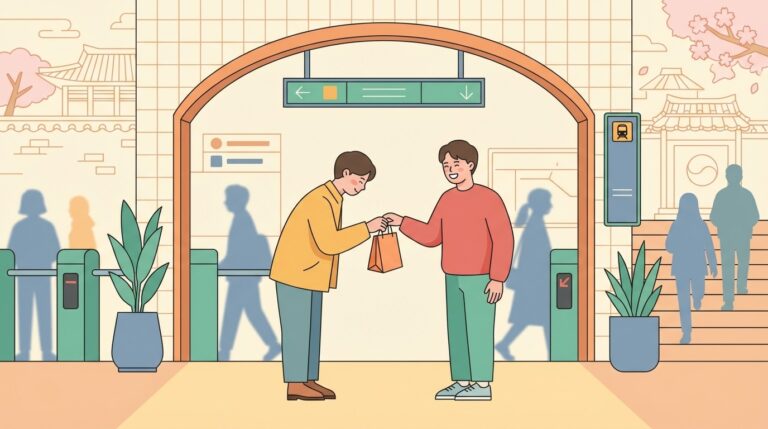
Hello! I’m the Lead Editor at Daily Hangul. Have you ever watched a K-Drama where the main character awkwardly meets a stranger at a subway exit, exchanges a paper bag, and quickly bows? You might have thought it was some top-secret spy mission. But let me tell you a secret: they were probably just doing a secondhand trade on Danggeun Market (Karrot)!
Secondhand trading apps have taken Korea by storm. It’s not just about buying and selling; there is a massive culture of 무료 나눔 (Muryo Nanum), which means “Free Sharing.” People give away perfectly good K-Pop albums, rice cookers, or even luxury cosmetics for free to their neighbors.
But when a kind Korean local hands you a free BTS photocard or a desk lamp, how do you say thank you? A robotic “Thank you” (감사합니다) works, but knowing the real local phrases will instantly warm their heart and boost your “Manner Temperature” (a literal rating on Korean trading apps!). This guide is built from the real-life panic moments of my students who met locals for a free trade and didn’t know what to say.
Let’s dive into the magical phrases of Korean secondhand sharing!
Phase 2: Core Expressions – Deep Dive
1. 잘 쓰겠습니다 (I will use it well)
- Pronunciation: jal sseugesseumnida [jal ssoo-ges-seum-ni-da]
- Meaning: Literal = I will use it well. / Real nuance = I will cherish this item and take good care of it.
- K-Culture Moment: You meet a university student giving away a slightly used Korean textbook. When they hand it to you, you say this. Their face immediately lights up because they know their old item is going to a good home.
- Editor’s Insight: This is the absolute golden rule of receiving a physical gift or a secondhand item in Korea. Just saying “Thank you” feels a bit empty. By saying “I will use it well,” you validate the giver’s generosity.
- Situation Spectrum:
[🚫 Never] ———— [⚠️ Be Careful] ———— [✅ Freely]
- Close Friends (Casual): ✅ (잘 쓸게! – jal sseulge!)
- Strangers on an app (Polite): ✅
- Elders/Superiors (Formal): ✅
- 🤔 Think About It: Why do Koreans focus on how they will use the item rather than just thanking the person? How does this reflect the Korean concept of attachment to personal belongings?
2. 나눔해 주셔서 감사합니다 (Thank you for sharing this)
- Pronunciation: nanumhae jusyeoseo gamsahamnida [na-noom-hae joo-shuh-suh gam-sa-ham-ni-da]
- Meaning: Literal = Thank you for doing a share. / Real nuance = Thank you so much for giving this away for free.
- K-Culture Moment: On local community boards, people use the word ‘나눔’ (Nanum – sharing) instead of ‘공짜’ (Gongjja – free stuff). It sounds much warmer. You’d type this in the app chat right after you secure the item.
- Editor’s Insight: ‘공짜’ (Free) sounds purely transactional. ‘나눔’ (Sharing) sounds like community love. Using this specific vocabulary shows you really understand modern Korean digital culture!
- Situation Spectrum:
[🚫 Never] ———— [⚠️ Be Careful] ———— [✅ Freely]
- Close Friends (Casual): ⚠️ (Friends usually don’t use this formal app-slang with each other)
- Strangers on an app (Polite): ✅
- Elders/Superiors (Formal): ✅
3. 조심히 들어가세요 (Get home safely)
- Pronunciation: josimhi deureogaseyo [jo-shim-hi deu-ruh-ga-seh-yo]
- Meaning: Literal = Enter carefully. / Real nuance = Get home safely / Have a safe trip back.
- K-Culture Moment: The transaction is done. You have the item, they are turning around. You don’t just say “Bye.” You say this. It’s the classic Korean street-parting phrase.
- Editor’s Insight: Saying goodbye in Korean depends on who is leaving and who is staying. But since both of you are heading home after a street meetup, this phrase is perfect. It shows care and politeness.
- Situation Spectrum:
[🚫 Never] ———— [⚠️ Be Careful] ———— [✅ Freely]
- Close Friends (Casual): ✅ (조심히 들어가~ – josimhi deureoga~)
- Strangers on an app (Polite): ✅
- Elders/Superiors (Formal): ✅
Phase 3: Textbook vs. Real Korean
| Situation | 📖 Textbook Korean | 🗣️ Real Korean (Streets & Apps) | 💡 Why the difference? |
|---|---|---|---|
| Expressing thanks | 고맙습니다. (Gomapseumnida) | 우와, 득템! 잘 쓰겠습니다! (Wow, great find! I’ll use it well!) | ‘득템’ (Deuk-tem) is a popular slang for “getting a great item,” adding excitement to your gratitude. |
| Parting ways | 안녕히 가세요. (Annyeonghi gaseyo) | 조심히 들어가세요~ (Get home safely~) | “Annyeonghi gaseyo” sounds a bit too formal for a quick neighborhood meetup. |
| Promising to leave a review | 후기를 쓰겠습니다. (Hugireul sseugesseumnida) | 매너 평가 좋게 남길게요! (I’ll leave a good Manner Rating!) | Secondhand apps run on user ratings; promising a good rating is the highest form of thanks! |
Phase 4: Cultural Context — K-Culture Deep Dive
4-1. The Non-Verbal “Nunchi” (눈치) of Trading
Language is only half the battle. When you meet a Korean for a secondhand trade, do not snatch the item with one hand. Always use two hands to receive the item, accompanied by a slight bow (a nod of the head works perfectly). Also, Korean street meetups are notoriously fast. Exchange pleasantries, get the item, say thanks, and leave. Small talk is usually not expected!
4-2. The “Karrot” Culture (당근마켓)
If you live in Korea, you must know the app 당근 (Danggeun – literally ‘Carrot’, but officially ‘Karrot’ in English). It’s a hyper-local secondhand market.
In many K-Dramas, you’ll see a wealthy Chaebol (business heir) utterly confused by a secondhand app, while the quirky, relatable female lead loves hunting for bargains. The app has a feature called “Manner Temperature” starting at 36.5°C. Good manners raise it; bad manners lower it. Saying “잘 쓰겠습니다” (I will use it well) is a guaranteed way to raise your temperature!
Phase 5: Real-Life Roleplay Scenario
Setting: Friday evening, 7 PM. Exit 3 of Hongdae Station. It’s bustling with people. You are looking at your phone, trying to find the person who promised to give you a free BTS concert DVD.
Characters:
– YOU: A foreign exchange student who managed to snag a free “Nanum” on a local app.
– Min-ji (25): A friendly Korean local, holding an orange shopping bag.
Dialogue:
YOU: 저기… 혹시 당근이세요? 🥕
(jeogi… hoksi danggeuniseyo?)
[Excuse me… are you by any chance ‘Karrot’?]
(🎭 Stage Direction: Min-ji’s eyes light up as she recognizes you.)
Min-ji: 아, 네! 안녕하세요! 방탄 DVD 나눔 받으시는 분 맞으시죠?
(a, ne! annyeonghaseyo! bangtan DVD nanum badeusineun bun majeushijyo?)
[Ah, yes! Hello! You’re the one receiving the BTS DVD free share, right?]
YOU: 네, 맞아요!
(ne, majayo!)
[Yes, that’s me!]
Min-ji: 여기요. 안에 포토카드도 몇 장 같이 넣었어요.
(yeogiyo. ane potokadeudo myeot jang gachi neoeosseoyo.)
[Here you go. I put a few photocards inside too.]
🔀 Your Turn! How should you respond to this unexpected gift?
– A) “얼마예요?” (How much is it?)
– B) “우와, 대박! 예쁘게 잘 쓰겠습니다! 너무 감사합니다.”
– C) “아, 포토카드는 필요 없어요.”✅ Best Choice: B — “Wow, amazing! I’ll cherish and use it well! Thank you so much.” This expresses the perfect amount of joy and gratitude.
⚠️ Why C is bad: Even if you didn’t ask for it, rejecting a free bonus item directly can hurt the giver’s feelings. Just accept it gracefully!
YOU: 우와, 대박! 예쁘게 잘 쓰겠습니다! 너무 감사합니다.
(uwa, daebak! yeppeuge jal sseugesseumnida! neomu gamsahamnida.)
[Wow, amazing! I’ll cherish it well! Thank you so much.]
Min-ji: 아니에요, 방탄 좋아하시는 것 같아서요. (Smiles)
(anieyo, bangtan joahasineun geot gataseoyo.)
[Don’t mention it, it’s because you seem to like BTS.]
YOU: 조심히 들어가세요!
(josimhi deureogaseyo!)
[Get home safely!]
Min-ji: 네, 안녕히 가세요~
(ne, annyeonghi gaseyo~)
[Yes, goodbye~]
🎁 Bonus Roleplay: The “Jeong” (정) Snack Exchange
Often, when receiving a free item, Koreans will hand over a small snack (like a Pepero, a tangerine, or a canned coffee) as a token of gratitude.
– You: “이거… 오는 길에 샀어요. 드세요!” (igeo… oneun gire sasseoyo. deuseyo! – I bought this on the way. Please have it!)
– Local: “어머, 안 주셔도 되는데! 감사합니다!” (eomeo, an jusyeodo doeneunde! gamsahamnida! – Oh my, you didn’t have to! Thank you!)
Phase 6: 10-Second Shadowing Drill
Try shadowing these sentences out loud. Pay attention to the pauses (/) and the emotions!
- 😊 예쁘게 / 잘 / 쓰겠습니다~
(yeppeuge / jal / sseugesseumnida~)
(Read brightly, stretching the ‘잘’ slightly to sound more enthusiastic!) -
🥺 나눔해 주셔서 / 정말 / 감사합니다!
(nanumhae jusyeoseo / jeongmal / gamsahamnida!)
(Read with genuine gratitude and a slight head bow.)
Phase 7: K-Culture Mini Dictionary
| Korean | Romanization | English | Context |
|---|---|---|---|
| 당근마켓 | danggeun maket | Karrot Market | The #1 secondhand app in Korea. ‘Danggeun’ literally means carrot. |
| 무료 나눔 | muryo nanum | Free sharing | Giving away an item for free. Often shortened to just ‘나눔’ (Nanum). |
| 직거래 | jikgeorae | Direct transaction | Meeting in person to trade, avoiding shipping fees and scams. |
| 매너온도 | maeneo ondo | Manner Temperature | A user rating system. 36.5°C is the default. Good reviews make it go up! |
| 득템 | deuktem | Great find/loot | Slang combining the Chinese character ‘득’ (obtain) and ‘아이템’ (item). |
Phase 8: Traveler Survival Kit
Even if you are just traveling in Korea, you might use secondhand apps to buy short-term items (like a T-money card or concert tickets) or navigate local community boards. Here are your survival phrases for meeting up!
🆘 Survival Phrases for Meetups
– 🇰🇷 “지금 도착했습니다!” (jigeum dochakaetseumnida!)
– 🗣️ English: I have arrived now!
– 🇰🇷 “어떤 옷 입고 계세요?” (eotteon ot ipgo gyeseyo?)
– 🗣️ English: What clothes are you wearing? (To find them in a crowd)
– 🇰🇷 “혹시 역 근처에서 뵐 수 있을까요?” (hoksi yeok geuncheoeseo boel su isseulkkayo?)
– 🗣️ English: Could we perhaps meet near the station?📌 Editor’s Travel Note
– Cash vs App Pay: In secondhand trades, Koreans mostly use bank transfers (계좌이체). However, as a traveler without a Korean bank account, always politely ask in advance if you can pay in cash: “제가 외국인이라서 그런데, 현금으로 드려도 될까요?” (Since I’m a foreigner, is it okay if I give you cash?)
– Location: Subway exits (e.g., “Hongdae Exit 3”) are the absolute standard for meetups in Korea.
Phase 9: Critical Thinking Corner — A Step Deeper
🧠 Think Deeper: Language & Power of Community (Jeong)
Why do Koreans use the word “Nanum” (Sharing) instead of “Free Giveaway”? In Korea, secondhand trading has evolved beyond mere commerce into a hyper-local community network. The concept of 정 (Jeong – a deep feeling of connection and affection) is heavily embedded here. By saying “I will use it well” (잘 쓰겠습니다), you are not just taking an object; you are acknowledging the previous owner’s memories and attachment to that item. It’s a respectful transfer of ownership, honoring the unseen bond between neighbors.💬 Your Turn: Does your culture have a strong secondhand or “free sharing” community? How do people express gratitude when receiving a free item in your hometown? Share in the comments!
Phase 10: FAQ & Avoiding Mistakes
Q: The person giving me the item looks much younger than me. Can I use casual language (Banmal)?
A: NO! 🚫 Even if they are a high school student and you are 40, always use polite form (존댓말) during trades. You are strangers making a transaction. Using Banmal will instantly drop your “Manner Temperature”!
Q: Do I have to give them a small snack when I receive a free item?
A: MAYBE! It’s not mandatory, but it’s a massive cultural flex. Giving a tiny box of juice or a chocolate bar makes you an absolute angel in their eyes.
❌ Common Mistake #1: Just saying “Thank you” and running away.
✅ Do This Instead: Say “잘 쓰겠습니다” (I will use it well) and finish with “조심히 들어가세요” (Get home safely). It perfectly closes the interaction.
Phase 11: Summary & Action Items
🎯 One-Liner Summary: When receiving a free secondhand item, validate their generosity by saying “잘 쓰겠습니다” (I will use it well) instead of just a basic thank you.
🚀 Action Missions:
– 🥉 Bronze (Solo): Stand in front of a mirror, pretend someone handed you an album, and say “우와, 잘 쓰겠습니다!”
– 🥈 Silver (Online): Go to a K-Pop community forum or Discord and type “나눔해 주셔서 감사합니다” to someone sharing a high-res photo or digital goodie.
– 🥇 Gold (Real Life): If you are in Korea, offer a small snack to the next person you buy or receive a secondhand item from!
🇰🇷 K-Culture Mission:
Search “당근마켓 무료나눔” (Danggeun Market Free Sharing) on YouTube or Google. Look at the thumbnails and see what kind of random, funny things Koreans give away to their neighbors!
Phase 12: Interactive Challenge (Quiz)
1. You just received a free desk lamp from a kind neighbor. They are turning to walk back to their apartment. What is the BEST thing to shout to them?
– A) 안녕히 주무세요! (Sleep well!)
– B) 조심히 들어가세요! (Get home safely!)
– C) 수고하셨습니다! (Good job!)
2. Fill in the blank: To show you will take good care of the free item, you should say “잘 _________.”
– A) 먹겠습니다 (I will eat well)
– B) 쓰겠습니다 (I will use it well)
– C) 보겠습니다 (I will look well)
3. True or False – K-Culture Edition:
“It is highly recommended to use Banmal (casual language) on Korean secondhand apps if the other person’s profile picture looks younger than you.”
(Answers: 1: B, 2: B, 3: False – Always use polite language with strangers!)
Frequently Asked Questions (FAQ)
Q: What does "잘 쓰겠습니다 (I will use it well)" mean in Korean and how do you pronounce it?
A: In Korean, "잘 쓰겠습니다 (I will use it well)" is pronounced [jal sseugesseumnida [jal ssoo-ges-seum-ni-da] and means: Literal = I will use it well. / Real nuance = I will cherish this item and take good care of it.
Q: What does "나눔해 주셔서 감사합니다 (Thank you for sharing this)" mean in Korean and how do you pronounce it?
A: In Korean, "나눔해 주셔서 감사합니다 (Thank you for sharing this)" is pronounced [nanumhae jusyeoseo gamsahamnida [na-noom-hae joo-shuh-suh gam-sa-ham-ni-da] and means: Literal = Thank you for doing a share. / Real nuance = Thank you so much for giving this away for free.
Q: What does "조심히 들어가세요 (Get home safely)" mean in Korean and how do you pronounce it?
A: In Korean, "조심히 들어가세요 (Get home safely)" is pronounced [josimhi deureogaseyo [jo-shim-hi deu-ruh-ga-seh-yo] and means: Literal = Enter carefully. / Real nuance = Get home safely / Have a safe trip back.







