

Phase 1: 공감 — 몰입형 오프닝 (Immersive Hook)
Hello! I’m the Daily Hangul Editor.
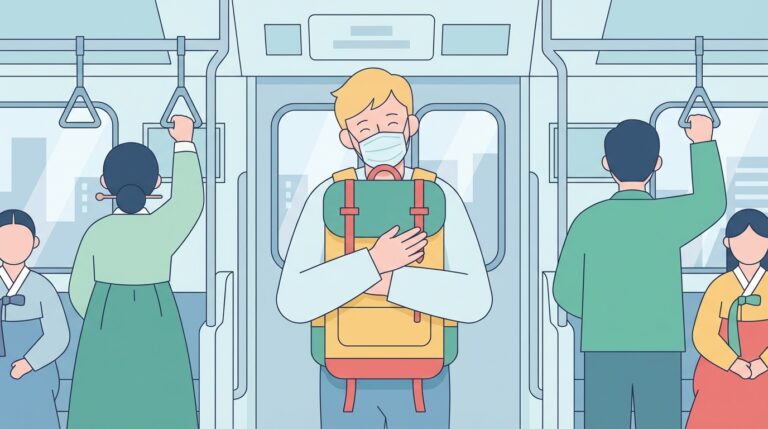
Picture this: It’s 8:30 AM on a Tuesday. You are standing inside a Seoul subway train on Line 2. It’s so crowded that you can barely breathe—this is what Koreans call 지옥철 (Jiokcheol, Hell-train). You are wearing your trusty backpack, ready to explore the city.
Suddenly, an older lady taps your shoulder, points at your bag, and says something in rapid Korean. You notice people around you are giving you a certain look. What did you do wrong?
You know those romantic K-Drama scenes where the main leads get pushed together in a crowded train, looking deeply into each other’s eyes? Well, in reality, what they don’t show you is the invisible, unspoken rule of Korean public transport: The Backpack Hug.
If you don’t know this etiquette, your backpack might become a weapon that accidentally hits people (Koreans jokingly call this being a ‘backpack turtle’). But once you master this, you’ll earn instant respect and be treated like a true insider! Let’s dive into the words and actions you need to survive the Korean subway like a local.
Phase 2: 핵심 표현 심층 분석 (Deep Dive)
Here are the top expressions you’ll hear and use when dealing with bags on public transit.
1. 가방을 앞으로 메 주세요 (Please wear your bag on the front)
- Pronunciation: [gabangeul apeuro me juseyo]
- Sound-alike guide: gah-bang-eul ah-peu-ro meh joo-seh-yo
- Meaning: Literal = Please wear the bag to the front. / Real nuance = “Your backpack is taking up too much space and hitting people, please hug it on your chest.”
- K-Culture Moment: You’ll hear this phrase broadcasted over the subway speakers during rush hour. It’s also what a brave Ahjumma (older lady) might say to you if your bag is bumping into her.
- Editor’s Insight: This isn’t an angry command; it’s a social request for harmony. In Korea, sharing limited physical space politely is a huge part of daily life.
- Situation Spectrum:
[🚫 절대 금지] ———— [⚠️ 주의] ———— [✅ 자유롭게]
- To a friend (Casual): 🚫 (Too formal, just say “가방 앞으로 메!”)
- Subway announcement (Formal): ✅
- You saying it to a stranger: ⚠️ (Only use if their bag is seriously hurting you, otherwise just endure it or move).
- 🤔 Think About It: Why do you think Korean public transport relies heavily on audio announcements for etiquette, rather than just signs? Does your country have similar announcements?
2. 잠시만요 (Excuse me / Just a moment)
- Pronunciation: [jamsimanyo]
- Sound-alike guide: jahm-shee-mahn-yo
- Meaning: Literal = Just a moment. / Real nuance = “I’m coming through, please make way!”
- K-Culture Moment: The train doors are opening, but there is a wall of people between you and the exit. You grab your backpack, lower your head slightly, and chant “잠시만요!” like a magic spell. Miraculously, the Red Sea of commuters parts for you.
- Editor’s Insight: This is your #1 survival word. It’s much more natural than saying “실례합니다” (Excuse me) when you need physical space.
- Situation Spectrum:
[🚫 절대 금지] ———— [⚠️ 주의] ———— [✅ 자유롭게]
- Pushing past friends: ✅
- Pushing past strangers: ✅
- Pushing past the CEO of your company: ⚠️ (Add “지나가겠습니다” – I will pass).
- 🤔 Think About It: “잠시만요” literally means time (“just a moment”), but it’s used for space (“let me pass”). Why do time and space overlap in this expression?
3. 선반 위에 올려도 될까요? (Can I put this on the shelf?)
- Pronunciation: [seonban wie ollyeodo doelkkayo?]
- Sound-alike guide: sun-bahn wee-eh oll-yeo-do dwel-kka-yo?
- Meaning: Literal = May I raise this onto the shelf? / Real nuance = “I’m going to put my heavy bag on the overhead rack, is that okay?”
- K-Culture Moment: Korean trains (like KTX or some subway lines) have overhead racks (seonban). If it’s crowded and your bag is huge, putting it up there is the ultimate polite move.
- Editor’s Insight: You use this when someone is sitting under the empty shelf space, just to be polite before reaching over their head.
- Situation Spectrum:
[🚫 절대 금지] ———— [⚠️ 주의] ———— [✅ 자유롭게]
- To a stranger sitting below: ✅
- Asking a friend: 🚫 (Just say “위에 올릴게”)
Phase 3: 교과서 vs 진짜 한국어 (Textbook vs Real Life)
| Situation | 📖 Textbook Korean | 🗣️ Real Korean | 💡 Why is it different? |
|---|---|---|---|
| Trying to get past someone with your bag | 실례합니다. 지나가겠습니다. (Excuse me. I will pass.) | 잠시만요! / 내릴게요! (Just a moment! / I’m getting off!) | Speed and efficiency. “잠시만요” is faster to say when the doors are closing in 5 seconds. |
| Telling a friend to move their bag | 가방을 앞으로 메는 것이 어때요? (How about wearing your bag on the front?) | 야, 가방 앞으로 안아. (Hey, hug your bag.) | Close friends use blunt, direct action verbs rather than polite suggestions. |
| When you accidentally hit someone with your bag | 대단히 죄송합니다. (I am extremely sorry.) | 아, 죄송합니다! (Ah, sorry!) + slight head bow | Non-verbal body language (the quick bow) does 80% of the apologizing in daily transit. |
Bottom Note: For B1 learners, sticking to “잠시만요” and “죄송합니다” is perfect. No need for complex slang here—politeness is key on the subway!
Phase 4: 문화적 맥락 — K-Culture 딥다이브 (Cultural Deep Dive)
4-1. 비언어적 요소 (Non-verbal Communication)
In Korea, 눈치 (Nunchi) is everything. Nunchi is the subtle art of reading the room. If you step onto a crowded subway and notice everyone else has their bags on their laps or chests, having nunchi means you silently do the same without being told.
When doing the “Backpack Hug,” you don’t need to announce it. Just quietly swing it around. If you accidentally bump someone while doing it, a quick, silent head nod and eye contact of regret is the perfect non-verbal apology.
4-2. K-Culture Connection: The K-Drama Transit Trope
If you watch K-Dramas like My Liberation Notes or Extraordinary Attorney Woo, you see the subway is a central character. The daily commute is a shared struggle.
When a K-Drama character hugs their backpack, they often lean their chin on it, looking exhausted but deeply thoughtful. It creates a physical barrier—a tiny, personal ‘safe zone’ in a public space.
Critical View: While K-Dramas often romanticize the crowded train (someone catches the female lead before she falls), in reality, if you lose your balance because of a heavy backpack, you might just annoy the exhausted office workers around you. Hugging your bag lowers your center of gravity and prevents you from falling over!
Phase 5: 실전 롤플레이 시나리오 (Immersive Roleplay)
시나리오 A: 메인 롤플레이 (Main Scenario)
- Setting: Friday, 6:30 PM. Gangnam Station, Line 2. The train arrives, and it’s packed like a can of sardines.
- Characters:
- YOU: A foreign traveler carrying a bulky daypack full of souvenirs.
- Ahjumma (60s): A tough but friendly older lady standing right behind you.
Dialogue:
(🚆 Stage Direction: The train jerks forward. Your backpack heavily bumps into the Ahjumma.)
Ahjumma: 아이고! 깜짝이야. 학생, 가방이 너무 커.
(Aigo! Kkamjjagiya. Haksaeng, gabangi neomu keo.)
[Oh my! You startled me. Student, your bag is too big.]
YOU: 헉, 죄송합니다! 제가 가방을 앞으로 멜게요.
(Heok, joesonghamnida! Jega gabangeul apeuro melgeyo.)
[Gasp, I’m sorry! I’ll wear my bag on the front.]
Ahjumma: 그래그래, 출퇴근 시간엔 원래 다 그래. 요기 빈 공간 있네.
(Geuraegeurae, chultoegeun siganen wollae da geurae. Yogi bin gonggan inne.)
[Yeah, yeah, it’s always like this during rush hour. There’s an empty space here.]
(🚆 Stage Direction: You swing your bag to your chest. Two stops later, it’s your turn to get off, but you are stuck in the middle.)
🔀 당신의 차례! 어떻게 대답할까요? (Your Turn! What do you say?)
– A) “비켜주세요!” (Move out of the way!)
– B) “잠시만요, 내릴게요!” (Excuse me, I’m getting off!)
– C) Stay silent and try to aggressively push through with your body.✅ Best Choice: B — This is the universal password to open the subway doors.
⚠️ Choice A & C 분석: “비켜주세요” sounds quite rude and demanding. C is the worst—pushing silently will make people angry.
YOU: 잠시만요, 내릴게요!
(Jamsimanyo, naerilgeyo!)
[Excuse me, I’m getting off!]
Ahjumma: 어이구, 사람 내려요! 길 좀 터주세요!
(Eoigu, saram naeryeoyo! Gil jom teojuseyo!)
[Oh my, someone is getting off! Please make some way!]
(You successfully exit the train with your bag safely hugged!)
시나리오 B: K-Culture 보너스 롤플레이 (Bonus Scenario)
- Setting: A crowded local bus. You are standing with your backpack.
Bus Driver: 승객 여러분, 안으로 들어가 주세요. 가방은 앞으로 메 주시고요!
(Seunggaek yeorobun, aneuro deureoga juseyo. Gabangeun apeuro me jusigoyo!)
[Passengers, please move inside. And please wear your bags on the front!]
YOU: (To the person next to you as you shuffle back) 조금만 들어갈게요.
(Jogeumman deureogalgeyo.)
[I’ll just move in a little bit.]
Passenger: 네, 천천히 들어오세요.
(Ne, cheoncheonhi deureooseyo.)
[Yes, come in slowly.]
Phase 6: 10초 섀도잉 드릴 (Shadowing Drill)
Let’s practice the magic phrase for getting off the train! Pay attention to the pauses (/) and intonation.
🥺 아, 죄송합니다! / 제가 / 가방을 / 앞으로 / 멜게요.
(Ah, joesonghamnida! / jega / gabangeul / apeuro / melgeyo.)
Ah, I’m sorry! I will wear my bag on the front.
😤 잠시만요! / 이번 역에서 / 내릴게요!
(Jamsimanyo! / ibeon yeogeseo / naerilgeyo!)
Excuse me! I’m getting off at this station!
Phase 7: K-Culture 미니 사전 (K-Culture Glossary)
| 한국어 (Korean) | Romanization | English | Context & Meaning |
|---|---|---|---|
| 눈치 | nunchi | Social sense | The ability to read the room. Hugging your bag shows great nunchi. |
| 지옥철 | jiokcheol | Hell-train | A portmanteau of 지옥 (hell) + 지하철 (subway). Refers to packed trains. |
| 백팩족 | baekpaek-jok | Backpack tribe | People who commute wearing backpacks. |
| 출퇴근 시간 | chultoegeun sigan | Rush hour | The time people go to work (출근) and leave work (퇴근). |
| 민폐 | minpye | Nuisance | Causing inconvenience to others. Hitting someone with a bag is a minpye. |
Phase 8: 여행자 서바이벌 키트 (Traveler’s Survival Kit)
🆘 서바이벌 표현 TOP 3 (Transit Survival Phrases)
- “잠시만요, 내릴게요!” (Jamsimanyo, naerilgeyo!) – Excuse me, I’m getting off!
- “가방 조심하세요.” (Gabang josimhaseyo.) – Please be careful of the bag. (If you are trying to squeeze by and don’t want your bag to scratch them).
- “이거 어디행 열차예요?” (Igeo eodihaeng yeolchayeyo?) – Which direction is this train going?
📌 Editor’s Travel Note
– Useful Apps: KakaoMetro or Naver Map. They even tell you which train car number is closest to the transfer stairs!
– Escalator Etiquette: Stand on the RIGHT, walk on the LEFT. (But officially, you are supposed to stand on both sides to prevent accidents!).
– T-Money Tip: Don’t take your card out of your wallet. Just tap your whole wallet or bag on the sensor. But make sure you only have ONE transit card inside, or it will say “카드를 한 장만 대주세요” (Please tap only one card).
Phase 9: 비판적 사고 코너 — “한 발 더 깊이” (Think Deeper)
🧠 Think Deeper: 언어와 공간 (Language & Space)
Korea has a very high population density, especially in Seoul. Because physical space is so limited, avoiding physical contact is often impossible. Therefore, Korean etiquette and language have evolved to manage this shared space gracefully.
When an announcement says “가방을 앞으로 메 주세요” (Please wear your bag on the front), it’s not just about rules; it’s an appeal to collective harmony. By hugging your bag, you are symbolically giving up your personal space for the comfort of the community. In Western cultures, touching a stranger on transit might be a huge offense, but in Korea, a slight bump is tolerated—as long as you show nunchi by trying to minimize your footprint.
💬 Your Turn: How does your culture handle personal space on public transit? Do people talk to each other, or avoid eye contact completely? Share in the comments!
Phase 10: FAQ & 오해 방지 (Troubleshooting)
Q: Do I always have to wear my backpack on the front?
No! Only during busy times (rush hour) or when the train is visibly crowded. If there is plenty of standing room, keeping it on your back is perfectly fine.
Q: Can I just put my bag on the floor between my legs?
Yes! Putting your heavy backpack on the floor between your feet is another highly appreciated nunchi move.
Q: What if I’m too short to reach the overhead shelf?
Don’t force it. Just hug the bag or place it on the floor. It’s better than accidentally dropping it on someone’s head!
❌ 흔한 실수 #1 (Common Mistake): Apologizing too loudly or dramatically.
✅ 이렇게 하세요: If you bump someone with your bag, do not yell “I’M SO SORRY!” A quiet “아, 죄송합니다” and a slight head bow is enough. Loud voices on the subway are considered a bigger nuisance (minpye) than a bag bump!
Phase 11: 요약 및 액션 아이템 (Wrap-up)
🎯 One-Liner Summary: On a crowded Korean subway, hugging your backpack on your chest (가방을 앞으로 메다) is the ultimate sign of respect and nunchi.
🔥 Action Mission:
– 🥉 Bronze (Solo): Stand in front of a mirror with your backpack, swing it to your chest, and say “제가 가방을 앞으로 멜게요!” 3 times.
– 🥈 Silver (Online): Go to a K-Drama YouTube video featuring a subway scene and comment: “In real life, they need to do the backpack hug! 가방을 앞으로 메 주세요!”
– 🥇 Gold (Real Life): Next time you ride public transit (anywhere in the world!), try hugging your backpack and observe how much more space it creates for others.
Phase 12: 퀴즈 — 인터랙티브 챌린지 (Interactive Quiz)
1. 상황 판단 문제 (Situational Judgment)
You are on a packed bus. You want to get off at the next stop, but 5 people are blocking the door. What do you yell?
– A) 비켜요! (Move!)
– B) 잠시만요, 내릴게요! (Excuse me, I’m getting off!)
– C) 실례합니다. (Excuse me – formal)
2. 빈칸 채우기 (Fill in the Blank)
지하철이 너무 복잡할 때는 다른 사람들을 위해 가방을 ( _____ ) 메 주세요.
(When the subway is too crowded, please wear your bag on the _____ for others.)
– A) 머리 위에 (on your head)
– B) 뒤로 (on your back)
– C) 앞으로 (on your front)
3. True or False — K-Culture Edition
– T/F: Making eye contact and loudly apologizing when you bump someone on the subway is considered the best manners in Korea.
4. 롤플레이 응용 (Roleplay Prediction)
In Phase 5, what would likely happen if you silently pushed the Ahjumma without saying “잠시만요”?
– A) She would politely step aside.
– B) She might click her tongue (쯧쯧) or say “아이고, 밀지 마요!” (Oh my, don’t push!).
– C) She would call the police.
(Answers: 1. B / 2. C / 3. False – a quiet apology and slight bow is better. Loud voices are frowned upon. / 4. B)
Frequently Asked Questions (FAQ)
Q: What does "가방을 앞으로 메 주세요 (Please wear your bag on the front)" mean in Korean and how do you pronounce it?
A: In Korean, "가방을 앞으로 메 주세요 (Please wear your bag on the front)" is pronounced [gabangeul apeuro me juseyo] and means: Literal = Please wear the bag to the front. / Real nuance = "Your backpack is taking up too much space and hitting people, please hug it on your chest."
Q: What does "잠시만요 (Excuse me / Just a moment)" mean in Korean and how do you pronounce it?
A: In Korean, "잠시만요 (Excuse me / Just a moment)" is pronounced [jamsimanyo] and means: Literal = Just a moment. / Real nuance = "I'm coming through, please make way!"
Q: What does "선반 위에 올려도 될까요? (Can I put this on the shelf?)" mean in Korean and how do you pronounce it?
A: In Korean, "선반 위에 올려도 될까요? (Can I put this on the shelf?)" is pronounced [seonban wie ollyeodo doelkkayo?] and means: Literal = May I raise this onto the shelf? / Real nuance = "I'm going to put my heavy bag on the overhead rack, is that okay?"







