

Phase 1: 공감 — 몰입형 오프닝 (Immersive Hook)
Hello! I am the lead editor of Daily Hangul. Welcome to your personalized cultural navigation guide.
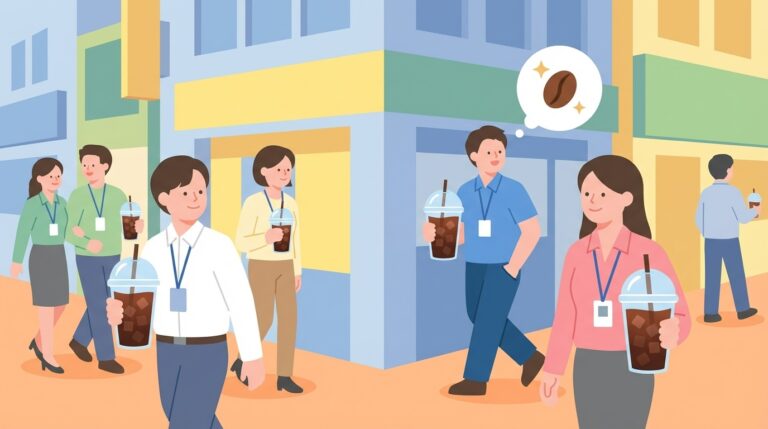
Imagine this K-Drama scene: The team has just finished a fiery, heavy meal of spicy pork (제육볶음) and garlic-heavy stews. Everyone is sweating and wiping their mouths. Suddenly, the manager looks around, claps his hands, and says, ‘자, 아아 가시죠!’ (Alright, let’s go for Iced Americano!). In perfect synchronization, the entire team stands up and marches toward the nearest cafe.
Why does this happen every single day at 12:30 PM in Seoul?
In Korea, a meal is never truly over until the caffeine kicks in. Welcome to the intense, fast-paced, and community-driven world of ‘식후 땡 커피’ (Sik-hu-ttaeng Coffee). If you don’t understand this culture, you might end up wandering back to the office alone while your colleagues are out bonding over roasted beans. Knowing these expressions won’t just help you order a drink; it will instantly upgrade your status from ‘foreign visitor’ to ‘local insider’ (인싸).
Everything in this post is based on real experiences from expats who once stood confused in front of a Kiosk at a bustling Gangnam cafe. Let’s dive in!
Phase 2: 핵심 표현 심층 분석 (Deep Dive)
1. 식후 땡 (Post-Meal Coffee/Hit)
- Pronunciation: sik-hu-ttaeng [Sounds like ‘seek-who-dang’ with a sharp, explosive ‘T’ sound like a bell ringing]
- Meaning: Literal = ‘After meal, ding!’ / Real nuance = The ritualistic habit of consuming coffee (or sometimes a cigarette) immediately after eating.
- K-Culture Moment: You’ll hear this right when people push their empty plates away at a restaurant. It signals the transition from ‘eating mode’ to ‘relaxing/digesting mode’.
- Editor’s Insight: This word has a very satisfying, rhythmic feel to it. The ‘땡’ (ttaeng) mimics the sound of a bell ringing, announcing that the meal is over and it is coffee time.
- Situation Spectrum:
[🚫 절대 금지] ———— [⚠️ 주의] ———— [✅ 자유롭게]
- 친구 사이(Casual): ✅
- 직장 동료(Semi-formal): ✅
- 직장 상사·어른(Formal): 🚫 (Too casual and slangy for older executives)
- 🤔 Think About It: Why do Koreans use a ‘sound effect’ (땡) to describe a daily habit? Does your language use onomatopoeia to describe cultural habits?
2. 입가심 하러 갈까요? (Shall we go cleanse our palate?)
- Pronunciation: ip-ga-sim ha-reo gal-kka-yo? [eep-gah-sheem ha-ro gal-kka-yo?]
- Meaning: Literal = ‘Shall we go rinse our mouths?’ / Real nuance = ‘Shall we go grab something sweet/refreshing (like coffee) to finish the meal?’
- K-Culture Moment: Korean food is delicious but often leaves a strong aftertaste of garlic, onions, or red pepper powder. ‘입가심’ is the cultural solution to reset your palate before heading back to the office.
- Editor’s Insight: This is a much more natural and mature way to suggest getting coffee than just saying ‘커피 마셔요’. It shows you deeply understand Korean food dynamics!
- Situation Spectrum:
[🚫 절대 금지] ———— [⚠️ 주의] ———— [✅ 자유롭게]
- 친구 사이(Casual): ✅
- 직장 동료(Semi-formal): ✅
- 직장 상사·어른(Formal): ✅ (Perfectly polite and acceptable!)
- 🤔 Think About It: Does your food culture have a specific concept for ‘cleansing the palate’ after a savory meal, or do you skip straight to dessert?
3. 커피는 제가 쏠게요! (Coffee is on me!)
- Pronunciation: keo-pi-neun je-ga ssol-ge-yo! [ko-pi-noon je-gah soul-geh-yo! – The ‘ss’ is a sharp, hissing snake sound]
- Meaning: Literal = ‘I will shoot the coffee!’ / Real nuance = ‘I’ll treat you to coffee!’
- K-Culture Moment: In a K-Drama, when the older sunbae (senior) pays for an expensive lunch, the smart junior (hoobae) quickly steps up at the cafe and shouts this phrase. It is the ultimate display of social grace (눈치).
- Editor’s Insight: We use the verb ‘쏘다’ (to shoot). Imagine shooting your credit card at the cashier! It’s lively, generous, and makes you look incredibly cool.
- Situation Spectrum:
[🚫 절대 금지] ———— [⚠️ 주의] ———— [✅ 자유롭게]
- 친구 사이(Casual): ✅ (‘내가 쏠게!’)
- 직장 동료(Semi-formal): ✅
- 직장 상사·어른(Formal): ⚠️ (Fine to offer, but elders often prefer to pay for everything. Offer once, then gracefully yield if they insist.)
- 🤔 Think About It: In Korea, splitting the bill (더치페이) is common among young friends, but taking turns ‘shooting’ (treating) is still the golden rule of relationship-building. Why do you think treating others is preferred over calculating exact change?
Phase 3: 교과서 vs 진짜 한국어 (Textbook vs Real Life)
| 상황 | 📖 교과서 한국어 | 🗣️ 진짜 한국어 | 💡 왜 다를까? |
|---|---|---|---|
| Suggesting coffee | 커피를 마시러 갑시다. (Let’s go drink coffee.) | 식후 땡 하러 가시죠! / 입가심 하러 가요. | Textbooks sound like robots. Real Koreans focus on the ‘purpose’ (cleansing the palate) rather than the literal action. |
| Ordering the standard | 아이스 아메리카노 한 잔 주세요. | 아아 한 잔이요. | ‘아아’ (Ah-ah) is the ultimate abbreviation. Korean office workers are always in a rush; efficiency is key! |
| Offering to pay | 제가 커피값을 지불하겠습니다. | 커피는 제가 쏠게요! / 이건 제가 낼게요. | ‘지불하다’ sounds like a legal contract. ‘쏘다’ adds a friendly, energetic emotional bond. |
Bottom Note for B2 Learners: You don’t need to use extreme slang, but adopting abbreviations like ‘아아’ (Iced Americano) or ‘뜨아’ (Hot Americano) will make your Korean sound incredibly natural.
Phase 4: 문화적 맥락 — K-Culture 딥다이브 (Cultural Deep Dive)
4-1. 비언어적 요소 (Non-verbal Communication)
When you shout ‘커피는 제가 쏠게요!’ and hand your card over, never slide it across the counter with one hand. Hand it to the barista with your right hand, while lightly supporting your right elbow or forearm with your left hand. This subtle gesture of respect is the cherry on top of your ‘Nunchi’ (눈치) skills. Also, when grabbing that precious iced americano, always take a sip immediately and let out a small, satisfied ‘아~’ (Ah~) to show it hit the spot!
4-2. K-Culture 연결 고리 (K-Food & K-Drama Connection)
Have you ever wondered why Koreans are obsessed with ‘아아’ (Iced Americano) even in freezing winter (a phenomenon known as 얼죽아 – Eol-juk-a: Freezing to death but still iced americano)?
It connects directly to K-Food. Korean lunches—like Kimchi Jjigae, Tteokbokki, or spicy stir-fried pork—are served boiling hot and packed with intense, spicy, and salty flavors. Drinking a scalding hot coffee after that? No way. The ice-cold, bitter Americano acts like a fire extinguisher for your stomach and a breath freshener for your mouth.
In K-Dramas, you rarely see office workers slowly sipping hot lattes from ceramic mugs during the day. They are carrying giant plastic cups of iced americano, using the cold temperature to physically wake up and cool down before facing their boss again.
Phase 5: 실전 롤플레이 시나리오 (Immersive Roleplay)
시나리오 A: 메인 롤플레이 (Main Scenario)
- Setting: Friday, 12:40 PM. A bustling Korean BBQ restaurant near Gangnam Station. The smell of garlic and roasted pork belly is heavy in the air.
- Characters:
- YOU: A foreign expat working at a Korean tech company for 6 months. You want to bond with your team.
- Minsu (32): Your friendly Korean coworker who loves taking care of you.
Minsu: 아, 배 터질 것 같아요. 삼겹살 진짜 맛있었죠? 🥩
(A, bae teojil geot gatayo. Samgyeopsal jinjja masisseotjyo?)
(Ah, I feel like my stomach will explode. The pork belly was really good, right?)
YOU: 맞아요. 고기가 입에서 살살 녹더라고요. 🤤
(Majayo. Gogiga ibeseo salsal nokdeoragoyo.)
(I agree. The meat was melting in my mouth.)
Minsu: 자, 그럼 이제 2차 가야죠? 식후 땡 하러 갑시다!
(Ja, geureom ije icha gayajyo? Sikhuttaeng hareo gapsida!)
(Alright, time for round 2? Let’s go do ‘Sik-hu-ttaeng’!)
YOU: 식후 땡이요? 지금 퇴근하는 거예요?
(Sikhuttaeng-iyo? Jigeum toegeunhaneun geoyeyo?)
(Sik-hu-ttaeng? Are we getting off work now?)
Minsu: (Laughs) 아뇨! 직장인한테 식후 땡은 무조건 카페인 충전이죠! 근처 카페로 가요.
(Anyo! Jikjanginhante sikhuttaengeun mujogeon kapein chungjeonijyo! Geuncheo kapero gayo.)
(No! For office workers, Sik-hu-ttaeng is unconditionally a caffeine recharge! Let’s go to a nearby cafe.)
YOU: 아하! 짠 걸 먹었더니 시원한 입가심이 필요하긴 했어요.
(Aha! Jjan geol meogeotdeoni siwonhan ipgasimi piryohagin haesseoyo.)
(Aha! Since we ate salty food, I did need a refreshing palate cleanser.)
Minsu: 오, ‘입가심’이라는 말도 알아요? 한국인 다 됐네요! 제가 자주 가는 단골 카페가 있어요.
(O, ‘ipgasim’iraneun maldo arayo? Hangugin da dwaenneyo! Jega jaju ganeun dangol kapega isseoyo.)
(Oh, you even know the word ‘ip-ga-sim’? You’re practically Korean now! I have a regular cafe I go to.)
(🎭 Stage Direction: You both arrive at the cafe. It is packed with office workers holding pagers. Minsu steps up to the Kiosk.)
Minsu: 저는 늘 먹던 ‘아아’ 마실 건데, 뭐 드실래요?
(Jeoneun neul meokdeon ‘aa’ masil geonde, mwo deusillaeyo?)
(I’m going to drink my usual ‘Ah-ah’, what would you like to drink?)
YOU: 저도 아이스 아메리카노로 할게요. 그리고…
(Jeodo aiseu amerikano-ro halgeyo. Geurigo…)
(I’ll have an iced americano too. And…)
🔀 당신의 차례! 어떻게 대답할까요? (Decision Point)
– A) “얼마예요? 제 건 제가 낼게요.” (How much is it? I’ll pay for mine.)
– B) “오늘 밥은 민수 씨가 샀으니까, 커피는 제가 쏠게요!” (Since you bought the food today, Minsu, coffee is on me!)
– C) “잘 마시겠습니다!” (Thanks for the drink!)✅ Best Choice: B — Why? In Korea, ‘Give and Take’ (기브 앤 테이크) is the foundation of office relationships. If an older colleague or someone else pays for a heavy meal, stepping up to buy the relatively cheaper coffee is the ultimate display of social tact (Nunchi).
⚠️ Choice A Analysis: Exact splitting (더치페이) is common among college students, but in office culture, alternating who ‘shoots’ (쏘다) builds warmer bonds (정).
YOU (Choosing B): 오늘 밥은 민수 씨가 샀으니까, 커피는 제가 쏠게요! 제 카드 쓰세요. 💳
(Oneul babeun Minsu ssiga sasseunikka, keopineun jega ssolgeyo! Je kadeu sseuseyo.)
(Since you bought the food today, Minsu, coffee is on me! Use my card.)
Minsu: 에이, 괜찮은데. 그럼 감사히 잘 마실게요! 다음엔 제가 맛있는 디저트 쏠게요.
(Ei, gwaenchaneunde. Geureom gamsahi jal masilgeyo! Daeumen jega masinneun dijeoteu ssolgeyo.)
(Hey, it’s fine though. Well, I’ll enjoy the drink thankfully! Next time I’ll treat you to a delicious dessert.)
시나리오 B: K-Culture 보너스 롤플레이 (The Kiosk Panic)
- Context: You decide to order via the cafe Kiosk, but the options are overwhelming.
- Machine: 매장 식사 / 포장 주문 (Dine-in / Take-out)
- You: (Presses Take-out) 아아 두 잔이요. (Two Ah-ahs.)
- Machine: 원두를 선택해 주세요: 산미 있는 맛 / 고소한 맛 (Choose beans: Acidic/Fruity or Nutty/Savory)
- You: (To Minsu) 민수 씨, 산미 있는 거 좋아해요, 고소한 거 좋아해요?
- Minsu: 저는 무조건 고소한 맛이요! (I’m unconditionally team nutty!)
Phase 6: 10초 섀도잉 드릴 (Shadowing Drill)
Let’s practice your tone! In Korea, how you sound matters just as much as what you say. Follow the pauses (/) and the emotion tags.
😤 단호하고 자신감 있게 (Firm and confident):
오늘 밥은 / 너무 잘 먹었으니까 / 커피는 / 제가 쏠게요!
(oneul babeun / neomu jal meogeosseunikka / keopi-neun / jega ssolgeyo!)
🥺 센스 있게 제안하며 (Politely suggesting):
우리 / 매운 거 먹었으니까 / 입가심 하러 / 갈까요?
(uri / maeun geo meogeosseunikka / ip-ga-sim hareo / gal-kka-yo?)
Phase 7: K-Culture 미니 사전 (K-Culture Glossary)
| 한국어 | Romanization | English Meaning | 맥락 설명 (Context) |
|---|---|---|---|
| 눈치 | nunchi | Social tact / Reading the room | Knowing when to offer to pay for coffee is high-level Nunchi. |
| 아아 | aa | Iced Americano | The abbreviation used 99% of the time. Don’t say the full name! |
| 쏘다 | ssoda | To treat / To pay for others | “내가 쏠게” (I’ll treat) is the best way to make friends in Korea. |
| 얼죽아 | eol-juk-a | Iced Americano even if freezing | A lifestyle choice. Koreans love ice-cold drinks to combat stress. |
| 입가심 | ip-ga-sim | Palate cleanser | Eating mints, gum, or drinking coffee to wash away food odors. |
| 가위바위보 | gawi-bawi-bo | Rock-paper-scissors | Often played in front of cafes to decide who ‘shoots’ the coffee! |
Phase 8: 여행자 서바이벌 키트 (Traveler’s Survival Kit)
Even if you’re just visiting Korea for a week, you will enter a cafe. Here is your ultimate survival kit for the post-meal rush hour.
🆘 서바이벌 표현 TOP 3
– 🇰🇷 “아아 한 잔, 테이크아웃이요.” (aa han jan, teikeu-aut-iyo.)
– 🗣️ English: One iced americano, for takeout.
– 📍 Where to use: Any bustling franchise cafe.
- 🇰🇷 “영수증은 버려주세요.” (yeong-su-jeung-eun beo-ryeo-ju-se-yo.)
- 🗣️ English: Please throw away the receipt.
- 📍 Where to use: Right after handing over your card.
🇰🇷 “진동벨 울리면 오시면 됩니다.” (jin-dong-bel ullimyeon osimyeon doemnida.)
- 🗣️ English: Please come when the buzzer rings. (You need to UNDERSTAND this, not say it!)
- 📍 Where to use: What the barista will say to you.
📌 Editor’s Travel Note
– The Kiosk Culture: 90% of Korean cafes now use touch-screen Kiosks. Look for the button that says ‘영어’ (English) at the top right, but knowing ‘매장’ (Dine-in) and ‘포장’ (Takeout) will save you time!
– No Tipping!: Do not leave extra coins or bills on the cafe counter. There is NO tipping culture in Korea; leaving money will only confuse the barista.
– Vibration Bells (진동벨): Don’t stand at the counter waiting. Take your buzzer, sit down, and relax until it aggressively vibrates and flashes red.
Phase 9: 비판적 사고 코너 — “한 발 더 깊이” (Think Deeper)
🧠 Think Deeper: Food, Identity, and the 60-Minute Lunch Hour
Why is ‘식후 땡 커피’ such a non-negotiable part of Korean culture? It’s not just about the caffeine. In Korean corporate culture, lunch is exactly 60 minutes. Koreans generally eat their food extremely fast—often finishing a hot stew in 15-20 minutes. That leaves 40 minutes of free time. Instead of resting alone at their desks, Koreans use this time to grab a coffee together, walk around the block, and vent about work or share personal stories. The coffee cup in hand is just an excuse; the real goal is community bonding (정) and solidarity. The act of drinking coffee together softens the strict hierarchical boundaries of the office.
💬 Your Turn:
How do people in your culture spend the remaining time of their lunch break? Do you prefer bonding with colleagues, or do you strictly protect your alone time? Let us know in the comments!
Phase 10: FAQ & 오해 방지 (Troubleshooting)
Q: Can I say ‘식후 땡 하러 가요’ to my boss?
– No! ‘식후 땡’ is derived from slang and has an extremely casual, almost mischievous vibe. To your boss, stick to the polite: “부장님, 커피 한잔 하러 가시죠!” (Manager, let’s go get a cup of coffee!).
Q: If my Korean friend says ‘내가 쏠게’ (I’ll treat), should I fight them for the bill?
– Maybe just a little. The polite cultural dance is to say “아니야, 내가 낼게!” (No, I’ll pay!) once or twice. If they insist, warmly say “우와, 고마워! 잘 마실게!” (Wow, thanks! I’ll enjoy it!) and promise to buy next time.
❌ 흔한 실수 (Common Mistake):
Ordering by saying “아메리카노 차가운 거 하나 주세요” (Give me one cold Americano).
✅ 이렇게 하세요 (Do this instead):
It’s not grammatically wrong, but it sounds like a textbook. Just confidently say “아이스 아메리카노 하나요” or the insider term “아아 한 잔이요”.
Phase 11: 요약 및 액션 아이템 (Wrap-up)
One-Liner Summary: A Korean meal is never complete without ‘입가심’ (palate cleansing), so grab an ‘아아’ (Iced Americano) and confidently shout ‘제가 쏠게요!’ (It’s on me!).
Action Mission 3단계:
– 🥉 Bronze (혼자서): Stand in front of a mirror and practice saying “아아 한 잔, 테이크아웃이요” with confident ‘Nunchi’ energy 3 times.
– 🥈 Silver (온라인): Leave a comment on this blog post answering our ‘Think Deeper’ question about your culture’s lunch break habits!
– 🥇 Gold (실전): Next time you eat out with a Korean friend or colleague, beat them to the cashier and say “오늘 식후 땡 커피는 제가 쏠게요!”
🎬 K-Culture Mission:
Turn on any modern workplace K-Drama (like Misaeng or Business Proposal). I challenge you to spot the exact moment the characters walk out of a restaurant holding large plastic cups of iced americano. Bonus points if you catch them doing ‘가위바위보’ (rock-paper-scissors) to decide who pays!
Phase 12: 퀴즈 — 인터랙티브 챌린지 (Interactive Quiz)
Let’s test your B2 ‘Nunchi’ skills!
1. 상황 판단 문제 (Situational Judgment)
You just finished lunch with your company CEO (a 55-year-old executive). You want to suggest getting coffee. Which phrase is appropriate?
– A) 대표님, 식후 땡 고고? (CEO, post-meal hit go-go?)
– B) 대표님, 아아 제가 쏠게요! (CEO, I’ll shoot the Ah-ah!)
– C) 대표님, 입가심으로 커피 한잔 어떠세요? (CEO, how about a cup of coffee to cleanse the palate?)
2. 빈칸 채우기 (Fill in the Blank)
Barista: 영수증 드릴까요? (Would you like the receipt?)
You: 아니요, ______________.
(Hint: I want you to throw it away)
3. True or False — K-Culture 에디션
“In a Korean cafe, leaving a small 1,000 KRW tip on the counter will make the barista very happy and give you better service.” (True / False)
4. 롤플레이 응용 (Roleplay Application)
In Phase 5, if you chose Option A (Asking to split the bill perfectly with your older coworker Minsu), what is the most likely cultural result?
– A) Minsu would respect your mathematical skills.
– B) Minsu might feel a bit distant, as sharing treats builds ‘Jeong’ (정 – emotional connection) in Korea.
👀 정답 보기 (Click for Answers)
1. C (A and B are way too casual for a CEO!)
2. 버려주세요 (beo-ryeo-ju-se-yo / Please throw it away)
3. False (There is no tipping culture in Korea. The barista will probably run out the door to return your money!)
4. B (Splitting is fine for students, but taking turns ‘treating’ builds warmer professional relationships!)
Frequently Asked Questions (FAQ)
Q: What does "식후 땡 (Post-Meal Coffee/Hit)" mean in Korean and how do you pronounce it?
A: In Korean, "식후 땡 (Post-Meal Coffee/Hit)" is pronounced [sik-hu-ttaeng [Sounds like 'seek-who-dang' with a sharp, explosive 'T' sound like a bell ringing] and means: Literal = 'After meal, ding!' / Real nuance = The ritualistic habit of consuming coffee (or sometimes a cigarette) immediately after eating.
Q: What does "입가심 하러 갈까요? (Shall we go cleanse our palate?)" mean in Korean and how do you pronounce it?
A: In Korean, "입가심 하러 갈까요? (Shall we go cleanse our palate?)" is pronounced [ip-ga-sim ha-reo gal-kka-yo? [eep-gah-sheem ha-ro gal-kka-yo?] and means: Literal = 'Shall we go rinse our mouths?' / Real nuance = 'Shall we go grab something sweet/refreshing (like coffee) to finish the meal?'
Q: What does "커피는 제가 쏠게요! (Coffee is on me!)" mean in Korean and how do you pronounce it?
A: In Korean, "커피는 제가 쏠게요! (Coffee is on me!)" is pronounced [keo-pi-neun je-ga ssol-ge-yo! [ko-pi-noon je-gah soul-geh-yo! - The 'ss' is a sharp, hissing snake sound] and means: Literal = 'I will shoot the coffee!' / Real nuance = 'I'll treat you to coffee!'







