

Hello! I’m the Lead Editor of Daily Hangul, your veteran Korean tutor and local culture navigator.
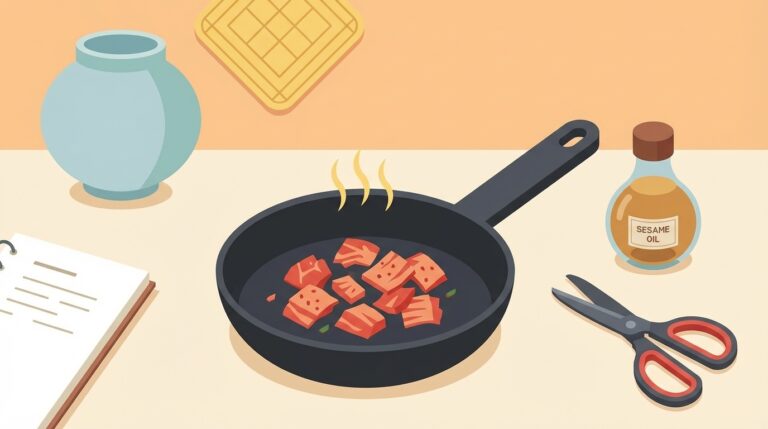
Imagine this scene from your favorite K-Drama: The main characters have had a long, exhausting day. They go back to a small rooftop apartment, open the fridge, and sigh. There’s barely anything inside. But wait! They pull out a container of very old, sour kimchi, toss it into a frying pan with a splash of sesame oil, and suddenly… sizzle. The entire room fills with a mouth-watering aroma, and instantly, everything is better.
This is the soul-comforting magic of 김치 볶기 (Stir-frying Kimchi).
But wait—if you are at a Korean shared kitchen, or cooking with your Korean friends, how do you tell them to “stir-fry” instead of “boil”? If you use the wrong word, you might end up with Kimchi Soup instead of delicious fried kimchi!
Today, we are going to learn the essential A2-level Korean expressions for cooking, mixed with the cultural secrets of K-Food. Let’s dive into the pan!
Phase 2: Core Expressions Deep Dive
Here are the 3 most important phrases you need when cooking Korean food, especially when dealing with the almighty Kimchi.
1. 김치를 볶아요. (I stir-fry the kimchi.)
- Pronunciation: [gimchireul bok-ga-yo]
(Sound analogy: ‘bok’ sounds like a chicken clucking ‘bok-bok!’ Imagine the kimchi sizzling like ‘bok-bok’ in the pan!)- Meaning: I stir-fry the kimchi. (Literal) / Let’s stir-fry the kimchi. (Contextual)
- K-Culture Moment: In a Korean BBQ restaurant, the waiter might put kimchi on the grill next to your pork belly. The pork fat melts into the kimchi, and it naturally bok-ga-yo (stir-fries). It is the ultimate sidekick to K-BBQ!
- Editor’s Insight: The verb 볶다 (bokda) means to cook something in a pan with a little bit of oil while continuously moving it. It’s different from deep-frying (튀기다).
- Situation Spectrum:
[🚫 절대 금지] ———— [⚠️ 주의] ———— [✅ 자유롭게]
- Close friends (Casual – 김치 볶아): ✅
- Coworkers/Acquaintances (Semi-formal – 김치 볶아요): ✅
- Formal/Elders (Formal – 김치를 볶습니다): ⚠️ (A bit too stiff for a fun cooking session!)
- 🤔 Think About It: Koreans love stir-fried dishes (Bokkeum). We have Kimchi-bokkeum, Jeyuk-bokkeum (spicy pork), and Nakji-bokkeum (octopus). Why do you think pan-frying with spicy sauces is so popular in Korea?
2. 참기름을 넣어요. (I add sesame oil.)
- Pronunciation: [cham-gi-reum-eul neo-eo-yo]
(Sound analogy: ‘neo’ sounds like saying “No” but with a soft ‘uh’ at the end. Neo-uh-yo!)- Meaning: Put in the sesame oil.
- K-Culture Moment: Sesame oil (참기름) is the magic potion of Korean cuisine. In variety shows like Jinny’s Kitchen, you’ll always see the cast drizzling sesame oil at the very end to give the dish its glossy, nutty finish.
- Editor’s Insight: You use the verb 넣다 (neota) when you “put into” or “add” an ingredient.
- Situation Spectrum:
[🚫 절대 금지] ———— [⚠️ 주의] ———— [✅ 자유롭게]
- Close friends (Casual – 참기름 넣어): ✅
- Standard Polite (Semi-formal – 참기름 넣어요): ✅
- 🤔 Think About It: In Korean cooking, sesame oil is usually added at the very end off the heat, rather than used to fry things in the beginning. Why? (Hint: It burns easily and loses its aroma!)
3. 불을 줄여요. (Turn down the heat.)
- Pronunciation: [bu-reul ju-ryeo-yo]
- Meaning: I reduce the fire/heat.
- K-Culture Moment: Korean moms in the kitchen are masters of multi-tasking. While boiling soup and chopping garlic, they’ll yell at you from across the room: “불 줄여! (Turn down the heat!)” just before the pot overflows.
- Editor’s Insight: 불 (bul) means fire, but on a stove, it means heat. 줄이다 (jul-i-da) means to reduce.
- Situation Spectrum:
[🚫 절대 금지] ———— [⚠️ 주의] ———— [✅ 자유롭게]
- General Polite (Semi-formal – 불을 줄여요): ✅
Phase 3: Textbook vs Real Life
How does textbook Korean differ from the energetic shouts in a real Korean kitchen?
| Situation | 📖 Textbook Korean | 🗣️ Real Korean | 💡 Why is it different? |
|---|---|---|---|
| Telling someone to fry kimchi | 김치를 볶으세요. (Please stir-fry the kimchi.) | 김치 좀 볶자! (Let’s fry up some kimchi!) | “~자” means “let’s.” It creates a sense of togetherness (우리/We culture). |
| Explaining you are frying it well | 저는 김치를 잘 볶고 있습니다. (I am stirring the kimchi well.) | 달달 볶고 있어요. (I’m frying it up nicely.) | “달달 (dal-dal)” is an onomatopoeia for continuous stirring. Fun fact: “달달 볶다” also means to nag someone! |
| Adding oil | 기름을 첨가하십시오. (Please add oil.) | 참기름 한 바퀴 둘러요~ (Drizzle one circle of sesame oil~) | Cooks measure oil by “circles” (바퀴) around the pan, not tablespoons! |
Phase 4: Cultural Deep Dive — K-Culture Connection
4-1. Non-verbal Communication: The Almighty Scissors ✂️
When making Stir-fried Kimchi or Kimchi Fried Rice (김치볶음밥), you might look for a cutting board and a knife. Stop right there!
In Korea, we use kitchen scissors (가위) to cut the kimchi directly inside the bowl or the frying pan. Why? Because Kimchi juice stains plastic and wood cutting boards bright orange permanently! Plus, it’s so much faster.
4-2. The “K-Dessert” Phenomenon (K-Food)
In Korea, Bokkeumbap (볶음밥 – Fried Rice) isn’t just a main dish; it is a K-Dessert.
Imagine you are at a K-BBQ restaurant, or eating spicy Dakgalbi (닭갈비). When you finish the meat, leaving a little bit of the spicy sauce in the pan is crucial. Why? Because the meal isn’t over. The waiter will bring rice, seaweed, and leftover kimchi to stir-fry it right in front of you. Koreans say, “No matter how full you are, there is always room for Bokkeumbap.”
Phase 5: Immersive Roleplay Scenario
Scenario A: The Midnight Snack (Main Scenario)
- Setting: Friday night, 11:30 PM. You are staying at an Airbnb in Seoul with your Korean friend, Min-su. You both just finished watching a drama, and suddenly, you’re starving. Min-su pulls out a huge container of very old, sour Kimchi.
- Characters:
- YOU: A hungry traveler who loves Korean food but is still learning how to cook it.
- Min-su (28): Your friendly Korean host who believes Kimchi fixes everything.
Min-su: 배고프지? 우리 김치볶음밥 먹을까? 🍳
(baegopeuji? uri gimchibokkeumbap meogeulkka?)
[You’re hungry, right? Should we eat Kimchi Fried Rice?]
YOU: 좋아요! 제가 도울게요. 뭐 하면 돼요?
(joayo! jega doulgeyo. mwo hamyeon dwaeyo?)
[Sounds good! I’ll help. What should I do?]
Min-su: (Handing you a pan) 자, 먼저 팬에 기름을 두르고…
(ja, meonjeo paene gireumeul dureugo…)
[Here, first put some oil in the pan and…]
YOU: 네, 그다음에는요?
(ne, geuda-eume-neun-yo?)
[Okay, and then?]
Min-su: 내가 가위로 김치를 자를게. 네가 김치를 볶아요!
(naega gawiro gimchireul jareulge. nega gimchireul boggayo!)
[I’ll cut the kimchi with scissors. You stir-fry the kimchi!]
(🎭 Stage Direction: Min-su snips the kimchi rapidly into the sizzling pan. The smell is incredibly sour!)
Min-su: 앗, 이 김치 너무 신김치(sour kimchi)다! 엄청 셔! 어떡하지?
(at, i gimchi neomu singimchida! eomcheong syeo! eotteokaji?)
[Oh no, this kimchi is too sour! It’s super tart! What should we do?]
🔀 Your Turn! How should you respond?
– A) “물로 씻어요!” (Wash it with water!)
– B) “설탕을 조금 넣어요!” (Add a little bit of sugar!)
– C) “그냥 버려요!” (Just throw it away!)✅ Best Choice: B — 설탕 (Sugar) is the ultimate Korean kitchen hack. When Kimchi ferments too much and becomes terribly sour (신김치), a pinch of sugar balances the acidity perfectly!
⚠️ Choice A Analysis: Washing it is what you do if it’s too spicy for a baby, but you lose all the delicious seasoning!
🚫 Choice C Analysis: Never throw away Kimchi! It’s disrespectful to the grandmothers who made it, and old Kimchi makes the best stews and stir-fries.
YOU: 설탕을 조금 넣어요! 백종원 선생님이 유튜브에서 그랬어요.
(seoltangeul jogeum neo-eo-yo! Baek Jong-won seonsaengnimi yutubeueseo geuraesseoyo.)
[Add a little bit of sugar! Chef Baek Jong-won said so on YouTube.]
Min-su: 오! 한국 사람 다 됐네! 마지막으로 참기름을 넣어요! 완벽해!
(o! hanguk saram da dwaenne! majimageuro chamgireumeul neo-eo-yo! wanbyeokhae!)
[Oh! You’re basically Korean now! Lastly, we add sesame oil! Perfect!]
Phase 6: 10-Second Shadowing Drill
Practice speaking with the right emotion and pauses! Read aloud:
😋 팬에 / 김치를 / 달~달 / 볶아요!
(paen-e / gimchi-reul / dal~dal / boggayo!)
[Happily: I thoroughly stir-fry the kimchi in the pan!]
🥺 너무 시니까 / 설탕을 / 쪼~금 / 넣어요.
(neomu sinikka / seoltang-eul / jjo~geum / neo-eo-yo.)
[Cautiously/Gently: Because it’s too sour, add a tiiiny bit of sugar.]
😤 타면 안 되니까 / 불을 / 줄여요!
(tamyeon an doenikka / bu-reul / ju-ryeo-yo!)
[Firmly/Urgently: It shouldn’t burn, so turn down the heat!]
Phase 7: K-Culture Glossary
| Korean | Romanization | English | Contextual Explanation |
|---|---|---|---|
| 볶음밥 | bokkeumbap | Fried Rice | Not just a dish, but the mandatory “K-Dessert” eaten at the end of a hot-pan meal. |
| 신김치 | sin-gimchi | Sour/Aged Kimchi | Essential for cooking. Fresh kimchi (겉절이) is bad for stir-frying or soups. |
| 가위 | gawi | Scissors | The MVP of Korean kitchens. Used to cut meat, kimchi, and noodles. |
| 달달 볶다 | daldal bokda | To stir-fry continuously | 1. To fry something well. 2. Slang for nagging someone constantly! |
| 눈치 | nunchi | Social intuition | Having “nunchi” in the kitchen means knowing when to hand the chef the sesame oil without being asked. |
Phase 8: Traveler’s Survival Kit 🧳
Even if you don’t cook at home, you WILL need these expressions at a Korean BBQ restaurant!
🆘 Survival Expression #1: Ordering the K-Dessert
– 🇰🇷 “사장님, 여기 밥 하나 볶아주세요!” (sajangnim, yeogi bap hana boka-juseyo!)
– 🗣️ Meaning: “Boss, please stir-fry one portion of rice here!”
– 📍 Where to use: Dakgalbi restaurants, K-BBQ, Gopchang places.
– 💡 Pro Tip: Never eat all the meat and sauce before saying this. You must leave about 10-20% of your food in the pan so the staff can chop it up and mix it with the rice!📌 Editor’s Travel Note
– Table Bell (벨): Don’t shout across the room. Look for the little button on your table to call the waiter to fry your rice.
– Self-service (셀프): In some modern places, they give you the ingredients, and you have to stir-fry it yourself. Now you know exactly what to do: Bokgayo! (Stir-fry!)
Phase 9: Think Deeper — “한 발 더 깊이”
Food & Identity: The Shared Pan (공동체 의식)
🧠 Think Deeper:
Why do Koreans love eating Bokkeumbap straight out of the same large frying pan, instead of serving it onto individual plates? In Korea, eating from the same pot or pan is a profound symbol of Jeong (정 – affection and deep connection). When everyone’s spoons meet in the center of the sizzling pan, scraping the crispy rice off the bottom together, the boundary between “you” and “me” blurs into “us” (우리). It’s not just about saving dishes; it’s about sharing a collective experience.💬 Your Turn: Does your culture have a dish that everyone eats together from one big pot or pan? Or do you prefer strict individual plating? Share in the comments!
Phase 10: FAQ & Troubleshooting
Q: “Can I use fresh Kimchi to make Kimchi Fried Rice?”
No! Freshly made kimchi (Geotjeori – 겉절이) is crisp and tastes like raw cabbage with spices. If you fry it, it tastes bland and weird. You MUST use 신김치 (Sin-gimchi), which is old, fermented, and sour. The heat transforms the sourness into a deep, savory umami flavor.
Q: “My Korean friend told me I am ‘Dal-dal bok-go-it-da’ (달달 볶고 있다), but we weren’t cooking. Was it a compliment?”
Uh oh… No! 😅 If a person is the object of the “stir-frying,” it means you are nagging or pressuring them relentlessly, just like stirring ingredients over high heat so they don’t rest. Give them a break!
❌ Common Mistake #1: Confusing 볶다 (fry) and 끓이다 (boil).
✅ Do this instead: If there is water/broth, it’s 끓이다 (ggeurida). If there is only oil/sauce in a pan, it’s 볶다 (bokda). Kimchi Jjigae is boiled. Kimchi Bokkeumbap is stir-fried.
Phase 11: Wrap-up & Action Items
One-Liner Summary: To cook the soul of Korean food, remember to use aged kimchi, turn down the heat, and stir-fry (bok-ga-yo) with a finishing touch of sesame oil!
Your 3-Step Action Mission:
– 🥉 Bronze (Solo): Look at your frying pan today and say “김치를 볶아요” three times out loud.
– 🥈 Silver (Online): Find a Korean cooking video on YouTube (like Paik’s Cuisine) and spot the moment they say “참기름” (Sesame oil).
– 🥇 Gold (Real Life): Go to a K-BBQ or Dakgalbi restaurant and confidently order: “여기 밥 볶아주세요!” (Stir-fry rice here, please!).
🥢 K-Culture Mission:
Next time you watch a K-Drama, pay attention to the “fridge raid” scenes. Watch how they inevitably end up throwing leftovers into a pan and frying it up. Now you understand the cultural comfort behind that simple meal!
Phase 12: Interactive Quiz
1. Fill in the Blank:
You are making Kimchi Fried Rice, but the kimchi is way too sour. You should say:
“너무 시니까, _____을/를 조금 넣어요!”
(A) 물 (Water)
(B) 참기름 (Sesame oil)
(C) 설탕 (Sugar)
2. True or False – K-Culture Edition:
When making Stir-fried Kimchi in a Korean home, it is traditional to use a heavy wooden cutting board and a butcher knife to chop the kimchi. (T / F)
3. Situational Judgment:
You just finished eating spicy stir-fried pork (Jeyuk Bokkeum) at a restaurant, but there is some sauce left. What is the most “Korean” thing to do next?
(A) Drink the sauce like soup.
(B) Say “사장님, 밥 볶아주세요!” to make K-Dessert.
(C) Ask the waiter to wash the pan immediately.
(Answers: 1. C / 2. F – We use scissors! / 3. B)
Did you enjoy today’s kitchen lesson? Leave a comment below with your favorite Korean dish that you want to learn how to cook!
Frequently Asked Questions (FAQ)
Q: What does "김치를 볶아요. (I stir-fry the kimchi.)" mean in Korean and how do you pronounce it?
A: In Korean, "김치를 볶아요. (I stir-fry the kimchi.)" is pronounced [gimchireul bok-ga-yo] and means: I stir-fry the kimchi. (Literal) / Let's stir-fry the kimchi. (Contextual)
Q: What does "참기름을 넣어요. (I add sesame oil.)" mean in Korean and how do you pronounce it?
A: In Korean, "참기름을 넣어요. (I add sesame oil.)" is pronounced [cham-gi-reum-eul neo-eo-yo] and means: Put in the sesame oil.
Q: What does "불을 줄여요. (Turn down the heat.)" mean in Korean and how do you pronounce it?
A: In Korean, "불을 줄여요. (Turn down the heat.)" is pronounced [bu-reul ju-ryeo-yo] and means: I reduce the fire/heat.







