

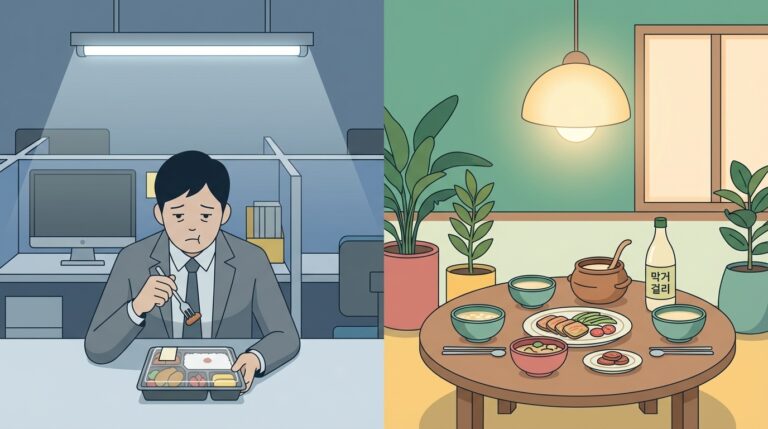
Hello there! I’m your Daily Hangul Editor. \n\nImagine this classic K-Drama scene: The exhausted protagonist, fresh off a 14-hour shift, slumps into a plastic chair at a convenience store. Under the flickering fluorescent lights, they peel open a cold triangle kimbap or a microwaved Home Meal Replacement (HMR) bento box. It’s a scene that screams ‘survival’ rather than ‘dining.’ \n\nBut cut to the weekend. That same protagonist is sitting in a warmly lit, hidden Euljiro tavern, pouring a milky, artisanal Makgeolli (traditional rice wine) into a ceramic bowl, paired with a slow-cooked, nutrient-dense Pajeon or Bossam. \n\nWhy this stark contrast? Modern Korea is currently wrestling with an extreme dietary dichotomy. While HMRs (가정 간편식) and meal kits have revolutionized our busy lives, there’s a growing C2-level societal discourse about ‘영양 불균형’ (nutritional imbalance). As a counter-movement, younger generations are actively seeking out traditional slow foods and premium traditional liquors to heal their weary bodies and minds.\n\nIf you’re an advanced (C2) Korean learner, you shouldn’t just be able to order food—you need to be able to discuss how we eat. Today, we’re going to dive into the sophisticated vocabulary used to critique modern fast-food culture and celebrate the restorative power of traditional Korean gastronomy. Let’s get into it!\n\n—\n\n### Phase 2: Deep Dive into Core Expressions\n\nLet’s elevate your Korean to op-ed and intellectual debate levels. Here are three high-level expressions you need to discuss the nutritional realities of HMRs.\n\n> ### 1. 영양 불균형이 우려되다\n> \n> – Pronunciation: Yeongyang bulgyunhyeongi uryeodaeda [Young-yang bool-gyoon-hyoung-ee oo-ryeo-dwae-da] \n> – Sound-alike guide: ‘Yeongyang’ sounds like ‘Young Yang’, and ‘uryeo’ sounds like ‘ooh-ryeo’ (like saying ‘Oreo’ with a tight ‘oo’ sound).\n> – Meaning: (Literal) Nutritional imbalance is worried about. -> (Real nuance) I’m concerned about the nutritional deficit/imbalance.\n> – K-Culture Moment: You’ll hear this on news broadcasts discussing the rise of single-person households (Honbap culture), or when a caring Korean mother packs up a ton of side dishes (Banchan) for her child living in Seoul, clicking her tongue at their convenience store diet.\n> – Editor’s Insight: This is a highly formal, academic, and journalistic phrase. It instantly signals that you have a mastery of societal issues. Using ‘우려되다’ (to be concerned/worried) instead of ‘걱정되다’ elevates your speech to a C2 professional level.\n> – Situation Spectrum: \n> [🚫 절대 금지] ———— [⚠️ 주의] ———— [✅ 자유롭게]\n> – Casual with friends: ⚠️ (A bit too formal, use ‘영양가 없잖아’ instead)\n> – Semi-formal/Debate: ✅\n> – Formal/Business/News: ✅\n> – 🤔 Think About It: Why do Koreans treat food as a matter of public health rather than just personal choice? How does the concept of collective well-being reflect in your own culture’s food policies?\n\n> ### 2. 끼니를 때우기에 급급하다\n> \n> – Pronunciation: Kkinireul ttaeugie geupgeuphada [Kki-nee-reul ttae-oo-gee-ae geup-geup-ha-da]\n> – Sound-alike guide: ‘Kki’ is a sharp, tense ‘k’ (like the ‘k’ in ‘skill’). ‘Ttae’ sounds like ‘deh’ but with a tense double ‘d/t’. \n> – Meaning: (Literal) Rushing to patch up a meal. -> (Real nuance) Just eating to survive/fill the void, with no regard for quality or nutrition.\n> – K-Culture Moment: This perfectly describes the sad reality of the modern office worker eating a frozen meal kit while staring at an Excel spreadsheet. It highlights the sorrow of losing the ritual of a proper meal.\n> – Editor’s Insight: ‘끼니를 때우다’ (patching a meal) is the polar opposite of ‘식사를 하다’ (having a meal). Adding ‘-에 급급하다’ means you are so pressed for time or resources that you can only manage to do this bare minimum.\n> – Situation Spectrum: \n> [🚫 절대 금지] ———— [⚠️ 주의] ———— [✅ 자유롭게]\n> – Casual with friends: ✅\n> – Semi-formal/Debate: ✅\n> – Formal/Business: ✅\n> – 🤔 Think About It: Does your language have a distinct word for ‘eating to survive’ versus ‘eating for enjoyment’? \n\n> ### 3. 약식동원(藥食同源)의 철학\n> \n> – Pronunciation: Yaksikdongwon-ui cheolhak [Yak-shik-dong-won-eui chul-hak]\n> – Sound-alike guide: ‘Yak’ (medicine) + ‘Shik’ (food) + ‘Dong’ (same) + ‘Won’ (source).\n> – Meaning: (Literal) The philosophy that medicine and food share the same origin. -> (Real nuance) Food is the best medicine.\n> – K-Culture Moment: When you visit a high-end traditional dining restaurant (Hanjeongsik) or taste a medicinal liquor (Baekseju), the chef or brewer will often cite this four-character idiom (Saja-seongeo). It is the ultimate counter-argument to the HMR trend.\n> – Editor’s Insight: Dropping a Saja-seongeo like this in a conversation about modern diets will make native Koreans’ jaws drop. It bridges the gap between criticizing modern fast food and appreciating the slow fermentation process of traditional Korean liquor and cuisine.\n> – Situation Spectrum: \n> [🚫 절대 금지] ———— [⚠️ 주의] ———— [✅ 자유롭게]\n> – Casual with friends: ⚠️ (Too academic, might sound like a professor)\n> – Fine dining/Cultural discussions: ✅\n> – Formal/Business: ✅\n\n—\n\n### Phase 3: Textbook vs. Real Life Korean\n\nHow do people actually complain about unhealthy convenience food in real life? Let’s compare the textbook C2 expressions with what you’ll actually hear at a pub.\n\n| Situation | 📖 Textbook Korean (C2 Formal) | 🗣️ Real Korean (Casual/Pub Talk) | 💡 Why the difference? |\n|—|—|—|—|\n| Critiquing a poor diet | 인스턴트 위주의 식단은 영양 불균형을 초래합니다. (Instant-focused diets cause nutritional imbalance.) | 맨날 편의점 밥만 먹으니까 몸이 축나는 느낌이야. (Eating convenience store food every day makes me feel like my body is decaying.) | ‘몸이 축나다’ is a highly visceral, native way to describe physical deterioration from bad habits. |\n| Longing for real food | 제대로 조리된 영양가 있는 음식이 필요합니다. (I need properly cooked, nutritious food.) | 아, 든든한 집밥에 반주 한잔 땡긴다. (Ah, I’m craving a solid home-cooked meal with a drink.) | ‘반주(Banju)’ is the cultural concept of having a small amount of alcohol with a meal to aid digestion and mood. |\n| Judging an HMR | 이 가정 간편식은 나트륨 함량이 높습니다. (This HMR has a high sodium content.) | 이거 완전 소금 덩어리네. 조미료 맛만 나. (This is a total lump of salt. It only tastes like MSG.) | Exaggeration (‘소금 덩어리’) is common to express dissatisfaction with artificial flavors. |\n\n—\n\n### Phase 4: Cultural Deep Dive — K-Culture Connection\n\n#### 4-1. Non-verbal Communication: The Nostalgic Sigh\nWhen Koreans talk about eating HMRs or fast food because they are too busy, they rarely say it cheerfully. There is usually a deep, audible sigh (한숨) followed by a slight shaking of the head. Food in Korea is love, community, and health. To admit you are relying on meal kits is to admit you are neglecting yourself. If you are serving premium traditional liquor to a friend who has been eating poorly, pour it with two hands, look them in the eye, and say, \”요즘 고생 많지? 이거 먹고 기운 내.\” (You’ve been suffering a lot lately, right? Eat this and gain strength.)\n\n#### 4-2. The Counter-Culture: Traditional Liquor & ‘Slow Food’\nThe dominance of HMRs in Korea has sparked a fascinating backlash among Millennials and Gen Z: the revival of Traditional Liquor (전통주). \nBecause HMRs represent extreme, hyper-processed convenience, young Koreans are seeking out artisanal Makgeolli, Cheongju, and Takju on weekends. These liquors take weeks or months to ferment using Nuruk (traditional fermentation starter). It’s not just about getting drunk; it’s a deliberate rejection of the fast-paced, nutritionally void modern lifestyle. In K-Dramas like Itaewon Class or Drink Now, Work Later, you see characters finding solace not in a plastic-wrapped sandwich, but in a warm bowl of stew and a carefully brewed glass of traditional alcohol.\n\n—\n\n### Phase 5: Immersive Roleplay Scenario\n\nSetting: A trendy, low-lit traditional liquor bar in Bukchon Hanok Village. Rain is lightly tapping against the tiled roof. You are sitting with your Korean foodie friend, Ji-hoon, who is pouring you a glass of a rare, 100-day fermented Makgeolli.\n\nCharacters:\n- YOU: An expat working in Seoul, exhausted from eating convenience store bento boxes all week.\n- Ji-hoon (30s): Your close Korean friend, passionate about traditional food and slow living.\n\nDialogue:\n\nJi-hoon: 자, 한잔 받아. 이거 첨가물 하나도 안 들어간 프리미엄 막걸리야. 🍶\n(Ja, hanjan bada. Igeo cheomgamul hanado an deureogan peurimieom makgeolriya.)\n[Here, take a glass. This is a premium Makgeolli with zero artificial additives.]\n(🎭 Stage Direction: Ji-hoon pours the thick, creamy liquor into your ceramic bowl with both hands.)\n\nYOU: 와, 향부터 다르네. 요즘 맨날 밀키트나 편의점 도시락으로 끼니를 때웠더니 이런 제대로 된 맛이 그리웠어.\n(Wa, hyangbuteo dareune. Yojeum maennal milkiteuna pyeonuijeom dosirageuro kkinireul ttaewotdeoni ireon jedaero doen masi geuriwosseo.)\n[Wow, even the aroma is different. Lately I’ve just been patching my meals with meal kits and convenience store bentos, so I really missed a proper taste like this.]\n\nJi-hoon: 내 말이! 간편식(HMR)이 편하긴 한데, 계속 먹으면 영양 불균형 오기 십상이라니까. 몸이 붓는 느낌 안 들어?\n(Nae mari! Ganpyeonsigi pyeonhagin hande, gyesok meogeumyeon yeongyang bulgyunhyeong ogi sipsangiranikka. Momi bunneun neukkim an deureo?)\n[Right! HMRs are convenient, but if you keep eating them, you’re bound to get a nutritional imbalance. Don’t you feel bloated?]\n\n> 🔀 Your Turn! How should you respond?\n> – A) \”맞아요. 나트륨 함량이 높아서 그런 것 같습니다.\” (Very textbook and a bit robotic for a pub setting.)\n> – B) \”어, 진짜 그래. 몸이 확 축나는 느낌이야. 역시 우리 몸엔 우리 것이 최고지!\” (Natural, native-like, and uses our C2 expression perfectly.)\n> – C) \”난 밀키트 좋은데? 맛있잖아.\” (Misses the point of the emotional venting session.)\n> \n> ✅ Best Choice: B — Reason: It acknowledges his concern, uses the visceral phrase ‘축나는 느낌’ (feeling physically drained), and throws in a classic Korean saying (우리 몸엔 우리 것이 최고지 – Our native things are best for our bodies) which fits the traditional liquor context perfectly!\n\n—\n\n### Phase 6: 10-Second Shadowing Drill\n\nPractice your pacing and intonation to sound like a native Korean intellectual. Follow the slash marks for pauses.\n\n😤 아무리 / 바빠도 그렇지, / 간편식으로만 / 끼니를 때우면 / 영양 불균형이 오기 / 십상이에요.\n(Amuri / bappado geureochi, / ganpyeonsigeuroman / kkinireul ttaeumyeon / yeongyang bulgyunhyeongi ogi / sipsangieyo.)\n\nTranslation: No matter how busy you are, if you only patch your meals with HMRs, you’re highly likely to suffer from nutritional imbalance.\n\n—\n\n### Phase 7: K-Culture Glossary (Food & Diet Edition)\n\n| Korean | Romanization | English | Cultural Context |\n|—|—|—|—|\n| 가정 간편식 (HMR) | Gajeong ganpyeonsik | Home Meal Replacement | The formal term for pre-packaged meals. A massive industry in modern, fast-paced Korea. |\n| 끼니를 때우다 | Kkinireul ttaeuda | To patch a meal | Eating purely for survival, usually fast food or snacks, ignoring joy and nutrition. |\n| 혼밥 | Honbap | Solo dining | Eating alone. Once taboo in communal Korea, now the driving force behind the HMR market. |\n| 약식동원 | Yaksikdongwon | Food is medicine | The traditional philosophy that heavily influences Korean medicinal cooking and liquor brewing. |\n| 반주 | Banju | Liquor with a meal | Having 1-2 glasses of alcohol (often traditional) to complement a meal, not to get drunk. |\n\n—\n\n### Phase 8: Traveler’s Survival Kit (Healthy Eating Edition)\n\nIf you’re traveling in Korea and sick of convenience store food, use these expressions to find wholesome, nutritious meals!\n\n> 🆘 Survival Phrases for the Health-Conscious\n> – 🇰🇷 \”조미료(MSG) 빼고 조리해 주실 수 있나요?\” (Jomiryo ppaego jorihae jusil su innayo?)\n> – 🗣️ English: Can you cook this without MSG?\n> – 📍 Where to use: Local restaurants (though traditional places might be offended, it’s useful in modern spots!).\n\n> – 🇰🇷 \”자극적이지 않은 음식 추천해 주세요.\” (Jageukjeogiji aneun eumsik chucheonhae juseyo.)\n> – 🗣️ English: Please recommend a dish that isn’t too irritating (not too spicy/salty).\n> – 📍 Where to use: Any restaurant when your stomach needs a break.\n\n> 📌 Editor’s Travel Note\n> – Looking for an antidote to HMRs? Search for ‘백반(Baekban)’ or ‘한정식(Hanjeongsik)’ on KakaoMap. These places serve a proper spread of rice, soup, and various nutritious side dishes.\n> – If you want traditional liquor that won’t give you a terrible hangover, ask the bartender for ‘무감미료 막걸리’ (Makgeolli with no artificial sweeteners/aspartame). Your body will thank you tomorrow!\n\n—\n\n### Phase 9: Think Deeper — Food & Identity\n\nFood as the Anchor of Korean Community\nIn Korea, the ultimate greeting isn’t \”How are you?\”—it’s \”밥은 먹었어?\” (Did you eat?). For decades, sharing a bubbling pot of stew (Jjigae) was the physical manifestation of Jeong (정, deep emotional connection). \n\nHowever, the explosion of HMRs and solo dining (Honbap) has severely fractured this communal identity. The concern over ‘영양 불균형’ (nutritional imbalance) isn’t just medical; it’s a profound cultural anxiety. It represents the fear that in our rush toward hyper-efficiency, we are losing our humanity and our connection to one another. This is precisely why the artisanal traditional liquor market is booming among the youth—it’s a conscious rebellion. Sharing a slow-brewed bottle of Cheongju is an attempt to reclaim the time, nutrition, and soulful connection that HMRs have stripped away.\n\n> 💬 Your Turn: How is the rise of instant food changing social interactions in your country? Let me know in the comments!\n\n—\n\n### Phase 10: FAQ & Troubleshooting\n\n❌ Common Mistake: Using ‘때우다’ in formal situations.\n✅ Do this instead: Never say to a boss, \”부장님, 점심 대충 때우시죠\” (Boss, let’s just patch up lunch). It sounds incredibly disrespectful. Use \”간단하게 식사하실까요?\” (Shall we have a simple meal?) instead.\n\nQ: Can I talk about ‘영양 불균형’ at a restaurant to the staff?\nA: No! Keep this academic term for debates, news, or deep discussions with friends. If you tell a restaurant owner their food causes 영양 불균형, you might get kicked out!\n\nQ: Is it rude to read the nutritional labels on HMRs inside a Korean convenience store?\nA: Not at all! In fact, Koreans are highly health-conscious. You’ll often see young people comparing the protein (단백질) and sodium (나트륨) levels of different chicken breasts or dosiraks.\n\n—\n\n### Phase 11: Wrap-up & Action Items\n\nOne-Liner Summary: To speak C2 Korean, move beyond just ordering food and start using words like ‘영양 불균형’ (nutritional imbalance) and ‘약식동원’ (food as medicine) to critique the modern HMR lifestyle and celebrate traditional gastronomy.\n\nYour Action Missions:\n- 🥉 Bronze: Stand in front of a mirror and deliver the Phase 6 shadowing sentence with a dramatic, concerned sigh.\n- 🥈 Silver: Leave a comment on a Korean YouTube video reviewing a meal kit, saying: \”간편해서 좋지만 영양 불균형이 우려되네요!\”\n- 🥇 Gold: Visit a traditional Korean pub, order a premium Makgeolli, and tell the owner you came because you missed real, slow food after eating too many HMRs!\n\n🎬 K-Culture Mission: \nNext time you watch a K-Drama, count how many times the main characters eat a convenience store meal vs. a home-cooked meal. Pay attention to how the background music and lighting change between those two scenes!\n\n—\n\n### Phase 12: Interactive Challenge\n\nQ1. Situational Judgment: \nYour close friend has been working overtime for a month and eating only microwaved sausages. You want to express your concern natively. What do you say?\n1) 영양 불균형이 초래되었습니다.\n2) 맨날 대충 끼니를 때우니까 몸이 축나잖아! 밥 좀 잘 챙겨 먹어!\n3) 우리 몸엔 우리 것이 최고야.\n\nAnswer: 2! (1 is too robotic/news-like, and 3 is a proverb better suited for a traditional food commercial, not scolding a friend.)\n\nQ2. True or False – K-Culture Edition:\n\”Premium traditional Korean Makgeolli is highly processed and causes severe nutritional imbalance.\”\n\nAnswer: False! Premium traditional Makgeolli is often unpasteurized, naturally fermented without artificial sweeteners, and historically considered part of the ‘약식동원’ (food is medicine) philosophy!
Frequently Asked Questions (FAQ)
Q: What does "'영양 불균형'" mean in Korean and how do you pronounce it?
A: In Korean, "'영양 불균형'" is pronounced [nutritional imbalance] and means: . As a counter-movement, younger generations are actively seeking out traditional slow foods and premium traditional liquors to heal their weary bodies and minds.\n\nIf you're an advanced (C2) Korean learner, you shouldn't just be able to order food—you need to be able to discuss







