

Phase 1: Immersive Hook
Hello! I’m the Lead Editor of Daily Hangul.
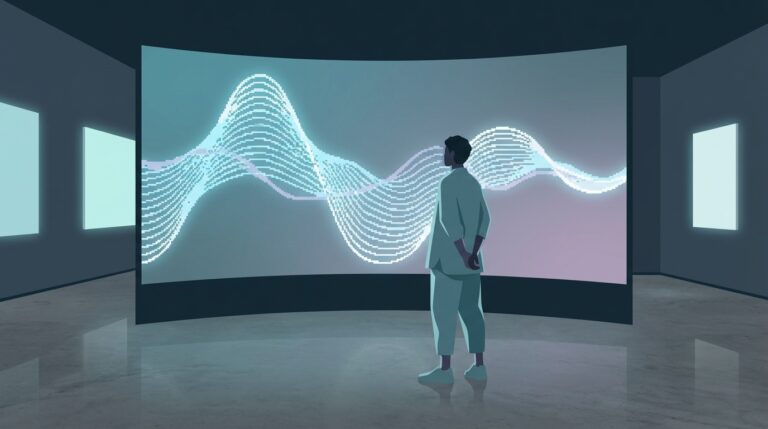
Picture this: You are standing inside a massive, pitch-black room at the DDP (Dongdaemun Design Plaza) or the famous Arte Museum. Suddenly, giant, hyper-realistic digital waves crash around you. The sound is deafening, the visuals are breathtaking, and you feel entirely transported to another dimension.
Your Korean friend turns to you, eyes wide, and asks, “어때? (How is it?)”
You want to express how deeply moved you are, how the artwork completely swallows the space, and how mind-bending the whole experience is. But all that comes out of your mouth is… “오… 아주 멋있어요.” (Oh… it is very cool.)
Sound familiar?
At a C1 level, relying on basic adjectives like “멋있다” (cool/stylish) or “예쁘다” (pretty) in front of profound contemporary installation or media art is like putting ketchup on a premium Hanwoo steak. It gets the job done, but you’re missing out on the rich, complex flavors.
In modern Korea, visiting art exhibitions—especially immersive media art and large-scale installations—has become a massive cultural trend. From K-Pop idols like BTS’s RM frequently “art-touring” to young Seoulites hunting for the perfect aesthetic shot, art is everywhere. Today, we are going to upgrade your vocabulary so you can discuss art, immersion, and space exactly like a sophisticated Seoul local.
Phase 2: Deep Dive (Core Expressions)
Let’s look at how Koreans truly express their awe when interacting with contemporary art.
1. 몰입감이 장난 아니에요
- Pronunciation: [moripgami jangnan anieyo] (Tip: ‘몰’ sounds like ‘mole’, but cut it short!)
- Meaning: The immersion is no joke / The sense of immersion is off the charts.
- K-Culture Moment: You are wearing a VR headset or standing in a 360-degree projection mapping room. When the sensory overload hits perfectly, this is what you whisper to your friend.
- Editor’s Insight: “장난 아니다” (literally “it’s not a joke”) is a native-level intensifier used for anything extreme. By pairing it with “몰입감” (the feeling of immersion), you sound instantly fluent.
- Situation Spectrum:
[🚫 절대 금지] ———— [⚠️ 주의] ———— [✅ 자유롭게]
- Close Friends (Casual): ✅ (몰입감 장난 아니다!)
- Colleagues (Semi-formal): ✅ (몰입감이 장난 아니네요.)
- Formal/Docent: ⚠️ (Better to say: 몰입감이 대단하네요)
- 🤔 Think About It: Why do Koreans use the word “장난” (joke) to emphasize something incredibly impressive or serious? Does your native language use humor or irony to describe magnitude?
2. 공간을 완벽하게 압도하네요
- Pronunciation: [gongganeul wanbyeokhage apdohaneyo]
- Meaning: It completely overwhelms/dominates the space.
- K-Culture Moment: You walk into the main hall of the MMCA (National Museum of Modern and Contemporary Art) and see a massive, 10-meter-tall kinetic sculpture hanging from the ceiling.
- Editor’s Insight: This is highly sophisticated. Korean aesthetics deeply value the relationship between an object and the space (공간) around it, including empty space (여백). Using the verb “압도하다” (to overwhelm/overpower) shows you appreciate the scale and presence of the installation.
- Situation Spectrum:
[🚫 절대 금지] ———— [⚠️ 주의] ———— [✅ 자유롭게]
- Close Friends (Casual): ✅ (공간 압도하는 거 봐.)
- Colleagues/Formal: ✅ (공간을 압도하네요.)
- 🤔 Think About It: Notice how this phrase makes the artwork the active subject, rather than the viewer. “It overwhelms the space” instead of “I am overwhelmed.” How does this reflect an objective appreciation of art?
3. 여기서 인생샷 건졌어요
- Pronunciation: [yeogiseo insaengsyat geonjyeosseoyo]
- Meaning: I got the photo of a lifetime here. (I got a killer shot.)
- K-Culture Moment: After posing in front of a glowing neon installation, you check your phone. The lighting is perfect, your silhouette looks amazing. It’s going straight to Instagram.
- Editor’s Insight: “인생” (life) + “샷” (shot) means the best photo of your life. “건지다” literally means to fish something out of the water, but colloquially means “to manage to get/score” something valuable.
- Situation Spectrum:
[🚫 절대 금지] ———— [⚠️ 주의] ———— [✅ 자유롭게]
- Close Friends (Casual): ✅ (야, 인생샷 건졌다!)
- Colleagues (Semi-formal): ✅ (인생샷 건지셨네요!)
- Formal/Elders: 🚫 (Too slangy.)
Phase 3: Textbook vs Real Life
How do we bridge the gap between intermediate textbook Korean and advanced conversational Korean in an art gallery?
| 상황 | 📖 교과서 한국어 | 🗣️ 진짜 한국어 | 💡 왜 다를까? |
|---|---|---|---|
| Expressing huge scale | 이 작품은 아주 큽니다. (This artwork is very big.) | 와, 스케일 미쳤다. (Wow, the scale is crazy.) | “미치다” (to be crazy) is the ultimate MZ generation compliment for something unbelievably good or grand. |
| Viewing the exhibition | 전시회를 봅니다. (I see the exhibition.) | 전시를 관람하다 / 감상하다. (I view/appreciate the exhibit.) | At a C1 level, distinguish between “보다” (general seeing), “관람하다” (attending/viewing a show), and “감상하다” (deeply appreciating art). |
| Taking photos | 사진을 예쁘게 찍어주세요. (Take a pretty picture please.) | 길게 나오게 찍어주세요. (Make me look tall in the photo.) | Koreans specifically value proportions in photos. Asking to look “long/tall” is a common directive! |
Phase 4: Cultural Deep Dive
4-1. Non-verbal Communication: The Art of “Nunchi” in the Gallery
While interactive media art often encourages you to touch screens or step on projections, Korean galleries have a strict unspoken rule: Watch the photo lines.
In popular spots (like the glowing moon installations), you will see an invisible, highly organized queue of people waiting to take their “인생샷”. Cutting into the frame or lingering too long when someone is posing requires a severe lack of Nunchi (눈치 – the ability to read the room). Step quickly, pose, and step out!
4-2. K-Culture Connection: The “Art-Touring” Idol Phenomenon
If you follow K-Pop, you know that art galleries are no longer just for the elite. Idols, particularly RM of BTS, have spearheaded a massive movement of “Art-Touring” (미술관 투어). When RM visits a contemporary exhibition and posts a quiet, contemplative photo, that gallery will see a 300% spike in visitors the next day.
Interestingly, this bridges a gap. Young fans come for the “idol pilgrimage,” but end up engaging deeply with complex installation art. When you visit these spaces, you aren’t just looking at art; you are participating in a modern K-Pop cultural ritual.
Phase 5: Immersive Roleplay Scenario
Setting: Saturday afternoon at MMCA Seoul. You and your Korean colleague, Min-su (32, witty, art enthusiast), are standing in a dark, cavernous room. In front of you is a massive, glowing mechanical flower that opens and closes based on the audience’s movements.
Min-su: 와… 이거 진짜 신기하네요. 우리가 움직일 때마다 반응해요.
(Wa… igeo jinjja singihaneyo. uriga umjigil ttaemada baneunghaeyo.)
[Wow… this is really fascinating. It reacts every time we move.]
(🎭 Stage Direction: Min-su waves his hand, and the giant metal petals slowly open with a deep mechanical hum.)
YOU: 그러게요. 그냥 보는 게 아니라 직접 참여하는 거라 더 좋은 것 같아요.
(Geureogeyo. geunyang boneun ge anira jikjeop chamyeohaneun geora deo joeun geot gatayo.)
[I know, right. It’s better because we’re directly participating, not just looking.]
Min-su: 맞아요. 이런 인터랙티브 아트(Interactive Art)가 요즘 대세잖아요. 그나저나…
(Majayo. ireon inteoraektibeu ateu-ga yojeum daesejanayo. Geunajeona…)
[Exactly. Interactive art like this is the major trend these days. By the way…]
Min-su: 이 작품, 스케일이 진짜 압도적이지 않아요?
(I jakpum, seukeiri jinjja apdojeogiji anayo?)
[Isn’t the scale of this piece truly overwhelming?]
🔀 당신의 차례! 어떻게 대답할까요? (Your turn! How do you reply?)
- A) 네, 아주 멋있습니다. 훌륭해요. (Safe, but a bit robotic)
- B) 와, 진짜요! 공간을 완전히 압도하네요. 몰입감 장난 아니에요.
- C) 에이, 우리 집 거실에 두면 딱이겠네요.
✅ Best Choice: B — Why? You are matching his C1-level vocabulary by combining “공간을 압도하다” and “몰입감 장난 아니다”. It shows you completely grasp the vibe of the room.
⚠️ Choice C Analysis: This is a hilarious, sarcastic joke (“Eh, it’d look perfect in my living room”). It’s great if you and Min-su are extremely close, but maybe a bit too flippant if he’s taking the art seriously!
Min-su: (Laughs) 그렇죠? 저기 서 보세요. 제가 인생샷 하나 건져 드릴게요!
(Geureochyo? jeogi seo boseyo. jega insaengsyat hana geonjyeo deurilgeyo!)
[Right? Go stand over there. I’ll get a killer shot for you!]
Phase 6: 10-Second Shadowing Drill
Speak out loud! Pay attention to the pauses (/) and the elongated emphasis (~~) to sound exactly like a Seoul local.
😲 와, / 이 작품 / 스케일이 / 장~~난 아니네요!
(Wa, / i jakpum / seukeiri / jang~~nan anineyo!)
Emotion: Pure awe. Stretch the ‘장’ to really emphasize how crazy the scale is.
✨ 와서 서 보세요. / 제가 / 인생샷 / 건져 드릴게요!
(Waseo seo boseyo. / jega / insaengsyat / geonjyeo deurilgeyo!)
Emotion: Enthusiastic and friendly.
Phase 7: K-Culture Glossary (Art Edition)
| 한국어 | Romanization | Meaning | K-Culture Context |
|---|---|---|---|
| 도슨트 | doseunteu | Docent/Guide | Guided art tours are immensely popular in Korea. Audio docents are often voiced by famous actors or idols! |
| 미디어 파사드 | midieo pasadeu | Media Facade | Projecting moving images onto building exteriors. DDP in Seoul is famous for its winter media facade shows. |
| 관람 예절 | gwallam yejeol | Viewing Etiquette | Museum manners. Includes silencing your phone, whispering, and not blocking photo zones. |
| 인생샷 | insaengsyat | Photo of a lifetime | The driving force behind many MZ generation museum visits. |
| 멍 때리다 | meong ttaerida | Spacing out | Often done intentionally in front of immersive media art (e.g., “물멍” – zoning out looking at water). |
Phase 8: Traveler’s Survival Kit
If you are visiting an exhibition in Seoul, keep these phrases in your back pocket!
🆘 Survival Phrases for the Gallery
– 🇰🇷 “오디오 가이드 영어 지원 되나요?” (odio gaideu yeongeo jiwon doenayo?)
– Meaning: Is the audio guide available in English?
– 🇰🇷 “관람 방향이 어디예요?” (gwallam banghyangi eodiyeyo?)
– Meaning: Which way is the viewing route?
– 🇰🇷 “플래시 끄고 찍어도 되나요?” (peullaesi kkeugo jjigeodo doenayo?)
– Meaning: Can I take pictures if I turn off the flash?📌 Editor’s Travel Note:
Almost all major museums in Korea (like MMCA or Leeum) offer free lockers (물품보관함). Koreans hate carrying heavy coats or bags while looking at art. Look for the lockers before you enter the exhibit. Also, remember to book tickets for popular media art exhibits (like Arte Museum) in advance online, as weekend walk-ins are often sold out!
Phase 9: Think Deeper — “One Step Further”
🧠 Think Deeper: Media vs Reality (The Democratization of Art)
In the past, fine art in Korea was considered an exclusive domain for the wealthy and elite—a trope you see constantly in K-Dramas where chaebol mothers run avant-garde galleries. However, the rise of “Media Art” and “Installation Art” has completely democratized this space. Today, art exhibitions are highly accessible, sensory, and designed to be shared on social media. But this brings up a debate in Korea: Are people truly appreciating the artist’s message, or are galleries just becoming elaborate photo studios for Instagram?💬 Your Turn: How does your culture view the balance between appreciating fine art and taking photos for social media? Do you prefer quiet, traditional galleries or loud, immersive, interactive art? Tell us below!
Phase 10: Troubleshooting & FAQ
Q: “미쳤다” (It’s crazy) seems like a great expression. Can I use it when talking to the museum docent?
No! While “미쳤다” is a fantastic way to express awe among friends, it is still slang derived from the word “crazy.” If you are speaking to a docent, a gallery employee, or someone older, use “정말 대단하네요” (It is truly incredible) or “압도적이네요” (It is overwhelming).
Q: I want to say “I saw the exhibit.” Should I use “전시를 봤어요”?
It’s not wrong, but at a C1 level, you should upgrade your vocabulary. Use “전시를 관람했어요” (I viewed the exhibition) or “작품을 감상했어요” (I appreciated the artwork). It makes your Korean sound much more educated and refined.
❌ Common Mistake #1: Calling the artwork “물건” (thing/object).
✅ Do this instead: Always refer to pieces of art as “작품” (artwork/piece). Saying “이 물건 멋있네요” sounds like you are looking at a toaster in a department store, not a sculpture!
Phase 11: Wrap-up & Action Items
🎯 One-Liner Summary: Ditch the basic adjectives and use “압도하다” (overwhelm) and “몰입감” (immersion) to sound like a sophisticated art critic in Seoul!
🔥 Action Mission:
– 🥉 Bronze: Stand in front of a mirror and say “와, 몰입감 장난 아니네요” three times with absolute awe.
– 🥈 Silver: Search for #미디어아트 on Instagram. Leave a comment in Korean on a cool video using today’s vocabulary.
– 🥇 Gold: Next time you visit an exhibition (in Korea or your home country), take a picture and post it with the caption: “여기 완전 인생샷 맛집! 공간을 압도하는 스케일 ✨”
🎭 K-Culture Mission: Go to YouTube and search for “아르떼뮤지엄 브이로그” (Arte Museum Vlog). Listen closely to how the Korean vloggers describe the massive digital waves. You will definitely hear the words “스케일” and “장난 아니다”!
Phase 12: Interactive Quiz
Test your C1 Korean intuition!
1. Situational Judgment: You are at an interactive art exhibit with a senior colleague (과장님). The light show is incredibly immersive. What is the BEST thing to say?
– A) 과장님, 여기 몰입감 미쳤어요!
– B) 과장님, 작품이 공간을 정말 압도하네요.
– C) 과장님, 빨리 가서 인생샷 찍어주세요.
2. Fill in the Blank:
“어제 미술관 갔는데, 전시 스케일이 ( ____ ) 아니었어!”
(Hint: It means “no joke”)
3. True or False (K-Culture Edition):
In Korean museums, it is considered polite to offer a tip to the docent after a good guided tour. (T / F)
(Answers below!)
👀 Click here for answers!
1. Answer: B.
A is too slangy for a boss (“미쳤어요”). C is bossing your senior around to take your photo (huge Nunchi failure!). B is perfectly polite, sophisticated, and observant.
2. Answer: 장난
(스케일이 장난 아니었어 – The scale was no joke!)
3. Answer: False (F).
Korea has absolutely no tipping culture. Trying to tip a docent or gallery worker will result in awkward confusion. A deep bow and a sincere “감사합니다, 설명이 너무 좋았어요” (Thank you, the explanation was wonderful) is the best reward!
What was the most awe-inspiring exhibition you’ve ever been to? Let me know in the comments using today’s expressions! 🎨✨
Frequently Asked Questions (FAQ)
Q: What does "몰입감이 장난 아니에요" mean in Korean and how do you pronounce it?
A: In Korean, "몰입감이 장난 아니에요" is pronounced [moripgami jangnan anieyo] and means: The immersion is no joke / The sense of immersion is off the charts.
Q: What does "공간을 완벽하게 압도하네요" mean in Korean and how do you pronounce it?
A: In Korean, "공간을 완벽하게 압도하네요" is pronounced [gongganeul wanbyeokhage apdohaneyo] and means: It completely overwhelms/dominates the space.
Q: What does "여기서 인생샷 건졌어요" mean in Korean and how do you pronounce it?
A: In Korean, "여기서 인생샷 건졌어요" is pronounced [yeogiseo insaengsyat geonjyeosseoyo] and means: I got the photo of a lifetime here. (I got a killer shot.)







