

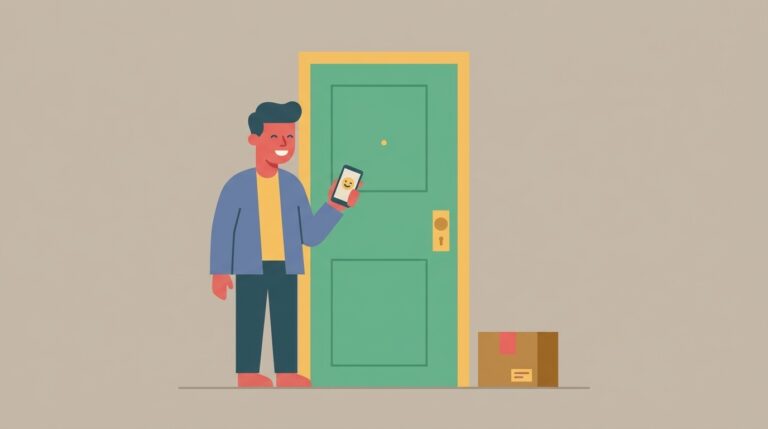
Phase 1: Immersive Hook
Hello! It’s your Daily Hangul Editor. 👋
Picture this K-Drama moment: The main character has a crucial date tomorrow. She ordered that viral lip tint online, and now she is aggressively tapping her phone screen, refreshing the delivery app every 10 seconds. We’ve all been there, right? Or maybe you just ordered your favorite K-Pop idol’s new album to your hotel in Seoul, and you’re sweating because your flight leaves in two days.
Korea is world-famous for its mind-blowing 빨리빨리 (Ppalli-ppalli / Hurry hurry) culture. Deliveries can arrive the next day, or even by dawn the next morning! But when you open that delivery app or get a text message entirely in Korean, panic sets in. What do these tracking words mean? Is my package lost?
Don’t worry! I’ve taught hundreds of expats who used to physically wait by the door because they couldn’t read the tracking text. Today, we are going to learn exactly how to read your package’s mind. Once you know these A1-level magic words, you’ll be tracking packages like a true Seoulite!
Phase 2: Deep Dive (Key Expressions)
Let’s look at the top 3 expressions you will see when tracking your package.
1. 배송 중 (In Transit / Shipping)
- Pronunciation: [bae-song jung]
- Tip: ‘bae’ sounds like ‘bay’, ‘song’ sounds like a musical ‘song’, and ‘jung’ sounds like ‘joong’.
- Meaning:
- Literal: Middle of delivery.
- Real nuance: It’s on the truck and moving towards you!
- K-Culture Moment: You get a KakaoTalk message at 10 AM. It says “배송 중.” In Korea, this usually means the delivery driver (기사님 – gisa-nim) is in your neighborhood and you will get your package today!
- Editor’s Insight: The word ‘중’ (jung) is incredibly useful. It means “in the middle of doing something.” You can attach it to many nouns!
- Situation Spectrum:
[🚫 Do Not Use] ———— [⚠️ Caution] ———— [✅ Freely]
- Used by apps/text messages: ✅
- Used when speaking to a driver: ✅ (e.g., “지금 배송 중이신가요?” – Are you delivering it now?)
- 🤔 Think About It: Why does Korean rely so heavily on simple noun-modifiers like ‘중’ (middle) to express ongoing action, rather than complex verb tenses? How does your language express “currently happening”?
2. 배송 완료 (Delivery Complete)
- Pronunciation: [bae-song wal-ryo]
- Tip: ‘wal-ryo’ sounds a bit like ‘wall-ryo’. Say it quickly!
- Meaning:
- Literal: Delivery finished.
- Real nuance: Open your door, it’s there!
- K-Culture Moment: This text almost always comes with a literal photo of your front door with the box sitting in front of it. It’s the most exciting text you can get in Korea.
- Editor’s Insight: When you see ‘완료’ (wal-ryo), you can relax. It means 100% finished.
- Situation Spectrum:
[🚫 Do Not Use] ———— [⚠️ Caution] ———— [✅ Freely]
- Text message status: ✅
- Telling your friend: ✅ (“내 택배 배송 완료됐어!” – My package is delivered!)
- 🤔 Think About It: Delivery drivers in Korea take photos of the dropped-off package as proof. Do they do this in your home country? Why do you think this became a standard practice in Korea?
3. 송장번호 (Tracking Number)
- Pronunciation: [song-jang beon-ho]
- Tip: ‘beon-ho’ sounds like ‘bun-ho’.
- Meaning:
- Literal: Invoice number.
- Real nuance: Your package’s unique ID for tracking.
- K-Culture Moment: If you buy K-Pop photo cards from another fan on X (Twitter), they will DM you saying, “Here is your 송장번호!”
- Editor’s Insight: If you ever need to ask a customer service agent about a lost box, this is the very first thing they will ask for.
- Situation Spectrum:
[🚫 Do Not Use] ———— [⚠️ Caution] ———— [✅ Freely]
- Talking to customer service: ✅
- Talking to friends: ✅
- 🤔 Think About It: Knowing your tracking number gives you control. In a fast-paced society, why is tracking visibility so emotionally important to people?
Phase 3: Textbook vs Real Life
How do we actually ask about our packages in real life? Let’s compare!
| Situation | 📖 Textbook Korean | 🗣️ Real Life Korean | 💡 Why the difference? |
|---|---|---|---|
| Asking where your box is | 제 택배는 어디에 있습니까? (Where is my parcel?) | 택배 어디쯤이에요? (Whereabouts is my package?) | ‘-쯤’ (around/about) softens the question so it doesn’t sound demanding. |
| Asking when it arrives | 언제 도착합니까? (When does it arrive?) | 오늘 와요? (Is it coming today?) | Koreans assume things arrive today. We just want confirmation! |
| Telling someone it arrived | 택배가 도착했습니다. (The parcel has arrived.) | 택배 왔다! (The package is here!) | Exclamations dropping formal endings show excitement among friends. |
Bottom Note: As a beginner, “오늘 와요?” (o-neul wa-yo? / Is it coming today?) is your best friend. It’s polite but natural!
Phase 4: Cultural Deep Dive
4-1. Non-verbal Communication: The “Ghost” Delivery
In Korea, delivery drivers are incredibly busy. You rarely interact with them face-to-face. The standard etiquette is 문 앞 (mun ap – in front of the door). They will leave the box, take a picture, text you, and disappear like a ninja. Do not expect them to ring the bell and wait for you to answer, unless it’s a very expensive item or you specifically requested it.
4-2. K-Culture Connection: The ‘Ppalli-Ppalli’ Ecosystem
If you watch a Korean drama, you’ll see characters ordering groceries on their phone before bed and waking up to fresh milk at their door. This is called 새벽배송 (Dawn Delivery).
Because the system is so fast, Korean consumers have high expectations. If an app says “배송 중” (In transit), it means you will get it that day. If it takes more than 2-3 days, Koreans genuinely start to worry that something is wrong!
Phase 5: Immersive Roleplay Scenario
Setting: A rainy Tuesday morning. You are staying at a guesthouse in Hongdae. You ordered a limited-edition Kakao Friends plushie, and you leave for the airport tomorrow. You need to check the status with the guesthouse host.
Characters:
– YOU: Anxious traveler, A1 Korean level.
– Minji (28): The friendly guesthouse manager.
Dialogue:
YOU: 민지 씨, 질문 있어요. (Minji-ssi, jilmun isseoyo.)
[Minji, I have a question.]
Minji: 네, 무슨 일이에요? (Ne, museun irieyo?)
[Yes, what’s up?]
YOU: 제 택배… 오늘 와요? (Je taekbae… oneul wayo?)
[My package… is it coming today?]
Minji: 아! 송장번호 있어요? (Ah! Songjang beonho isseoyo?)
[Ah! Do you have the tracking number?]
YOU: 네, 여기요. (Ne, yeogiyo.)
(🎭 You show her your phone screen)
[Yes, here it is.]
Minji: 음… 앱에는 ‘배송 완료’라고 나와요. (Eum… aebeneun ‘baesong walryo’rago nawayo.)
[Hmm… the app says ‘Delivery Complete’.]
YOU: 네? 하지만 제 방 앞에는 없어요. (Ne? Hajiman je bang apeneun eopseoyo.)
[What? But it’s not in front of my room.]
Minji: 1층 우편함 확인해 봤어요? (1-cheung upyeonham hwaginhe bwasseoyo?)
[Did you check the mailboxes on the 1st floor?]
🔀 Your Turn! How do you respond?
– A) “아니요, 지금 갈게요!” (No, I’ll go right now!)
– B) “네, 확인했어요. 없어요.” (Yes, I checked. It’s not there.)
– C) “기사님한테 전화해 주세요!” (Please call the driver!)✅ Best Choice: A or B depending on your situation. But C is a bit too aggressive for Korea’s polite culture! If it’s truly missing, Minji will usually offer to call the driver for you (눈치 – Nunchi!).
Phase 6: 10-Second Shadowing Drill
Practice reading your delivery status out loud! Follow the pauses (/) and match the emotion.
- 📱 (Curious) 제 택배 / 언제 / 와요?
(je taekbae / eonje / wayo?)- When is my package coming?
- 🤩 (Excited) 와! / 배송 / 완료!
(wa! / baesong / walryo!)- Wow! Delivery complete!
- 🤔 (Focused) 송장번호가 / 뭐예요?
(songjang beonhoga / mwoyeyo?)- What is the tracking number?
Phase 7: K-Culture Glossary
| Korean | Romanization | English | Context |
|---|---|---|---|
| 택배 | taekbae | Parcel/Delivery | The general word for any package delivery service. |
| 기사님 | gisa-nim | Driver | Respectful title for delivery drivers or taxi drivers. |
| 문 앞 | mun ap | Front of the door | The default location where packages are left. |
| 착불 | chak-bul | Pay on delivery | When you must pay the shipping fee to the driver directly. |
| 반값택배 | ban-kkap taekbae | Half-price delivery | A cheap service where you pick up packages at a convenience store. |
Phase 8: Traveler’s Survival Kit
If you are traveling in Korea, you might order things to a convenience store (CU or GS25) using 반값택배 (Half-price delivery). Here is your survival kit!
🆘 Survival Expression #1
– 🇰🇷 “택배 찾으러 왔어요.” (Taekbae chajeureo wasseoyo.)
– 🗣️ English Pronunciation: taek-bae cha-jeu-reo wa-sso-yo.
– 📍 Where to use: Convenience stores, hotel front desks.
– 💡 Pro Tip: Have your tracking number (송장번호) or QR code ready on your phone before you walk up to the counter!📌 Editor’s Travel Note
– Useful Apps: Most expats use Coupang (it has an English interface now!), Gmarket, or native brand apps (like Olive Young).
– Security: Don’t worry about porch pirates. Korea has CCTVs everywhere. Packages left outside are incredibly safe!
Phase 9: Think Deeper — “One Step Further”
Trust & The Korean Doorstep
One of the biggest culture shocks for foreigners in Korea is seeing a brand new laptop sitting outside an apartment door all day long. How is this possible? Korea is a “High-Trust Society,” heavily reinforced by an extensive network of CCTVs and strict social norms against theft. The concept of “배송 완료” (Delivery Complete) leaving a package in a public hallway relies entirely on this unspoken social contract. It’s not just about cameras; it’s a cultural mindset that “other people’s belongings are not mine to touch.”
💬 Your Turn: Does package theft happen in your home country? How would people react if a driver just left a box outside an apartment door?
Phase 10: Troubleshooting (FAQ & Mistakes)
Q: Should I tip the delivery driver?
No! Korea does not have a tipping culture. Tipping the driver will confuse them. If you want to show appreciation, especially during hot summers or holidays, you can leave a small snack or a canned drink outside your door with a post-it note saying “감사합니다” (Thank you).
Q: What if I miss the delivery call?
Usually, they don’t call! They will just send a text message or a KakaoTalk message. If they do call, it’s usually because they need the password to the main building entrance (공동현관 비밀번호).
❌ Common Mistake #1: Thinking “배송 준비 중” (Preparing for shipment) means it’s coming today.
✅ Do this instead: Look for “배송 중” (In transit). “준비 중” means the warehouse is still putting it in the box!
Phase 11: Wrap-up & Action Items
One-Liner Summary: Look for “배송 중” when you’re waiting, and celebrate when you see “배송 완료”!
Action Mission:
– 🥉 Bronze: Say “택배 언제 와요?” out loud 3 times right now.
– 🥈 Silver: Change the language of one of your shopping apps to Korean for a day and try to find the word for “Tracking” or “Delivery.”
– 🥇 Gold: Order something small to your hotel or home in Korea, and track it using the Korean app!
K-Culture Mission: Watch a K-Drama today and spot the scene where a character opens their front door to find a brown box waiting for them. Notice how the driver is nowhere to be seen!
Did you ever have a funny delivery experience in Korea? Leave a comment below!👇
Phase 12: Interactive Quiz
1. You are checking your KakaoTalk, and you see a message from the delivery company. It says “배송 완료”. What should you do?
– A) Call the police; it’s lost.
– B) Wait for the truck to arrive.
– C) Open your front door; your package is there!
2. Fill in the blank: The unique number used to track your package is called the ________.
– A) 송장번호 (songjang beonho)
– B) 전화번호 (jeonhwa beonho)
– C) 비밀번호 (bimil beonho)
3. True or False: You should always leave a 10% tip for the delivery driver in Korea.
(Answers: 1: C, 2: A, 3: False – No tipping in Korea!)
Frequently Asked Questions (FAQ)
Q: What does "배송 중 (In Transit / Shipping)" mean in Korean and how do you pronounce it?
A: In Korean, "배송 중 (In Transit / Shipping)" is pronounced [bae-song jung] and means: a key conversational Korean expression covered in this lesson.
Q: What does "배송 완료 (Delivery Complete)" mean in Korean and how do you pronounce it?
A: In Korean, "배송 완료 (Delivery Complete)" is pronounced [bae-song wal-ryo] and means: a key conversational Korean expression covered in this lesson.
Q: What does "송장번호 (Tracking Number)" mean in Korean and how do you pronounce it?
A: In Korean, "송장번호 (Tracking Number)" is pronounced [song-jang beon-ho] and means: a key conversational Korean expression covered in this lesson.







