

Phase 1: 공감 — 몰입형 오프닝 (Immersive Hook)
Hello! I’m your Daily Hangul Editor, your “Korean bestie” and personal local guide. 😊
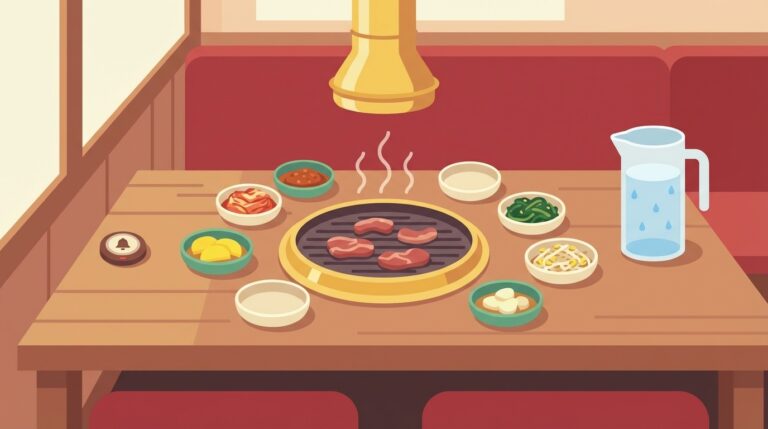
Picture this K-Drama scene: The main characters are sitting at a cozy, slightly noisy local restaurant. One of them bravely eats a bright red piece of Tteokbokki or a garlic clove wrapped in spicy pork belly. Suddenly, their face turns red, they start fanning their mouth, and they desperately reach for the water pitcher… but it’s empty! 😱
If you travel to Korea, this will happen to you. Korean food is incredibly delicious, but it can pack a spicy punch. When your mouth is on fire, you don’t have time to look up a dictionary. You need to know exactly how to ask for more water, quickly and politely.
Today, we are going to learn how to survive the “spicy emergency” and ask for water like a true local. By the end of this guide, you won’t just get your water—you’ll get an approving nod from the restaurant owner!
Phase 2: 핵심 표현 심층 분석 (Deep Dive)
1. 물 좀 더 주세요.
- Pronunciation: mul jom deo juseyo + [mool johm duh joo-seh-yo]
- Meaning: (Literal) Water a little more give please. / (Real Nuance) Please give me some more water.
- K-Culture Moment: You’ll hear this at almost every table in a K-BBQ restaurant. The ice-cold water in Korea is a lifesaver, and asking for a refill is a daily routine.
- Editor’s Insight: The word ‘좀 (jom)’ literally means ‘a little’, but here it acts as a polite softener. Without it, “물 더 주세요” sounds a bit demanding. Think of ‘좀’ as the magic word that adds a soft smile to your request!
- Situation Spectrum:
[🚫 절대 금지] ———— [⚠️ 주의] ———— [✅ 자유롭게]
- 친구 사이 (Casual): ⚠️ (Friends use casual language: “물 좀 더 줘”)
- 식당 직원 (To Staff): ✅
- 직장 상사 (Formal): ✅ (Perfectly polite!)
- 🤔 Think About It: Why do Koreans use “좀 (a little)” even when they want a LOT of water? How does your culture soften requests?
2. 사장님, 여기 물이요!
- Pronunciation: sajangnim, yeogi muriyo! + [sah-jang-neem, yuh-gee moo-ree-yo!]
- Meaning: (Literal) Boss, water here! / (Real Nuance) Excuse me, we need water over here!
- K-Culture Moment: A bustling Pojangmacha (street tent) or a crowded Friday night restaurant. It’s loud, people are chatting, and you need to project your voice!
- Editor’s Insight: ‘사장님’ means ‘boss/owner’, but it’s the most common and respectful way to call any restaurant staff in Korea, regardless of whether they actually own the place.
- Situation Spectrum:
[🚫 절대 금지] ———— [⚠️ 주의] ———— [✅ 자유롭게]
- 고급 레스토랑 (Fine Dining): 🚫 (Too loud/casual)
- 일반 식당 (Casual Dining): ✅
- 포장마차 (Street Food Tent): ✅
3. 물은 셀프인가요?
- Pronunciation: mureun selpeuingayo? + [moo-reun sel-peu-in-gah-yo?]
- Meaning: Is water self-service?
- K-Culture Moment: You sit down at a cute little Gimbap shop. You’ve been waiting for water for 10 minutes, only to realize no one is bringing it. You look around and see a water dispenser.
- Editor’s Insight: In many casual Korean diners, labor is saved by having customers get their own water. The Konglish word ‘셀프 (Self)’ is essential survival vocabulary!
- Situation Spectrum:
[🚫 절대 금지] ———— [⚠️ 주의] ———— [✅ 자유롭게]
- Any restaurant where you are unsure: ✅
Phase 3: 교과서 vs 진짜 한국어 (Textbook vs Real Life)
| 상황 | 📖 교과서 한국어 | 🗣️ 진짜 한국어 | 💡 왜 다를까? |
|---|---|---|---|
| 종업원을 부를 때 | 실례합니다. (Excuse me.) | 사장님! or 저기요! (Boss! / Over here!) | “실례합니다” is mostly used when bumping into someone or asking strangers for directions on the street, not in restaurants! |
| 물을 요청할 때 | 물을 더 주시겠습니까? (Would you give me more water?) | 여기 물 좀 더 주세요~ (More water here, please~) | Fast-paced “Pali-pali” culture prefers short, direct, yet polite requests over long, grammatically complex sentences. |
| 얼음물이 필요할 때 | 얼음물을 주십시오. (Please give me ice water.) | 얼음물 좀 주실 수 있나요? (Can you give me ice water?) | Many Korean restaurants only serve chilled water in pitchers. Asking with “수 있나요? (Is it possible?)” is more considerate! |
Phase 4: 문화적 맥락 — K-Culture 딥다이브 (Cultural Deep Dive)
4-1. 비언어적 요소 (Non-verbal Communication)
Don’t just shout “사장님!” into the void. In Korea, eye contact and a slight hand raise are key.
However, the absolute BEST way to get water? The Call Button (벨).
Look at your table. Is there a small, round button attached to the edge? Press it once. You will hear a loud “Ding-dong!” echoing through the restaurant, and a staff member will rush over. It’s the magical “Nunchi” (눈치) button that saves you from having to shout!
4-2. K-Food Connection: “물은 셀프” (Water is Self)
Have you ever noticed a sign that says “물은 셀프입니다” (Water is self-service) in K-Dramas?
Because Korean food features a lot of red pepper paste (Gochujang) and savory broths, drinking water is an absolute must. To handle the high demand for water efficiently, many casual restaurants (especially Bunsik spots selling Tteokbokki and Gimbap) place a large water purifier (정수기) in the corner. You just grab a small stainless steel cup and help yourself. It’s totally free, and you can drink as much as you want!
Phase 5: 실전 롤플레이 시나리오 (Immersive Roleplay)
Setting: Friday night, 7:30 PM. A bustling K-BBQ restaurant in Gangnam. Smoke fills the air, K-Pop is playing in the background, and you are having dinner with your Korean coworker.
Characters:
– YOU: A foreigner in Korea for a business trip. You just ate a piece of pork wrapped with raw garlic and a green pepper that turned out to be insanely spicy.
– Min-su (32): Your friendly Korean coworker who is currently flipping the meat.
Dialogue:
Min-su: 많이 드세요! 한국 고기 진짜 맛있죠? 🥩
(manhi deuseyo! hanguk gogi jinjja masitjyo?)
(Eat up! Korean meat is really delicious, right?)
YOU: 네! 정말 맛있어요. 그런데… 헥헥… 🔥
(ne! jeongmal masisseoyo. geureonde… hekhek…)
(Yes! It’s really delicious. But… pant pant…)
Min-su: 헉, 방금 청양고추 드셨어요?! 얼굴이 빨개요!
(heok, banggeum cheongyanggochu deuseosseoyo?! eolguri ppalgaeyo!)
(Gasp, did you just eat a Cheongyang chili pepper?! Your face is red!)
(🎭 Stage Direction: You look at the water pitcher, but it’s completely empty.)
🔀 당신의 차례! 어떻게 대답할까요? (Your Turn! How should you react?)
– A) “Min-su, 물을 더 주시겠습니까?” (Min-su, would you give me more water?)
– B) (Press the table button) “사장님~ 물 좀 더 주세요!” (Boss~ Please give us more water!)
– C) “물! 빨리!” (Water! Fast!)✅ Best Choice: B — You correctly used the call button and the natural phrase!
⚠️ Choice A 분석: This is too textbook-like and formal for a casual dinner with a coworker.
🚫 Choice C 분석: NEVER use this! Dropping the politeness marker ‘요’ to staff is considered extremely rude (Banmal).
Min-su: (Laughs) 아, 제가 누를게요! 띵동~
(a, jaega nureulgeyo! ttingdong~)
(Ah, I’ll press it! Ding-dong)
Staff: 네~ 필요하신 거 있으세요?
(ne~ piryohasin geo isseuseyo?)
(Yes~ Do you need anything?)
YOU: 여기 물 좀 더 주세요!
(yeogi mul jom deo juseyo!)
(Please give us some more water here!)
Phase 6: 10초 섀도잉 드릴 (Shadowing Drill)
Practice reading these out loud. Pay attention to the pauses (/) and the emotion!
- 🥺 (Polite & Desperate) 사장님! / 여기 / 물 좀 더 / 주세요~~
(sajangnim! / yeogi / mul jom deo / juseyo~~) - 🤔 (Curious & Looking around) 혹시 / 물은 / 셀프인가요?
(hoksi / mureun / selpeuingayo?) - 😊 (Friendly) 얼음물 / 좀 / 주실 수 있나요?
(eoreummul / jom / jusil su innayo?)
Phase 7: K-Culture 미니 사전 (K-Culture Glossary)
| 한국어 | Romanization | English | 맥락 설명 (Context) |
|---|---|---|---|
| 사장님 | sajangnim | Boss / Owner | The safest, most polite way to address restaurant staff. |
| 눈치 | nunchi | Social awareness | Knowing when to use the call button vs when to speak up. |
| 셀프 | selpeu | Self-service | Often seen as “물은 셀프” (Water is self-service). |
| 정수기 | jeongsugi | Water purifier | The machine you go to when water is “self”. |
| 띵동 | ttingdong | Ding-dong | The iconic sound of the restaurant call button. |
Phase 8: 여행자 서바이벌 키트 (Traveler’s Survival Kit)
🆘 식당 서바이벌 표현 TOP 3 (Restaurant Survival TOP 3)
- 🇰🇷 “이거 얼마예요?” (igeo eolmayeyo?)
- 🗣️ English: How much is this?
- 📍 Use it: When ordering from a menu without clear prices (like at traditional markets).
- 🇰🇷 “화장실 어디예요?” (hwajangsil eodiyeyo?)
- 🗣️ English: Where is the restroom?
- 📍 Use it: You drank too much water! Time to find the restroom.
- 🇰🇷 “덜 맵게 해주세요.” (deol maepge haejuseyo.)
- 🗣️ English: Please make it less spicy.
- 📍 Use it: Say this before you order so you don’t need 5 pitchers of water later!
📌 Editor’s Travel Note
– Free Water: In Korea, tap water is rarely served in restaurants. You always get purified or boiled water (like barley tea), and it’s 100% FREE!
– Tipping: Do NOT tip the waiter for bringing you water. Korea has a strict no-tipping culture. Just say “감사합니다” (Thank you).
Phase 9: 비판적 사고 코너 — “한 발 더 깊이” (Think Deeper)
🧠 Think Deeper: Food & Identity (음식과 정체성)
In many Western countries, you must pay for bottled water at a restaurant, and side dishes cost extra. In Korea, water is endlessly free, and so are the Banchan (side dishes)! Why?
This traces back to the Korean concept of 정 (Jeong)—a deep sense of affection, community, and generosity. Historically, sharing food and water generously with neighbors and guests was a basic human courtesy. When a restaurant owner gives you free refills of water and Kimchi, they are treating you not just as a customer, but as a guest at their table.
💬 Your Turn: Does your country charge for water in restaurants? How does your culture show hospitality through dining? Share in the comments!
Phase 10: FAQ & 오해 방지 (Troubleshooting)
- Q: Can I just point at my cup and say “물 (Mul)”?
- A: NO! 🚫 Just saying the noun sounds like a command to a servant. Always attach “주세요 (juseyo – please give)”.
- Q: Can I call the young female staff “이모 (Auntie)”?
- A: Maybe… but be careful! “이모님 (Imo-nim)” is affectionately used for middle-aged or older female staff at traditional, casual spots. If the staff looks young, stick to “사장님 (Sajangnim)” or simply “저기요 (Excuse me)”.
❌ 흔한 실수 #1 (Common Mistake): Shouting “저기요!!!” aggressively.
✅ 이렇게 하세요 (Do this instead): “저기요” is fine, but the tone matters! Say it with a bright, slightly raised pitch, not like you’re angry.
Phase 11: 요약 및 액션 아이템 (Wrap-up)
One-Liner Summary: To survive spicy Korean food, press the call button and confidently say, “사장님, 물 좀 더 주세요!”
🔥 Action Mission 3단계:
– 🥉 Bronze (Solo): Stand in front of your mirror and practice saying “사장님, 물 좀 더 주세요!” three times with a bright smile.
– 🥈 Silver (Online): Find a scene in a K-Drama where people are eating K-BBQ. Spot the “Call Button” on their table!
– 🥇 Gold (Real Life): Next time you visit a Korean restaurant in your city, order in Korean and ask for water using today’s phrase!
🥡 K-Culture Mission:
Search for a Korean street food vlog on YouTube. Listen closely to what the customers say when they need something from the owner. Did you hear Sajangnim?
Phase 12: 퀴즈 — 인터랙티브 챌린지 (Interactive Quiz)
1. You are at a busy Tteokbokki shop. You want more water. What is the BEST thing to do first?
A) Scream “물!!!” (Water!!!)
B) Look around for a “물은 셀프” (Water is self-service) sign or a water purifier.
C) Wait patiently for 30 minutes in silence.
2. Fill in the blank: “사장님, 여기 ______ 좀 더 주세요!”
A) 셀프 (Self)
B) 물 (Water)
C) 눈치 (Nunchi)
3. True or False — K-Culture Edition:
“If the restaurant staff brings you a pitcher of water, you must leave a $2 tip on the table.”
(Scroll down for answers!)
Answers:
1. B – Casual shops often have self-serve water. Always check your surroundings first!
2. B – “Boss, please give me some more WATER (물) here!”
3. False – Korea is a completely tip-free culture. Tipping might actually confuse the staff!
Frequently Asked Questions (FAQ)
Q: What does "물 좀 더 주세요." mean in Korean and how do you pronounce it?
A: In Korean, "물 좀 더 주세요." is pronounced [mul jom deo juseyo + [mool johm duh joo-seh-yo] and means: (Literal) Water a little more give please. / (Real Nuance) Please give me some more water.
Q: What does "사장님, 여기 물이요!" mean in Korean and how do you pronounce it?
A: In Korean, "사장님, 여기 물이요!" is pronounced [sajangnim, yeogi muriyo! + [sah-jang-neem, yuh-gee moo-ree-yo!] and means: (Literal) Boss, water here! / (Real Nuance) Excuse me, we need water over here!
Q: What does "물은 셀프인가요?" mean in Korean and how do you pronounce it?
A: In Korean, "물은 셀프인가요?" is pronounced [mureun selpeuingayo? + [moo-reun sel-peu-in-gah-yo?] and means: Is water self-service?







