

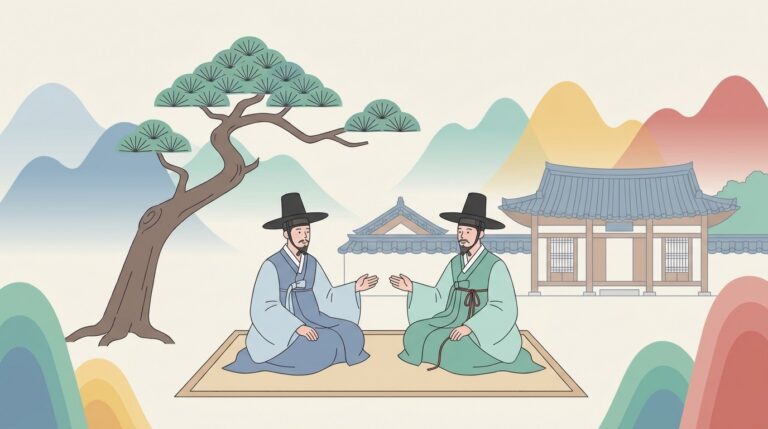
Phase 1: Empathy — When K-Drama Philosophy Meets Real Conversation
안녕하세요! 매일한글 에디터입니다. (Annyeonghaseyo! Hello, I’m your Daily Hangul Editor.) Picture yourself binge-watching a prestige K-drama like Six Flying Dragons or sipping tea at Andong’s Dosan Seowon when a Korean friend brings up the legendary 16th-century Four-Seven Debate between Toegye Yi Hwang and Gobong Gi Dae-seung. Suddenly, you’re hit with terms like Sadan (사단, Four Moral Sprouts) and Chiljeong (칠정, Seven Everyday Emotions), and your Level 6 Korean freezes! Don’t worry—even native speakers sweat over Joseon Neo-Confucianism. Based on real feedback from advanced learners, this guide unlocks the exact philosophical vocabulary and cultural nuance you need to discuss morality and emotion like an insider.
Phase 2: Deep Dive Into 3 Essential Expressions
When thinkers in Joseon probed how Mencius’s Four Moral Sprouts (Sadan: compassion, shame, deference, and moral discernment) relate to the Seven Everyday Emotions (Chiljeong: joy, anger, sorrow, fear, love, hate, and desire), they shaped how Koreans still talk about inner conflict today. Let’s master three Level 6 expressions to navigate this debate effortlessly.
1. 사단과 칠정의 근원을 묻다 (Sadangwa chiljeongui geunwoneul mutda)
- Pronunciation: [Sa-dan-gwa chil-jeong-ui geun-won-eul mut-da] (Sounds like “sah-dahn-gwah cheel-jung-eh goon-won-ool moot-dah”—imagine a crisp, steady drumbeat on “moot-dah”!)
- Meaning: Literally “to ask about the origin of the Four Sprouts and Seven Emotions.” In real discourse, it means probing the metaphysical root where innate morality separates from—or merges with—raw human feelings.
- K-Culture Moment: Picture an intense scene in the historical K-drama Tree With Deep Roots (뿌리깊은 나무), where scholars debate late into the candlelit night over whether a ruler’s decisions stem from pure ethical duty or personal passion.
- Editor’s Insight: Using 근원 (geunwon, fundamental origin) instead of a simpler word like 시작 (sijak, beginning) immediately signals C2-level intellectual authority. It tells your listener you aren’t just asking “what happened,” you’re examining the philosophical DNA of human nature.
- Situation Spectrum: Casual (🚫 Too heavy for grabbing fried chicken) / Semi-formal (⚠️ Great in book clubs or deep late-night talks) / Formal (✅ Gold standard for university seminars, essays, and museum tours)
- 🤔 Think About It: In Western philosophy, reason and emotion are often treated as a tug-of-war (think Plato’s charioteer). Why do you think Joseon scholars spent eight years debating whether moral sprouts and everyday emotions share the exact same root or two distinct origins?
2. 이(理)와 기(氣)가 교차하는 지점 (I-wa gi-ga gyocha-haneun jijeom)
- Pronunciation: [I-wa gi-ga gyo-cha-ha-neun ji-jeom] (Sounds like “ee-wah ghee-gah gyo-chah-hah-nun jee-jum”—smoothly glide “ee-wah” like a gentle breeze.)
- Meaning: Literally “the point where Principle (Li) and Material Force (Qi) intersect.” Nuance-wise, it describes the exact psychological crossroads where what you ought to do ethically collides with what you viscerally feel.
- K-Culture Moment: Think of K-pop lyricists (like BTS’s RM in his more introspective tracks) or Korean essayists reflecting on the tension between idealism and human vulnerability—that exact intersection is what Toegye’s Juri-ron (주리론, Principle-centered theory) and Gobong’s Jugi-ron (주기론, Qi-centered theory) tried to map.
- Editor’s Insight: In everyday advanced Korean, Koreans love the metaphor of 교차하다 (gyochahada, to intersect). Even if you’re discussing a courtroom drama or a morally gray character in The Glory, saying 이성과 감정이 교차하는 지점 (iseonggwa gamjeongi gyocha-haneun jijeom — the intersection of reason and emotion) sounds remarkably articulate.
- Situation Spectrum: Casual (⚠️ Works ironically when over-analyzing a dating show!) / Semi-formal (✅ Brilliant for film/book discussions) / Formal (✅ Ideal for academic critiques and cultural commentary)
- 🤔 Think About It: Does your native language have a concise pair of concepts like Li (abstract moral order) and Qi (physical, emotional energy) to explain why good people sometimes act out of selfish impulses?
3. 도덕적 심성과 보편 감정의 괴리 (Dodeokjeok simseonggwa bopyeon gamjeongui goeri)
- Pronunciation: [Do-deok-jeok sim-seong-gwa bo-pyeon gam-jeong-ui goe-ri] (Sounds like “doh-duk-juk sheem-sung-gwah boh-pyun gahm-jung-eh gweh-ree”—keep “gweh-ree” sharp and decisive.)
- Meaning: Literally “the disparity between moral disposition and universal emotion.” Practically, it captures the painful gap between our noble ideals and our messy, human reactions.
- K-Culture Moment: Imagine a K-drama protagonist like the torn crown prince in The Crowned Clown (왕이 된 남자), struggling between his Confucian duty to the people (Sadan) and his terror or desire (Chiljeong).
- Editor’s Insight: 괴리 (goeri, disparity/estrangement) is a Level 6 powerhouse noun! While novices say 차이 (chai, difference), 괴리 carries a subtle emotional ache—implying two things that should align are painfully drifting apart.
- Situation Spectrum: Casual (🚫 Save it for serious heart-to-hearts) / Semi-formal (✅ Spot-on for podcast-style cultural chats) / Formal (✅ Essential for TOPIK II essay questions and debates)
- 🤔 Think About It: In Toegye’s view, elevating Sadan helps keep Chiljeong in check, whereas Gobong argued Sadan is actually embedded inside Chiljeong. Which model feels truer to how you experience guilt or empathy in daily life?
Phase 3: Textbook Korean vs. Real Korean
Even at Level 6, textbook Neo-Confucian explanations can make you sound like a 16th-century scroll. Here is how educated Koreans actually unpack the Four-Seven Debate over specialty coffee in Seoul!
Situation 1: Explaining Toegye vs. Gobong’s core disagreement
- 📖 Textbook Korean (교과서 한국어): 퇴계 이황은 사단은 이(理)가 발한 것이고 칠정은 기(氣)가 발한 것이라고 주장하며 주리론적 입장을 취했습니다. (Toegye Yi Hwangeun sadaneun i-ga balhan geosigo chiljeongeun gi-ga balhan geosirago jujanghamyeo jurironjeok ipjangeul chwihaetseumnida. — Toegye Yi Hwang argued that the Four Sprouts are manifested by Li and the Seven Emotions by Qi, taking a Principle-centered stance.)
- 🗣️ Real Korean (진짜 한국어): 퇴계 선생님은 “선한 마음의 싹이랑 일반 감정은 뿌리부터 결이 다르다”고 본 거고, 고봉 선생님은 “아니, 인간 감정 안에 다 같이 섞여 있는 거지”라고 받아친 셈이죠. (Toegye seonsaengnimeun “seonhan maeumui ssagirang ilban gamjeongeun ppuributeo gyeori dareuda”go bon geogo, Gobong seonsaengnimeun “ani, ingan gamjeong ane da gachi seokkyeo inneun geoji”rago badachin semijyo. — Master Toegye viewed the sprouts of goodness and everyday emotions as different in grain from the root, while Master Gobong basically shot back, “No, they’re all mixed together inside human emotion.”)
- 💡 Why the difference? (왜 다를까?): Koreans love the sensory noun 결 (gyeol — grain/texture, like wood or silk) to explain abstract philosophical differences, and 받아치다 (badachida — to volley/counterpunch) turns a dusty historical debate into a lively intellectual sparring match!
Situation 2: Asking how moral sprouts and everyday emotions relate to modern life
- 📖 Textbook Korean (교과서 한국어): 현대 사회에서 사단과 칠정의 상관관계는 어떠한 철학적 함의를 지닙니까? (Hyeondae sahoeeseo sadangwa chiljeongui sanggwangwangyeneun eotteohan cheolhakjeok hamuireul jinimnikka? — What philosophical implications does the correlation between the Four Sprouts and Seven Emotions hold in modern society?)
- 🗣️ Real Korean (진짜 한국어): 결국 요즘 말로 풀면, 도덕적인 양심이 먼저냐 아니면 본능적인 감정 기복이 먼저냐 그 얘기 아닌가요? (Gyeolguk yojeum mallo pulmyeon, dodeokjeogin yangsimi meonjeonya animyeon bonneungjeogin gamjeong gibogi meonjeonya geu yaegi aningayo? — Basically, translating it into modern terms, isn’t it just asking whether moral conscience comes first or instinctive emotional ups and downs come first?)
- 💡 Why the difference? (왜 다를까?): Using 요즘 말로 풀면 (yojeum mallo pulmyeon — if we unpack it in today’s words) is a native Korean conversational superpower. It bridges classical Hanja-heavy concepts to relatable daily psychology without losing depth.
Phase 4: K-Culture Deep Dive & Non-Verbal Manners
4-1. Nunchi (눈치) & Gestures: The Art of Scholarly Debate
Wait—how did Gobong, a brilliant 32-year-old junior scholar, challenge Toegye, the 58-year-old towering giant of Joseon Neo-Confucianism, for eight straight years without breaking Confucian etiquette? Through supreme nunchi and humble poise! When you discuss sensitive philosophy or critique an elder’s viewpoint in Korea:
- Posture & Gaze: Keep your shoulders relaxed yet upright—never slouch or point fingers while making a sharp logical counterargument. Maintain warm eye contact, occasionally nodding slowly (
고개를 끄덕이다, gogaereul kkeudeogida) to show you are digesting their premise. - Two-Handed Cushioning: Just as Gobong opened his letters by praising Toegye’s wisdom before dissecting his Li-Qi logic, physically soften disagreement with an open-palm gesture rather than a slicing hand motion.
4-2. Cultural Code Analysis: Why Toegye Is Still in Your Wallet
Pull out a South Korean 1,000-won bill and look closely—that serene scholar staring back at you is none other than Toegye Yi Hwang! Why does modern Korea, a hyper-fast tech powerhouse, revere a man who spent years dissecting whether compassion originates from Li or Qi? Because the Four-Seven Debate forged the Korean Seonbi (선비, virtuous scholar) ideal: the belief that intelligence without moral self-reflection (수양, suyang) is hollow. You see this DNA everywhere in K-Culture—from K-drama villains who fall not for lack of talent, but because their Chiljeong (greed and envy) eclipses their Sadan (shame and empathy), to K-pop idols apologizing sincerely when fans hold them to high ethical standards.
Phase 5: Interactive Roleplay Scenario
Setting: A breezy autumn afternoon at Dosan Seowon (도산서원) in Andong. The scent of aged pine needles drifts across the wooden veranda (마루, maru). You’re chatting with Min-jun (민준), a witty, coffee-obsessed Korean philosophy PhD candidate who volunteers as a heritage docent.
Min-jun: 이 마루에 앉아 있으면 퇴계 선생님이 고봉 선생님의 편지를 읽던 모습이 그려지지 않나요? (I marue anja isseumyeon Toegye seonsaengnimi Gobong seonsaengnimui pyeonjireul ikdeon moseubi geuryeojiji annayo? — Sitting on this veranda, can’t you just picture Master Toegye reading Master Gobong’s letters?) 🎭 He gestures warmly toward the wooden courtyard bathed in golden sunlight.
You: 그러게요. 그런데 두 분이 8년 동안이나 사단과 칠정의 관계를 물고 늘어진 이유가 궁금해요. (Geureogeyo. Geureonde du buni palnyeon donganinga sadangwa chiljeongui gwangyereul mulgo neureojin iyuga gunggeumhaeyo. — Indeed. Still, I’m curious why the two of them dug relentlessly into the relationship between the Four Sprouts and Seven Emotions for eight whole years.) 🎭 You lean forward slightly, tilting your head with genuine curiosity.
Min-jun: 아, 핵심을 찌르셨네요! 결국 “선한 마음의 싹인 사단이 칠정과 별개로 발현되는가”라는 문제 때문이었죠. (A, haeksimeul jjireusyeonne-yo! Gyeolguk “seonhan maeumui ssagin sadani chiljeonggwa byeolgaero balhyeondoeneunga”raneun munje ttaemunieotjyo. — Ah, you hit the nail on the head! Ultimately, it was over whether the Four Sprouts of goodness manifest separately from the Seven Emotions.) 🎭 His eyes light up, tapping his notebook with excitement.
You: 퇴계 선생님은 사단은 이(理)가 발한 것이고, 칠정은 기(氣)가 발한 거라고 보신 건가요? (Toegye seonsaengnimeun sadaneun i-ga balhan geosigo, chiljeongeun gi-ga balhan georago bosin geongayo? — Did Master Toegye view the Four Sprouts as manifested by Principle, and the Seven Emotions by Material Force?) 🎭 You hold up two fingers gently to distinguish the two concepts.
Min-jun: 맞아요! 이른바 이기호발설(理氣互發說)이죠. 도덕적 순수성을 지키려는 간절함이 담긴 거예요. (Majayo! Ireunba igihobalseorijyo. Dodeokjeok sunsuseongeul jikiryeoneun ganjeolhami damgin geoyeyo. — Exactly! That’s the so-called Mutual Manifestation theory. It holds a desperate wish to protect moral purity.) 🎭 He nods approvingly, clearly impressed by your grasp of the nuance.
You: 반면 고봉 선생님은 칠정 안에 사단이 이미 포함되어 있다고 반박하셨고요? (Banmyeon Gobong seonsaengnimeun chiljeong ane sadani imi pohamdoeeo itdago banbakhasyeotgoyo? — Whereas Master Gobong countered that the Four Sprouts are already included within the Seven Emotions, right?) 🎭 You raise your eyebrows slightly, inviting his elaboration.
Min-jun: 정확해요! 인간이 느끼는 희로애락의 현실적 감정을 떠나서는 도덕도 성립할 수 없다고 본 거죠. (Jeonghwakhaeyo! Ingani neukkineun hiroaeragui hyeonsiljeok gamjeongeul tteonaseoneun dodeokdo seongniphal su eopdago bon geojyo. — Spot on! He believed morality cannot even stand apart from the realistic emotions of joy, anger, sorrow, and pleasure that humans feel.) 🎭 He smiles broadly and takes a sip of iced Americano. 그런데, 개인적으로는 어느 쪽 입장에 더 공감이 가세요? (Geureonde, gaeinjeogeureoneun eoneu jjok ipjange deo gonggami gaseyo? — By the way, personally, which stance do you resonate with more?) 🎭 He leans back, genuinely eager to hear your verdict.
🔀 Interactive Branching Point: How do you respond to Min-jun?
- Option A: “저는 칠정 속에 사단이 녹아 있다는 고봉의 현실적인 통찰에 한 표를 던지고 싶어요.” (Jeoneun chiljeong soge sadani noga itdaneun Gobongui hyeonsiljeogin tongchare han pyoreul deonjigo sipeoyo. — I’d like to cast my vote for Gobong’s realistic insight that the Four Sprouts are dissolved within the Seven Emotions.)
- Feedback (Best ✅): Brilliant Level 6 Korean! Using 녹아 있다 (noga itda — dissolved/embedded inside) and 한 표를 던지다 (han pyoreul deonjida — cast a vote) blends philosophical precision with warm, conversational charm.
- Option B: “둘 다 비슷비슷한 말장난 아닌가요? 그냥 착하게 살면 되죠.” (Dul da biseutbiseuthan maljangnan aningayo? Geunyang chakhage salmyeon doejyo. — Aren’t both just similar wordplay? You just have to live kindly.)
- Feedback (Bad 🚫): Calling an 8-year landmark debate 말장난 (maljangnan — mere wordplay) can sound dismissive to a Korean host who deeply respects intellectual history. Even if you disagree, acknowledge the intent first!
- Option C: “이론적으로는 퇴계 선생님이 옳지만, 실제 인간 심리는 고봉 선생님 말씀처럼 복잡하게 얽혀 있는 것 같아요.” (Ironjeogeureoneun Toegye seonsaengnimi olchiman, silje ingan simnineun Gobong seonsaengnim malsseumcheoreom bokjaphage eolkyeo inneun geot gatayo. — Theoretically Master Toegye is right, yet actual human psychology seems intricately tangled just as Master Gobong said.)
- Feedback (Risk / Nuanced Win ⚠️✅): Very diplomatic! Watch out only for over-agreeing if Min-jun pushes you to pick a philosophical side—follow up with a concrete example of why you feel that way, and you’ll win the whole room.
Phase 6: 10-Second Emotional Shadowing Drill
Read these lines aloud, pausing briefly at / and matching the emotional cue!
[🤔 Deeply Contemplative]
사단과 칠정은 / 뿌리가 같은가요, / 아니면 전혀 다른 출발선인가요?
(Sadangwa chiljeongeun / ppuriga gateungayo, / animyeon jeonhyeo dareun chulbalseoningayo?)
— Do the Four Sprouts and Seven Emotions share the same root, or do they have completely different starting lines?-
[🔥 Passionate & Persuasive]
도덕적 싹조차 / 인간의 보편적 감정 없이는 / 피어날 수 없습니다!
(Dodeokjeok ssakjocha / inganui bopyeonjeok gamjeong eopsineun / pieonal su eopseumnida!)
— Even a moral sprout cannot bloom without universal human emotion! -
[😊 Warm & Reflective]
격렬하게 논쟁하면서도 / 서로를 향한 경의를 잃지 않았던 두 선비의 품격이 / 참 인상 깊네요.
(Gyeongnyeolhage nonjaenghamyeonseodo / seororeul hyanghan gyeonguireul ilchi anatdeon du seonbiui pumgyeogi / cham insang gipneyo.)
— The dignity of two scholars who debated fiercely yet never lost reverence for one another is truly impressive.
Phase 7: K-Culture Mini Dictionary
- 사단칠정 (四端七情 / Sadanchiljeong) | The Four Moral Sprouts and Seven Everyday Emotions | Real Usage: Beyond history textbooks, Koreans invoke this term in humanities podcasts, ethics columns, and witty critiques when dissecting whether a public figure acted out of pure conscience (Sadan) or raw impulse (Chiljeong).
- 측은지심 (惻隱之心 / Cheugeunjisim) | A heart of compassion and pity (one of the Four Sprouts) | Real Usage: Very common in daily speech and news! When someone helps a struggling stranger or pardons a minor mistake, Koreans warmly say, “측은지심이 발동했네” (Cheugeunjisimi baldonghaetne — their compassion kicked in).
- 선비정신 (선비精神 / Seonbijeongsin) | The virtuous scholar spirit | Real Usage: Used in business ethics and pop culture to praise integrity that refuses to bow to money or power—though playfully teased as “선비질” (seonbijil) online if someone acts overly preachy!
- 이기론 (理氣論 / Igiron) | Theory of Principle (Li) and Material Force (Qi) | Real Usage: In university seminars or architectural/design interviews, Koreans occasionally reference Li (ideal structure) vs. Qi (tangible energy) to describe harmony between concept and execution.
Phase 8: Survival Kit for Travelers
Heading to Andong (안동) to walk in Toegye’s footsteps at Dosan Seowon? Pack these three Level 6-friendly survival phrases:
- 도산서원의 역사적 의의에 대해 설명해 주실 수 있나요? (Dosanseowonui yeoksajeok uiuie daehae seolmyeonghae jusil su innayo?) — “Could you explain the historical significance of Dosan Seowon?” Pro Tip: Cultural heritage guides (문화관광해설사, munhwagwangwanghaeseolsa) stationed at major Joseon academies offer free, passionate explanations—asking with 역사적 의의 (historical significance) makes their day!
- 이 유물과 관련된 사단칠정 자료가 따로 있나요? (I yumulgwa gwallyeondoen sadanchiljeong jaryoga ttaro innayo?) — “Are there separate materials on the Four-Seven Debate related to this artifact?” Pro Tip: Museum curators often keep bilingual pamphlets behind the information desk; just ask!
- 안동역으로 돌아가는 막차가 몇 시에 끊기나요? (Andongyeogeuro doraganeun makchaga myeot sie kkeunkinayo?) — “What time does the last bus back to Andong Station stop running?” Pro Tip: Rural buses in Andong have wide intervals—always confirm the last bus (막차, makcha) before getting lost in philosophical daydreaming!
Editor’s Travel Note: Google Maps struggles with walking and bus transfers in historic towns like Andong. Before boarding your KTX train, check out the Naver Map App for English Bus Routes and book high-speed rail seats ahead via the Korail KTX Ticket Reservation Portal. Bring a charged T-money transit card too—rural city buses in Gyeongbuk Province still prefer physical tap cards over foreign credit cards!
Phase 9: “One Step Deeper” — Humanities Reflection
What astonishes me most about the Four-Seven Debate isn’t just its metaphysical brilliance—it is the radical humility behind it. In a rigid hierarchical society where a 26-year age gap normally silenced dissent, 58-year-old Toegye actually revised his own phrasing multiple times after reading young Gobong’s sharp rebuttals. Korean communal culture (우리, uri) is often misunderstood by outsiders as blind deference to elders, yet Joseon’s finest scholars proved that true respect (예, ye) means honoring the truth together through rigorous dialogue. When you speak Korean at Level 6, you aren’t just conjugating honorifics—you’re stepping into a centuries-old tradition where deep empathy and fearless logic walk hand in hand.
💬 Your Turn: Do you side more with Toegye (protecting a pure moral compass separate from messy emotions) or Gobong (believing morality only exists inside our everyday human feelings)? Drop your take in the comments!
Phase 10: FAQ & Myth-Busting
Q: Why did Joseon scholars care so deeply about abstract concepts like Sadan and Chiljeong?
A: Far from idle ivory-tower chatter, they believed the answer determined how a society should cultivate ethical citizens and just kings. If moral sprouts (Sadan) originate in pure Principle (Li) as Toegye argued, self-cultivation means fiercely guarding moral purity against selfish desires; if they are inseparable from everyday emotions (Chiljeong) as Gobong argued, ethical growth happens right inside messy daily life.
Q: Are the “Seven Emotions” (Chiljeong) considered bad or sinful in Korean Neo-Confucianism?
A: Not at all! Joy, anger, sorrow, fear, love, hate, and desire are seen as natural human responses—not “original sin.” The philosophical tension wasn’t about suppressing emotions, but preventing them from overflowing out of balance (절제, jeolje) and eclipsing moral discernment.
Q: How can I remember the difference between Juri-ron (주리론) and Jugi-ron (주기론) easily?
A: Think of the character 주 (主, master/priority)! Juri-ron (주리론) prioritizes Ri/Li (理)—the ideal blueprint or moral principle (championed by Toegye). Jugi-ron (주기론) prioritizes Gi/Qi (氣)—tangible energy, reality, and lived emotion (later expanded by Yulgok Yi I, building on Gobong’s insights).
🚨 Common Mistakes Warning Board
- Mistake: Pronouncing 이(理) as “Ri” everywhere in Korean (
사단과 리).- Correct Action: Due to Korea’s initial-sound rule (두음법칙, dueumbeopchik), Ri is pronounced and written as 이 (i) when standing alone (e.g., 이와 기, i-wa gi), but stays 리 (ri) inside compounds like 주리론 (Juriron) or 성리학 (Seongnihak)!
- Mistake: Mixing up the two “애” syllables in 칠정 (
희·노·애·구·애·오·욕).- Correct Action: Notice “애” appears twice! The first 애 is 哀 (슬플 애 — sorrow) and the second 애 is 愛 (사랑 애 — love). Keep the context clear in essays!
- Mistake: Using casual debate phrases like “틀렸어요” (teullyeosseoyo — you’re wrong) during intellectual discussions.
- Correct Action: Follow Gobong’s blueprint! Use “그 관점도 일리가 있지만, ~라는 측면에서는 다르게 볼 여지가 있지 않을까요?” (Geu gwanjeomdo illiga itjiman, ~raneun cheungmyeoneseo-neun dareuge bol yeojiga itji aneulkkayo? — That perspective has merit, yet from the aspect of ~, isn’t there room to view it differently?).
Phase 11: Action Mission & Engagement
- 🥉 Bronze Mission (Solo Practice): Record yourself performing the 3 sentences in Phase 6’s Emotional Shadowing Drill, aiming for natural pauses at every
/. - 🥈 Silver Mission (SNS Share): Post one quote or insight about Toegye vs. Gobong on Instagram or Threads using one Korean keyword from Phase 7 (like
#사단칠정or#측은지심) and tag a study buddy. - 🥇 Gold Mission (Real-World Use): Next time you talk with a Korean friend or tutor about a movie villain or a difficult moral choice, drop the phrase “도덕적 심성과 보편 감정의 괴리” (the gap between moral nature and universal emotion) and watch their jaw drop!
- 🎮 K-Culture Mission: Watch an episode of a historical K-drama (Six Flying Dragons, My Dearest, or Under the Queen’s Umbrella) and spot one moment where a character’s Sadan (e.g., 측은지심 compassion or 수오지심 shame) clashes with their Chiljeong (fear, anger, or desire).
Phase 12: Interactive Quiz Challenge
Test your Level 6 mastery! Try answering before clicking the spoiler toggle.
1. Situation Judgment: Your Korean literature professor asks what Toegye and Gobong’s Four-Seven Debate fundamentally explored. Which response sounds the most accurate and sophisticated?
* A) 두 분은 조선의 세금 제도를 개혁하기 위해 논쟁했습니다.
* B) 두 분은 도덕적 심성의 싹인 사단과 보편 감정인 칠정의 근원적 관계를 규명하려 했습니다.
* C) 두 분은 감정 자체를 완전히 없애야 한다고 주장했습니다.
Click to reveal Answer & Feedback for Quiz 1
Correct Answer: B!
* Why A is wrong: While Neo-Confucian scholars cared about governance, the Four-Seven Debate specifically probed moral psychology and Li-Qi metaphysics, not tax reform.
* Why C is wrong: Neither Toegye nor Gobong wanted to erase emotions; they debated how moral sprouts and everyday emotions arise and harmonize.
2. Fill in the Blank: Complete this Level 6 sentence about human inner conflict.
“이성과 감정이 ________ 지점에서 우리는 가장 깊은 내적 성찰을 경험한다.”
(Hint: Where reason and emotion intersect — Phase 2!)
Click to reveal Answer & Explanation for Quiz 2
Correct Answer: 교차하는 (gyochahaneun)
Full sentence: 이성과 감정이 교차하는 지점에서 우리는 가장 깊은 내적 성찰을 경험한다. (At the point where reason and emotion intersect, we experience our deepest inner introspection.)
3. True / False Cultural Quiz: True or False — Gobong Gi Dae-seung was older than Toegye Yi Hwang, which is why Toegye yielded to his arguments out of Confucian seniority.
Click to reveal Answer & Explanation for Quiz 3
Correct Answer: False!
It was the exact opposite! Gobong was 26 years younger than Toegye. What makes the Four-Seven Debate legendary in Korean culture is that the elder master Toegye treated his young challenger with immense intellectual respect and even revised his theories in response.
🎬 Watch Our Daily Videos! (Daily Hangul Official Instagram)
Review the expressions you learned in this article with our fun daily short videos! Check out native pronunciation and real-life nuances in action.
- Instagram @dailyhangul_en







