

Phase 1: Immersive Hook — The “Convenience Store” Paradox
Greeting: 안녕하세요! This is your Daily Hangul Senior Editor.
The Scene: Picture a typical scene from a slice-of-life K-Drama like Misaeng (Incomplete Life) or My Liberation Notes. It’s 10 PM. The protagonist drags their tired body home after overtime work. They don’t have the energy to wash vegetables or boil broth. Instead, they rip open a plastic pouch—a Home Meal Replacement (HMR)—microwave it for 3 minutes, and sit alone at a small table.
They take a bite of the spicy Jeyuk Bokkeum (Stir-fried Pork). It tastes amazing—sweet, salty, spicy. It hits the spot. But as the camera zooms out, you feel a sense of emptiness. Is this really a meal? Or is it just “fuel”?
The ‘Why’: As a C2 learner, you’ve moved past ordering food. Now, you need to discuss quality of life. In Korea, the HMR market is exploding, but so is the debate about nutritional imbalance (영양 불균형). To sound like an educated local or a food critic, you need to know how to critique what you eat, not just swallow it.
Transparency: This guide is built on real debates happening in Korean society today—between convenience-seeking millennials and health-conscious traditionalists.
Phase 2: Deep Dive — Essential Expressions for the Food Critic
1. 영양 불균형 [Yeongyang Bul-gyun-hyeong]
- Pronunciation: [Yeong-yang Bull-gyoon-hyeong]
(Tip: ‘Yeong’ sounds like ‘Young’, ‘Bull’ implies something forceful/negative here.) - Meaning: Nutritional Imbalance.
- K-Culture Moment: You’ll see this word flashing in news reports or documentaries contrasting the “Longevity Diet” of the countryside with the “Convenience Store Diet” of Seoul’s youth.
- Editor’s Insight: This is a high-level academic/formal term. Using this shows you are analyzing the food, not just tasting it. It’s perfect for serious discussions about health.
- Situation Spectrum:
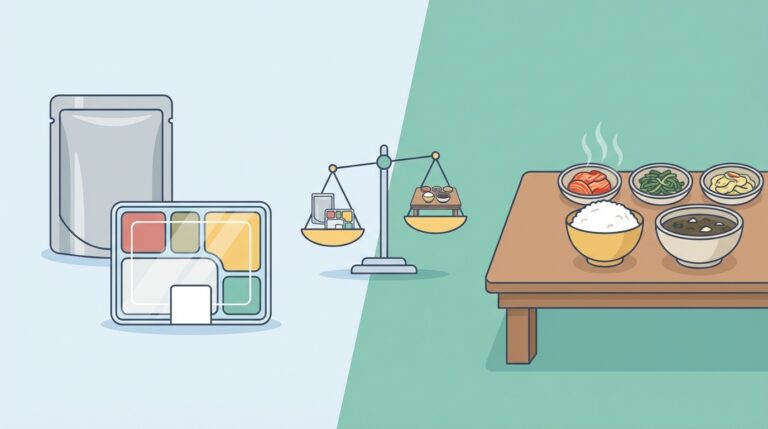
[🚫 Casual Chat] ———— [⚠️ Semi-Formal] ———— [✅ Debate/Article] - 🤔 Think About It: Why does Korean society emphasize “balance” (rice, soup, side dishes) so much? How does a single-dish HMR disrupt this traditional philosophy?
2. 자극적인 맛 [Jageuk-jeogin Mat]
- Pronunciation: [Ja-geuk-jeog-in Mat]
(Tip: ‘Ja-geuk’ sounds jagged or sharp—stimulating.) - Meaning: Stimulating taste / Provocative flavor (usually implies too salty, spicy, or sweet).
- K-Culture Moment: Watching a Mukbang (eating show). The streamer takes a bite of fiery tteokbokki and shouts, “와, 진짜 자극적이다!” (Wow, this is really stimulating!). It can be a compliment or a criticism depending on tone.
- Editor’s Insight: HMRs are notorious for this. To preserve shelf life and mask the lack of fresh ingredients, they pump up the sodium and MSG.
- Situation Spectrum:
[✅ Friends] ———— [✅ Reviews] ———— [✅ Formal]
3. 집밥 느낌 [Jip-bap Neu-kkim]
- Pronunciation: [Jip-bap Neu-kkim]
(Tip: ‘Jip’ is house, ‘Bap’ is rice/meal. ‘Neu-kkim’ is feeling.) - Meaning: A feeling of a home-cooked meal.
- K-Culture Moment: Marketing slogans for HMR products often claim, “It tastes just like Mom’s cooking!” (어머니의 손맛). Ironically, we use this phrase to describe something that isn’t actually home-cooked but tries to mimic that warmth.
- Editor’s Insight: This is the gold standard of Korean food praise. Even at a restaurant, if you say, “It feels like ‘Zip-bap’,” it’s the highest compliment.
- Situation Spectrum:
[✅ Everywhere] ———— [✅ Marketing] ———— [✅ Casual]
Phase 3: Textbook vs. Real Life
| Situation | 📖 Textbook Korean | 🗣️ Real Korean (C2 Level) | 💡 Why the difference? |
|---|---|---|---|
| Checking Ingredients | “이 음식은 건강에 좋지 않습니다.” (This food is not good for health.) | “이거 완전 나트륨 폭탄이네.” (This is a total sodium bomb.) | Koreans love dramatic metaphors. “Bomb” implies an excessive amount that creates shock. |
| Tasting HMR | “맛이 좀 강합니다.” (The taste is a bit strong.) | “조미료 맛이 너무 강해서 금방 질려요.” (The MSG taste is so strong, I get sick of it quickly.) | Advanced speakers distinguish between “strong” and “artificial flavoring” (MSG/Seasoning). |
| Choosing Lunch | “편의점에서 먹읍시다.” (Let’s eat at the convenience store.) | “그냥 편의점 도시락으로 때우자.” (Let’s just patch/fill in with a convenience store bento.) | ‘때우다’ is a crucial verb. It implies eating not for pleasure, but just to survive/save time. |
Phase 4: Cultural Deep Dive — The Sociology of the “Solo Meal”
4-1. Non-verbal: The “Nutrition Label Scrutiny” (성분표 확인)
In Korea, flipping a package over to check the label isn’t just a habit; it’s a statement. If you do this in front of others while holding an HMR product, you are signaling: “I care about my body, even if I’m eating instant food.” It’s a performative act of self-care in a busy society.
4-2. K-Culture Connection: K-Food & The “Anju” (Snack) Trap
Koreans often use HMR products not just for meals, but as Anju (snacks for alcohol).
– Scenario: You bought a “Spicy Pig Trotters” (Bul-jokbal) vacuum pack to go with your Soju.
– The Issue: Traditional alcohol like Makgeolli or Soju is caloric. Combined with high-sodium HMR Anju, it creates the perfect storm for health issues.
– Critical View: While K-Media glamorizes the “late-night solo drink” (Hon-sul), it rarely addresses the morning-after bloating (bukkki) caused by the extreme sodium intake.
Phase 5: Immersive Roleplay Scenario
Setting: A Friday evening at a Han River Park. You and your Korean friend, Ji-min (30, health-conscious but loves convenience), are deciding what to eat. You are sitting on a mat, looking at delivery apps and convenience store bags.
Characters:
– YOU: An expat who loves Korean food but worries about health.
– Ji-min: Wants to eat something tasty and fast to relieve stress.
Dialogue:
(You see Ji-min holding a retort pouch of spicy chicken feet)
Ji-min: 와, 이거 요즘 유행하는 ‘화끈한 닭발’이야! 스트레스 풀게 이거랑 맥주 한잔할까?
(Wa, igeo yojeum yuhaenghaneun ‘hwakkeunhan dakbal’-iya! Stress pulge igeorang maekju hanjan-halkka?)
(Wow, this is the trendy ‘Fiery Chicken Feet’! Shall we have this with beer to relieve stress?)
YOU: (Looking at the package)
음, 맛있겠는데… 뒤에 성분표 한번 봤어?
(Eum, masitgenneunde… dwie seongbunpyo hanbeon bwasseo?)
(Hmm, looks tasty… Did you check the nutrition label on the back?)
Ji-min: 에이, 맛있으면 0칼로리라잖아. 그냥 먹자~
(Ei, masisseumyeon yeong-kalrori-rajana. Geunyang meokja~)
(Ay, they say if it’s tasty, it’s 0 calories. Let’s just eat it~)
🔀 Decision Point: How do you respond gently but firmly?
- A) “안 돼. 나트륨이 너무 많아서 내일 얼굴 부을 거야.” (Direct/Logical)
- B) “맛있긴 하겠지만, 이거 먹으면 우리 일주일치 나트륨을 한 번에 먹는 걸걸?” (Witty exaggeration)
- C) “건강 생각해서 샐러드 먹자.” (Too strict/Buzzkill)
✅ Best Choice: B
– Reason: Choice B uses a rhetorical question and exaggeration (“one week’s worth of sodium”). It gets the point across without ruining the mood. Choice A is too lecturesque, and C kills the “Friday vibe.”
(Continuing with Choice B)
Ji-min: (Laughing) 야, 너무하다. 일주일치라니! 그럼 뭐 먹고 싶은 거 있어?
(Ya, neomuhada. Iljuil-chi-rani! Geureom mwo meokgo sipeun geo isseo?)
(Hey, that’s harsh. One week’s worth! Then is there anything you want to eat?)
YOU: 가성비는 좀 떨어져도, 편의점 도시락 말고 배달시켜서 제대로 된 밥 먹는 게 낫지 않을까?
(Gaseongbineun jom tteoreojyeodo, pyeonuijeom dosirak malgo baedalsikyeoseo jedaero doen bap meokneun ge natji aneulkka?)
(Even if the cost-effectiveness is a bit lower, wouldn’t it be better to order delivery and eat a proper meal rather than a convenience store bento?)
Ji-min: 오~ 플렉스(Flex) 하는데? 좋아, 그럼 보쌈 시키자!
(Oh~ Flex-haneunde? Joa, geureom bossam sikija!)
(Oh~ You’re flexing? Okay, let’s order Bossam [Boiled Pork Wraps]!)
Phase 6: 10-Second Shadowing Drill
Let’s practice a sophisticated sentence you can use when debating food quality.
Sentence:
“Convenience is great, but relying solely on HMR seems to ruin our nutritional balance.”
Korean:
😢 편리한 건 좋지만 / 가정 간편식에만 의존하다가는 / 영양 균형이 다 무너질 것 같아요.
Romanization:
[Pyeon-ri-han geon jo-chi-man / ga-jeong gan-pyeon-sik-e-man ui-jon-ha-da-ga-neun / yeong-yang gyun-hyeong-i da mu-neo-jil geot ga-ta-yo.]
Intonation Guide:
– Pyeon-ri-han geon jo-chi-man (⤴️ Rise slightly at ‘man’ to show contrast)
– ui-jon-ha-da-ga-neun (Emphasize ‘ui-jon’ – dependency)
– mu-neo-jil geot ga-ta-yo (⤵️ Lower pitch at the end to show concern/regret)
Phase 7: K-Culture Mini Glossary
| Korean | Romanization | English | Context |
|---|---|---|---|
| 나트륨 | Nateuryum | Sodium | The #1 enemy in Korean health discussions. Pronounced like the German ‘Natrium’. |
| 혼밥 | Hon-bap | Eating alone | Eating alone was taboo; now it’s a huge market driving HMR sales. |
| 집밥 | Jip-bap | Home-cooked meal | The symbol of health, love, and nutritional balance in Korea. |
| 레토르트 | Retoreuteu | Retort Pouch | Food cooked in a sealed pouch (like 3-min curry). synonymous with “cheap taste.” |
| 밀키트 | Mil-kiteu | Meal Kit | A step up from retort. Contains fresh ingredients you cook yourself. Viewed as “healthier.” |
Phase 8: Traveler’s Survival Kit — Reading the Fine Print
Even if you are just traveling, you might grab a quick breakfast at a convenience store (CU, GS25, 7-Eleven). Here is how to survive the “Sodium Trap.”
🆘 Survival Label Reading
1. Look for 영양정보 (Yeongyang-jeongbo) on the back. This is the “Nutrition Facts.”
2. Find 나트륨 (Sodium). The % next to it tells you everything.
– If it says 50% or more, that single meal contains half your daily limit.
– Pro Tip: Most Korean cup ramens are over 70-80%.
3. 당류 (Sugars): Watch out for this in “healthy” yogurt drinks or juices.📌 Editor’s Travel Note
If you must eat HMR/Convenience food, buy a Banana (바나나) or Milk (우유) to go with it. The potassium in bananas helps excrete sodium, and milk helps soothe the stomach from spicy additives!
Phase 9: Critical Thinking — “Think Deeper”
Topic: The Myth of “Zip-bap” (Home-cooked meals)
We often criticize HMR for nutritional imbalance, assuming that “Zip-bap” is automatically healthier. However, traditional Korean home cooking—based on salted kimchi, soy sauce-marinated sides, and salty stews—is also incredibly high in sodium. Is HMR really the villain, or is the Korean palate itself the issue?
🧠 Think Deeper:
Does the “Warm Rice” (따뜻한 밥 한 끼) symbolize nutrition, or does it symbolize emotional care? When Koreans complain about HMR, are they missing the vitamins, or are they missing the connection with family? As a C2 learner, try to distinguish between the biological need for food and the social function of dining.
Phase 10: FAQ & Troubleshooting
Q: If I’m invited to a Korean’s house and they serve delivery food or HMR (Meal Kit), can I complain about nutrition?
A: Absolutely NOT. Even if it’s HMR, the host prepared it for you. In modern Korea, serving a premium Meal Kit (Mil-kit) is considered acceptable hosting for casual gatherings. Criticizing it would be very rude (눈치 없는 행동).
Q: Is “MSG” considered bad in Korea?
A: There is a huge debate. While the older generation often blames MSG (called 미원 – Miwon) for thirst or headaches, the younger generation and many chefs accept it as a necessary flavor enhancer. Saying “It tastes like MSG” (조미료 맛이 나요) is generally a negative comment about the food’s quality/depth.
❌ Common Mistake:
Don’t confuse 인스턴트 (Instant) with 레토르트 (Retort).
– Instant usually implies dry, processed (ramen).
– Retort implies wet, sterilized pouches (curry, soups).
– Meal Kit is fresh ingredients.
Using the specific term shows your high proficiency!
Phase 11: Wrap-up & Action Items
One-Liner Summary:
Eating HMR is convenient, but knowing how to critique its 영양 불균형 (nutritional imbalance) and 자극적인 맛 (stimulating taste) makes you a true Korean insider.
Action Missions:
– 🥉 Bronze: Go to a Korean convenience store (or Asian market) and find a package. Read the 나트륨 (Sodium) % aloud.
– 🥈 Silver: Post a photo of an instant meal on social media with the caption: “간편하긴 한데, 영양 균형이 좀 걱정되네요.” (It’s convenient, but I’m worried about nutritional balance.)
– 🥇 Gold: Next time you eat with Korean friends, debate “Meal Kits vs. Delivery vs. Cooking.” Use the word 가성비 (Cost-effectiveness)!
K-Culture Mission:
Watch a clip of the movie Little Forest (Korean version). Contrast the protagonist’s cooking process with a typical convenience store meal scene in any K-Drama. Feel the difference in “Time” invested.
Phase 12: Interactive Quiz
1. Which phrase is the most sophisticated way to say “This food is too salty and artificial”?
– A) 맛이 없어요. (It tastes bad.)
– B) 너무 짜요. (It’s too salty.)
– C) 맛이 너무 자극적이고 인위적이네요. (The taste is too stimulating and artificial.)
– D) 엄마 맛이 아니에요. (It’s not Mom’s taste.)
2. True or False?
– “In Korea, offering a guest a high-quality Meal Kit (Mil-kit) is considered an insult.”
– Answer: ( False ) -> Modern hosting embraces premium meal kits!
3. Fill in the Blank:
– “Today, I’m too tired to cook. Let’s just _______ with a bento.”
– “오늘 너무 피곤해. 그냥 도시락으로 ( )자.”
– Answer: 때우 (From 때우다 – to fill in/patch up/make do)
(Toggle for Answers: 1-C, 2-False, 3-때우)
Frequently Asked Questions (FAQ)
Q: What does "영양 불균형 [Yeongyang Bul-gyun-hyeong]" mean in Korean and how do you pronounce it?
A: In Korean, "영양 불균형 [Yeongyang Bul-gyun-hyeong]" is pronounced [Yeong-yang Bull-gyoon-hyeong] and means: Nutritional Imbalance.
Q: What does "자극적인 맛 [Jageuk-jeogin Mat]" mean in Korean and how do you pronounce it?
A: In Korean, "자극적인 맛 [Jageuk-jeogin Mat]" is pronounced [Ja-geuk-jeog-in Mat] and means: Stimulating taste / Provocative flavor (usually implies too salty, spicy, or sweet).
Q: What does "집밥 느낌 [Jip-bap Neu-kkim]" mean in Korean and how do you pronounce it?
A: In Korean, "집밥 느낌 [Jip-bap Neu-kkim]" is pronounced [Jip-bap Neu-kkim] and means: A feeling of a home-cooked meal.







