

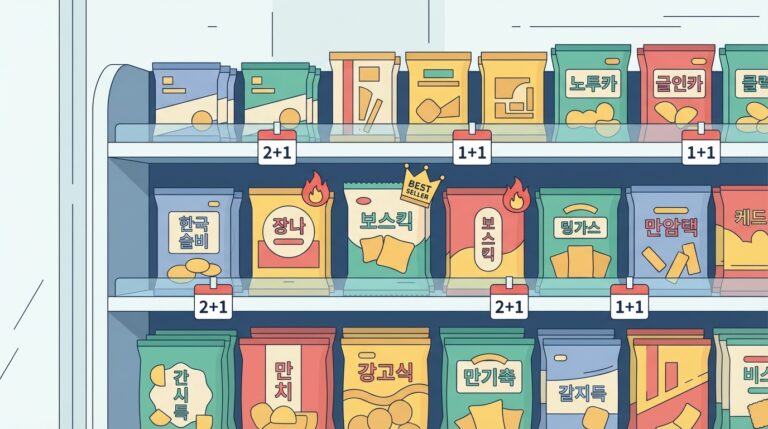
Phase 1: The Immersive Hook
Hello! This is your Daily Hangul Editor. 👋
Picture this: It’s 11 PM in Seoul. You’ve just finished watching a K-Drama where the main characters were eating snacks on a rooftop. Now you’re hungry. You walk into a bright GS25 or CU (Korean convenience stores).
Suddenly, you are faced with the Great Wall of Snacks. 🏰
Hundreds of colorful packages. Some look cute, some look dangerous (red usually means fire! 🔥). You want to buy that chips your favorite idol ate on a V-Live, but… is it sweet? Is it salty? Is it spicy enough to make you cry?
Don’t worry. You don’t need to be fluent to snack like a pro. Today, we’re going to learn the survival codes to pick the perfect snack without playing “Russian Roulette” with your taste buds.
Phase 2: Deep Dive into Key Expressions
Here are the 3 golden phrases you need to navigate the snack aisle.
1. 이거 매워요? (Is this spicy?)
- Pronunciation: [i-geo mae-wo-yo?]
- Sound-alike: E-go (like ‘ego’) + meh (like ‘meh’) + wo-yo (like ‘war’ without ‘r’ + yo-yo).
- Meaning:
- Literal: Is this spicy?
- Real Nuance: “Will this destroy my tongue?” / “Is this safe for a baby?”
- K-Culture Moment: Think of those “Spicy Noodle Challenges” on YouTube. In Korea, “spicy” is a flavor spectrum ranging from “tasty tingles” to “nuclear explosion.”
- Editor’s Insight: If the packaging is black and red, asking this is mandatory unless you have a stomach of steel.
- Situation Spectrum:
[🚫 Formal Boss] ———— [✅ Convenience Store Staff] ———— [✅ Friends]- 🤔 Think About It: Koreans often eat spicy food to relieve stress (called stress-pul-gi). Does your culture have a specific flavor for bad days?
2. 어떤 게 제일 인기 많아요? (Which one is the most popular?)
- Pronunciation: [eo-tteon ge je-il in-ki ma-na-yo?]
- Sound-alike: Uh-ton + geh + jay-il + in-ki (like ‘inky’) + ma-na-yo.
- Meaning:
- Literal: Which one has the most popularity?
- Real Nuance: “I don’t know what to choose, so just tell me what everyone else is buying.”
- K-Culture Moment: Koreans follow trends fast. Remember the “Honey Butter Chip” craze? When a snack becomes trendy, it sells out instantly. Asking this helps you find the current “It-Snack.”
- Editor’s Insight: Part-timers (Alba-saeng) know the inventory best. Trust them.
- Situation Spectrum:
[⚠️ Formal Settings] ———— [✅ Shops/Restaurants] ———— [✅ Friends]- 🤔 Think About It: Why is “ranking” and “popularity” so important in Korea? It reflects the fast-paced trend culture (Yuhang).
3. 이거 투 플러스 원이에요? (Is this 2+1?)
- Pronunciation: [i-geo tu-peul-leo-seu-wo-ni-e-yo?]
- Sound-alike: E-go + Two-Plus-One (Konglish style!) + e-eh-yo.
- Meaning: Is this a “Buy 2, Get 1 Free” deal?
- K-Culture Moment: You will see 1+1 (One plus One) and 2+1 (Two plus One) tags everywhere. It’s the national sport of Korean convenience store shopping.
- Editor’s Insight: You don’t say “BOGO” in Korea. You must use the English numbers “One-Plus-One” or “Two-Plus-One.”
- Situation Spectrum:
[🚫 Fancy Department Store] ———— [✅ Convenience Store/Olive Young] ———— [✅ Supermarket]
Phase 3: Textbook vs. Real Life
| Situation | 📖 Textbook Korean | 🗣️ Real Korean | 💡 Why is it different? |
|---|---|---|---|
| Asking flavor | 이것은 무슨 맛입니까? (What taste is this?) | 이거 무슨 맛이에요? (What flavor is this?) | The textbook version sounds like a robot inspector. |
| Asking price | 이것은 얼마입니까? (How much is this?) | 이거 얼마예요? (How much?) | “-imnikka?” is too stiff for buying chips. |
| Checking promo | 행사 상품입니까? (Is this an event product?) | 이거 투플원(2+1)이에요? | We love abbreviations! “Tu-Ppeul-Won” is short for 2+1. |
Bottom Note: For A1 beginners, sticking to “-yo?” ending (polite casual) is the safest bet everywhere!
Phase 4: Cultural Deep Dive
4-1. Non-verbal: The “Pointing Finger” ☝️
In some cultures, pointing is rude. In a Korean CVS, it’s helpful! When asking “Igeo maewo-yo?” (Is this spicy?), point your finger directly at the package. The clerk needs to know exactly which red bag you are scared of.
4-2. K-Food Connection: The “Dan-Jjan” (Sweet & Salty) Law
Koreans believe in the harmony of flavors. If you pick a sweet snack (like Choco Pie), you must also buy a salty snack (like Onion Rings) to balance it out. This is called Dan-Jjan (단짠).
– Challenge: If a friend asks you to pick snacks, grab one sweet and one salty. You will be praised as a genius with “Sense” (Sen-seu).
Phase 5: Immersive Roleplay
Setting: A Friday night at a GS25 near the Han River. It’s buzzing with people. You are looking for a snack to go with your beer (or soda).
Characters:
– YOU: Hungry traveler.
– Alba (Part-timer): A university student, looking slightly tired but helpful.
Start!
YOU: (Holding a bag of red chips) 저기요… (Excuse me…)
(Jeo-gi-yo…)
Alba: 네, 손님? (Yes, customer?)
(Ne, son-nim?)
YOU: 이거 매워요? 🔥
(I-geo mae-wo-yo?)
Alba: 아, 네. 그거 진짜 매워요. 불닭 맛이에요.
(Ah, ne. Geu-geo jin-jja mae-wo-yo. Bul-dak ma-si-e-yo.)
(Translation: Ah, yes. That is really spicy. It’s Fire Chicken flavor.)
🔀 Decision Point! Your Turn:
Option A: “Okay, I love spicy!” (Accept the challenge)
Option B: “Oh no. Which one is not spicy?” (Safety first)
(Let’s go with Option B for survival)
YOU: 아… 그럼 어떤 게 안 매워요? 🥺
(Ah… geu-reom eo-tteon ge an mae-wo-yo?)
Alba: (Points to a yellow bag) 이거요. 버터 맛이에요.
(I-geo-yo. Beo-teo ma-si-e-yo.)
(Translation: This one. It’s butter flavor.)
YOU: 감사합니다! 이거 주세요.
(Gam-sa-ham-ni-da! I-geo ju-se-yo.)
Phase 6: 10-Second Shadowing Drill
Listen to the rhythm and repeat. Imagine you are holding a bag of chips!
- 😰 Worried: 이-거 / 너-무 / 매-워-요?
(I-geo / neo-mu / mae-wo-yo?)
Is this / too / spicy? -
🤩 Curious: 요-즘 / 어-떤 게 / 핫-해-요?
(Yo-jeum / eo-tteon ge / hat-hae-yo?)
These days / which one is / hot (trendy)? -
🤔 Calculating: 이-거 / 원-플-러-스-원 / 이-에-요?
(I-geo / won-peul-leo-seu-won / i-e-yo?)
Is this / 1+1 / is it?
Phase 7: K-Culture Mini Glossary
| Korean | Rom | Meaning | Context |
|---|---|---|---|
| 편의점 | Pyeonuijeom | Convenience Store | The lifeline of modern Korea. Open 24/7. |
| 행사 상품 | Haengsa Sangpum | Event Product | Items on sale (1+1, 2+1). Look for these tags! |
| 신상 | Sinsang | New Product | Koreans love trying “new releases” ASAP. |
| 단짠 | Dan-jjan | Sweet & Salty | The golden combo of flavors. |
Phase 8: Traveler’s Survival Kit
Found a snack? Here is how to pay.
🆘 Survival Phrases
– 🇰🇷 “봉투 필요 없어요.” (Bong-tu pi-ryo eop-seo-yo.)
– Meaning: I don’t need a plastic bag.
– Why: Plastic bags cost extra (20-100 won) in Korea.
– 🇰🇷 “영수증 버려 주세요.” (Yeong-su-jeung beo-ryeo ju-se-yo.)
– Meaning: Please throw away the receipt.📌 Editor’s Travel Note
– Tables: Many Korean CVS have tables inside or outside (plastic chairs). It is totally okay to cook your ramen and eat it there. It’s a K-Drama classic move!
– T-Money: You can pay for snacks with your T-Money (subway/bus) card!
Phase 9: Think Deeper — “Trends”
Why does everyone buy the same snack?
In Korea, you might see a snack sell out nationwide in days (like the “Honey Butter Chip” phenomenon or “Pokemon Bread”). This reflects the Korean culture of “Yuhang” (Trend) and “Insa” (Insider). Being part of the trend means you are connected to society. It’s not just about the taste; it’s about sharing the same experience as everyone else.
💬 Your Turn: Does your country have “viral snacks”? Tell us in the comments!
Phase 10: FAQ & Troubleshooting
- Q: Can I open the snack before paying?
- A: NO! 🚫 Unlike some Western countries where you can sip a drink while waiting in line, in Korea, you must pay first. Opening it before paying is considered rude or even theft.
- Q: Can I speak informally (Banmal) to the staff if they look younger?
- A: NEVER. Even if the staff is a teenager, you are strangers. Always use “-yo” ending. It shows your class and manners.
- ❌ Common Mistake: Asking “Do you have snacks?” (Gwaja isseoyo?)
- Correction: It’s a convenience store. They always have snacks. Be specific: “Do you have chocolate snacks?” (Choko gwaja isseoyo?)
Phase 11: Wrap-up & Action Mission
Summary: Today we learned how to ask if a snack is spicy (Igeo maewo-yo?), ask for popularity (Eotteon ge jeil inki manayo?), and check for deals (Tu-plus-one-ieyo?).
🚀 Your Mission:
– 🥉 Bronze: Look at a snack in your pantry and ask aloud: “Igeo maewo-yo?”
– 🥈 Silver: Go to a local Asian market, find a Korean snack, and check if it has a “1+1” sticker (or imagine it does) and say the phrase!
– 🥇 Gold: Visit a Korean convenience store (or H-Mart), find a red package, and ask the staff: “Is this spicy?” in Korean!
Phase 12: Quiz — Snack Master Challenge
- Situation: You see a package with a picture of a crying cartoon character and fire. What do you ask?
- A) 이거 달아요? (Is this sweet?)
- B) 이거 매워요? (Is this spicy?)
- Culture: You picked a sweet chocolate cake. According to “Dan-Jjan” law, what should you buy next?
- A) A sweet strawberry milk.
- B) Salty potato chips.
- True or False: It is polite to open the ice cream wrapper while waiting in line to pay.
- (True / False)
Answers:
1. B (Red + Fire = Spicy! Save yourself!)
2. B (Sweet needs Salty to balance the universe.)
3. False (Pay first, eat later!)
Frequently Asked Questions (FAQ)
Q: What does "이거 매워요? (Is this spicy?)" mean in Korean and how do you pronounce it?
A: In Korean, "이거 매워요? (Is this spicy?)" is pronounced [i-geo mae-wo-yo?] and means: a key conversational Korean expression covered in this lesson.
Q: What does "어떤 게 제일 인기 많아요? (Which one is the most popular?)" mean in Korean and how do you pronounce it?
A: In Korean, "어떤 게 제일 인기 많아요? (Which one is the most popular?)" is pronounced [eo-tteon ge je-il in-ki ma-na-yo?] and means: a key conversational Korean expression covered in this lesson.
Q: What does "이거 투 플러스 원이에요? (Is this 2+1?)" mean in Korean and how do you pronounce it?
A: In Korean, "이거 투 플러스 원이에요? (Is this 2+1?)" is pronounced [i-geo tu-peul-leo-seu-wo-ni-e-yo?] and means: a key conversational Korean expression covered in this lesson.







