

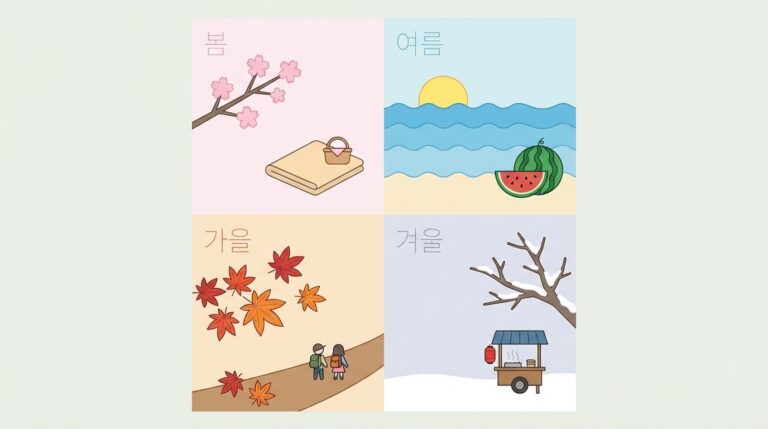
Korea Beyond Seoul: Mastering Seasonal Travel like a Local 🌸🌊🍁❄️
Phase 1: The Hook — Welcome to the “Drama Moment”
안녕하세요! Daily Hangul Editor here.
Picture this: You are watching your favorite K-Drama. The lead couple is walking down a street where pink petals are falling like snow (Spring), or perhaps they are sharing a red scarf on a snow-covered sheep farm (Winter). You think, “I want to go there, exactly like that.”
But here is the reality check: If you go to that cherry blossom spot one week too late, you’ll just see green leaves. If you go to the beach in winter without knowing the context, you might freeze while everyone else is eating roasted sweet potatoes in a warm cafe.
In Korea, “Timing is everything.” We don’t just ask “Where are you going?” We ask, “Is it the season for that place?”
Today, we are going to learn how to discuss travel plans like a seasoned Korean local—navigating the intense seasonality of the Korean peninsula. Ready to find your own K-Drama scene? Let’s go! (갑시다!)
Phase 2: Deep Dive — 3 Expressions to Sound Like a Local
1. ~기 딱 좋은 날씨예요 (~gi ttak jo-eun nal-ssi-ye-yo)
- Pronunciation: ~gi (like ‘geese’ without ‘se’) + ttak (strong ‘t’, short and sharp) + jo-eun + nal-ssi-ye-yo
- Meaning: “It is the perfect weather for [doing something].”
- Literal: It is weather that is exactly good for ~ing.
- K-Culture Moment: In a variety show like 1 Night 2 Days, when the cast steps out of the car and the sun is shining, someone always yells this. It sets the mood.
- Editor’s Insight: The word 딱 (ttak) is magic. It means “exactly” or “perfectly.” You don’t just say “It’s good weather.” You say it fits the occasion perfectly.
- Example: “한강에서 치맥하기 딱 좋은 날씨예요!” (It’s perfect weather for Chi-maek at the Han River!)
- Situation Spectrum:
[🚫 Formal Report] ———— [✅ Friendly/Polite] ———— [✅ Casual] - 🤔 Think About It: Why do Koreans link weather so tightly to specific activities (rain = pajeon/pancake, rain = makgeolli)? Does your culture have food or activities that are “mandatory” for certain weather?
2. ~는/은 역시 ~죠 (~neun/eun yeok-si ~jyo)
- Pronunciation: yeok-si (sounds like ‘yuck’ but with a ‘yo’, meaning ‘as expected’)
- Meaning: “When it comes to [A], it has to be [B] (as expected/undoubtedly).”
- K-Culture Moment: Imagine a K-Pop idol doing a Mukbang. They take a bite of pork belly and say, “Ah, pork belly is definitely best with Soju.” -> “삼겹살은 역시 소주죠.”
- Editor’s Insight: This expresses a shared consensus or strong recommendation. It shows you know the “rules” of Korean culture.
- Example: “겨울 여행은 역시 강원도죠.” (For winter travel, it has to be Gangwon-do.)
- Situation Spectrum:
[⚠️ Boss] ———— [✅ Colleagues] ———— [✅ Friends]
3. 인생샷 건지다 (Insaeng-syat geon-ji-da)
- Pronunciation: In-saeng (Life) + syat (Shot) + geon-ji-da (to fish out/salvage)
- Meaning: “To get the photo of a lifetime.”
- K-Culture Moment: Every tourist spot in Korea has a line of people waiting for that one spot. They aren’t just taking photos; they are “salvaging” a masterpiece from hundreds of attempts.
- Editor’s Insight: We use the verb 건지다 (to scoop/fish out) because you might take 100 photos, but you only “save” one good one to post on Instagram. It implies effort!
- Situation Spectrum:
[🚫 Formal Meeting] ———— [✅ Socializing] ———— [✅ Friends]
Phase 3: Textbook vs. Real Life
| Situation | 📖 Textbook Korean | 🗣️ Real Korean (Insa-style) | 💡 Why the difference? |
|---|---|---|---|
| Suggesting a place | 경주에 가는 게 어때요? (How about going to Gyeongju?) | 이번 가을엔 경주가 국룰이죠. (Gyeongju is the national rule for this autumn.) | Koreans love following trends. 국룰 (Gung-nul) implies everyone agrees it’s the standard. |
| Expressing excitement | 경치가 정말 아름다워요. (The scenery is beautiful.) | 와, 여기 뷰 미쳤다. (Wow, the view here is crazy.) | “Beautiful” sounds poetic; “Crazy” sounds genuine and raw in modern speech. |
| Crowded place | 사람이 정말 많아요. (There are many people.) | 여기 완전 물반 고기반이에요. (Here is half water, half fish = half people, half air.) | A classic idiom used humorously to describe packed tourist spots. |
Bottom Note: Use “미쳤다” (Crazy) with friends only. With a guide or elder, stick to “정말 예쁘네요” (It’s really pretty).
Phase 4: Cultural Deep Dive — The “Seasonality” Obsession
4-1. The Concept of “Je-cheol” (제철)
You might know Je-cheol refers to seasonal food (like eating crabs in spring or gizzard shad in autumn). But this applies to travel too. Koreans believe there is a “Right Time” for everything.
* Spring: You must see cherry blossoms (Beotkkot). If you miss it, you feel FOMO (Fear Of Missing Out).
* Summer: You must go to the valley (Gyegok) or beach to beat the heat.
* Autumn: You must see the maple leaves (Danpung).
* Winter: You must eat street snacks like Hotteok.
4-2. K-Drama Connection: The “First Snow” (첫눈)
In dramas like Goblin or Winter Sonata, why is the first snow so important? There is a superstition that if you confess your love during the first snow, it will last forever. If you are traveling in Korea and it starts snowing, look around—you might see couples excitedly making calls or taking photos. It’s not just weather; it’s a romantic event.
Thinking Point: Is the travel destination important, or is who you are with more important? In Korea, the “atmosphere” (분위기) created by the season often matters more than the location itself.
Phase 5: Immersive Roleplay — Planning a Weekend Getaway
Setting: It is a crisp Friday evening at a cafe in Hongdae. You are with your Korean friend, Ji-min (28, loves photography and cafes). You have a free weekend coming up.
Characters:
* YOU: An expat looking for a break from city life.
* Ji-min: Your trendy local guide/friend.
(Dialogue Start)
Ji-min: (Looking at her phone) 와, 이번 주말 날씨 대박이래! 집에만 있기는 좀 아깝지 않아?
(Wa, ibeon jumal nalssi daebak-irae! Jibe-man itgi-neun jom akkapji ana?)
(Wow, they say the weather this weekend is going to be amazing! Isn’t it a waste to just stay home?)
YOU: 그러게. 어디 놀러 가기 딱 좋은 날씨네.
(Geureoge. Eodi nolleo gagi ttak jo-eun nalssi-ne.)
(I know right. It’s perfect weather to go play somewhere.)
Ji-min: 내 생각엔… 가을이니까 역시 단풍 구경을 가야 해. 설악산 어때? 케이블카도 탈 수 있어.
(Nae saenggak-en… ga-eul-inikka yeok-si danpung gugyeong-eul gaya hae. Seoraksan eottae? Keibuilka-do tal su isseo.)
(I think… since it’s autumn, we definitely have to go see the foliage. How about Seoraksan Mountain? We can take the cable car too.)
🔀 Decision Point: How do you respond?
- Option A: “좋아! 가서 인생샷 건져야지!” (Good! We gotta get that life shot!) -> Shows you understand the assignment.
- Option B: “산은 좀 힘들지 않을까? 그냥 호캉스 하자.” (Isn’t a mountain a bit tough? Let’s just do a hotel-vacation.) -> Honest, but misses the seasonal spirit.
- Option C: “단풍? 그게 뭐야?” (Foliage? What’s that?) -> A1 Level response.
(Let’s go with Option A)
YOU: 좋아! 가서 인생샷 건져야지! 카메라 챙겨갈게.
(Joa! Gaseo insaeng-syat geon-jeo-ya-ji! Kamera chaeng-gyeo-gal-ge.)
(Great! Gotta get that life shot! I’ll bring my camera.)
Ji-min: 오~ 센스 있는데? 근데 주말이라 차가 많이 막힐 텐데… KTX 예매할까?
(Oh~ Sense inneunde? Geunde jumal-ira cha-ga mani makil tende… KTX yemaehalkka?)
(Oh~ You have sense! But since it’s the weekend, traffic will be bad… Should we book KTX tickets?)
YOU: 응, 매진되기 전에 빨리 하자.
(Eung, maejindoegi jeone ppalli haja.)
(Yeah, let’s do it quickly before it sells out.)
Phase 6: 10-Second Shadowing Drill
Practice these to sound natural! Pay attention to the emotion tags.
- (😊 Excitedly) 이번 여행에서 / 인생샷 꼭 / 건질 거예요!
(Ibeon yeohaeng-eseo / insaeng-syat kkok / geonjil geoyeyo!)
“I’m definitely going to get a life shot on this trip!” -
(😤 Confidently) 여름 휴가는 / 역시 / 부산이죠!
(Yeoreum hyuga-neun / yeok-si / Busan-ijyo!)
“Summer vacation is undoubtedly Busan!” -
(😌 Relaxed) 걷기 / 딱 / 좋은 날씨네요.
(Geotgi / ttak / jo-eun nalssi-neyo.)
“It’s just the right weather for walking.”
Phase 7: K-Culture Mini Glossary
| Korean | Rom | Meaning | Context |
|---|---|---|---|
| 성수기 | Seongsu-gi | Peak Season | July-Aug (Summer), Oct-Nov (Autumn). Everything is expensive and booked. |
| 비수기 | Bisu-gi | Off-Season | March, November. Cheaper, but weather might be ambiguous. |
| 호캉스 | Hokang-seu | Hotel + Vacance | A popular trend of spending vacation in a nice hotel instead of sightseeing. |
| 꽃놀이 | Kkot-nori | Flower viewing | Picnic under cherry blossoms. A must-do spring activity. |
| 불멍 | Bul-meong | Fire spacing-out | Staring blankly at a campfire while camping. A popular “healing” activity. |
Phase 8: Traveler’s Survival Kit (Travel Planning Edition)
🆘 Survival Phrases for Booking/Travel
1. “혹시 빈 방 있어요?” (Hoksi bin bang isseoyo?)
* Do you happen to have a vacant room? (Useful for guesthouses).
2. “예약 확인해주세요.” (Yeyak hwagin-haejuseyo.)
* Please confirm my reservation. (Hotels/Restaurants).
3. “여기서 제일 유명한 게 뭐예요?” (Yeogiseo jeil yumyeonghan ge mwoyeyo?)
* What is the most famous thing here? (Ask this to find the best local food/spot).📌 Editor’s Travel Note: The Speed of Booking
* KTX/SRT (Trains): For major holidays (Chuseok/Seollal) or peak summer, tickets open 1 month in advance and sell out in minutes. Literally minutes. Set an alarm!
* Naver Map is King: Google Maps often fails in Korea. Download Naver Map or KakaoMap. They even show real-time bus locations.
Phase 9: Think Deeper — Collectivism in Travel?
Brain Teaser: You might notice that when a place becomes a “Hot Place” (핫플레이스) on Instagram, everyone goes there. Suddenly, a quiet cafe is overrun with people taking the exact same photo.
Why? In Western culture, finding a “hidden gem” nobody knows is often the goal. In Korea, going to the “famous place” validates your experience. It implies, “I am part of this cultural moment.” Participating in the trend is a way of connecting with others.
💬 Your Turn: Do you prefer going to the popular “Hot Place” to see what the fuss is about, or do you seek out quiet, unknown spots? Why? (Tell me in the comments!)
Phase 10: FAQ & Troubleshooting
- Q: Can I travel alone in Korea? (Hon-yeohaeng)
- A: Yes! It’s becoming very common. However, some traditional BBQ restaurants might require a minimum order of 2 servings. Look for places that say “1인 식사 가능” (Dining for 1 person available).
- Q: Should I book everything in advance?
- A: For “Hot Places” and accommodation in Seongsu-gi (Peak season), YES. Korea is a “reservation society.” But for random cafes or weekday travel, walk-ins are fine.
- Q: Is it rude to take photos of people?
- A: Yes. Korea has strict privacy laws. If you post a photo/video where a stranger’s face is clearly visible without consent, it can be a legal issue. Always blur faces of strangers!
Phase 11: Wrap-up & Mission
One-Liner: To travel Korea well, you must follow the seasons and know when to say “It’s the perfect weather for this!”
🚀 Action Mission:
* 🥉 Bronze: Look out your window and say “~하기 딱 좋은 날씨예요” based on the current weather.
* 🥈 Silver: Go to a Korean travel hashtag on Instagram (#한국여행) and comment “여기 뷰 미쳤다!” on a nice photo.
* 🥇 Gold: Plan a hypothetical 2-day trip to a Korean city using Naver Map, finding one “Hot Place” and one restaurant.
📺 K-Culture Mission: Watch an episode of “2 Days & 1 Night” (1박 2일). Count how many times they talk about the weather or food being “seasonal”!
See you in the next lesson! 다음에 봐요! 👋
Phase 12: Interactive Quiz
- Situation: Your friend suggests going to the beach in the middle of a freezing winter. You want to agree enthusiastically because it’s romantic. What do you say?
- a) 겨울 바다는 너무 추워요. (Winter sea is too cold.)
- b) 겨울엔 역시 바다죠! (Winter is definitely for the beach!)
- c) 바다에 사람이 많아요. (There are many people at the beach.)
- True or False: In Korea, it is polite to take photos of strangers on the street to show the lively atmosphere.
- ( ) True
- ( ) False
- Fill in the blank: You just took an amazing photo of your friend. You say: “와, 너 오늘 ________ 건졌다!”
Click for Answers
- b) (This captures the “romantic winter sea” vibe perfectly.)
- False (Strict privacy laws apply!)
- 인생샷 (Insaeng-syat)
Frequently Asked Questions (FAQ)
Q: What does "~기 딱 좋은 날씨예요 (~gi ttak jo-eun nal-ssi-ye-yo)" mean in Korean and how do you pronounce it?
A: In Korean, "~기 딱 좋은 날씨예요 (~gi ttak jo-eun nal-ssi-ye-yo)" is pronounced [~gi (like 'geese' without 'se'] and means: "It is the perfect weather for [doing something]."
Q: What does "~는/은 역시 ~죠 (~neun/eun yeok-si ~jyo)" mean in Korean and how do you pronounce it?
A: In Korean, "~는/은 역시 ~죠 (~neun/eun yeok-si ~jyo)" is pronounced [yeok-si (sounds like 'yuck' but with a 'yo', meaning 'as expected'] and means: "When it comes to [A], it has to be [B] (as expected/undoubtedly)."
Q: What does "인생샷 건지다 (Insaeng-syat geon-ji-da)" mean in Korean and how do you pronounce it?
A: In Korean, "인생샷 건지다 (Insaeng-syat geon-ji-da)" is pronounced [In-saeng (Life] and means: "To get the photo of a lifetime."







