

Phase 1: The “K-Drama Moment” Hook 🎬
Hello, Daily Hangul family! It’s your editor, the one who watches too many dramas.
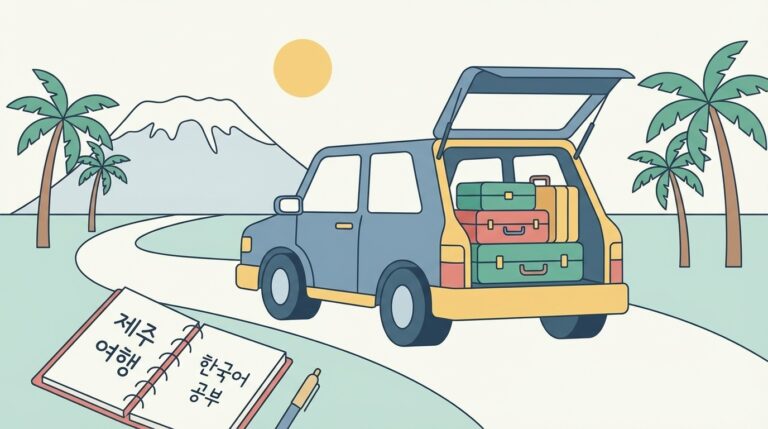
Picture this: You are the main character in a romantic K-Drama. You’ve just arrived on Jeju Island for a road trip. The wind is blowing, the music swells… but wait. You have three giant suitcases, and the rental car trunk is locked tight.
In dramas, the male lead usually presses a button, and the trunk pops open magically (sometimes filled with balloons for a surprise proposal 🎈). But in real life, you’re standing in the parking lot, sweating, trying to figure out how to say, “Hey, how do I open this thing?”
Don’t let a locked trunk ruin your main character moment. Today, we learn the essential survival phrases for handling luggage in Korea, whether you’re renting a car or taking a taxi.
Phase 2: Deep Dive into Key Expressions 🤿
1. 트렁크 좀 열어주세요 (Please open the trunk)
- Pronunciation: [Teu-reong-keu jom yeo-reo-ju-se-yo]
- Sound-alike: “Teu-rung-keu” (like Trunk) + “Jom” (rhymes with Home) + “Yo-ro-ju-se-yo”
- Meaning:
- Literal: Please open the trunk a little.
- Real Nuance: “Could you please open the trunk for me?”
- K-Culture Moment: You see this in variety shows like Running Man when members rush into a taxi to escape a mission. They shout this to the driver instantly!
- Editor’s Insight: Notice the word 좀 (jom)? It literally means “a little,” but in Korea, it acts like “please” or softeners. Without it, you might sound like a robot or a bossy general. Always add “jom” to sound like a polite local!
- Situation Spectrum:
[🚫 To Boss] ———— [⚠️ To Stranger/Driver] ———— [✅ To Friend]- To Friend: “트렁크 열어줘!” (Teu-reong-keu yeo-reo-jwo!)
- To Driver/Staff: “트렁크 좀 열어주세요.” (Standard & Polite) ✅
🤔 Think About It: Why do Koreans add “a little” (jom) when asking for a favor? It minimizes the burden on the listener. It’s the Korean way of saying, “It’s just a small favor, no big deal!”
2. 짐이 많아요 (I have a lot of luggage)
- Pronunciation: [Jim-i ma-na-yo]
- Sound-alike: “Jim” (like the name Jim) + “ee” + “Ma-na-yo” (rhymes with Ma + Na + Yo)
- Meaning: “I have a lot of baggage/stuff.”
- K-Culture Moment: K-Pop idols at the airport (Airport Fashion photos). They look cool, but their managers are usually in the back shouting, “짐이 많아요!” while loading 10 suitcases into the van.
- Editor’s Insight: Use this before asking to open the trunk. It gives the driver or rental staff a “heads up” that they might need to help you or give you more time.
3. 어떻게 열어요? (How do I open it?)
- Pronunciation: [Eo-tteo-ke yeo-reo-yo?]
- Sound-alike: “Uh-tuh-kay” + “Yo-ro-yo?”
- Meaning: “How do I open (this)?”
- Editor’s Insight: Rental cars in Korea (especially Hyundai/Kia) often have hidden trunk buttons inside the logo or under the bumper. If you can’t find it, don’t panic. Just point at the trunk and ask this!
Phase 3: Textbook vs. Real Life 🥊
| Situation | 📖 Textbook Korean | 🗣️ Real Street Korean | 💡 Why the difference? |
|---|---|---|---|
| Stopping a Taxi | 트렁크를 열어 주시겠습니까? (Would you please open the trunk?) | 기사님, 트렁크요! (Driver, trunk!) | In busy traffic, speed is key. “Noun + Yo” is efficient but still polite enough. |
| Rental Car Center | 이것을 어떻게 작동합니까? (How do I operate this?) | 이거 버튼 어디 있어요? (Where is the button for this?) | Koreans prefer asking about the specific object (button) rather than abstract concepts (operation). |
💡 Editor’s Note: “기사님, 트렁크요!” is very common, but make sure to smile and nod. Body language fills the gap of missing grammar!
Phase 4: Cultural Deep Dive — The Art of “Nunchi” 👀
4-1. Non-verbal Communication (The Silent Stare)
In Korea, if you stand at the back of a taxi or rental car and stare at the trunk door without moving, the driver will usually notice your “Trunk Nunchi” and pop it open for you. You don’t always have to speak! But if 3 seconds pass and nothing happens, use the phrase above.
4-2. K-Travel Context: The “Self-Service” Culture
Unlike high-end hotel limousines in K-Dramas, many taxi drivers in Korea expect you to load your own bags, especially if they are elderly. However, if you are a rental car user, the staff will almost always show you the features politely.
Phase 5: Immersive Roleplay 🎭
Scenario: You have arrived at Jeju International Airport. You are picking up your rental car. It’s a shiny new Hyundai, but you can’t find the trunk button.
- Characters:
- YOU: Excited tourist with two heavy bags.
- Staff (Min-su): Helpful rental car employee, wearing a blue vest.
Start Dialogue:
Staff (Min-su): 차 확인해 보시겠어요? (Would you like to check the car?)
(Cha hwagin-hae bosi-gesseoyo?)
YOU (Select your response):
🔀 Decision Point:
* A) “네, 그런데 트렁크 버튼이 어디예요?” (Yes, but where is the trunk button?)
* B) “트렁크 열어!” (Open the trunk!)
* C) “짐이 많아서… 트렁크 좀 열어주세요.” (I have a lot of luggage… Please open the trunk.)
💡 Analysis:
* Choice A: ✅ Smart Choice! Direct and solves the problem.
* Choice B: 🚫 Rude! This is Banmal (casual speech) and sounds like a command. Never use this with staff.
* Choice C: 🏆 Best Choice! Explaining the situation (“I have luggage”) makes the request softer and more natural.
(Dialogue continues with Choice C)
Staff (Min-su): 아, 네! 여기 누르시면 됩니다. (Ah, yes! You just press here.)
(Ah, ne! Yeogi nureu-simyeon doemnida.)
YOU: 아! 감사합니다. (Ah! Thank you.)
(Ah! Gamsa-hamnida.)
Phase 6: 10-Second Shadowing Drill 🎤
Practice these lines with the emotion tags!
- 😰 (Worried/Heavy): 짐이 / 너무 / 많아요.
- (Jimi / neomu / manayo)
- “I have too much luggage.”
- 😊 (Polite/Friendly): 기사님! / 트렁크 좀 / 열어주세요.
- (Gisa-nim! / Teu-reong-keu jom / yeo-reo-ju-se-yo)
- “Driver! Please open the trunk.”
Phase 7: K-Culture Mini Glossary 📘
| Korean | Romanization | Meaning | Context |
|---|---|---|---|
| 렌터카 | Renteo-ka | Rental Car | Konglish! Easy to remember. |
| 기사님 | Gisa-nim | Driver (Mr./Ms.) | The polite title for taxi or bus drivers. Never say “Taxi Man.” |
| 풀옵션 | Pul-op-syeon | Full Option | Used when renting cars. Means the car has all features (sunroof, GPS, etc). |
Phase 8: Traveler’s Survival Kit (Car Edition) 🚗
🆘 Survival Phrases for Rental Cars
1. 🇰🇷 “내비게이션 영어로 돼요?” (Navigation yeong-eo-ro dwaeyo?)
* 🗣️ “Does the GPS work in English?” (Crucial for driving!)
2. 🇰🇷 “주유구 어디예요?” (Juyu-gu eodi-yeyo?)
* 🗣️ “Where is the gas tank cap?” (Save yourself embarrassment at the gas station.)📌 Editor’s Travel Note:
Most rental cars in Korea have “Black Boxes” (Dashcams). Don’t be surprised by the blinking lights inside the car; they are for your safety and insurance!
Phase 9: Think Deeper — Language & Politeness 🧠
Why do we say “Give me opening” (열어-주세요)?
In English, we say “Can you open it?” (Ability). In Korean, we say “Yeoreo-juseyo” which literally means “Open and give (the favor to) me.”
This auxiliary verb 주다 (to give) is the heart of Korean politeness. It acknowledges that the other person is performing a service or favor for you. It turns a command (“Open it!”) into a relational exchange (“Do this for me?”).
💬 Your Turn: Does your language have a special word to soften requests? Tell me in the comments!
Phase 10: FAQ & Troubleshooting 🛠️
- Q: Can I ask a random person to help me with my heavy bag?
- Answer: Maybe. Young people are often helpful, but in Korea, we try not to bother strangers (Minpwe culture). It’s better to ask staff or the driver.
- Q: What if the driver doesn’t hear me?
- Answer: Wave your hand slightly and say “Jogiyo!” (Excuse me) first, then point to the trunk.
- ❌ Common Mistake: Saying “Open!” (열어!) because you heard it in a drama.
- ✅ Correction: Drama characters are often rude or intimate. Always add “-yo” or “-juseyo” in real life.
Phase 11: Wrap-up & Mission 🚀
Summary: To open a trunk, remember the magic combo: “Trunk” + “Jom” + “Yeoreo-juseyo.”
🎯 Action Missions:
* 🥉 Bronze: Say “트렁크 좀 열어주세요” 3 times fast while pretending to hold heavy bags.
* 🥈 Silver: Search for “Korean Taxi Trunk” on YouTube and see how people interact.
* 🥇 Gold: Next time you take an Uber or Taxi (even in your country), try whispering the Korean phrase to yourself before getting in!
K-Culture Mission: Watch a scene from the drama “Our Blues” (set in Jeju). Look at how they load trucks and cars. Do they use formal or casual language? (Hint: It’s very casual there!)
See you in the next lesson! Drive safely! 🚗💨
Frequently Asked Questions (FAQ)
Q: What does "트렁크 좀 열어주세요 (Please open the trunk)" mean in Korean and how do you pronounce it?
A: In Korean, "트렁크 좀 열어주세요 (Please open the trunk)" is pronounced [Teu-reong-keu jom yeo-reo-ju-se-yo] and means: a key conversational Korean expression covered in this lesson.
Q: What does "짐이 많아요 (I have a lot of luggage)" mean in Korean and how do you pronounce it?
A: In Korean, "짐이 많아요 (I have a lot of luggage)" is pronounced [Jim-i ma-na-yo] and means: a key conversational Korean expression covered in this lesson.
Q: What does "어떻게 열어요? (How do I open it?)" mean in Korean and how do you pronounce it?
A: In Korean, "어떻게 열어요? (How do I open it?)" is pronounced [Eo-tteo-ke yeo-reo-yo?] and means: a key conversational Korean expression covered in this lesson.







