

Help! I’m on the Wrong Train! 😱 (Subway Survival Guide)
Phase 1: The “K-Drama Panic” Moment
Hello! This is your Senior Editor at Daily Hangul.
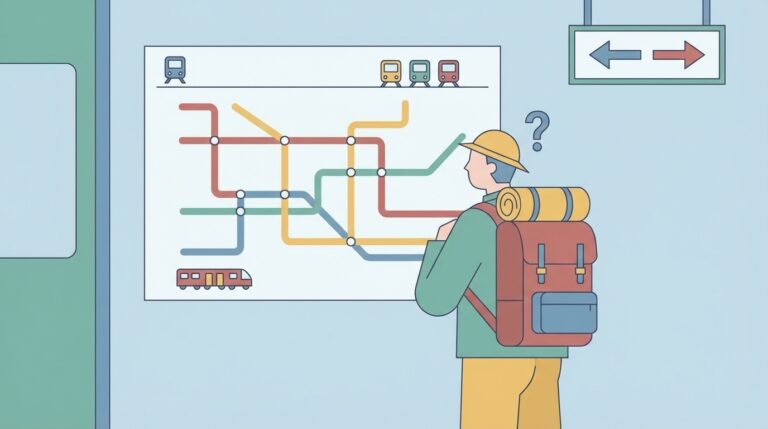
Picture this: You are in Seoul. You just tapped your card—beep!—and rushed onto the subway because the famous “jingle” music was playing. The doors close. You look up at the digital map.
Suddenly, your heart sinks. You wanted to go to Gangnam, but the stops are moving towards Hongdae.
In a K-Drama, this is the moment the sad ballad music starts, and the protagonist presses their forehead against the glass window. But you? You don’t have time for a ballad! You need to get off and turn back.
Today, we will learn the #1 Survival Phrase to save you from ending up in a completely different city. Let’s fix this together!
Phase 2: Deep Dive into Core Expressions
Here are the 3 life-saving phrases when you are lost in the underground maze.
1. 반대 방향이에요 (Bandae banghyang-ieyo)
- Pronunciation: [Ban-dae bang-hyang-i-eh-yo]
- Sound Analogy: Ban (like ‘Ban’ning someone) + Dae (like ‘Day’) + Bang (like a drum ‘Bang!’) + Hyang (sounds like ‘yang’)
- Meaning:
- Literal: It is the opposite direction.
- Real Nuance: “You’re going the wrong way! Turn around!”
- K-Culture Moment: Imagine a variety show like Running Man. The members are racing, and someone shouts this when their teammate runs the wrong way. It’s a phrase of urgency!
- Editor’s Insight: This is the most polite and accurate way to say it. You will hear this from station staff or helpful strangers.
- Situation Spectrum:
[🚫 Casual Friends] ———— [⚠️ Semi-formal] ———— [✅ Standard/Polite]
- Use this with strangers or elders.
🤔 Think About It: Why does Korean use “Opposite Direction” (반대 방향) instead of just “Wrong Way”? It implies a spatial relationship rather than a mistake. It’s not that you are wrong; the direction is just opposite.
2. 갈아타야 해요 (Garataya haeyo)
- Pronunciation: [Ga-ra-ta-ya hae-yo]
- Meaning: You have to transfer.
- K-Travel Context: The Seoul Subway is massive (like a spiderweb). “Transferring” (hwan-seung) is a daily skill for every Seoulite.
- Editor’s Insight: If you ask for directions and hear “Gara…”, pay attention! You probably need to change lines.
3. 반대쪽 (Bandae-jjok)
- Pronunciation: [Ban-dae-jjok]
- Meaning: The opposite side.
- Usage: Use this when pointing to the platform across from you. “Ah! Bandae-jjok!”
Phase 3: Textbook vs. Real Life
| Situation | 📖 Textbook Korean | 🗣️ Real Street Korean | 💡 Why the difference? |
|---|---|---|---|
| Realizing the mistake | 반대 방향입니다. (It is the opposite direction.) | 아, 반대다! (Ah, opposite!) | In panic moments, we drop the grammar and just say the core word. |
| Telling a friend | 반대쪽으로 가야 해요. (We must go to the opposite side.) | 야, 저쪽이야. (Hey, it’s that way.) | Friends value speed over politeness. ‘Jeo-jjok’ means ‘over there’. |
Bottom Note: As a beginner (A1), stick to “반대 방향이에요?” (Is it the opposite direction?) when asking strangers. It’s safe and polite!
Phase 4: Cultural Deep Dive — The Art of the Subway
4-1. Non-verbal: The “X” Sign
If you ask a Korean, “Is this for Gangnam?” and they wave their hands in front of their face or make an X with their arms, get off immediately! We don’t just say “No”; we use our whole body to stop you from going the wrong way. It’s the Korean way of caring!
4-2. K-Drama Trope: The Missed Timing
Have you seen scenes in dramas like My Liberation Notes where characters stare at the subway map endlessly? The Seoul subway is a symbol of the busy, complex modern life. Getting on the “Opposite Direction” train is often used as a metaphor for being lost in life. But unlike dramas, in real life, you just need to cross the stairs to fix it!
Phase 5: Interactive Roleplay 🎬
Setting: It’s Friday, 6 PM. Hongik Univ. Station (Line 2). It is incredibly crowded. You are squeezed against the door with your backpack. You suspect you are going the wrong way.
Characters:
– YOU: A tourist trying to get to City Hall.
– Student: A university student standing next to you with headphones.
YOU: (Tapping their shoulder lightly) 저기요… 시청 가요?
(Jeogiyo… Sicheong gayo?)
(Excuse me… Does this go to City Hall?)
Student: (Takes off one headphone) 네? 아… 아니요! 반대 방향이에요! 🙅♂️
(Ne? Ah… Aniyo! Bandae banghyang-ieyo!)
(Huh? Ah… No! It’s the opposite direction!)
🔀 Decision Point! The doors are opening. What do you say?
A) “Thank you!” and run out.
B) “Oh no! Ottoke!” (freeze in panic)
C) “Gamsahamnida!” and calmly walk out.
✅ Best Choice: A or C. Speed is key! The doors close fast in Seoul.
⚠️ Choice B Analysis: “Ottoke” (What do I do?) is cute in K-Pop, but in the subway during rush hour, you might get trapped inside!
Phase 6: 10-Second Shadowing Drill 🗣️
Let’s practice the rhythm. Repeat after the guide!
- (😨 Shocked/Urgent)
아! / 반대 / 방향이에요!
(Ah! / Bandae / banghyang-ieyo!) -
(🤔 Confused/Asking)
이거 / 반대쪽 / 아니에요?
(Igeo / bandae-jjok / anieyo?)
Is this not the opposite side?
Phase 7: K-Culture Mini Glossary
| Korean | Rom. | English | Context |
|---|---|---|---|
| 환승 | Hwan-seung | Transfer | The magic word. You hear “Hwan-seung” in the subway announcement jingle. |
| 막차 | Mak-cha | Last Train | The most important word for K-Pop fans returning from concerts. Don’t miss the Mak-cha! |
| 지옥철 | Ji-ok-cheol | Hell Train | A slang combining “Hell” + “Subway”. Used for rush hour (Line 9 is famous for this). |
Phase 8: Traveler’s Survival Kit 🧳
Use these tools when you are on the wrong train!
🆘 Survival Phrase #1
– 🇰🇷 “어디서 갈아타요?” (Eodiseo garatayo?)
– 🗣️ Meaning: Where do I transfer?
– 📍 Use: When you realize you need to switch lines.📌 Editor’s Travel Note
– The Apps: Forget Google Maps for walking/transit in Korea. Download Naver Map or KakaoMetro. They tell you exactly which “Car Number” (e.g., 5-3) is fastest for transferring.
– The Card: Get a T-Money card. If you go to the wrong side, some stations let you tap out and tap in again on the other side for free within 5 minutes (varies by station/policy), but usually, you can just find the stairs connecting the platforms without exiting the gate!
Phase 9: Think Deeper — “Wait, why is it so fast?”
🧠 The ‘Ppalli-ppalli’ (Hurry-Hurry) Culture
Have you noticed people running for the subway even when the next one comes in 3 minutes? This reflects Korea’s rapid modernization. Efficiency is a virtue.
💬 Your Turn: In your country, if you get on the wrong train, do people help you immediately, or do they let you figure it out? How does the “speed of life” compare to Korea? Share in the comments!
Phase 10: FAQ & Troubleshooting
Q: Is it rude to ask someone who is wearing headphones?
A: Generally, yes, but in an emergency (like going the wrong way), it’s okay! Just use a polite “Jeogiyo” (Excuse me) and look desperate. Most Koreans will help a lost foreigner immediately.
❌ Common Mistake:
Don’t stand right in front of the doors when people are getting off. You will get swept away by the “human wave.”
✅ Do this: Stand to the side (left or right) and wait for everyone to exit.
Phase 11: Wrap-up & Mission
One-Liner Summary: If you are going the wrong way, just say “Bandae banghyang-ieyo!” and find the stairs!
🎯 Action Mission:
– 🥉 Bronze: Say “Bandae banghyang!” 3 times while pointing to the opposite side.
– 🥈 Silver: Download KakaoMetro app and look at the map of Line 2 (The Green Circle Line).
– 🥇 Gold: Next time you take a train (anywhere), imagine you are in Seoul and check if you know which way is “Bandae”!
Phase 12: Interactive Quiz 🧩
1. You are on the train. An old lady asks you: “Is this Gangnam?” You know Gangnam is the other way. What do you say?
– A) Yes, Gangnam Style!
– B) Aniyo, bandae banghyang-ieyo. (No, opposite direction.)
– C) Ne, gamsahamnida. (Yes, thank you.)
2. True or False?
– “If you realize you are in the wrong direction, you must always exit the ticket gate and pay again.”
(Hint: Look for stairs inside the station first!)
Answers:
1. B (Please save the grandma!)
2. False (Most stations have connecting stairs/bridges inside the paid area. Look around before tapping out!)
Frequently Asked Questions (FAQ)
Q: What does "반대 방향이에요 (Bandae banghyang-ieyo)" mean in Korean and how do you pronounce it?
A: In Korean, "반대 방향이에요 (Bandae banghyang-ieyo)" is pronounced [Ban-dae bang-hyang-i-eh-yo] and means: Literal: It is the opposite direction.
Q: What does "갈아타야 해요 (Garataya haeyo)" mean in Korean and how do you pronounce it?
A: In Korean, "갈아타야 해요 (Garataya haeyo)" is pronounced [Ga-ra-ta-ya hae-yo] and means: You have to transfer.
Q: What does "반대쪽 (Bandae-jjok)" mean in Korean and how do you pronounce it?
A: In Korean, "반대쪽 (Bandae-jjok)" is pronounced [Ban-dae-jjok] and means: The opposite side.







