

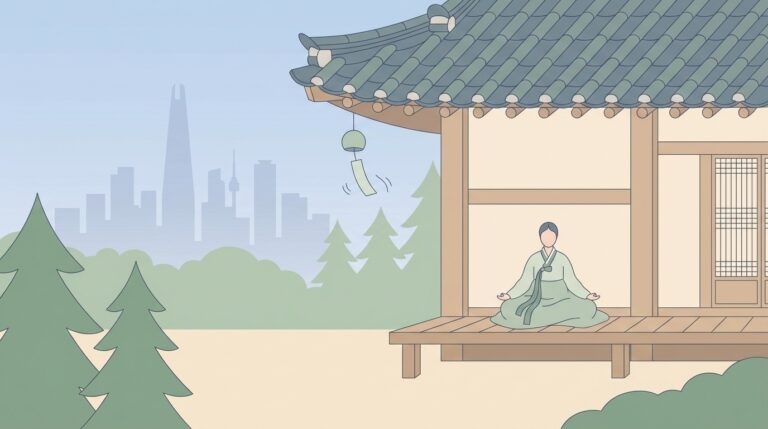
Phase 1: The Immersive Hook
Greeting: 안녕하세요! Welcome back to Daily Hangul. I’m your Senior Editor, and today, we are slowing things down.
The Scene: Picture this. You are standing in the middle of Gangnam Station during rush hour. A sea of people is surging past you, the rhythm of ppalli-ppalli (hurry-hurry) culture vibrating through the floor. Your heart races. The noise is overwhelming. It feels like a scene from a K-Drama right before the protagonist has a panic attack and collapses, only to be caught by the lead actor.
But today, there is no lead actor to catch you. You need to catch yourself.
In a society driven by high pressure and the intense gaze of others (nunchi), talking about mental health was once taboo. However, the narrative is shifting. From K-Pop idols taking hiatuses for anxiety to the national obsession with “Healing” (힐링) and “Spacing Out” (mung), Korea is learning to breathe again.
Today’s lesson isn’t just about vocabulary; it’s about the linguistic tools for survival and serenity in a high-octane society. Let’s find our inner peace, shall we?
Phase 2: Deep Dive into Expressions
Since you are an advanced (C2) learner, we move beyond “I am sad.” We are exploring the nuance of the psyche.
1. 마음을 비우다 (Maeum-eul biuda)
- Pronunciation: [ma-eum-eul bi-u-da] (Sounds like: Ma-eum-eul + be like beverage + u like uber + da)
- Meaning: Literally “to empty the mind/heart.” Contextually, it implies letting go of greed, obsession, or chaotic thoughts to reach a state of equilibrium.
- K-Culture Moment: Think of a Temple Stay variety show where a stressed celebrity is sweeping the yard. The monk doesn’t say “relax.” He says, “욕심을 버리고 마음을 비우세요” (Throw away greed and empty your mind). It’s deeply rooted in Buddhist philosophy.
- Editor’s Insight: This isn’t just about relaxation; it’s an active decision to detach. It’s the linguistic equivalent of formatting your hard drive.
- Situation Spectrum:
[🚫 Formal Report] ———— [✅ Self-Reflection/Deep Talk] ———— [✅ Advice to Friend]- 🤔 Think About It: Why does Korean use the metaphor of “emptying” (container) rather than “calming” (state)? Does this suggest the mind is viewed as a vessel that gets ‘full’ of stress?
2. 강박관념에 시달리다 (Gangbak-gwannyeom-e sidallida)
- Pronunciation: [gang-bak-gwan-nyeom-e shi-dal-li-da]
- Meaning: To be tormented by an obsession/compulsion/fixation.
- K-Culture Moment: In thrillers or heavy dramas like Sky Castle, a character obsessed with grades or success isn’t just “worried.” They are suffering from 강박관념. It describes a mental prison.
- Editor’s Insight: 시달리다 (to suffer/be pestered) adds a layer of victimization. You aren’t just having the thought; the thought is attacking you.
- Situation Spectrum:
[🚫 Casual Greeting] ———— [✅ Therapy/Serious Talk] ———— [✅ Literary Writing]- 🤔 Think About It: Korea has a high standard for perfectionism. How does the frequent use of the word 강박 (compulsion) reflect the societal pressure to be perfect?
3. 오롯이 나에게 집중하다 (Orosi na-ege jipjunghada)
- Pronunciation: [o-ro-shi na-e-ge jip-jung-ha-da]
- Meaning: To focus solely and wholly on myself.
- K-Culture Moment: You see this in vlog titles of people traveling alone or going on a “digital detox.” It’s the ultimate slogan for the modern YOLO or Honjok (people who prefer doing things alone) generation.
- Editor’s Insight: 오롯이 is a beautiful, native Korean adverb meaning “perfectly, completely, without lacking.” It sounds much more poetic and deliberate than just 완전히 (completely).
- Situation Spectrum:
[⚠️ Business Meeting] ———— [✅ Journaling] ———— [✅ Yoga/Meditation Class]- 🤔 Think About It: In a collective society where “We” (uri) is default, why is the linguistic shift to “Solely Me” (orosi na) becoming a trend? Is it rebellion or survival?
Phase 3: Textbook vs. Real Life
| Situation | 📖 Textbook Korean | 🗣️ Real Korean (C2 Nuance) | 💡 Why the difference? |
|---|---|---|---|
| Telling someone to relax | 긴장을 푸세요. (Release your tension.) | 머리 좀 식혀. (Cool down your head.) | “Cooling the head” implies physical heat from overthinking/stress (Hwabyung concept). |
| “I am very stressed.” | 스트레스를 많이 받아요. (I receive a lot of stress.) | 기가 빨려. (My energy/Qi is being sucked out.) | Traditional medicine influence. Used when social interaction or work drains your vital energy. |
| “Don’t worry too much.” | 너무 걱정하지 마세요. (Don’t worry too much.) | 마음 쓰지 마. (Don’t use your heart/mind.) | Worrying is seen as an expenditure of emotional labor/resources. |
Bottom Note: Using 기가 빨려 (Gi-ga ppallyeo) instantly makes you sound like a local who understands the exhaustion of modern Korean social life.
Phase 4: Cultural Deep Dive — The “Mung” (멍) Phenomenon
4-1. The Art of Spacing Out
In the West, staring at nothing might be seen as “zoning out” or being unproductive. In Korea, it has been elevated to an art form and a mental health necessity called “Mung” (멍).
We combine it with nouns to describe what we are staring at:
* Bul-mung (불멍): Staring at a campfire (Fire-mung).
* Mul-mung (물멍): Staring at water (Water-mung).
* Sup-mung (숲멍): Staring at the forest (Forest-mung).
There is even an annual “Space-out Competition” in Seoul where the person with the most stable heart rate while doing absolutely nothing wins. It is a collective rebellion against the hyper-competitive society.
4-2. The “Hwabyung” (화병) Context
Historically, Koreans suffered from Hwabyung (literally “Fire Illness”), a somatic symptom disorder resulting from repressed anger and unfairness. While the younger generation talks about “Panic Disorders” or “Burnout,” the cultural DNA of suppressing emotion still exists. Therefore, expressions like “속이 타다” (my insides are burning) or “답답하다” (feeling suffocated/frustrated) are crucial for describing anxiety in Korea.
Phase 5: Immersive Roleplay
Setting: A serene Temple Stay program in the mountains of Gangwon-do. You are sitting on a wooden porch with a Monk (Seunim) drinking tea. The wind chimes are ringing softly.
Characters:
* YOU: A high-level executive experiencing burnout.
* Seunim (Monk): Wise, calm, speaks in a gentle but firm tone.
Dialogue:
Seunim: 차 향기가 참 좋지요? 도시의 소음은 잠시 잊으셨습니까?
(Cha hyang-gi-ga cham jot-ji-yo? Dosi-ui so-eum-eun jamsi ijeusyeot-seumnikka?)
(The scent of the tea is lovely, isn’t it? Have you forgotten the noise of the city for a moment?)
YOU: 네, 조용해서 좋네요. 그런데… 가만히 있어도 자꾸 불안한 마음이 올라와요.
(Ne, joyonghaeseo jonneyo. Geureonde… gamanhi isseodo jakku buranhan ma-eum-i ollawayo.)
(Yes, the silence is nice. But… even when sitting still, feelings of anxiety keep rising up.)
Seunim: 무엇이 그대 마음을 그토록 짓누르고 있나요?
(Mueosi geudae ma-eum-eul geutorok jit-nureugo innayo?)
(What is pressing down on your heart so heavily?)
YOU: 잘해야 한다는 강박관념이요. 멈추면 뒤처질 것 같아서 무서워요.
(Jalhaeya handaneun gangbak-gwannyeom-iyo. Meomchumyeon dwicheojil geot gat-aseo museowoyo.)
(The compulsion that I have to do well. I’m afraid that if I stop, I’ll fall behind.)
🔀 Decision Point: How do you respond to the Monk’s silence?
- Option A: “스님은 어떻게 마음을 비우세요?” (Monk, how do you empty your mind?)
- Option B: “그냥 정답을 알려주세요.” (Just give me the answer/solution.)
- Option C: (Take a deep breath and say nothing)
✅ Best Choice: Option A. Asking for guidance shows humility and a willingness to introspect, fitting the context.
⚠️ Choice B Analysis: This reflects the “Ppalli-ppalli” efficiency mindset, which is exactly what you are trying to cure here. The monk might chuckle at your impatience.
Seunim: (Smiling) 흐르는 물을 억지로 잡으려 하지 마세요. 그냥 흘려보내세요. 그게 ‘비움’의 시작입니다.
(Heureuneun mureul eokjiro jabeuryeo haji maseyo. Geunyang heullyeo-bonaeseyo. Geuge ‘bium’-ui sijagirmnida.)
(Do not try to forcefully grasp flowing water. Just let it flow. That is the beginning of ‘emptying’.)
Phase 6: 10-Second Shadowing Drill
Let’s practice a mantra you can use when you feel overwhelmed. Focus on the low, resonant tone.
The Sentence:
지금 이 순간 / 나를 괴롭히는 강박을 / 미련 없이 / 내려놓습니다.
(Ji-geum i sun-gan / na-reul goe-rop-hi-neun gang-ba-geul / mi-ryeon eop-si / nae-ryeo-not-seum-ni-da.)
Emotion: 🧘 Calm, deeply exhaling, resolute.
Meaning: In this moment, I lay down the obsessions that torment me, without any lingering attachment.
Phase 7: K-Culture Mini Glossary
| Korean | Romanization | English Meaning | Contextual Note |
|---|---|---|---|
| 멍 때리다 | Meong ttaerida | To space out | Not lazy, but a necessary mental break. |
| 소확행 | So-hwak-haeng | Small but certain happiness | A trend focusing on small joys (coffee, books) to counter anxiety about the uncertain future. |
| 멘탈이 털리다 | Mental-i teollida | My mental state is dusted/shaken | Slang. Used when you are mentally exhausted or shocked. “My mental is dust.” |
| 힐링 | Hilling | Healing | A massive industry in Korea covering everything from spas to camping. |
Phase 8: Traveler’s Survival Kit (Mental Health Edition)
Seoul can be overstimulating. Here is how to find sanctuary.
🆘 Survival Phrases for Seeking Quiet
– 🇰🇷 “조용한 자리로 부탁드려도 될까요?” (Joyonghan jari-ro butak-deuryeodo doelkkayo?)
– “Could I ask for a quiet seat, please?” (Use in cafes/restaurants).
– 🇰🇷 “잠시 혼자 있고 싶어요.” (Jamsi honja itgo sipeoyo.)
– “I want to be alone for a moment.” (Polite but firm boundary).📍 Editor’s Travel Note: Urban Sanctuaries
* Bongeunsa Temple (Gangnam): A peaceful temple right in the middle of the city. Perfect for a quick meditation break.
* Coin Karaoke (Coin Noraebang): Sounds crazy? It’s a valid stress relief method. Go alone, sing one sad ballad, cry, and leave. No one judges.
* Han River Parks at Night: Bring a mat, look at the water (Mul-mung), and order delivery chicken. It’s the ultimate Seoul therapy.
Phase 9: Critical Thinking — “Think Deeper”
Topic: The Paradox of “Healing” in a Hyper-Competitive Society
Korea has one of the most active “Healing” markets in the world. But isn’t it ironic? The society pushes individuals to the brink of burnout with education and work pressure, and then sells them “healing” as a product. The term “Hell Joseon” (a satirical term comparing modern Korea to a hellish feudal society) coexists with the “So-hwak-haeng” (small happiness) movement.
🧠 Think Deeper:
Is the concept of “emptying the mind” (마음을 비우다) in Korea a spiritual pursuit, or is it a survival mechanism to cope with systemic pressure? In your culture, is meditation seen as a spiritual act or a productivity tool?
Phase 10: FAQ & Troubleshooting
Q: Is it okay to tell my Korean boss I have anxiety?
A: ⚠️ Proceed with caution. While things are changing, older generations might view it as “mental weakness.” It is safer to say “I need to manage my condition” (컨디션 조절이 필요합니다) rather than explicitly stating a diagnosis, unless you are very close.
Q: Can I cry in public in Korea?
A: Generally, Koreans avoid causing a scene. However, silently weeping on the subway or bus with headphones on? Surprisingly common. Just don’t make loud noises. It’s almost a trope of the “lonely city dweller.”
❌ Common Mistake:
* Saying: “나 우울증 있어” (I have depression) to a new acquaintance.
* Correction: Use “요즘 좀 기분이 다운되네요” (I’m feeling a bit down these days). “Depression” (우울증) is a medical diagnosis; use it carefully.
Phase 11: Wrap-up & Action Items
Summary: Today we learned how to articulate high-level emotions, specifically regarding anxiety and letting go, using culturally deep terms like 비우다 and 강박.
🚀 Action Missions:
* 🥉 Bronze: Stand in front of a mirror, take a deep breath, and say “마음을 비우자” (Let’s empty the mind) three times.
* 🥈 Silver: Search for “Han River Mul-mung” (한강 물멍) on YouTube and leave a comment in Korean: “마음이 편안해지네요” (My mind feels at peace).
* 🥇 Gold: Next time you are stressed with a Korean friend, use the phrase: “아, 기 빨려. 머리 좀 식혀야겠어.” (Ah, my energy is drained. I need to cool my head.)
K-Culture Mission: Watch an episode of the K-Drama My Liberation Notes (나의 해방일지). Look for the scene where they discuss “worshipping” (추앙) instead of love, and notice how they describe their inner hollowness.
Phase 12: Interactive Quiz
1. Situational Judgment:
Your friend is frantically checking their phone for work emails during dinner. You want to tell them to stop obsessing. What is the most appropriate C2-level expression?
* A) 핸드폰 좀 그만 봐. (Stop looking at your phone.) – Too direct/simple.
* B) 일에 대한 강박을 좀 내려놔. (Put down your compulsion/obsession with work.) – ✅ Correct.
* C) 너 미쳤어? (Are you crazy?) – Rude.
2. True or False:
“Hwabyung” is a modern disease caused by smartphones.
* ( False ) – It is a traditional illness related to suppressed anger, though modern stress triggers it too.
💬 Share your thoughts below! How do you “cool your head” in your country?
Frequently Asked Questions (FAQ)
Q: What does "마음을 비우다 (Maeum-eul biuda)" mean in Korean and how do you pronounce it?
A: In Korean, "마음을 비우다 (Maeum-eul biuda)" is pronounced [ma-eum-eul bi-u-da] and means: Literally "to empty the mind/heart." Contextually, it implies letting go of greed, obsession, or chaotic thoughts to reach a state of equilibrium.
Q: What does "강박관념에 시달리다 (Gangbak-gwannyeom-e sidallida)" mean in Korean and how do you pronounce it?
A: In Korean, "강박관념에 시달리다 (Gangbak-gwannyeom-e sidallida)" is pronounced [gang-bak-gwan-nyeom-e shi-dal-li-da] and means: To be tormented by an obsession/compulsion/fixation.
Q: What does "오롯이 나에게 집중하다 (Orosi na-ege jipjunghada)" mean in Korean and how do you pronounce it?
A: In Korean, "오롯이 나에게 집중하다 (Orosi na-ege jipjunghada)" is pronounced [o-ro-shi na-e-ge jip-jung-ha-da] and means: To focus solely and wholly on myself.







