

Phase 1: The Immersive Hook
Hello! This is your Daily Hangul Editor.
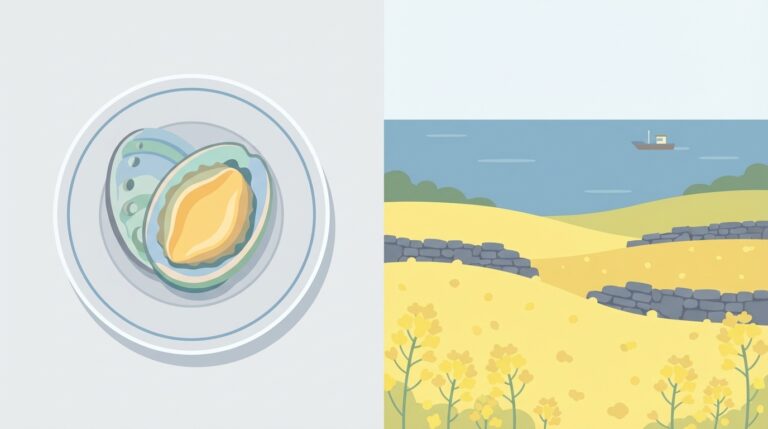
Imagine this scene: You’ve been surviving the “Ppalli-ppalli” (Hurry-hurry) culture of Seoul for months. You’re exhausted. In a K-Drama, this is the exact moment the protagonist drops everything, packs a small bag, and heads to a remote island to find themselves. The camera pans over endless fields of yellow rape flowers and stone walls, and for the first time in 10 episodes, the character smiles genuinely.
Today, we are going to that place. We are heading to Wando for the emperor’s food, Abalone (Jeonbok), and taking a slow ferry to Cheongsando, the first “Slow City” in Asia.
But here is the challenge: At a C1 level, you can order food. But can you describe the texture of raw abalone? Can you express the philosophical relief of escaping the city? If you just say “맛있어요” (It’s delicious) or “좋아요” (It’s good), you are missing the soul of this trip.
Let’s learn how to speak like a true Korean connoisseur of travel and taste.
Phase 2: Deep Dive into Core Expressions
1. 몸보신하다 (Mombosin-hada)
- Pronunciation: [Mom-bo-sin-ha-da] + (Think: “Mom” + “Bo” like ‘bow’ + “Sin” like ‘seen’)
- Meaning: To eat nutritious food to restore health and stamina (Literal: To protect the body).
- K-Culture Moment: You know those scenes in variety shows where the cast eats an octopus or abalone and suddenly yells, “Energy!!”? That is Mombosin. It’s not just eating; it’s fueling your life force.
- Editor’s Insight: Use this when eating Wando abalone. It justifies spending a lot of money on food. “Delicious” is subjective; “Mombosin” is essential.
- Situation Spectrum:
[🚫 Formal Report] ———— [⚠️ Semi-formal] ———— [✅ Casual/Social]- Friends/Family: ✅ “완도까지 왔는데 몸보신 제대로 하고 가야지!”
- Business Dinner: ✅ “부장님, 오늘 전복으로 몸보신하시죠.”
- 🤔 Think About It: Why does Korean culture obsess over “stamina foods” (boyangshik)? How does this relate to the intense work culture?
2. 숨통이 트이다 (Sumtong-i teu-i-da)
- Pronunciation: [Sum-tong-ee teu-ee-da]
- Meaning: To feel like one can finally breathe; to feel a sense of relief from pressure.
- K-Culture Moment: Standing on a cliff in Cheongsando, looking at the ocean. The wind blows your hair back. The BGM swells. You take a deep breath. That physical sensation is this phrase.
- Editor’s Insight: It’s much stronger than “relaxing.” It implies you were suffocating (metaphorically) before this moment.
- Situation Spectrum:
[🚫 None] ———— [⚠️ Formal Writing] ———— [✅ Everywhere]- This phrase is widely accepted to describe emotional relief.
- 🤔 Think About It: Is “stress” considered a default state in modern society, making “breathing” a luxury?
3. 식감이 쫄깃하다 (Sikgam-i jjolgit-hada)
- Pronunciation: [Sik-gam-ee jjol-git-ha-da]
- Meaning: The food texture is chewy and elastic.
- K-Culture Moment: Watching a Mukbang (eating show). The host chews loudly and points to their cheek. Korean gastronomy values texture (mouthfeel) almost as much as flavor.
- Editor’s Insight: Describing abalone as just “tasty” is a crime. Is it crunchy (odok-odok)? Is it chewy (jjolgit-jjolgit)? Showing you know texture words makes you an instant expert.
- Situation Spectrum:
[🚫 None] ———— [⚠️ None] ———— [✅ Foodie Talk]
Phase 3: Textbook vs. Real Korean
| Situation | 📖 Textbook Korean | 🗣️ Real Korean (Insider) | 💡 Why the difference? |
|---|---|---|---|
| Eating fresh abalone | 전복이 정말 신선해요. (The abalone is fresh.) | 와, 전복이 살아있네! 식감이 미쳤어. (Wow, it’s alive! The texture is crazy.) | “Alive” emphasizes freshness; “Crazy” is the go-to intensifier for modern Koreans. |
| Feeling relaxed | 저는 지금 편안해요. (I am comfortable now.) | 이제야 좀 살 것 같다. (Now I feel like I can live.) | Koreans often express happiness through the relief of suffering. |
| Walking slow paths | 천천히 걸읍시다. (Let’s walk slowly.) | 멍 때리면서 걷기 딱 좋다. (It’s perfect for walking while spacing out.) | “Spacing out” (Mung) is a highly valued mental break in Korea today. |
Bottom Note: At C1 level, move away from simple adjectives like “good/bad” and start using verbs that describe physical sensations (breathe, live, chew).
Phase 4: Cultural Deep Dive
4-1. Non-verbal: The “Ssam” (Wrap) Etiquette
If you order grilled abalone or sashimi in Wando, you might be offered lettuce or sesame leaves.
– The Rule: If you make a wrap for someone else (older or close friend), it’s a sign of affection (Jeong).
– The Eye Contact: When clinking soju glasses with the seafood, turn your head slightly away if you are with elders. Even on a relaxing island, hierarchy exists!
4-2. K-Drama Connection: The “Healing Trip”
Cheongsando is the quintessential “Healing Trip” location. In dramas, characters don’t just go there to have fun; they go to reset.
– The Trope: The protagonist walks along the stone walls (Doldam-gil), usually reflecting on a failed career or romance.
– Critical View: In reality, these “Slow Cities” are often flooded with tourists on weekends. The media sells the fantasy of solitude. True “healing” might require visiting on a Tuesday morning, not Saturday afternoon.
Phase 5: Immersive Roleplay Scenario
Setting: A bustling seafood restaurant overlooking Wando Port. The smell of ocean brine and grilled garlic is thick. You are with a Korean client, Manager Kim (50s, loves fishing).
Manager Kim: (Looking at the menu) 여기까지 왔는데, 전복 코스로 가시죠? 자연산이라 서울이랑 차원이 달라요.
(Yeogi-kkaji wat-neunde, jeonbok course-ro ga-si-jyo? Jayeonsan-ira Seoul-irang chawon-i dallayo.)
(Since we came all this way, shall we go for the abalone course? It’s wild-caught, so it’s on a different dimension from Seoul.)
(🎭 Stage Direction: He looks at you expectantly, proud of his suggestion.)
🔀 Your Turn! How do you respond?
- A) 네, 좋아요. 비싸지 않아요? (Yes, good. Isn’t it expensive?)
- B) 우와, 자연산이요? 오늘 몸보신 제대로 하겠네요! (Wow, wild-caught? I’m going to properly restore my health today!)
- C) 저는 생선 싫어해요. (I don’t like fish.)
✅ Best Choice: B
– Reason: You acknowledged his hospitality, used the keyword 몸보신 (Mombosin), and elevated the mood. Koreans love it when foreigners appreciate the “health benefits” of food.
– Why A is risky: Asking about price when being treated (or treating a client) can kill the vibe (Heung). Focus on the value, not the cost.
Manager Kim: 하하, 맞습니다! 사장님, 여기 제일 좋은 놈으로 주세요!
(Haha, that’s right! Boss, give us the best ones here!)
Phase 6: 10-Second Shadowing Drill
Emotion: 😌 Relieved & Awed (Imagine the sea breeze hitting your face)
Sentence:
서울에서는 / 숨 쉴 틈도 없었는데, / 여기 오니까 / 진짜 숨통이 트이네요.
(Seoul-eseoneun / sum swil teum-do eop-seot-neunde, / yeogi o-nikka / jinjja sumtong-i teu-i-neyo.)
Translation: In Seoul, I didn’t even have a moment to breathe, but coming here, I really feel like I can breathe freely.
Phase 7: K-Culture Mini Glossary
| Korean | Rom. | English | Context |
|---|---|---|---|
| 슬로시티 | Seullo-siti | Slow City | Cities designated by Cittaslow International; Cheongsando was the first in Asia. |
| 자연산 | Jayeonsan | Wild-caught | Opposite of farmed (Yangsik). Highly prized and expensive. |
| 힐링 | Hilling | Healing | Konglish for “relaxing” or “mental recovery.” Used everywhere in travel marketing. |
| 해녀 | Haenyeo | Female Diver | While famous in Jeju, Wando also has women who harvest seafood without equipment. |
| 유채꽃 | Yuchae-kkot | Rape Flowers | The yellow flowers that cover Cheongsando in spring. Major photo op. |
Phase 8: Traveler’s Survival Kit (Wando & Cheongsando)
🆘 Survival Expression #1: Ferry Logistics
– 🇰🇷 “청산도 들어가는 배, 마지막이 몇 시예요?” (Cheongsando deureoganeun bae, majimak-i myeot siyeyo?)
– Meaning: What time is the last boat into Cheongsando?
– 📍 Where: Wando Ferry Terminal.
– 💡 Pro Tip: Island weather is unpredictable. If the fog (angae) is thick, ships won’t sail. Always ask: “오늘 배 떠요?” (Is the boat leaving today?)📌 Editor’s Travel Note
– Wando Tower: Great view, but you need a taxi or strong legs to get up there.
– Walking Cheongsando: The courses are long (Slow Paths). Bring comfortable shoes. There are few convenience stores on the trails, so pack water!
Phase 9: Think Deeper — “The Paradox of Slow City”
Why does the “Pali-Pali” (Hurry-Hurry) nation love “Slow Cities”?
It is ironic that Korea, famous for the world’s fastest internet and delivery services, turns “Slowness” into a travel brand. This reflects a societal burnout. The popularity of Cheongsando implies that “slowness” has become a commodity—something you have to travel and pay to experience because it no longer exists in daily life.
💬 Your Turn: In your country, is “slowness” a luxury or a way of life? How do you express the need to escape the city?
Phase 10: FAQ & Troubleshooting
Q: Can I eat the abalone organs (Naejang)? They look green/yellow…
A: Yes! In Korea, the entrails (called Ge Woo) are considered the most nutritious part. They are rich and savory. If you don’t eat it, the locals might think, “Oh, they don’t know the real taste.”
Q: Is it okay to drink alcohol during the day here?
A: On islands and hiking trails, “Nat-sul” (Day drinking) is culturally more acceptable than in the city, especially with good seafood. Just don’t get drunk and loud.
❌ Common Mistake: Expecting city-speed service on Cheongsando.
✅ Do this: It is a Slow City. If the food comes late, take a selfie with the view. Complaining about speed here defeats the purpose of the trip!
Phase 11: Wrap-up & Action Items
Summary: Today we learned to seek health (Mombosin) in Wando and find breathing room (Sumtong) in Cheongsando.
🚀 Action Missions:
– 🥉 Bronze: Look in the mirror and practice the “texture” expression: “와, 식감이 쫄깃해요!”
– 🥈 Silver: Post a photo of a relaxing place on social media with the caption: “여기 오니까 숨통이 트인다.”
– 🥇 Gold: Go to a Korean seafood restaurant (or H Mart seafood section) and ask, “Is this Jayeonsan (wild) or Yangsik (farmed)?”
K-Culture Mission: Watch the movie Seopyeonje (classic) or scenes from Spring Waltz to see the famous Cheongsando stone paths!
Phase 12: Interactive Quiz
- Situation: You take a bite of fresh abalone. It is very chewy and fresh. You say:
- a) 맛이 없어요. (It tastes bad.)
- b) 식감이 쫄깃해요. (The texture is chewy.)
- c) 너무 부드러워요. (It’s too soft.)
- True or False: In Korea, eating the intestines of the abalone is considered rude and dirty.
- (True / False)
- Context: You are exhausted from work and finally arrive at the quiet island. You say:
- “______이 트인다!”
(Answers: 1-b, 2-False [It’s a delicacy!], 3-숨통)
Frequently Asked Questions (FAQ)
Q: What does "몸보신하다 (Mombosin-hada)" mean in Korean and how do you pronounce it?
A: In Korean, "몸보신하다 (Mombosin-hada)" is pronounced [Mom-bo-sin-ha-da] and means: To eat nutritious food to restore health and stamina (Literal: To protect the body).
Q: What does "숨통이 트이다 (Sumtong-i teu-i-da)" mean in Korean and how do you pronounce it?
A: In Korean, "숨통이 트이다 (Sumtong-i teu-i-da)" is pronounced [Sum-tong-ee teu-ee-da] and means: To feel like one can finally breathe; to feel a sense of relief from pressure.
Q: What does "식감이 쫄깃하다 (Sikgam-i jjolgit-hada)" mean in Korean and how do you pronounce it?
A: In Korean, "식감이 쫄깃하다 (Sikgam-i jjolgit-hada)" is pronounced [Sik-gam-ee jjol-git-ha-da] and means: The food texture is chewy and elastic.







