

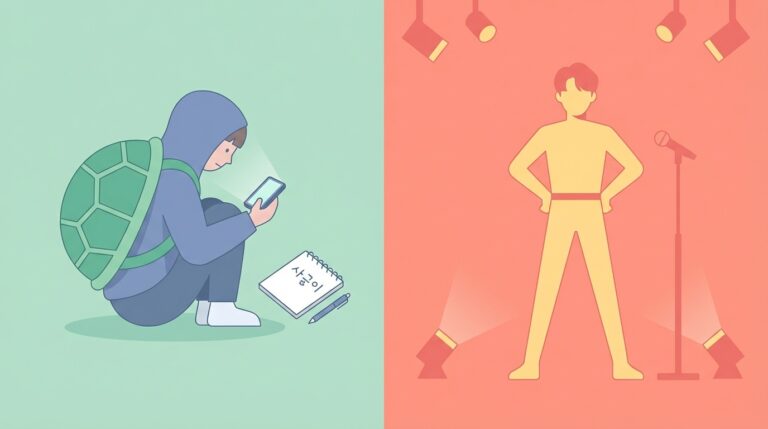
Phase 1: The Hook — Are You a “Smombie” in Seoul?
Hello! This is your Senior Editor at Daily Hangul.
Picture this: You are on the Seoul Metro Line 2 during rush hour. It’s packed. You look around, and what do you see? Everyone—from students in uniforms to salarymen in suits—is looking down at their smartphones. Their necks are bent at a 45-degree angle. In Korea, we call these folks “Smombies” (Smartphone Zombies).
Suddenly, you catch your reflection in the subway window. Your shoulders are rounded, your head is jutting forward… Oh no. You look like a turtle.
In K-Dramas, the CEO always walks with impeccable posture—chest out, chin up. In K-Pop, idols train for years to maintain a straight back even while dancing. But in reality? We are a nation fighting a war against “Geobukmok” (Turtle Neck).
Today, we’re going to learn how to talk about this modern epidemic. Knowing these expressions won’t just improve your Korean; it might actually save your spine during your long study sessions. Let’s straighten up and dive in!
Phase 2: Deep Dive into Core Expressions
1. 거북목 (Geobukmok)
- Pronunciation: [Geobungmok] Note: The ‘k’ (ㄱ) at the end of the first block interacts with the ‘m’ (ㅁ) to create an ‘ng’ sound. It sounds like ‘Geobung-mok’.
- Meaning:
- Literal: Turtle (Geobuk) + Neck (Mok)
- Real Nuance: Forward Head Posture / Text Neck Syndrome.
- K-Culture Moment: You’ll see ads for “Geobukmok Pillows” (neck correction pillows) all over Korean Instagram and Olive Young stores. It’s a huge industry.
- Editor’s Insight: This isn’t just a medical term; it’s everyday slang. If someone tells you, “You have Geobukmok,” they are worried about your health (or your visuals).
- Situation Spectrum:
[🚫 Formal(Boss)] ———— [✅ Casual(Friends/Doctor)] - 🤔 Think About It: Why do Koreans use an animal metaphor (Turtle) for a medical condition? It’s visual and intuitive. Does your language have a specific name for “text neck”?
2. 허리를 펴다 (Heorireul pyeoda)
- Pronunciation: [Heori-reul pyeo-da] Sounds like: ‘Hurry-reul pyuh-da’
- Meaning:
- Literal: To unfold/spread the waist.
- Real Nuance: Straighten your back / Sit up straight.
- K-Culture Moment: In variety shows like Running Man, when the cast is exhausted and slouching, the MC will yell “허리 펴!” (Straighten up!) to keep the energy high.
- Editor’s Insight: In Korean anatomy, 허리 (Heori) often covers the lower back up to the mid-back. So even if you are slouching your upper back, we say “fix your Heori.”
- Situation Spectrum:
[⚠️ Semi-Formal] ———— [✅ Casual]
(Note: Use “허리 좀 펴세요” for politeness.)
3. 뻐근하다 (Ppeogeunhada)
- Pronunciation: [Ppeo-geun-ha-da] The ‘Pp’ is a tense sound. Imagine spitting out a watermelon seed: Ppeo!
- Meaning:
- Literal: N/A
- Real Nuance: Stiff / Sore / Tight (specifically for muscles/joints).
- K-Culture Moment: After a long flight to Incheon or a 4-hour K-Pop concert, this is the first word you will say while stretching.
- Editor’s Insight: Don’t confuse this with 아프다 (Apeuda – Sick/Pain). Apeuda means you need a doctor; Ppeogeunhada means you need a massage or a stretch. It’s a very B2-level native distinction!
Phase 3: Textbook vs. Real Life Korean
| Situation | 📖 Textbook Korean | 🗣️ Real Korean | 💡 Why the difference? |
|---|---|---|---|
| Feeling stiff | 목이 아픕니다. (My neck hurts.) |
아, 목 뻐근해. (Ah, neck is stiff.) |
‘Ah’ acts as a sigh. ‘Ppeogeun’ is more specific than generic pain. |
| Correcting posture | 바른 자세를 유지하세요. (Maintain correct posture.) |
허리 좀 펴! 거북이 될라. (Straighten your back! You’ll become a turtle.) |
Koreans use humor and mild threats (“You’ll be a turtle”) to show care. |
| At a Massage Shop | 여기를 치료해 주세요. (Please treat this area.) |
여기 좀 많이 풀어주세요. (Please loosen/release this spot a lot.) |
We focus on “releasing” (풀다) the tension/stress knot. |
💡 Editor’s Note: Using “풀어주세요” (Please loosen it) at a massage shop or spa will make you sound like a local pro. “Heal/Treat” (치료) sounds like you are at a hospital.
Phase 4: Cultural Deep Dive — The “Visual” of Posture
4-1. The Attitude of Standing Straight
In Western cultures, slouching might just mean you are tired. In Korea, posture is heavily linked to “Tae-do” (Attitude/태도).
- In Business: If a junior employee slouches in a meeting, it can be interpreted as a lack of enthusiasm or respect.
- The Bow: Ironically, while you must stand straight to show confidence, you must also know when to bend (bow). The transition from a perfectly straight posture to a 90-degree bow is the hallmark of Korean business etiquette.
4-2. K-Beauty Connection: “Ratio” (Bi-yul)
Why is Geobukmok considered so bad? Aside from health, it ruins your “Bi-yul” (Body proportions). Koreans are obsessed with having a small face and long limbs. Forward head posture makes the neck look shorter and the face look bigger—the ultimate K-Beauty nightmare! Many idols do Pilates not just for fitness, but to correct their posture for better visuals.
Phase 5: Immersive Roleplay
Setting: A trendy study cafe in Hongdae. It’s exam period. You and your Korean friend, Ji-min, have been studying for 3 hours straight.
Characters:
* YOU: An exchange student, exhausted.
* Ji-min (24): A health-conscious friend who does Pilates.
Dialogue:
YOU: (Rubbing neck) 아… 공부 너무 많이 했나 봐.
(Ah… gongbu neomu mani haenna bwa.)
(Ah… I think I studied too much.)
Ji-min: 왜? 목 아파?
(Wae? Mok apa?)
(Why? Does your neck hurt?)
YOU: 응, 좀 뻐근해.
(Eung, jom ppeogeunhae.)
(Yeah, it’s a bit stiff.)
Ji-min: (Looking at you) 야, 너 지금 완전 거북목이야! 허리 좀 펴!
(Ya, neo jigeum wanjeon geobungmog-iya! Heori jom pyeo!)
(Hey, you have total turtle neck right now! Straighten your back!)
🔀 Decision Point: How do you respond?
- Option A: “진짜? 나 거북이 같아?” (Really? Do I look like a turtle?)
- Option B: “죄송합니다. 바르게 앉겠습니다.” (I am sorry. I will sit correctly.)
- Option C: “네가 마사지 좀 해줘.” (You give me a massage then.)
✅ Best Choice: Option A or C.
* Why A: It shows you understand the “Geobukmok” slang and can laugh at yourself.
* Why C: If you are close friends, asking for a quick shoulder rub is a sign of “Jeong” (bonding).
* ⚠️ Avoid B: Too formal! Ji-min is your friend, not your professor.
Phase 6: 10-Second Shadowing Drill
Let’s practice saying you are stiff. Try to express the physical discomfort!
Sentence:
“아이고, / 어깨가 / 너무 / 뻐근해요.”
(Aigo, / eokkaega / neomu / ppeogeunhaeyo.)
- Context: Stretching your arms after waking up or working.
- Emotion: 😩 (Tired but relieved to stretch)
- Sound Guide:
- Aigo: Like a deep sigh.
- Ppeogeun: Stress the ‘Ppeo’.
Phase 7: K-Culture Glossary: Health Edition
| Korean | Romanization | Meaning | Context |
|---|---|---|---|
| 파스 | Paseu | Pain Relief Patch | The magical sticky patch Koreans put on every ache. Smells like mint/menthol. |
| 도수치료 | Dosu-chiryo | Manual Therapy | A medicalized massage/adjustment popular for fixing posture. Covered by insurance sometimes! |
| 승모근 | Seungmogeun | Trapezius Muscle | K-Beauty obsession: Botox is often injected here to lower the shoulders for a longer neck look. |
| 스트레칭 | Seuteureching | Stretching | Konglish. Everyone uses this. |
Phase 8: Traveler’s Survival Kit (Pharmacy/Spa)
Walking around Seoul all day? You might need this.
🆘 Survival Phrase #1: At the Pharmacy (Yak-guk)
* 🇰🇷 “목이랑 어깨가 뻐근해요. 파스 주세요.”
* (Mog-irang eokkae-ga ppeogeunhaeyo. Paseu juseyo.)
* 🗣️ Meaning: “My neck and shoulders are stiff. Please give me a pain patch.”
* 💡 Pro Tip: There are “Cool” (Siwonhan) patches for acute pain and “Hot” (Tteugeoun) patches for chronic aches. The pharmacist might ask!📌 Editor’s Travel Note
* Jjimjilbang (Sauna): If you have body aches, go to a Korean sauna. Soaking in hot water is the Korean cure-all for “Ppeogeun” muscles.
* Massage Chairs: Many cafes and even movie theaters (like CGV) have high-end massage chairs you can use for a small fee.
Phase 9: Think Deeper — Health & Beauty Standards
Why is “Posture” a Beauty Trend?
In many Western countries, posture is a medical issue. In Korea, it’s often marketed as a beauty issue. “Correct your posture to become taller,” or “Fix your turtle neck to have a slimmer face line.” This reflects the intense pressure of Oemo-jisu-juui (Lookism) in Korean society. Even health is commodified as a way to look better.
💬 Your Turn: In your country, is posture linked to health, confidence, or beauty? Do you have “posture correction clinics” on every street corner like in Gangnam?
Phase 10: FAQ & Troubleshooting
Q: Can I say “허리 펴” (Straighten back) to an older person?
* NO! 🚫 That is a command. If an elder is slouching, you usually say nothing. If you must help (e.g., for a photo), suggest it indirectly: “자세를 조금만 편안하게 하실까요?” (Shall we make the posture a bit more comfortable?)
Q: Is “Geobukmok” an insult?
* Maybe. Between friends, it’s a caring nag. But don’t say it to a stranger. It implies they look bad.
❌ Common Mistake: Saying “My body is sick” (몸이 아파요) when you are just stiff.
* ✅ Fix: Use “몸이 찌뿌둥해요” (My body feels heavy/clunky) or “뻐근해요” (Stiff). “Sick” implies you have a fever or virus.
Phase 11: Wrap-up & Mission
Summary: Today we learned that Geobukmok is the enemy, Heori-reul pyeoda is the solution, and Ppeogeunhada is how you complain about it.
🚀 Action Missions:
* 🥉 Bronze: Look in the mirror, straighten your back, and say “허리 펴!” to yourself.
* 🥈 Silver: Search “거북목 교정” (Turtle neck correction) on YouTube and try one exercise.
* 🥇 Gold: Go to a Korean pharmacy or convenience store and buy “파스” (Pain patch) using the phrase we learned!
K-Culture Mission: Next time you watch a K-Drama, spot the character with the “perfect posture.” Usually, it’s the rich heir or the ambitious villain. Spot the difference!
Phase 12: Interactive Quiz
1. Which phrase is best when your shoulders feel tight after studying?
* A) 어깨가 아파요. (My shoulder is sick/painful.)
* B) 어깨가 뻐근해요. (My shoulder is stiff.)
* C) 어깨가 기뻐요. (My shoulder is happy.)
2. True or False?
* In Korea, having “Geobukmok” (Turtle Neck) is only considered a medical problem, not a visual one.
3. Situation Check:
* Your boss is slouching in a chair. What do you say?
* A) 부장님, 허리 펴세요! (Boss, straighten your back!)
* B) 부장님, 거북목이시네요. (Boss, you have turtle neck.)
* C) Nothing. (Silence is golden.)
Answers:
1. B (A is okay, but B is more natural for stiffness. C is… weird.)
2. False (It’s a huge aesthetic/beauty concern too!)
3. C (Never correct a superior’s posture unless you are their personal trainer!)
Frequently Asked Questions (FAQ)
Q: What does "거북목 (Geobukmok)" mean in Korean and how do you pronounce it?
A: In Korean, "거북목 (Geobukmok)" is pronounced [Geobungmok] and means: Literal: Turtle (Geobuk) + Neck (Mok)
Q: What does "허리를 펴다 (Heorireul pyeoda)" mean in Korean and how do you pronounce it?
A: In Korean, "허리를 펴다 (Heorireul pyeoda)" is pronounced [Heori-reul pyeo-da] and means: Literal: To unfold/spread the waist.
Q: What does "뻐근하다 (Ppeogeunhada)" mean in Korean and how do you pronounce it?
A: In Korean, "뻐근하다 (Ppeogeunhada)" is pronounced [Ppeo-geun-ha-da] and means: Literal: N/A







