

Phase 1: The Immersive Hook
Hello! This is your Daily Hangul Editor. 👋
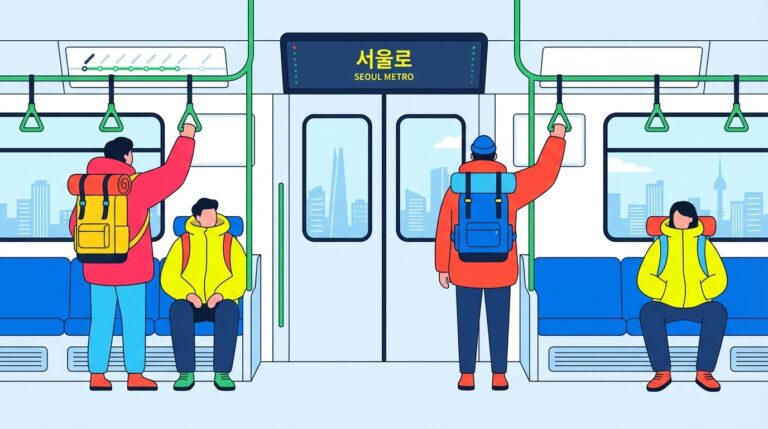
Imagine this: It’s Saturday morning, 9:00 AM. You step onto the Seoul Subway Line 3, expecting a quiet ride. Instead, you are greeted by a sea of neon colors—hot pink, lime green, electric blue. Everyone, from energetic 20-somethings to grandmothers who look stronger than you, is decked out in high-tech Gore-Tex jackets, hiking poles, and backpacks big enough to conquer Everest.
Did you accidentally walk into a sporting goods convention? No. You’ve just encountered the “Weekend Hiking Army” (주말 등산객).
In K-Dramas, hiking isn’t just exercise. It’s where CEOs make secret deals, where estranged fathers and sons reconcile while panting up a hill, or where the protagonist screams their stress away at the peak. Hiking in Korea is a religion, a social club, and a fashion show rolled into one.
Today, we’re going to decode this colorful phenomenon. Knowing these expressions won’t just help you survive the crowded subway; it will help you understand the soul of the Korean weekend.
Phase 2: Deep Dive — 3 Key Expressions
1. [잠시만 지나갈게요]
- Pronunciation: [Jam-si-man ji-na-gal-ge-yo] + (Sounds like: “Jams” + “see” + “man” + “gee-na-gal” + “K-O”)
- Meaning: “Excuse me, I’m passing through for a moment.”
- The Context: The subway is packed with backpacks (배낭). To get off at your station, you can’t just say “Excuse me.” You need to announce your movement.
- K-Culture Moment: Think of those chaotic subway scenes in dramas like My Liberation Notes. This is the magic spell that parts the Red Sea of backpacks.
- Editor’s Insight: Use a firm but polite tone. Don’t ask for permission; announce your intention. You can also shorten it to “잠시만요!” (Jam-si-man-yo!) if you are in a rush.
- Situation Spectrum:
[🚫 To a King] ———— [⚠️ Semi-Formal] ———— [✅ Casual/Public]- (Actually, this is ✅ Universal for public transport survival!)
- 🤔 Think About It: In many Western cultures, physical contact on subways is avoided at all costs. In Korea, a little nudging is acceptable if you say this phrase. Why do you think personal space rules differ in high-density cities?
2. [다 왔어요 / 금방 가요]
- Pronunciation: [Da wa-sseo-yo / Geum-bang ga-yo]
- Meaning: “We’re almost there” / “We’ll be there soon.”
- The Nuance: The Great Korean Hiking Lie. If an Ahjussi (older man) tells you this on the mountain, do not trust him. It usually means you have at least 30 more minutes of torture left.
- K-Drama Trope: The breathless girlfriend asking, “Oppa, are we there yet?” and the boyfriend lying, “Yeah, just around the corner,” to keep her moving.
- Editor’s Insight: This isn’t malicious; it’s motivational! It’s a way to encourage others not to give up.
- Situation Spectrum:
[🚫 Formal Report] ———— [⚠️ Caution] ———— [✅ Hiking/Driving]
3. [뒷풀이]
- Pronunciation: [Dwit-pu-ri] (The ‘l’ sound is soft, like a flap)
- Meaning: “After-party” or “Wrap-up party.”
- The Real Goal: For 50% of hikers, the mountain is just the obstacle course they must complete to get to the Dwitpuri. This usually involves Pajeon (green onion pancake) and Makgeolli (rice wine) at a restaurant at the base of the mountain.
- K-Culture Moment: Every office drama (like Misaeng) has a Dwitpuri scene after a big project. Hiking is no different.
- 🤔 Think About It: Why does almost every group activity in Korea end with eating and drinking together? It connects to the concept of Jeong (정)—building a bond through shared food.
Phase 3: Textbook vs. Real Life
| Situation | 📖 Textbook Korean | 🗣️ Real Korean | 💡 Why the difference? |
|---|---|---|---|
| Crowded Subway | 실례합니다. (Excuse me.) | 잠시만요! / 내릴게요! (Just a moment! / I’m getting off!) | “Sil-rye-ham-nida” is too formal and long. In the chaos, short & loud wins. |
| Encouraging | 포기하지 마세요. (Do not give up.) | 다 왔어! 힘내! (Almost there! Cheer up!) | Hiking is a communal struggle. Informal encouragement builds camaraderie. |
| Suggesting Food | 등산 후에 식사 하실래요? (Shall we eat after hiking?) | 내려가서 막걸리 콜? (Makgeolli down there, cool?) | “Call?” (콜?) is slang for “Deal?” or “I’m in!” essential for casual plans. |
💡 Editor’s Note: “Call?” (Derived from English) is extremely common in Korea to say “Yes/Okay” to a suggestion. Use it with friends!
Phase 4: Cultural Deep Dive — The “Equipment Disease”
4-1. Non-verbal: The Backpack Etiquette
On the subway, hikers often forget they have a giant turtle shell on their backs. If you get hit by a backpack, don’t get angry. It’s an unspoken annoyance everyone tolerates. However, if you have a bag, wear it in front of you (kangaroo style) on the train. It’s the ultimate “manner” move.
4-2. Why the Expensive Gear? (Jangbi-bal)
You might see someone wearing full Himalayan-grade gear to hike a 300-meter hill. We call this 장비발 (Jangbi-bal)—relying on the power of equipment.
* Face Culture (Chemyon): Looking professional is part of the hobby. It shows you take the activity seriously.
* Safety: Korean mountains are rocky (granite). Good boots are actually necessary!
* Fashion: Outdoor brands (North Face, Black Yak) are huge status symbols in Korea.
Phase 5: Interactive Roleplay 🎬
Setting: It’s Saturday morning inside a packed subway car headed toward Bukhansan. You are squeezed between a door and a hiker.
Characters:
* YOU: An expat trying to survive the crush.
* Hiker Uncle (Ahjussi): Friendly, loud, wearing a bright yellow jacket.
Start Dialogue:
Ahjussi: (Smiling, gesturing to your shoes) 아이고, 등산 가요? 학생?
(Aigo, deungsan gayo? Haksaeng?)
(Oh my, are you going hiking? Student?)
🔀 Your Turn! How do you reply?
- Option A: “네, 친구들이랑 가요.” (Yes, I’m going with friends.)
- Option B: “아니요, 저는 그냥 집에 가요.” (No, I’m just going home.)
- Option C: “네! 정상에서 김밥 먹을 거예요!” (Yes! I’m going to eat Kimbap at the peak!)
✅ Best Choice: Option A or C.
* Analysis: Koreans love it when foreigners engage in local hobbies. Mentioning Kimbap (Option C) will likely get you a thumbs up or a piece of chocolate from his pocket! Hiking is a communal vibe.
(Dialogue Continues)
Ahjussi: 그래요! 산이 최고지. 끝나고 막걸리 한잔 해야지?
(Geuraeyo! Sani choegoji. Kkeunnago makgeolli hanjan haeyaji?)
(Right! Mountains are the best. You gotta have a Makgeolli after, right?)
YOU: (Use what you learned!)
* “네, 뒷풀이가 제일 중요하죠!” (Yes, the after-party is the most important part!)
Phase 6: 10-Second Shadowing Drill 🎧
Let’s practice the subway survival phrase. Focus on the sharp, polite tone.
- Emotion: 😤 Urgent but Polite (don’t sound angry, just firm)
- Drill:
잠시만 / 지나갈게요! / 내려요!
(Jam-si-man / ji-na-gal-ge-yo! / Nae-ryeo-yo!)
(Excuse me / I’m passing through! / I’m getting off!)
Phase 7: K-Culture Mini Glossary 📘
| Word | Romanization | Meaning | Context |
|---|---|---|---|
| 김밥 | Kimbap | Seaweed Rice Roll | The #1 hiking snack. Portable and delicious. |
| 막걸리 | Makgeolli | Rice Wine | The soulmate of hiking. Usually drunk from metal bowls. |
| 아이고 | Aigo | Oh my/Geez | The sound you make when climbing stairs or stretching. |
| 정상 | Jeongsang | Peak/Summit | The goal (or the halfway point to the restaurant). |
Phase 8: Traveler’s Survival Kit 🎒
Hiking in Korea? Keep this handy.
🆘 Survival Phrase #1
* 🇰🇷 “화장실 어디예요?” (Hwajangsil eodi-yeyo?)
* 🗣️ Pronunciation: [Hwa-jang-shill uh-dee-yay-yo?]
* 📍 Use: At the subway station or park entrance. Bathrooms on the mountain are rare!📌 Editor’s Travel Note
* Maps: Google Maps doesn’t work well for walking/hiking trails in Korea. Download Naver Map or KakaoMap.
* Water: Most major trails have natural springs (Yaksu-teo), but bring your own bottle just in case.
Phase 9: Think Deeper — Language & Society 🧠
The “We” Culture in Hiking
In English, we say “I am going hiking.” In Korean, even if you go alone, you enter a space of “We” (Woori). Strangers share food at the summit. If you look tired, someone might hand you a cucumber (classic hydration snack).
This reflects the high-context, collectivist nature of Korean society. The mountain isn’t a place of isolation; it’s a place of shared struggle and shared reward. When you say “Sugo-hasyeosseoyo” (Good job/You worked hard) to a passing hiker, you are acknowledging that shared effort.
💬 Your Turn: Does your country have a hobby where strangers naturally talk to each other? Tell us in the comments!
Phase 10: FAQ & Troubleshooting 🛠️
- Q: Do I have to bow to everyone on the mountain?
- A: Not a full 90-degree bow! But a slight nod and a breathless “An-nyeong-ha-se-yo” (Hello) or “Sugo-haseyo” (Keep up the good work) to people passing you is very common and polite on trails.
- Q: Can I wear jeans to hike?
- A: You can, but you will stick out. Koreans take gear seriously. Breathable athletic wear is standard. Jeans might get you looks of concern from local aunties.
- ❌ Common Mistake: Believing the distance signs exactly.
- Reality: “0.5km” in the mountains can feel like 5km depending on the slope. Trust your legs, not the sign (or the Ahjussi)!
Phase 11: Wrap-up & Mission 🚀
Summary: Today we learned how to navigate the “Hiking Army” on the subway using “Jam-si-man-yo,” understood the lie of “Da wa-sseo-yo,” and set our sights on the real goal: “Dwitpuri.”
Your Mission:
* 🥉 Bronze: Say “Jam-si-man ji-na-gal-ge-yo” out loud 3 times right now.
* 🥈 Silver: Watch a YouTube vlog of “Bukhansan Hiking” and spot the colorful fashion.
* 🥇 Gold: Go to a Korean restaurant, order Makgeolli and Pajeon, and post a photo with the caption: “My kind of hiking! #Dwitpuri”
Phase 12: Quiz — K-Culture Challenge 📝
- Situation: You are on the subway and need to get off, but a giant backpack is blocking you. What do you say?
- a) 비켜! (Move!)
- b) 잠시만 지나갈게요. (Excuse me, passing through.)
- c) 사랑해요. (I love you.)
- True or False: If a hiker says “We are almost there,” it means you are 1 minute away.
- (True / False)
- Culture: What is the most popular alcohol to drink after hiking?
- a) Soju
- b) Wine
- c) Makgeolli
Answers:
1. (b). (a) is rude!
2. False. It’s a motivational lie.
3. (c). It’s refreshing and traditional.
Frequently Asked Questions (FAQ)
Q: What does "[잠시만 지나갈게요]" mean in Korean and how do you pronounce it?
A: In Korean, "[잠시만 지나갈게요]" is pronounced [Jam-si-man ji-na-gal-ge-yo] and means: "Excuse me, I'm passing through for a moment."
Q: What does "[다 왔어요 / 금방 가요]" mean in Korean and how do you pronounce it?
A: In Korean, "[다 왔어요 / 금방 가요]" is pronounced [Da wa-sseo-yo / Geum-bang ga-yo] and means: "We're almost there" / "We'll be there soon."
Q: What does "[뒷풀이]" mean in Korean and how do you pronounce it?
A: In Korean, "[뒷풀이]" is pronounced [Dwit-pu-ri] and means: "After-party" or "Wrap-up party."







