

Phase 1: The Hook — Welcome to the “Library” of Seoul
Annyeonghaseyo! This is your Daily Hangul Editor. 👋
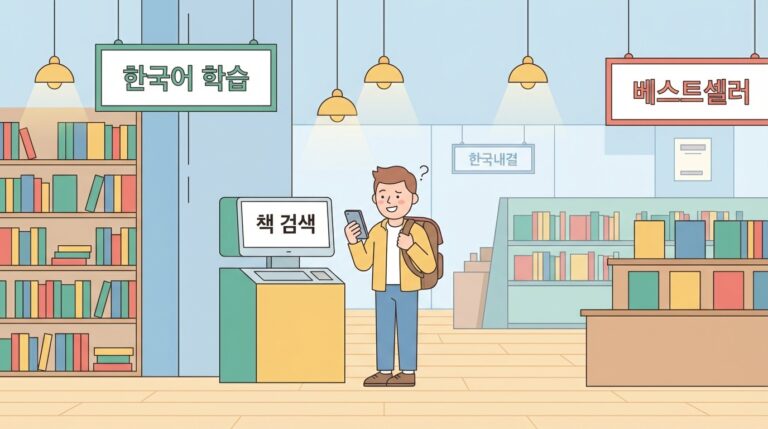
Picture this: You’ve just walked into Kyobo Bookstore in Gwanghwamun. It’s not just a shop; it’s massive. It smells like fresh paper and coffee. You feel like the main character in a K-Drama—maybe Romance is a Bonus Book? You are ready to start your Korean journey, but there’s a problem.
There are 50,000 books in front of you. You’re looking for that one textbook your teacher recommended, but the signs are all in Korean, the store is crowded, and the staff looks busy.
In a K-Drama, a handsome stranger might reach for the same book as you. In reality? You need to ask a staff member before your legs get tired!
Today, we aren’t just learning how to ask “Where is the book?” We are learning how to ask politely, effectively, and with the kind of “Sensible Nunchi” that makes the staff want to help you immediately.
Let’s find that book! 📚
Phase 2: Deep Dive — 3 Key Expressions
1. 혹시… (Hoksi…)
- Pronunciation: [Hok-shi]
- Sound Analogy: Sounds like “Hoke-she”. The ‘sh’ is soft.
- Meaning: By any chance… / Excuse me… (Literal: Perhaps)
- K-Culture Moment: You hear this constantly in dramas. Before someone asks a favor, confesses love, or asks a stranger a question, they start with “Hoksi…” It lowers the barrier.
- Editor’s Insight: This is your Magic Shield. In English, you might just say “Excuse me.” In Korean, starting a question without “Hoksi” can feel a bit abrupt or demanding to a stranger. It signals, “I am about to bother you, and I am sorry.”
- Situation Spectrum:
[🚫 Formal Speech Only] ———— [✅ Essential for Strangers] ———— [✅ Casual] - 🤔 Think About It: Why do Koreans feel the need to soften their questions so much? It reflects a culture that values indirectness to avoid seeming aggressive.
2. 이 책 어디에 있어요? (I chaek eodie isseoyo?)
- Pronunciation: [E-check uh-dee-eh e-ssuh-yo?]
- Sound Analogy: E (like the letter) + Check (like checkmark) + Uh-dee-eh + E-suck-yo (don’t stress the ‘suck’ too much!).
- Meaning: Where is this book?
- K-Culture Moment: Think of a variety show like Running Man where members are frantically looking for a mission item. “Where is it? Eodie isseoyo?!”
- Editor’s Insight: While grammatically correct, in a busy bookstore, you can make it shorter. Show a picture of the book cover on your phone and just ask: “이거 어디에 있어요?” (Where is this?).
- Situation Spectrum:
[🚫 Boss] ———— [⚠️ Stranger/Staff] ———— [✅ Friends]
(Note: Use ‘Isseumnikka?’ for very formal situations, but ‘Isseoyo’ is perfect for store staff.)
3. 재고 있어요? (Jaego isseoyo?)
- Pronunciation: [Jae-go e-ssuh-yo?]
- Sound Analogy: Jae (like Jay-Z) + Go (like Go!) + E-ssuh-yo.
- Meaning: Do you have stock? / Is it in stock?
- K-Culture Moment: Essential for K-Pop fans buying albums on release day. “Poster jaego isseoyo?” (Do you have posters left?)
- Editor’s Insight: Sometimes the shelf is empty. Don’t give up! Ask this. They might have it in the back or can check another branch for you.
- 🤔 Think About It: “Jaego” is a Sino-Korean word (Hanja). Why do we use a difficult word like “Jaego” instead of just “Is there a book?” It sounds more professional and specific in a retail setting.
Phase 3: Textbook vs. Real Life
| Situation | 📖 Textbook Korean | 🗣️ Real Korean (Street Smart) | 💡 Why the difference? |
|---|---|---|---|
| Asking location | 서점 직원이 어디에 있습니까? (Where is the staff?) | 저기요, 혹시… (Excuse me, by any chance…) | Looking for a person? Just call out politely! “Jeogiyo” captures attention faster. |
| Searching | 한국어 교재 섹션을 찾고 싶습니다. (I want to find the Korean section.) | 한국어 책, 어느 쪽에 있어요? (Korean books, which side?) | “Side/Direction” (Jjok) is more natural than “Section” when asking for general location. |
| Out of stock | 이 책은 여기에 없습니다. (This book is not here.) | 재고 다 나갔어요. (Stock all went out.) | “Nagass-eoyo” (went out) implies it was popular and sold out, not just missing. |
💡 Editor’s Tip: In busy Seoul bookstores, shorter sentences are appreciated. Don’t worry about perfect grammar; focus on the keyword + polite ending (Yo).
Phase 4: Cultural Deep Dive — The “Search Computer”
4-1. The Silent Savior: 도서 검색대 (Book Search Kiosk)
Before you ask a human, look around. Every major Korean bookstore has computers labeled “도서 검색 (Book Search).”
* K-Culture Context: Koreans value efficiency (Palli-Palli culture). Asking a staff member for something you could have looked up yourself might be seen as slightly lazy (though they will still help you!).
* Pro Move: Use the computer, print the little receipt (it tells you the shelf number, e.g., F-12), and then ask staff if you still can’t find shelf F-12.
4-2. Non-verbal: The “Pointing” Etiquette
When you ask “Where is it?”, don’t point with one finger. It’s considered rude. Instead, use an open hand (palm up) to gesture towards the section or the book picture on your phone.
Phase 5: Immersive Roleplay 🎬
Setting: A bustling Saturday afternoon at Kyobo Bookstore in Gangnam. It’s crowded. You are holding your phone with a picture of a “Daily Hangul” textbook.
Characters:
* YOU: A determined Korean learner.
* Staff (Min-ji): Helpful but wearing a headset, looking very busy organizing a pile of books.
Dialogue:
YOU: (Approaching cautiously) 저기요… 혹시…
(Jeogiyo… Hoksi…)
(Excuse me… By any chance…)
Min-ji: (Looks up and smiles) 네, 찾으시는 책 있으세요?
(Ne, chajeusi-neun chaek isseuseyo?)
(Yes, is there a book you are looking for?)
YOU: 네. 이 책 어디에 있어요? (Showing phone screen)
(Ne. I chaek eodie isseoyo?)
(Yes. Where is this book?)
Min-ji: (Typing on her computer) 아, ‘매일한글’이요? 잠시만요… 어? 여기 재고가 없다고 나오네요.
(Ah, ‘Daily Hangul’? Jamsimanyo… Uh? Yeogi jaegoga eopdago naoneyo.)
(Ah, ‘Daily Hangul’? One moment… Oh? It says there is no stock here.)
🔀 DECISION POINT: What do you say?
- A) 아, 알겠습니다. 안녕히 계세요. (Give up and leave)
- B) 다른 지점에 있어요? (Is it at another branch?)
- C) 진짜요? 왜 없어요? (Really? Why not? – Too aggressive!)
✅ Best Choice: B
Min-ji: 네, 광화문 점에는 3권 있다고 나오네요. 예약해 드릴까요?
(Ne, Gwanghwamun jeom-e-neun 3-gwon itdago naoneyo. Yeyak-hae deurilkkayo?)
(Yes, Gwanghwamun branch has 3 copies. Shall I reserve one for you?)
YOU: 네! 감사합니다!
(Ne! Gamsahamnida!)
Phase 6: 10-Second Shadowing Drill 🗣️
Let’s practice the magic sentence. Say it with a “worried but polite” face.
🥺 Excuse me… do you have this book in stock?
저기요 / 혹시… / 이 책 / 재고 있어요?
(Jeogiyo / hoksi… / i chaek / jaego isseoyo?)
- Intonation Tip: Raise your pitch slightly at “Hoksi” (to grab attention softly) and at “Isseoyo?” (to ask).
Phase 7: Traveler’s Survival Kit 🎒
Since you are at a bookstore, you might need these too!
🆘 Survival Phrases for Bookstores
1. “베스트셀러는 어디예요?” (Where are the bestsellers?)
* Use when: You just want to see what Koreans are reading these days.
2. “택스 리펀 되나요?” (Is Tax Refund available?)
* Crucial: Large bookstores like Kyobo offer immediate tax refunds for tourists if you spend over 30,000 KRW. Don’t forget your passport!
3. “봉투 필요 없어요.” (I don’t need a bag.)
* Eco-tip: You have to pay for bags in Korea. Say this if you have your own.📌 Editor’s Travel Note:
Most large bookstores in Korea also sell K-Pop albums and cute stationery (Artbox style). It’s a trap for your wallet! Be careful! 😉
Phase 8: Think Deeper — Language & Efficiency 🧠
Why do we use “Search Computers” so much?
In many Western countries, chatting with a bookstore clerk about book recommendations is part of the charm. In Korea, while staff are helpful, the culture values speed and efficiency (Palli-Palli). The “Book Search” machine represents a social agreement: “I will respect your time by trying to find it myself first.”
Asking a human is often the “Plan B.” How does this compare to bookstores in your country? Do you prefer the human interaction or the machine’s speed?
Phase 9: FAQ & Troubleshooting 🛠️
- Q: Can I read the books without buying them?
- A: YES! This is a huge part of Korean bookstore culture. You will see people sitting on floors or at big tables reading. However, don’t take photos of the inside pages (copyright etiquette) and don’t damage them.
- Q: Can I ask “Do you speak English?” first?
- A: Yes! “혹시 영어 하세요?” (Hoksi yeong-eo haseyo?). Many staff at major branches speak basic English.
- ❌ Common Mistake:
- Asking for a book by its English title only.
- Fix: Always have a screenshot of the Korean cover or the ISBN. Korean titles are often completely different from the English ones!
Phase 10: Wrap-up & Mission 🎁
One-Liner Summary: Use “Hoksi” to be polite, use “Jaego” to sound pro, and use the computer first if you can!
Your Mission:
* 🥉 Bronze: Look up a Korean book online and find its Korean title.
* 🥈 Silver: Practice saying “Hoksi… i chaek isseoyo?” while holding a book at home.
* 🥇 Gold: Go to a Korean bookstore (or a library) and ask a staff member for a specific book using these phrases!
K-Culture Mission: Watch a scene in a K-Drama where characters meet in a bookstore/library. Notice how quiet they are? Try to spot if they use the “Search Computer”!
Phase 11: Pop Quiz 📝
1. Which word is the “Magic Shield” to make your question polite?
A) Ya! (야)
B) Hoksi… (혹시)
C) Palli (빨리)
2. You found the book on the computer, but the shelf is empty. What do you ask the staff?
A) “Ige mwoyeyo?” (What is this?)
B) “Jaego isseoyo?” (Is there stock?)
C) “Annyeonghaseyo?” (Hello?)
3. True or False: It is rude to read a book in a Korean bookstore if you haven’t bought it yet.
(True / False)
Answers:
1. B (Hoksi is key!)
2. B (Jaego means stock.)
3. False (It is very common and accepted to read in the store!)
💬 Your Turn: Have you ever been to a bookstore in a foreign country? What was the hardest thing to find? Tell me in the comments!
Frequently Asked Questions (FAQ)
Q: What does "혹시... (Hoksi...)" mean in Korean and how do you pronounce it?
A: In Korean, "혹시... (Hoksi...)" is pronounced [Hok-shi] and means: a key conversational Korean expression covered in this lesson.
Q: What does "이 책 어디에 있어요? (I chaek eodie isseoyo?)" mean in Korean and how do you pronounce it?
A: In Korean, "이 책 어디에 있어요? (I chaek eodie isseoyo?)" is pronounced [E-check uh-dee-eh e-ssuh-yo?] and means: a key conversational Korean expression covered in this lesson.
Q: What does "재고 있어요? (Jaego isseoyo?)" mean in Korean and how do you pronounce it?
A: In Korean, "재고 있어요? (Jaego isseoyo?)" is pronounced [Jae-go e-ssuh-yo?] and means: a key conversational Korean expression covered in this lesson.







