

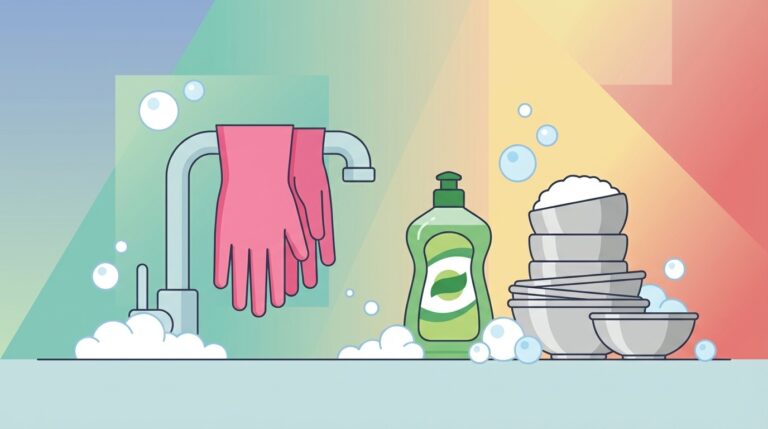
Unit: 설거지하기 (Doing the Dishes)
Phase 1: The Kitchen Battlefield 🍽️
Greeting: Hello! This is your Daily Hangul Head Editor.
Imagine this: You are watching a Korean reality show like Three Meals a Day (Samsiseki). After a delicious feast of Samgyeopsal (pork belly), the cast members suddenly freeze. The tension rises. Is it a fight? No. They are playing rock-paper-scissors to decide who has to face the mountain of greasy plates.
Or think of a K-Drama scene: The protagonist tries to impress their future mother-in-law by rolling up their sleeves in the kitchen. But wait—why are they putting on neon pink rubber gloves?
In Korea, Doing the Dishes (설거지, Seolgeoji) isn’t just a chore. It’s a social ritual. It’s where you show your manners (Nunchi), prove your diligence, and sometimes, pay for your meal with labor!
Today, we aren’t just learning how to clean plates. We are learning how to survive the “After-Dinner Nunchi Game” in a Korean home.
Phase 2: Core Expressions Deep Dive
1. 설거지해요 (Seolgeoji-haeyo)
- Pronunciation: [Seol-geo-ji-hae-yo]
- Sound Analogy: Soul (like the music) + Go (go away) + Gee (gee whiz) + Hey-yo.
- Meaning:
- Literal: Do dishwashing.
- Real Nuance: “I am washing the dishes.”
- K-Culture Moment: In variety shows, you’ll often hear stars groaning, “Ah, oneul seolgeoji nuguya?” (Ah, who is doing dishes today?). It’s the ultimate punishment!
- Editor’s Insight: The noun is 설거지 (dishwashing). You attach 해요 (do) to make it a verb.
- Situation Spectrum:
[🚫 Boss] ———— [✅ Stranger/Polite] ———— [✅ Friendly] - 🤔 Think About It: In English, we say “do the dishes.” In Korean, it’s a specific noun Seolgeoji. Why do you think Korea has a specific word just for washing bowls, separate from cleaning the house (cheongso)?
2. 제가 할게요 (Jega halgeyo)
- Pronunciation: [Je-ga hal-ge-yo]
- Sound Analogy: Jay-ga + Hal (like ‘Hall’) + Ge (like ‘Get’ without ‘t’) + Yo.
- Meaning:
- Literal: I will do it.
- Real Nuance: “Let me handle this!” (The polite volunteer).
- K-Culture Moment: You are at a Korean friend’s house. Dinner is over. Do not just sit there! Stand up and say this phrase. Even if the host refuses, you must offer.
- Editor’s Insight: This is the magic phrase to become a beloved guest. It shows you are not treating their house like a hotel.
- Situation Spectrum:
[✅ Boss/Elder] ———— [✅ Coworker] ———— [✅ Friend]
3. 고무장갑 (Gomu janggap)
- Pronunciation: [Go-mu jang-gap]
- Sound Analogy: Go + Moo (cow sound) + Jang (Django) + Gap.
- Meaning: Rubber gloves.
- K-Culture Moment: Have you noticed? In America, gloves are yellow. In Korea, they are almost always PINK (sometimes red). They are an icon of the Korean mother (eomma).
- Editor’s Insight: If you buy these as a housewarming gift, it’s practical, but maybe add some fancy hand cream too!
Phase 3: Textbook vs. Real Life
| Situation | 📖 Textbook Korean | 🗣️ Real Korean | 💡 Why the difference? |
|---|---|---|---|
| Suggesting to wash | 설거지 합시다. (Let’s do dishes.) |
내가 할게! / 가위바위보? (I’ll do it! / Rock-paper-scissors?) |
“Let’s do it” sounds like work. Friends usually gamble for it or fight to volunteer. |
| Asking for soap | 주방 세제 있어요? (Do you have kitchen detergent?) |
퐁퐁 어디 있어? (Where is the Pongpong?) |
Pongpong was a famous brand of dish soap, now used like “Kleenex” for all dish soap. |
Bottom Note: If you are A1 level, sticking to “Seolgeoji haeyo” is safe. But knowing “Pongpong” will make Koreans laugh and say, “Wow, you are almost Korean!”
Phase 4: Cultural Deep Dive
4-1. The Art of “Nunchi” Cleanup
In Korea, leaving your empty bowl on the table and walking away to watch TV is a crime in a home setting. You don’t have to actually wash them (the host might stop you), but you must pretend to try. Pick up your plate and move it to the sink. That is basic Nunchi.
4-2. K-Food Connection: The “Banchan” Nightmare
Why is Seolgeoji so feared in Korea? Because of Banchan (side dishes).
In a Western meal, you might have one plate and one fork per person. In a Korean meal, you have a rice bowl, a soup bowl, a main plate, a dipping sauce dish, and 5~10 small side dish containers. The sheer volume of dishes is 3x higher! When a Korean says, “Seolgeoji is hard,” they mean it.
Phase 5: Immersive Roleplay
Scenario: The “Polite War” at a Dinner Party
Setting: Friday night. You are at your Korean friend Min-su’s apartment after eating delivery fried chicken and tteokbokki. The table is a mess.
Characters:
* YOU: A polite guest trying to make a good impression.
* Min-su: Your Korean friend who wants to be a good host.
(Dialogue)
Min-su: 아, 배부르다! 잘 먹었다. 🍗
(Ah, baebureuda! Jal meogeotda.)
(Ah, I’m full! That was a good meal.)
YOU: (Standing up and picking up plates)
설거지 제가 할게요! 🧼
(Seolgeoji jega halgeyo!)
(I’ll do the dishes!)
Min-su: (Waving hands frantically)
아니야, 아니야! 손님인데 앉아 있어.
(Aniya, aniya! Sonnim-inde anja isseo.)
(No, no! You’re a guest, stay seated.)
YOU:
괜찮아요! 저 설거지 잘해요.
(Gwaenchana-yo! Jeo seolgeoji jal-haeyo.)
(It’s okay! I’m good at doing dishes.)
Min-su:
에이, 진짜 괜찮은데… 그럼, 같이 치울까?
(Ei, jinjja gwaenchaneunde… geureom, gachi chiulkka?)
(Ey, it’s really okay… then, shall we clear it together?)
🔀 Your Turn! How do you respond?
* A) “네, 같이 해요!” (Yes, let’s do it together!)
* B) “아니요, 제가 다 할게요. 쉬세요.” (No, I’ll do it all. You rest.)
* C) “오예! 고마워요.” (Oh yeah! Thanks.)✅ Best Choice: A. Doing it together (gachi) is the best bonding experience.
⚠️ Choice B Analysis: Very polite, but might make the host feel uncomfortable in their own home.
🚫 Choice C Analysis: Too rude! You offered first, you can’t back down now!
Phase 6: 10-Second Shadowing Drill
Let’s practice with emotion! Follow the marks.
- 😊 Brightly:
설거지 / 제가 / 할게요!
(Seolgeoji / jega / halgeyo!)
“I’ll / do / the dishes!” -
😤 Determined (with ‘Fighting’ spirit):
제가 / 다 / 치울게요.
(Jega / da / chiul-geyo.)
“I will / clean / everything.” -
🥺 Apologetic (when breaking a plate):
접시가 / 깨졌어요…
(Jeopsiga / kkae-jyeosseoyo…)
“The plate / broke…”
Phase 7: K-Culture Mini Glossary
| Korean | Romanization | Meaning | Context |
|---|---|---|---|
| 퐁퐁 | Pongpong | Dish Soap | The “Kleenex” of dish soap brands in Korea. |
| 음식물 쓰레기 | Eumsikmul sseuregi | Food Waste | CRITICAL. You cannot just throw food in the trash. It goes in a special yellow bag! |
| 행주 | Haengju | Kitchen Cloth | Used for wiping the table. Never use it on the floor! |
| 건조대 | Geonjodae | Drying Rack | Most Korean homes have a drying rack above the sink. |
Phase 8: Traveler’s Survival Kit (Airbnb/Guesthouse Edition)
If you stay in a Korean Airbnb or Guesthouse, you must do your own dishes. It’s not a hotel!
🆘 Survival Expression
* 🇰🇷 “음식물 쓰레기 어디에 버려요?” (Eumsikmul sseuregi eodie beoryeoyo?)
* 🗣️ Pronunciation: [Eum-shik-mool sseu-re-gi …]
* 📍 Where to use: Asking your host or landlord.
* 💡 Pro Tip: Korea has one of the strictest recycling systems in the world. If you mix chicken bones (general trash) with banana peels (food waste), the owner might get fined!
Phase 9: Think Deeper — “Why We Fight to Work”
Communal Responsibility vs. Individualism
In many Western cultures, the host cooks and cleans, or perhaps the guest is told explicitly to “relax.” But in Korea, the line between host and guest blurs after the meal. Fighting to do the dishes (“No, I’ll do it!” “No, put that down!”) is a form of expressing affection (Jeong, 정). It shows that we are not just transactional strangers, but a community sharing the labor.
💬 Your Turn: In your country, is it rude for a guest to enter the kitchen, or is it helpful? Tell us in the comments!
Phase 10: FAQ & Troubleshooting
- Q: Can I wash dishes with my bare hands?
- A: You can, but Koreans almost always use rubber gloves. The water is often very hot, and the detergent can be strong. Plus, putting on the pink gloves gets you into the “zone.”
- Q: A Korean friend cooked for me. Can I just say “Thank you”?
- A: “Thank you” is good, but offering to clean up is 100x better. Even if they say no, the offer counts.
- ⚠️ Common Mistake: Throwing leftover food in the sink drain.
- Do not do this! Korean sinks have a strainer, but you must empty that strainer into the food waste bag. Clogged drains are a major headache in Korean apartments.
Phase 11: Wrap-up & Mission
One-Liner: “In Korea, the sound of washing dishes is the sound of a good guest!”
🏆 Action Mission:
* 🥉 Bronze: Say “Seolgeoji haeyo” 3 times while washing your own cup today.
* 🥈 Silver: Watch a K-Drama scene with a family dinner. Spot the Pink Rubber Gloves!
* 🥇 Gold: Next time you eat with a Korean friend, stand up first and say, “Jega halgeyo!” Watch their surprised face!
Phase 12: Quiz — The Nunchi Test
1. You finished dinner at a Korean friend’s house. What is the BEST first move?
* A) Run to the sofa and turn on Netflix.
* B) Take your plate to the sink and say “Jega halgeyo.”
* C) Leave the plate on the table and wait for the host to take it.
2. True or False?
* “In Korea, you can throw chicken bones into the ‘Food Waste’ (Yellow bag).”
Answers:
1. B) Even if they stop you, this shows excellent manners.
2. False! Hard bones (chicken, beef), eggshells, and calm shells are General Trash, not Food Waste. Animals eat food waste, and they can’t eat bones!
Frequently Asked Questions (FAQ)
Q: What does "설거지해요 (Seolgeoji-haeyo)" mean in Korean and how do you pronounce it?
A: In Korean, "설거지해요 (Seolgeoji-haeyo)" is pronounced [Seol-geo-ji-hae-yo] and means: a key conversational Korean expression covered in this lesson.
Q: What does "제가 할게요 (Jega halgeyo)" mean in Korean and how do you pronounce it?
A: In Korean, "제가 할게요 (Jega halgeyo)" is pronounced [Je-ga hal-ge-yo] and means: a key conversational Korean expression covered in this lesson.
Q: What does "고무장갑 (Gomu janggap)" mean in Korean and how do you pronounce it?
A: In Korean, "고무장갑 (Gomu janggap)" is pronounced [Go-mu jang-gap] and means: a key conversational Korean expression covered in this lesson.







