

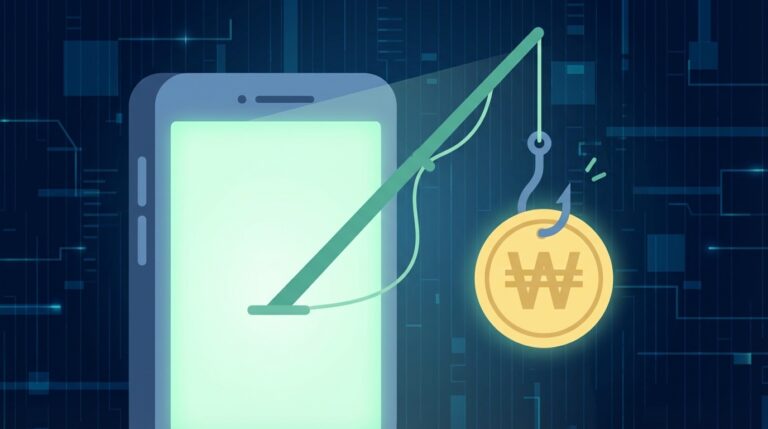
Don’t Take the Bait: Mastering the Language of Korean Cybercrime & Voice Phishing
Phase 1: The Immersive Hook
Hello! This is your Senior Editor at Daily Hangul.
Picture this: You are sitting in a hip cafe in Seongsu-dong, enjoying your iced americano. Suddenly, your phone rings. It’s an unknown number. You pick up, expecting a delivery driver, but instead, a stern, authoritative voice says:
“Here is the Seoul Central District Prosecutors’ Office. Your bank account has been involved in a crime.”
Your heart drops. In K-Dramas like Taxi Driver or Vincenzo, this is the moment the protagonist realizes they are in deep trouble. But in real life? This is the classic opening line of Voice Phishing (보이스피싱).
Korea is a hyper-connected digital society, which makes life convenient but also opens the door to sophisticated cybercrimes. As a C1 learner, you need to distinguish between a genuine emergency and a scripted scam. Understanding the specific vocabulary of “Authority” and “Urgency” used by scammers isn’t just about language skills—it’s about survival.
Today, we aren’t just learning words; we are learning how to protect your identity and your hard-earned money in Korea.
Phase 2: Deep Dive into Key Expressions
Here are the high-level terms you will hear in crime dramas and, hopefully never, on your own phone.
1. 명의 도용 (Myeong-ui do-yong)
- Pronunciation: [myeong-ui do-yong] Sounds like ‘Myung-ui’ (name/title) + ‘do-yong’ (stealing/using without permission).
- Meaning: Identity Theft / Stolen Identity
- K-Culture Moment: In almost every thriller drama, the villain opens a “burner phone” (daepo phone) using someone else’s ID. That act is myeong-ui do-yong.
- Editor’s Insight: This is a formal legal term. If a police officer uses this, it’s serious. If a caller uses this, they are trying to scare you into compliance by claiming your identity was stolen to commit a crime.
- Situation Spectrum:
[🚫 Casual Chat] ———— [⚠️ News/Legal] ———— [✅ Police Report]- 🤔 Think About It: Korea has a unique digital ID system (Resident Registration Number). Why does having a single, unchangeable ID number make myeong-ui do-yong so dangerous compared to other countries?
2. 대포통장 (Daepo-tongjang)
- Pronunciation: [dae-po-tong-jang] ‘Dae-po’ means cannon + ‘Tong-jang’ means bankbook.
- Meaning: Illegal Bank Account / Burner Account
- K-Culture Moment: In the movie Veteran, criminal organizations use these accounts to launder money. The term comes from the idea of a “cannon”—firing something (the account) once for a crime and then discarding it.
- Editor’s Insight: Scammers will often accuse you of creating a daepo-tongjang. They will say, “Your account was used as a daepo-tongjang for a fraud case.” It’s a terrifying accusation designed to make you panic.
- Situation Spectrum:
[🚫 Friends] ———— [⚠️ Banking] ———— [✅ Legal Context]3. 협조하지 않으시면… (Hyeopjo-haji aneusimyeon…)
- Pronunciation: [hyeop-jo-ha-ji a-neu-si-myeon]
- Meaning: “If you do not cooperate…”
- Editor’s Insight: This is the Conditional Threat. It sounds polite because of the honorific ‘-(eu)si-‘, but the intent is coercive. Genuine police rarely threaten you over the phone like this in the first contact; they send a physical summons.
- Situation Spectrum:
[🚫 Daily Life] ———— [⚠️ Scams] ———— [✅ Interrogations]- 🤔 Think About It: Notice the high level of honorifics used here. Why do criminals use ultra-polite language (Guek-jon-dae) while threatening you? It mimics the bureaucratic authority of the Korean government.
Phase 3: Textbook vs. Real Life
How does a scammer speak compared to a real official?
| Situation | 📖 Textbook / Official Protocol | 🗣️ Scammer / Real Criminal | 💡 Why the difference? |
|---|---|---|---|
| Initial Contact | “This is Officer Kim from [Station]. Please visit us.” (Calm, requests physical presence) | “This is Prosecutor Kim. Your account is frozen. ACT NOW.” (Urgent, demands immediate remote action) | Scammers rely on panic to bypass your critical thinking. Real legal processes are slow and bureaucratic. |
| Asking for Info | “Please confirm your DOB.” (Verify existing info) | “Tell me your banking password and OTP code.” (Extracting private info) | NEVER give an OTP or password. No government agency asks for this. |
| Tone | Dry, boring, administrative. | Aggressive, fast-paced, sometimes oddly quiet background. | Scammers create a “soundscape” of authority (fake typing noises, fake sirens). |
💡 Bottom Note: Real prosecutors (Gum-sa) almost never call individuals directly for initial investigations. They send mail (deung-gi). If someone claims to be a prosecutor on the phone, it is 99.9% a scam.
Phase 4: Cultural Deep Dive — The Psychology of “Authority”
4-1. The “Palli-Palli” Trap
Korea’s famous “Palli-Palli” (Hurry, Hurry) culture is usually about efficiency. However, scammers weaponize this. They know Koreans (and residents) are conditioned to resolve administrative issues immediately. They will say, “Unless you transfer funds right now, you will be arrested.”
Non-verbal Tip: If you feel your heart racing and the person is not letting you hang up or check facts, take a deep breath. The “Korean pause”—silence—is your weapon. Stop talking. See how they react. A professional waits; a scammer gets angry.
4-2. K-Drama Connection: The “Prosecutor” Trope
In dramas like Stranger (Secret Forest), prosecutors are powerful figures. Scammers exploit the fear and respect ordinary people have for this title. They use difficult Hanja (Sino-Korean) legal terms to make you feel uneducated and inferior, forcing you to rely on them for a solution.
Phase 5: Immersive Roleplay Scenario
Setting: It is 2:00 PM on a Tuesday. You are at your office desk. You receive a call from a restricted number.
Characters:
* YOU: An expat professional working in Seoul.
* Caller: A sophisticated voice phisher posing as an investigator.
Dialogue:
Caller: 김철수 씨 핸드폰 맞습니까? 서울중앙지검 첨단범죄수사팀입니다.
(Kim Cheol-su ssi haendeupon matseumnika? Seoul-jung-ang-ji-geom cheom-dan-beom-joe-su-sa-tim-imnida.)
“Is this Kim Cheol-su’s phone? This is the Advanced Crime Investigation Team at Seoul Central District Prosecutors’ Office.”
YOU: 네, 맞는데요. 무슨 일이시죠?
(Ne, matneundeyo. Museun il-i-si-jyo?)
“Yes, that’s correct. What is this about?”
Caller: 귀하의 명의로 대포통장이 개설되어 범죄에 이용되었습니다.
(Gwi-ha-ui myeong-ui-ro daepo-tongjang-i gaeseol-doeeo beom-joe-e i-yong-doe-eot-seumnida.)
“An illegal account was opened in your name and used for a crime.”
🔀 Decision Point! How do you respond?
A) Panic: “어떡해요? 제가 안 했어요! 어떻게 해야 하죠?” (What do I do? I didn’t do it!)
B) Challenge: “소환장 보내주세요. 제가 직접 경찰서로 가겠습니다.” (Send me a summons. I will go to the police station myself.)
C) Hang up: (Just hang up without a word.)
✅ Best Choice: B or C.
* Analysis: Option B is the ultimate C1 power move. By saying “Send a summons (so-hwan-jang)” and “I will go physically,” you signal that you understand the legal process. Scammers will usually hang up on you at this point. Option C is the safest.
Scenario B: Smishing (SMS Phishing) Bonus
Text Message: [CJ Logistics] Address unclear. Please click the link to confirm delivery: `http://bit.ly/scam`
YOU: (Do NOT click). Instead, open the official CJ App or check the tracking number separately. This is the most common scam targeting foreigners who love online shopping.
Phase 6: 10-Second Shadowing Drill
Practice this sentence to use when you want to verify a caller’s identity firmly.
“Where exactly did you say you were calling from?”
😤 Firm & Skeptical:
정확히 / 어디시라고 / 하셨죠?
(Jeong-hwaki / eo-di-si-ra-go / ha-syeot-jyo?)
Phase 7: K-Culture Mini Glossary
| Korean | Romanization | Meaning | Context |
|---|---|---|---|
| 보이스피싱 | Voice Phishing | Phone Scam | Konglish for Voice + Private Data + Fishing. |
| 스미싱 | Smishing | SMS Scam | Scams via text messages (usually delivery or wedding invites). |
| 전세 사기 | Jeonse Sagi | Rental Deposit Fraud | A massive issue in Korea where tenants lose their huge lump-sum deposits. |
| 사칭 | Saching | Impersonation | Pretending to be a public official or celebrity. |
| 112 | Il-il-i | Police | The number to call if you are being threatened. |
Phase 8: Traveler’s Survival Kit
Even short-term travelers are targets, usually via fake accommodation listings or taxi scams. However, digital crime is the focus here.
🆘 Survival Phrase #1
– 🇰🇷 “신고하겠습니다.” (Singo-ha-get-seumnida)
– 🗣️ Meaning: “I will report this (to the police).”
– 📍 Use: When someone is threatening you or trying to scam you.
– 💡 Pro Tip: The word ‘Singo’ covers everything from calling the police to reporting a spam number.📌 Editor’s Security Note
– Wifi Safety: Public Wifi in Seoul is everywhere, but avoid doing online banking on open networks (like in subways) without a VPN.
– KakaoTalk: Scammers often impersonate friends on KakaoTalk asking for money (“Hey, I lost my wallet, can you send 100k won?”). Always call the friend to verify.
Phase 9: Think Deeper — “Hyper-connectivity & Vulnerability”
Korea is a paradoxical model of the future. It is one of the safest countries in the world regarding physical violent crime (you can leave your laptop on a cafe table, and no one will steal it). However, it is a battlefield for cybercrime.
Why? Because everything is linked to your phone number and Resident ID. This high level of integration offers incredible convenience but creates a “single point of failure.” If your phone is compromised, your banking, identity, and social life are all exposed.
🧠 Think Deeper: In your country, is physical safety or digital safety a bigger concern? Does the convenience of a fully digital society outweigh the risks of data privacy?
Phase 10: FAQ & Troubleshooting
Q: A caller knew my name and birthday. Doesn’t that mean they are real?
A: No. Personal data leaks are unfortunately common. Just because they know your info doesn’t mean they are the police.
Q: I clicked a link in a text message. What should I do?
A: If you downloaded an APK file (app) from that link, your phone might be compromised (
Frequently Asked Questions (FAQ)
Q: What does "명의 도용 (Myeong-ui do-yong)" mean in Korean and how do you pronounce it?
A: In Korean, "명의 도용 (Myeong-ui do-yong)" is pronounced [myeong-ui do-yong] and means: Identity Theft / Stolen Identity
Q: What does "대포통장 (Daepo-tongjang)" mean in Korean and how do you pronounce it?
A: In Korean, "대포통장 (Daepo-tongjang)" is pronounced [dae-po-tong-jang] and means: Illegal Bank Account / Burner Account
Q: What does "협조하지 않으시면... (Hyeopjo-haji aneusimyeon...)" mean in Korean and how do you pronounce it?
A: In Korean, "협조하지 않으시면... (Hyeopjo-haji aneusimyeon...)" is pronounced [hyeop-jo-ha-ji a-neu-si-myeon] and means: "If you do not cooperate..."







