

Phase 1: Immersive Hook
Greeting: 안녕하세요! 매일한글(Daily Hangul)의 Senior Editor입니다.
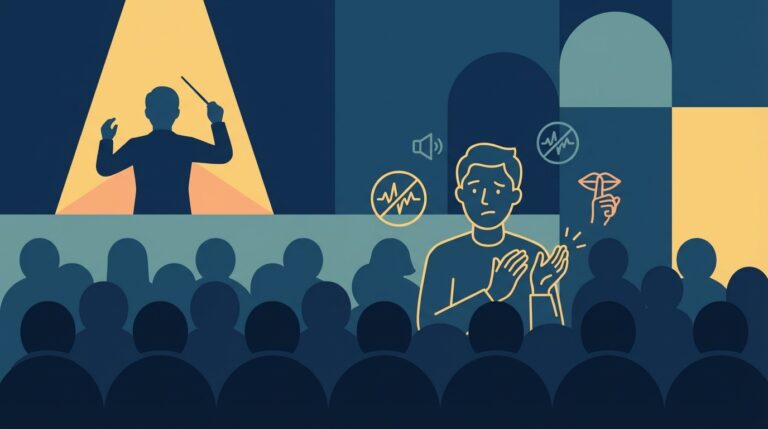
The Tension: Imagine this: You are at the Seoul Arts Center (예술의전당), the heart of Korea’s classical music scene. The pianist just finished a storm of notes and lifts their hands dramatically. The silence in the hall is absolute—so quiet you could hear a pin drop. In your home country, this might be the moment to applaud. But here? If you clap now, 2,000 pairs of eyes might turn to you with a look of polite but intense judgment.
The ‘Why’: Korean audiences are world-renowned for their ‘Molip’ (몰입 – total immersion). While K-Pop concerts are about explosive energy, K-Classical concerts are about collective, breathless concentration. Misreading this atmosphere isn’t just awkward; it’s considered a disruption of the ‘flow’ (흐름).
Transparency: Today, we move beyond basic phrases. We are dealing with C2-level nuances: interpreting silence, understanding the high-context concept of ‘Gwanke’ (관크), and mastering the art of the ‘Korean Curtain Call.’
Phase 2: Deep Dive into Advanced Expressions
1. 악장 간 박수는 삼가 주시기 바랍니다.
(Akjang gan baksuneun samga jusigi baramnida.)
- Pronunciation: [Ak-jang gan bak-su-neun sam-ga ju-shi-gi ba-ram-ni-da]
- Meaning: Please refrain from clapping between movements. (Formal & Written)
- Context: You will see this on screens before the show or hear it in the house manager’s announcement. ‘삼가다’ (to refrain) is a high-level verb essential for formal etiquette.
- Editor’s Insight: In casual speech, we just say “Don’t clap,” but in this setting, the language elevates to match the art form. It’s polite but firm command.
- Situation Spectrum:
[🚫 Casual Chat] ———— [⚠️ Polite Request] ———— [✅ Official Announcement]- 🤔 Think About It: Why does Korean use the verb ‘to refrain’ (삼가다) instead of a direct ‘do not’? It softens the prohibition while maintaining authority.
2. 관크 (Gwanke)
(Gwan-keu)
- Pronunciation: [Gwan-keu] sounds like ‘Gwan’ (from Gwang-gaek/Audience) + ‘Keu’ (from Critical/Critical Hit in gaming).
- Meaning: An audience member who disturbs others’ viewing experience (e.g., coughing, phone lights, talking).
- K-Culture Moment: If you read Korean classical music forums or ticket reviews (Interpark), you will see: “오늘 옆자리 관크 때문에 집중 못 했어요.” (I couldn’t concentrate today because of the ‘Gwanke’ next to me.)
- Editor’s Insight: This is advanced slang. It shows you understand the subculture of Korean performance arts where the audience holds each other accountable.
- Situation Spectrum:
[✅ Internet/Friends] ———— [⚠️ Whisper to companion] ———— [🚫 To the offender directly]3. 커튼콜 (Keoteunkol) & 기립박수 (Giripbaksu)
(Keoteunkol & Gi-rip-bak-su)
- Pronunciation: [Keo-teun-kol] & [Gi-rip-bak-su]
- Meaning: Curtain Call & Standing Ovation.
- K-Drama Context: Remember the drama Do You Like Brahms? (브람스를 좋아하세요?) The emotional climax often happens here. In Korea, the rhythmic clapping during the curtain call is perfectly synchronized. It’s a communal experience.
- Editor’s Insight: While ‘Gwanke’ is negative, ‘Giripbaksu’ is the ultimate praise. Koreans are generous with standing ovations if the performance was genuine.
Phase 3: Textbook vs. Real Life
| Situation | 📖 Textbook Korean | 🗣️ Real Korean (Pro Level) | 💡 Why the difference? |
|---|---|---|---|
| Complaining about noise | 조용히 해 주세요. (Please be quiet.) | (To companion) 아, 관크 쩐다… (Ah, the disturbance is severe…) | ‘Jo-yong-hi’ is too direct. Using slang like ‘Gwanke’ to a friend vents frustration without confrontation. |
| Asking when to clap | 언제 박수를 쳐야 합니까? (When should I applaud?) | (Whisper) 눈치 보고 칠게요. (I’ll play it by ear/watch others.) | Relying on Nunchi is more reliable than asking for rules in a fluid situation. |
| Praising the show | 공연이 아주 훌륭했습니다. (The performance was excellent.) | 연주 찢었다… (They tore up the stage / nailed it.) | ‘Hullyung-hada’ is academic. ‘Tjijeotda’ is the visceral reaction of a true fan. |
Bottom Note: Use ‘Gwanke’ only with friends. It’s expressive but slangy.
Phase 4: Cultural Deep Dive — The Sound of Silence
4-1. Nunchi in the Concert Hall
In a Korean concert hall, Nunchi (눈치) is your survival skill. It’s not just about reading minds; it’s about reading the collective breath of the audience. If the conductor lowers the baton but holds the tension, that is not silence—it is part of the music. Breaking this silence with a clap is considered breaking the artwork itself. The “Korean Glare” (눈총 – noon-chong, literally ‘eye-gun’) you receive for coughing loudly is real.
4-2. K-Drama Connection
In dramas like Beethoven Virus or Secret Affair (밀회), classical music represents high status, hidden passion, and strict discipline. The audience in these dramas sits rigid, analyzing every note. This reflects reality: Korean classical audiences are highly educated and critical. They aren’t just enjoying; they are evaluating.
Phase 5: Immersive Roleplay
Setting: Seoul Arts Center Concert Hall. The first movement of a Tchaikovsky Violin Concerto just ended. The hall is dead silent. You are sitting next to Ji-eun (29, a classical music enthusiast and your Korean friend).
Dialogue:
YOU: (Instinctively raising hands to clap)
(Wait… nobody else is moving?)
Ji-eun: (Swiftly but gently grabbing your wrist)
🤫 쉿! 아직 1악장이야. 지금 치면 안 돼.
(Shh! Ajik il-akjang-iya. Jigeum chimyeon an dwae.)
(Shh! It’s only the first movement. You shouldn’t clap now.)
YOU: (Whispering)
😲 아, 깜짝이야. 다 끝난 줄 알았어.
(Ah, kkam-jjak-i-ya. Da kkeun-nan jul a-ras-seo.)
(Whoa, you scared me. I thought it was all over.)
Ji-eun: 한국 관객들은 흐름 끊기는 거 되게 싫어하거든. 눈치 챙겨!
(Hanguk gwangyak-deureun heureum kkeunki-neun geo doege sireo-ha-geoden. Nunchi chaeng-gyeo!)
(Korean audiences really hate it when the flow gets cut off. Use your Nunchi!)
🔀 Decision Point: The movement finally ends properly. What do you do?
- A) Shout “Bravo!” immediately. (Expressive but risky)
- B) Wait 0.5 seconds to see if others clap, then join in. (The Nunchi Master)
- C) Clap politely but softly. (Safe but boring)
✅ Best Choice: B — In Korea, the “An-da-bak-su” (안다박수 – Clapping only when you know it’s done) is the safest bet. Even if you know the piece, the conductor might hold the silence. Waiting that split second shows you are “reading the room.”
Phase 6: 10-Second Shadowing Drill
Let’s practice explaining why you were so quiet.
😊 분위기가 / 너무 엄숙해서 / 숨도 못 쉬겠더라고요.
(Bun-wi-gi-ga / neo-mu eom-suk-hae-seo / sum-do mot swi-get-deo-ra-go-yo.)
Meaning: The atmosphere was / so solemn/serious that / I couldn’t even breathe.
Emotion: A mix of awe and relief.
Phase 7: K-Culture Mini Glossary
| Korean | Romanization | Meaning | Context |
|---|---|---|---|
| 안다박수 | An-da-bak-su | Knowing Applause | Clapping only when you are sure the piece is finished. |
| 초대권 | Chodaekwon | Invitation Ticket | Free tickets often given to VIPs; sometimes implies a less engaged audience member. |
| 피켓팅 | Piketting | Blood-Ticketing | Ticketing war so fierce it spills blood (Blood + Ticketing). Applies to both K-Pop and famous classical soloists (like Cho Seong-jin). |
| 막공 | Mak-gong | Last Performance | The final show of a run, usually having the best fan service or atmosphere. |
Phase 8: Traveler’s Survival Kit (Concert Hall Edition)
🆘 Survival Expression #1: Late Arrival
– 🇰🇷 “중간 입장 가능한가요?” (Jung-gan ip-jang ga-neung-han-ga-yo?)
– 🗣️ Pronunciation: [Jung-gan ip-jang ga-neung-han-ga-yo?]
– 📍 Meaning: “Is intermission entry possible?” / “Can I enter in the middle?”
– 💡 Pro Tip: In Korea, you cannot just sneak in. Ushers will hold you in the lobby until a specific break in the music. Watch the monitor outside until they open the door.📌 Editor’s Note: Ticket Pick-up
– Most Korean sites (Interpark, Melon Ticket) require a mobile number or ID. If you are a foreigner, showing your Passport and the Reservation Number is crucial. Screenshots sometimes don’t work; have the email ready.
Phase 9: Think Deeper — Critical Thinking
The Collective vs. The Individual
In Western cultures, clapping between movements might be seen as an innocent expression of joy. In Korea, it is often viewed as a lack of consideration for the group’s immersion. This reflects the broader Korean value of “Uri” (We/Us) over “Na” (I/Me). The audience moves as a single organism. The silence is a shared agreement to protect the sanctity of the art.
🧠 Think Deeper: Does this strict etiquette kill the spontaneity of the music, or does it elevate the concentration to a spiritual level? How does this compare to concert culture in your country?
Phase 10: FAQ & Troubleshooting
Q: Can I wear jeans to a classical concert in Seoul?
A: Yes, but “Smart Casual” is the norm. While not as formal as a black-tie event, looking neat (단정한 복장) is a sign of respect. Avoid flip-flops or gym shorts.
Q: taking photos?
A: Absolutely NOT during the performance. Unlike some Western venues where a quick snap is ignored, in Korea, an usher will rush to you immediately. Only take photos during the Curtain Call (unless even that is forbidden—check the signs!).
❌ Common Mistake: Shouting “Encore” (앵콜) too early.
✅ Fix: Wait until the performer leaves the stage and comes back, or until the rhythmic clapping is established. Premature shouting can be seen as rushing the artist.
Phase 11: Wrap-up & Mission
One-Liner: In Korea, silence is as loud as applause—read the air (Nunchi) before you clap!
Action Mission:
– 🥉 Bronze: Say “관크” (Gwanke) out loud and imagine a situation where you’d use it.
– 🥈 Silver: Watch a YouTube video of pianist Cho Seong-jin’s performance in Seoul. Observe exactly when the audience claps.
– 🥇 Gold: If you are in Korea, visit the Seoul Arts Center or Lotte Concert Hall. Try to get through the whole performance without a single “Nunchi failure”!
💬 Your Turn: Have you ever clapped at the wrong time and felt embarrassed? Tell us your story in the comments!
Phase 12: Interactive Quiz
Situation: The movement ends. It’s quiet. The person next to you starts unwrapping a cough drop loudly. What is the most “Korean” reaction?
- Ignore it completely.
- Turn your head slightly and give them a sharp look (Noon-chong).
- Shout “Be quiet!”
- Start clapping to cover the noise.
Answer: 2. Giving ‘Noon-chong’ is the standard non-verbal social correction in Korea. Option 3 creates more ‘Gwanke’. Option 4 disrupts the flow.
Frequently Asked Questions (FAQ)
Q: What does ""중간 입장 가능한가요?"" mean in Korean and how do you pronounce it?
A: In Korean, ""중간 입장 가능한가요?"" is pronounced [Jung-gan ip-jang ga-neung-han-ga-yo?] and means: - 🗣️







