

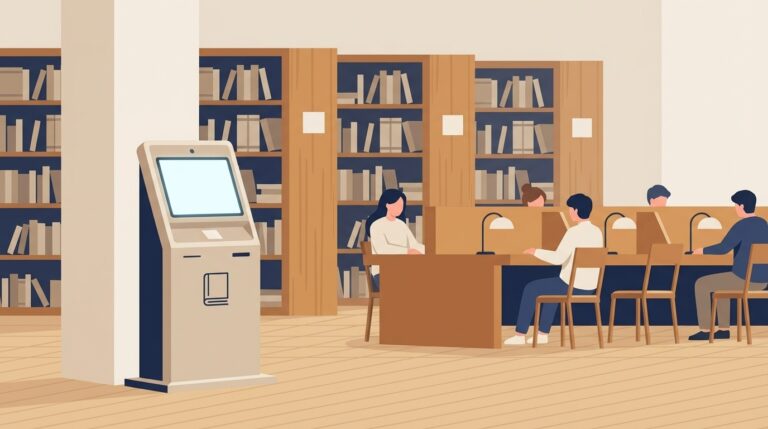
Phase 1: Immersive Hook
👋 Hello, Daily Hangul Future Scholars!
Picture this: You are the main character in a K-Drama set in a university. You are walking through the library rows, looking for that one book. Suddenly, your hand touches someone else’s hand reaching for the same book. The music starts playing… 🎵
Okay, cut! 🎬 Back to reality.
In real Korean university life, before you can have that romantic moment, you face a bigger challenge: The Entry Gate and The Seat Kiosk.
If you don’t know the right words, the machine beeps loudly at you, and everyone looks up from their books. Awkward.
Today, we are going to learn how to survive the Korean library (Doseogwan) jungle. Whether you need to find a book or just find a place to sit without getting kicked out, this guide is your survival map.
Phase 2: Core Expressions (Deep Dive)
1. …이/가 어디에 있어요? (…i/ga eodi-e isseoyo?)
- Pronunciation: …ee/gah uh-dee-eh ee-ssuh-yo?
- (Tip: ‘eo’ sounds like the ‘u’ in ‘cup’.)
- Meaning: “Where is [Subject]?”
- K-Culture Moment: You will hear this in every drama when the protagonist is lost. In a library, you use this to find the restroom or the copy machine.
- Editor’s Insight: This is the magic key. You can put anything before this phrase.
- “Hwajangsil (Restroom) eodi-e isseoyo?”
- Situation Spectrum:
[🚫 Formal Boss] ———— [⚠️ Polite/Daily] ———— [✅ Casual]- This is the standard polite form (Zone ⚠️). Safe to use with librarians or strangers.
- 🤔 Think About It: In English, we might say, “Excuse me, could you tell me where…?” Korean is more direct but adds politeness at the end of the verb (-yo).
2. 여기 앉아도 돼요? (Yeogi anjado dwaeyo?)
- Pronunciation: Yuh-gee an-jah-doh dway-yo?
- Meaning: “Can I sit here?”
- Yeogi = Here
- Anjado = Even if I sit
- Dwaeyo? = Is it okay?
- K-Culture Moment: Imagine a crowded cafeteria or library in a high-teen K-Drama. The new student timidly points to a chair. That’s this phrase.
- Editor’s Insight: Korean libraries are crowded during exam periods. Never assume an empty seat is free! People leave books to “save” spots (though they shouldn’t).
- Situation Spectrum:
[🚫 Formal] ———— [⚠️ Polite/Daily] ———— [✅ Casual]- Perfect for asking fellow students you don’t know well.
3. 학생증 (Hak-saeng-jeung)
- Pronunciation: Hak-seng-jeung
- Meaning: Student ID Card
- K-Culture Moment: In Korea, your Haksaengjeung is your life. It’s your library pass, your subway card, and sometimes your payment method at the uni cafeteria.
- Editor’s Insight: Without this, you cannot enter the library gate. The librarian will ask, “Hak-saeng-jeung isseoyo?” (Do you have your student ID?)
Phase 3: Textbook vs. Real Life
| Situation | 📖 Textbook Korean | 🗣️ Real Korean (Slang/Short) | 💡 Why the difference? |
|---|---|---|---|
| Going to the library | 도서관에 가요. (Doseogwan-e gayo) | 중도 가요. (Jung-do gayo) | “Jung-do” is short for Jungang Doseogwan (Central Library). Students love shortening words for efficiency! |
| Studying hard | 열심히 공부해요. (Yeolsimhi gongbuhaeyo) | 열공! (Yeol-gong!) | Short for Yeolsimhi Gongbu. It’s a common text message cheer. |
| Full of people | 사람이 많아요. (Sarami manayo) | 자리가 없어요. (Jariga eopseoyo) | In a library context, we care more about “no seats” than just “many people.” |
Bottom Note for Beginners: Stick to “Doseogwan” for now, but if you hear “Jung-do,” nod knowingly like an insider!
Phase 4: Cultural Deep Dive
4-1. The “Seat Kiosk” Culture (Jari-bae-jeong)
In Western universities, you usually just walk in and sit down. In Korea? No.
Most Korean university libraries have a Seat Assignment System (Kiosk) at the entrance.
1. You scan your Haksaengjeung (ID).
2. You choose a seat number on the screen.
3. You get a receipt.
Why? Because Korean students take studying very seriously (the “Exam Hell” culture). This system prevents fights over seats and ensures fairness. If you sit in a seat without assigning it to yourself, someone might come and kick you out!
4-2. The Sound of Silence
Korean libraries are extremely quiet. Even clicking your mouse too loudly or unzipping your bag aggressively can earn you the “Laser Eyes” (glares) from others.
Pro Tip: If you need to discuss a group project, look for a “Group Study Room” (Seu-teo-di Room), not the general Reading Room (Yeol-lam-sil).
Phase 5: Immersive Roleplay
Setting: University Central Library (Jung-do). Exam period. You are standing in front of a table, holding your heavy bag.
Characters:
* YOU: An exchange student looking for a spot.
* Minji: A Korean student studying with headphones on.
(Dialogue Start)
YOU: (Approaching cautiously) 저기요… 실례합니다.
(Jeogiyo… Sillye-hamnida.)
(English: Excuse me… Pardon me.)
Minji: (Takes off headphones) 네?
(Ne?)
(English: Yes?)
YOU: 혹시… 여기 앉아도 돼요?
(Hoksi… yeogi anjado dwaeyo?)
(English: By any chance… can I sit here?)
Minji: 아, 죄송해요. 여기 친구 자리예요.
(Ah, joesonghaeyo. Yeogi chingu jariyeyo.)
(English: Ah, I’m sorry. This is my friend’s seat.)
🔀 Decision Point: How do you respond?
- A) “아, 네! 알겠습니다.” (Ah, ne! Al-get-seumnida.) – Accept and move on.
- B) “진짜요?” (Jinjjayo?) – Ask “Really?” (A bit aggressive/rude here).
- C) Just walk away silently.
✅ Best Choice: A. It’s polite and clean.
⚠️ Analysis: In Korea, if someone says it’s a friend’s seat (even if it looks empty), we respect it. Arguing causes a scene.
(Alternative Ending if Minji says Yes)
Minji: 네, 앉으세요. (Ne, anjeuseyo.)
YOU: 감사합니다! (Gamsahamnida!)
Phase 6: 10-Second Shadowing Drill
Repeat after me! Watch your intonation.
- Polite Inquiry 😊
- 혹시 / 여기 / 앉아도 돼요?
- (Hoksi / yeogi / anjado dwaeyo?)
- Meaning: By any chance, can I sit here?
- The Essential Question 🥺
- 화장실이 / 어디에 / 있어요?
- (Hwajangsil-i / eodi-e / isseoyo?)
- Meaning: Where is the restroom?
- Cheering a friend 😤
- 오늘도 / 열공!
- (Oneul-do / yeol-gong!)
- Meaning: Study hard today too!
Phase 7: K-Culture Mini Glossary
| Korean | Romanization | Meaning | Context |
|---|---|---|---|
| 열람실 | Yeollam-sil | Reading Room | The quiet area with desks for studying. |
| 시험 기간 | Siheom gigan | Exam Period | Usually mid-April and mid-October. Libraries are packed 24/7. |
| 매점 | Maejeom | Convenience Store | The store inside the school/library where students buy energy drinks. |
| 팀플 | Tim-peul | Team Play | Group project. The word makes every Korean university student shudder. |
Phase 8: Student Survival Kit
Even if you are a traveler visiting a university campus for sightseeing (like Ewha Womans University or Yonsei), these tips help!
🆘 Survival Phrase #1
* 🇰🇷 “와이파이 비밀번호 뭐예요?” (Wa-i-pa-i bimil-beonho mwoyeyo?)
* 🗣️ Sound: Wa-ee-pah-ee bee-mil-bun-ho mwo-yeh-yo?
* 📍 Where: Library lobby, campus cafes.
* 💡 Pro Tip: Often, the password is on a sticker on the table or the receipt from the coffee shop.📌 Editor’s Campus Note
* App Essential: Most Korean unis have a Mobile ID App. You don’t always need the plastic card. Download the school app!
* Etiquette: Do not talk on the phone in the hallway/corridor (Bok-do) right outside the reading room. Sound travels!
Phase 9: Think Deeper — “Study Culture”
Why is the library open 24 hours?
In many Western countries, libraries close in the evening. In Korea, university libraries often have 24-hour reading rooms. This reflects the intense competitive society where “effort” is visualized by hours spent sitting at a desk. The phrase “Sa-dang-o-rak” (4 hours sleep = pass, 5 hours sleep = fail) is an old saying, but the spirit remains.
💬 Your Turn: Does your country’s library stay open all night? Do you reserve seats? Tell me in the comments!
Phase 10: FAQ & Troubleshooting
- Q: Can I eat inside the library?
- NO. Drinks with lids (tumblers) are usually okay, but food is a huge taboo in the Yeollam-sil (Reading Room). Go to the Hyuge-sil (Lounge) or Maejeom.
- Q: Can I leave my laptop on the desk to go to the bathroom?
- Yes! Korea is famous for this. CCTV is everywhere. However, take your wallet/phone just in case. But generally, “Laptop dropping” is a way to say “This seat is taken.”
- ❌ Common Mistake: Talking loudly in the elevator near the library.
- Why? Sound leaks. Students are sensitive during exam week. Keep it to a whisper.
Phase 11: Wrap-up & Mission
One-Liner Summary: To survive the Korean library, grab your Haksaengjeung, find the Kiosk, and whisper “Yeogi anjado dwaeyo?”
🔥 Action Mission:
* 🥉 Bronze: Look at a mirror and practice asking “Where is the library?” (Doseogwan-i eodi-e isseoyo?)
* 🥈 Silver: Find a map of a Korean university (e.g., Seoul National Univ) online and find where the “Central Library” is labeled.
* 🥇 Gold: If you are in Korea, go to a library (public or uni), find the Kiosk machine, and see how it works!
📺 K-Culture Mission: Watch a scene from the drama “Reply 1988” where they study in the reading room (Dokseo-sil). Notice how tiny the cubicles are!
Phase 12: Quiz — Interactive Challenge
- Situation: You want to ask where the restroom is. What do you say?
- a) 화장실 주세요. (Give me the restroom.)
- b) 화장실이 어디에 있어요? (Where is the restroom?)
- c) 화장실 앉아도 돼요? (Can I sit in the restroom?)
- True or False (Culture):
- “In Korean university libraries, you can sit anywhere you want without checking in.” (T/F)
Answers:
1. b) …eodi-e isseoyo? is for location.
2. False. You almost always need to use the Seat Assignment Kiosk!
Frequently Asked Questions (FAQ)
Q: What does "...이/가 어디에 있어요? (...i/ga eodi-e isseoyo?)" mean in Korean and how do you pronounce it?
A: In Korean, "...이/가 어디에 있어요? (...i/ga eodi-e isseoyo?)" is pronounced [...ee/gah uh-dee-eh ee-ssuh-yo?] and means: a key conversational Korean expression covered in this lesson.
Q: What does "여기 앉아도 돼요? (Yeogi anjado dwaeyo?)" mean in Korean and how do you pronounce it?
A: In Korean, "여기 앉아도 돼요? (Yeogi anjado dwaeyo?)" is pronounced [Yuh-gee an-jah-doh dway-yo?] and means: "Can I sit here?"
Q: What does "학생증 (Hak-saeng-jeung)" mean in Korean and how do you pronounce it?
A: In Korean, "학생증 (Hak-saeng-jeung)" is pronounced [Hak-seng-jeung] and means: Student ID Card







