

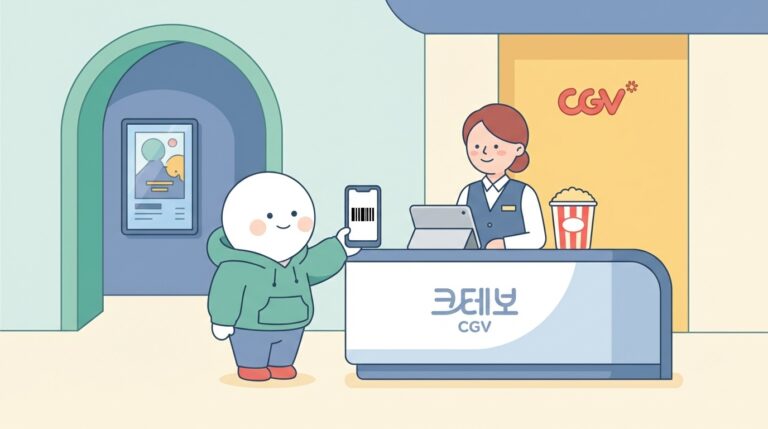
Save Money Like a Local: Asking for Movie Discounts in Korea 🎬
Phase 1: The Hook — Welcome to the “Discount Jungle”
Annyeonghaseyo! It’s your Daily Hangul Editor. 👋
Picture this: It’s a Friday night in Gangnam. You’ve just finished a delicious K-BBQ dinner and now you’re at a CGV or Lotte Cinema to catch the latest blockbuster. You see the ticket price: 15,000 KRW. Ouch.
But wait! You look to your left. A Korean college student shows her phone screen to the staff, beep, beep, and she pays half the price. You look to your right. A couple pulls out a credit card, the staff nods, and they get a free popcorn combo.
In K-Dramas, rich chaebols buy the whole theater. In real life, smart Koreans never pay full price.
If you don’t ask for a discount, you aren’t just losing money; you’re missing out on a huge part of the Korean consumer experience known as “Al-tteul-ham” (frugality/smart spending). Today, I’ll teach you the magic words to unlock those VIP prices without freezing up at the counter.
Phase 2: Deep Dive — The Magic Spells for Savings
Here are the top 3 phrases you need to survive the ticket counter.
1. 할인 되나요? (Is a discount available?)
- Pronunciation: [Halin dwenayo?] -> Hahl-in dweh-nah-yo?
- Sound Analogy: ‘Hahl’ sounds like the start of ‘Hal-leluja’, ‘in’ as in ‘in’. ‘Dwe’ sounds like ‘w’ in ‘wet’.
- Meaning: “Can I get a discount?” (Literal: Does discount work?)
- K-Culture Moment: You’ll hear this everywhere—bakeries, amusement parks, and hair salons. It’s the national anthem of smart shoppers.
- Editor’s Insight: Don’t be shy. In Korea, asking for a discount isn’t “cheap”; it’s expected. There are so many partnerships (telecoms, credit cards) that the staff expects you to ask.
- Situation Spectrum:
[🚫 Boss] ———— [⚠️ Colleague] ———— [✅ Shop Staff]- 🤔 Think About It: Why is “discount” (Hal-in) a noun here? Korean often uses Noun + Verb (Do) structures. It makes communication efficient!
2. 이 카드로 할게요. (I’ll do it with this card.)
- Pronunciation: [I kadeuro halgeyo.] -> Ee kah-deu-roh hal-geh-yo.
- Meaning: I will pay/use this card.
- K-Culture Moment: In K-Dramas, when the protagonist confidently hands over a black card? They might not say anything, but in real life, this is what you say to signal, “Check this specific card for benefits.”
- Editor’s Insight: You use this when you aren’t sure if your credit card has a movie benefit. You hand it over and say this sentence implies, “Try this one.”
- Situation Spectrum:
[🚫 N/A] ———— [⚠️ N/A] ———— [✅ Any Payment Situation]3. 적립해 주세요. (Please accumulate points.)
- Pronunciation: [Jeongnip-hae juseyo.] -> Jeong-nip-heh ju-seh-yo.
- Sound Analogy: ‘Jeong’ sounds like ‘Jung’ in ‘Jungle’.
- Meaning: Please give me points/credit.
- K-Culture Moment: Koreans are obsessed with “Points.” CJ One points, L.Points… If you watch a reality show, you’ll see celebrities asking for points even when buying a single coffee.
- Editor’s Insight: If you plan to live in Korea for more than a month, say this. Points add up to free movies fast!
- 🤔 Think About It: Does your home country have a strong “loyalty point” culture? In Korea, it’s almost a sport.
Phase 3: Textbook vs. Real Life
Let’s see how a textbook robot speaks versus a Seoul local.
| Situation | 📖 Textbook Korean | 🗣️ Real Korean | 💡 Why the difference? |
|---|---|---|---|
| Asking for discount | 할인을 받을 수 있습니까? (Can I receive a discount?) | 혹시 할인 돼요? (By chance, discount okay?) | “Hoksi” (by chance) makes it softer and less demanding. |
| Showing an app | 여기 있습니다. (Here it is.) | (Showing screen) 이거요. (This one.) | In a busy line, speed is politeness. Verbalizing is secondary to showing. |
| No membership | 아니요, 없습니다. (No, I do not have it.) | 아뇨, 없어요. (No, don’t have.) | “Ani-yo” is often shortened to “Anyo” or just a hand wave. |
Bottom Note: For A2 learners, sticking to “~yo” endings (Polite style) is perfect. It’s safe, respectful, and natural enough.
Phase 4: Cultural Context — The “Telecom” Power
4-1. Non-verbal: The “Ready Screen”
Don’t wait until you are at the counter to unlock your phone. The staff is busy! Have your barcode ready on your screen brightness set to 100%. Showing a dim screen that doesn’t scan is a major “noonchi” (social awareness) fail!
4-2. The Holy Trinity of Discounts: KT, SKT, LG U+
In Korea, your mobile phone provider (carrier) dictates your movie life.
* SKT (T-Membership)
* KT (KT Membership)
* LG U+ (U+ Membership)
Almost everyone has a membership tier that gives free or heavily discounted movie tickets once a month.
The K-Drama Trope:
Ever seen a couple arguing over who pays? Eventually, the guy might say, “Don’t worry, I have VIP membership points expiring soon!” It turns a frugal moment into a “cool provider” moment.
Phase 5: Immersive Roleplay
Setting: A bustling CGV Cinema in Hongdae on a Saturday afternoon. The smell of caramel popcorn is everywhere. You are next in line.
Characters:
* YOU: An exchange student who wants to save money.
* Staff: A quick-talking part-timer wearing a headset.
Start!
Staff: 어서 오세요. 어떤 영화 보시겠어요?
(Eoseo oseyo. Eotteon yeonghwa bosigesseoyo?)
(Welcome. Which movie would you like to see?)
YOU: [Movie Name] 한 장 주세요.
(Han jang juseyo.)
(One ticket for [Movie Name], please.)
Staff: 15,000원입니다. 할인 카드 있으세요?
(Man-o-cheon-won-imnida. Halin kadeu isseuseyo?)
(It’s 15,000 won. Do you have a discount card?)
🔀 Decision Point! How do you reply?
- Option A: “Yes, is a discount available with this?” (You hold out your credit card)
- Option B: “No, I don’t need it.” (You just want to pay)
- Option C: “Please give me a student discount.” (You have your ID)
(Let’s go with Option A – The most common scenario)
YOU: 네, 이 카드로 할인 되나요?
(Ne, i kadeuro halin dwenayo?)
(Yes, is a discount available with this card?)
Staff: (Checks card) 네, 2,000원 할인됩니다. 적립도 해드릴까요?
(Ne, icheon-won halin-doemnida. Jeongnip-do haedeurilkkayo?)
(Yes, 2,000 won discount. Shall I accumulate points too?)
YOU: 아니요, 괜찮아요.
(Aniyo, gwaenchanayo.)
(No, I’m okay/fine.)
Phase 6: 10-Second Shadowing Drill
Let’s practice the rhythm. Don’t be robotic! Put some curiosity in your voice.
- Is a discount available? (Polite & curious) 😊
- sk-t / ha-lin / dwe-na-yo?
- SKT 할인 / 되나요?
- Does this card work? (Holding out a card) 🤔
- i / ka-deu / dwe-yo?
- 이 카드 / 돼요?
- I don’t have a membership. (Lightly shaking head) 🙅
- mem-beo-ship / eop-seo-yo.
- 멤버십 / 없어요.
Phase 7: K-Culture Mini Glossary
| Korean | Romanization | Meaning | Context |
|---|---|---|---|
| 조조 | Jojo | Morning Discount | Literally “Early Morning.” The first movie of the day (usually before 10 AM) is much cheaper. |
| 심야 | Simya | Late Night | Late-night movies. Great for avoiding crowds. |
| 통신사 | Tongsinsa | Telecom Carrier | Companies like SKT, KT, LG. They offer the best movie deals. |
| 매점 | Maejeom | Concession Stand | Where you buy popcorn. Separate from the ticket counter! |
Phase 8: Traveler’s Survival Kit 🧳
Top 3 Survival Phrases for Theaters:
🆘 Survival Card #1: “Adult, one person.”
* 🇰🇷 성인 한 명이요. (Seong-in han myeong-i-yo)
* 💡 Tip: If numbers are hard, just show 1 finger and say “Adult.”🆘 Survival Card #2: “What time is the next movie?”
* 🇰🇷 다음 영화 몇 시예요? (Daeum yeonghwa myeot siyeyo?)
* 📍 Where: Use this if the electronic board is confusing.🆘 Survival Card #3: “Where is the bathroom?”
* 🇰🇷 화장실 어디예요? (Hwajangsil eodiyeyo?)
* 💡 Pro Tip: In Korean theaters, bathrooms are often outside the ticket hall.📌 Editor’s Note: Most Korean theaters now have Kiosks with an “English” button. But asking staff is faster if the Kiosk line is long or if your foreign credit card gets rejected by the machine (which happens often)!
Phase 9: Think Deeper — “Why is everything a membership?”
🧠 The Data-Driven Society
Have you noticed that in Korea, you can barely buy a pack of gum without being asked for a membership card?
This reflects Korea’s hyper-connected, digital-first society. Companies compete fiercely for customer loyalty. In exchange for your data (shopping habits), they give you immediate financial rewards (discounts).
💬 Your Turn: In your country, do you prefer direct discounts or collecting points? Or do you find it annoying? Let me know!
Phase 10: FAQ & Troubleshooting
- Q: Can I use my International Student ID for a discount?
- A: Usually, No. Most theaters require a Korean university ID. However, some museums do accept international ones. It doesn’t hurt to ask “Student discount?” (Hakseng halin?), but have a backup plan.
- Q: Can I use Netflix?
- A: Haha, no! But fun fact: Many Koreans go to “DVD Bangs” (DVD Rooms) to watch Netflix on a big screen with friends. That’s a whole different culture!
- ❌ Common Mistake: Trying to use a screenshot of a credit card.
- Correction: You can use a screenshot of a barcode membership, but for payment, you must have the physical card or Samsung Pay/Apple Pay (if supported).
Phase 11: Wrap-up & Action Mission
Summary: Today we learned how to be a smart consumer by asking “Halin dwenayo?” (Is a discount available?)
🚀 Your Mission:
- 🥉 Bronze: Look in your wallet. Do you have any card with a logo? Practice handing it to the mirror saying, “I kadeuro halgeyo.”
- 🥈 Silver: Download the CGV or Lotte Cinema app and try to navigate to the English setting (if available) or look for the word “이벤트” (Event).
- 🥇 Gold: Go to a convenience store or cafe in Korea and ask “Halin dwenayo?” just to see their reaction. (Even if they say no, you succeeded in asking!)
Phase 12: Quiz — Are you ready for the box office?
- Situation: The staff asks if you have a membership, but you don’t. What do you say?
- A) 네, 있어요. (Ne, isseoyo.)
- B) 아니요, 없어요. (Aniyo, eopseoyo.)
- C) 할인 주세요. (Halin juseyo.)
- True or False: You should wait until the staff asks for payment to start looking for your discount barcode on your phone.
- (True / False)
- Fill in the blank:
- “Is a discount available?” = “_______ dwenayo?”
Answers:
1. B (A means you have it, C is a bit rude/demanding without context).
2. False! Have it ready. Don’t block the line! (Nunchi!)
3. Halin (할인)
Frequently Asked Questions (FAQ)
Q: What does "할인 되나요? (Is a discount available?)" mean in Korean and how do you pronounce it?
A: In Korean, "할인 되나요? (Is a discount available?)" is pronounced [Halin dwenayo?] and means: "Can I get a discount?" (Literal: Does discount work?)
Q: What does "이 카드로 할게요. (I'll do it with this card.)" mean in Korean and how do you pronounce it?
A: In Korean, "이 카드로 할게요. (I'll do it with this card.)" is pronounced [I kadeuro halgeyo.] and means: I will pay/use this card.
Q: What does "적립해 주세요. (Please accumulate points.)" mean in Korean and how do you pronounce it?
A: In Korean, "적립해 주세요. (Please accumulate points.)" is pronounced [Jeongnip-hae juseyo.] and means: Please give me points/credit.







