

Phase 1: Empathy — The K-Drama Moment 🎬
Annyeonghaseyo! It’s your Daily Hangul editor. 👋
Picture this: You are watching a high-stakes scene in your favorite medical K-Drama (like Dr. Romantic or Hospital Playlist). It’s raining. The main character collapses on the street. The lead actor runs over, holding them, and screams at the crowd. The subtitles say: “Call an ambulance!”
But what did they actually scream? It sounded short, urgent, and desperate. It definitely wasn’t a long, polite sentence.
In real life, there are no subtitles. If you trip while hiking Bukhansan or eat something that really disagrees with you in Myeongdong, knowing how to ask for help can literally save the day. Today, we are putting aside the polite textbook phrases for a moment to learn the survival Korean you need when seconds count.
Don’t worry—I’ve taught this to hundreds of students, and I hope you never have to use it. But if you do, you’ll be ready. Let’s start.
Phase 2: Deep Dive — Critical Survival Phrases 🚨
Here are the 3 most important phrases for an emergency. We keep it short because when you are scared, grammar goes out the window.
1. 도와주세요! (Dowajuseyo!)
- Pronunciation: [Do-wah-ju-seh-yo]
Sounds like: “Dough” + “Wah” (like water) + “Juice” + “Say” + “Yo”- Meaning: Please help me.
- K-Culture Moment: In almost every thriller or crime drama, the victim whispers this into the phone. It is the universal cry for help.
- Editor’s Insight: This works for everything—from a serious injury to being lost. The urgency in your voice changes the meaning.
- Situation Spectrum:
[🚫 Casual] ———— [✅ Universal] ———— [✅ Formal]
(You can use this with anyone in an emergency!)- 🤔 Think About It: In English, we just yell “Help!” In Korean, we still add the polite suffix “-yo” (요). Why do you think Korean maintains politeness even in emergencies?
2. 119에 전화해 주세요! (Il-il-gu-e jeonhwahae juseyo)
- Pronunciation: [Ill-ill-goo-eh jeon-hwa-hae ju-seh-yo]
Remember: 1 (il), 1 (il), 9 (gu). It sounds like “Eel-Eel-Goo”.- Meaning: Please call 119.
- K-Culture Moment: Unlike the US (911) or UK (999), Korea uses 119 for fire and ambulance. You’ll see this number on every red fire truck in Seoul.
- Editor’s Insight: Don’t try to say “Call an ambulance” (Gu-geup-cha-reul bul-leo-ju-se-yo). It’s too long! Just say “119” (Il-il-gu). Everyone will understand.
- Situation Spectrum:
[✅ Urgent] ———— [✅ Serious] ———— [✅ Critical]3. 사람 다쳤어요! (Saram dachyeosseoyo!)
- Pronunciation: [Sa-ram da-chyeo-sseo-yo]
“Saram” (Person) + “Da-chyeo-sseo-yo” (Got hurt)- Meaning: Someone is hurt.
- Editor’s Insight: Use this when you are the witness. Point to the injured person and shout this.
Phase 3: Textbook vs. Real Life 🥊
When panic sets in, shorter is better.
| Situation | 📖 Textbook Korean | 🗣️ Real Survival Korean | 💡 Why different? |
|---|---|---|---|
| Calling for help | 도와주십시오 (Dowajusipsio) | 도와주세요! (Dowajuseyo!) | The textbook version sounds like a soldier reporting to a general. “-seyo” is standard polite. |
| Requesting Ambulance | 구급차를 불러 주시겠습니까? | 119(일일구) 불러 주세요! | In an emergency, nobody asks “Would you mind…?” We command politely: “Call 119!” |
| Expression of Pain | 저는 지금 매우 아픕니다. | 아파요! (Apayo!) | Pain makes sentences short. “It hurts!” is enough. |
Phase 4: Cultural Context — The “Golden Time” 🏥
4-1. Non-verbal: The Power of Pointing 👉
In Western cultures, pointing can be rude. In a Korean emergency, pointing is essential. If you just shout “Call 119!” into the air, people might hesitate (the Bystander Effect).
* Tip: Point directly at one specific person and say, “Dowajuseyo! 119!” This breaks the freeze and forces them to act.
4-2. K-Drama Connection: “Golden Time”
Have you heard the term “Golden Time” (골든타임) in Korean medical dramas? It refers to the crucial first hour after an injury. Koreans are very aware of this concept. If you signal that it is an emergency, Korean citizens are generally very quick to help because they don’t want to miss that “Golden Time.”
Phase 5: Immersive Roleplay — Hiking Mishap ⛰️
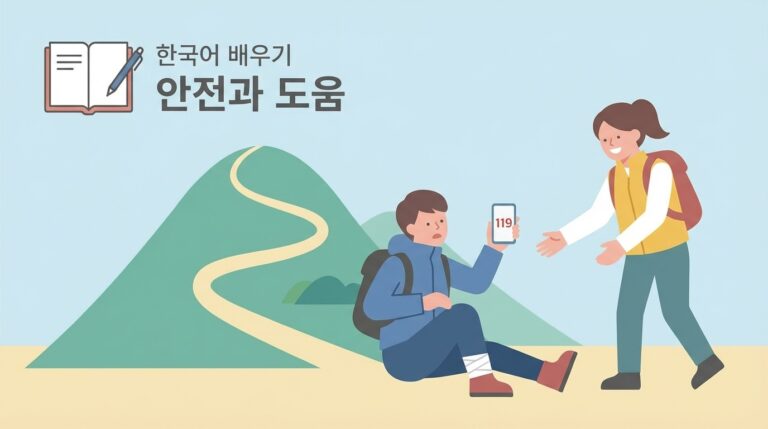
Setting: It’s a beautiful Saturday morning on Bukhansan Mountain. You are hiking alone. Suddenly, you slip on a rock and twist your ankle badly. You can’t stand up. A Korean hiker (Ajusshi) is walking by.
Characters:
* YOU: An injured tourist.
* Ajusshi: A helpful local hiker.
Dialogue:
YOU: (Holding your ankle) 아! 도와주세요! 😫
(Ah! Dowajuseyo!)
(English: Ah! Please help me!)
Ajusshi: (Stopping immediately) 왜 그래요? 괜찮아요? 😲
(Wae geuraeyo? Gwaenchanayo?)
(English: What’s wrong? Are you okay?)
YOU: 아니요, 안 괜찮아요. [ 1 ]
(Aniyo, an gwaenchanayo…)
(English: No, I’m not okay…)
🔀 Decision Point! What do you say next?
A) “병원 어디예요?” (Where is the hospital?)
B) “119에 전화해 주세요!” (Please call 119!)
C) “엄마 보고 싶어요…” (I miss my mom…)
✅ Best Choice: B — You can’t walk. You need immediate help. The Ajusshi will call the rescue team.
⚠️ Choice A: Valid if you can walk, but if you are on a mountain, you can’t get to a hospital alone.
Ajusshi: 알겠어요! 119 부를게요! 움직이지 마세요!
(Algesseoyo! 119 bureulgeyo! Umjigiji maseyo!)
(English: Understood! I’ll call 119! Don’t move!)
Phase 6: 10-Second Shadowing Drill 🗣️
Practice these until they are automatic. The goal is speed and clarity.
- 😨 Urgent & Loud:
도와주세요! / 사람 다쳤어요!
(Do-wa-ju-seh-yo! / Sa-ram da-chyeo-sseo-yo!) -
😤 Clear Command:
119에 / 전화해 주세요!
(Il-il-gu-eh / jeon-hwa-hae ju-seh-yo!) -
🥺 Painful:
여기 / 너무 아파요.
(Yeo-gi / neo-mu a-pa-yo.)
(Here / it hurts a lot.)
Phase 7: K-Culture Mini Glossary 📙
| Korean | Romanization | English | Context |
|---|---|---|---|
| 119 (일일구) | Il-il-gu | Emergency Number | Fire & Ambulance. It is free of charge in Korea. |
| 112 (일일이) | Il-il-i | Police Number | Easy to remember: 112 for Police, 119 for Fire/Ambulance. |
| 응급실 | Eunggeupsil | Emergency Room (ER) | Where you go if it is urgent but not 119-worthy. |
| 병원 | Byeongwon | Hospital/Clinic | In Korea, even small clinics are called “Byeongwon.” |
Phase 8: Traveler’s Survival Kit 🧳
Going to Korea? Save these numbers and tips NOW.
🆘 Survival Card
– 🚑 Ambulance/Fire: 119 (Free, available 24/7)
– 🚓 Police: 112
– 🗣️ Language Help: 1330 (Korea Travel Hotline – connects you to a translator)
– 💡 Pro Tip: If you call 119 and don’t speak Korean, say “Help” and “English.” They have a 3-way interpretation service connected to the call center!📌 Editor’s Travel Note:
Korean ambulances (119) are free for emergency transport, even for foreigners. Don’t hesitate to call because you are worried about the bill. Your safety comes first!
Phase 9: Think Deeper — “Why do we say ‘Please’?” 🧠
Language & Culture:
Did you notice that even in the most urgent phrase, “Dowajuseyo” (Help me), the suffix “-seyo” is polite?
In many Western cultures, brevity is key in emergencies (“Help!”, “Stop!”). In Korea, the social hierarchy and respect system are so deeply embedded in the language that dropping the polite ending—even when injured—can feel unnatural to a native speaker addressing a stranger. It shows that relationships and social harmony are prioritized, even in chaos.
💬 Your Turn: Does your language have a specific “polite” way to ask for help, or do you just scream? Tell me in the comments!
Phase 10: Troubleshooting & FAQ 🛠️
Q: What if I forget “119”?
A: If you dial 911 in Korea on a mobile phone, it often redirects to 119 automatically! But try to remember Il-il-gu.
Q: Can I just scream in English?
A: In major cities like Seoul or Busan, many young people understand “Help.” But in the countryside, “Dowajuseyo” is much safer.
❌ Common Mistake:
Don’t say “Sal-lyeo-ju-se-yo” (살려주세요) unless your life is literally being threatened (like you are drowning or being attacked). It means “Please save my life.”
* Everyday Emergency: Dowajuseyo (Help me with a situation).
* Life/Death: Sallyeojuseyo (Save my life).
Phase 11: Wrap-up & Missions 🎁
One-Liner Summary: In an emergency, point at someone and shout “Dowajuseyo! 119(Il-il-gu)!”
🔥 Action Missions:
* 🥉 Bronze: Say “Dowajuseyo, Il-il-gu” out loud 3 times right now. Get the rhythm.
* 🥈 Silver: Save “119” and “1330” in your phone contacts under “Korea Emergency.”
* 🥇 Gold: Watch a scene from a K-Drama (like Descendants of the Sun) and listen for the word “Eunggeupsil” (ER) or “119.”
K-Culture Mission: Next time you see a fire truck in a K-Drama or Variety Show, look for the numbers written on the side. Is it 911 or 119?
Phase 12: Interactive Quiz 📝
1. You see a fire in a restaurant. What number do you call?
A) 112
B) 119
C) 110
2. True or False?
“Korean ambulances are very expensive for foreigners.”
(True / False)
3. Situation Check:
You tripped and scraped your knee slightly. It hurts, but you can walk. Should you scream “Sallyeojuseyo!” (Save my life!)?
(Yes / No)🔑 Answers:
1. B (119) – 112 is police.
2. False – Emergency transport is free.
3. No – That is too dramatic! Just ask for a pharmacy (Yak-guk).
Stay safe, and see you in the next lesson! 파이팅! (Hwaiting!)
Frequently Asked Questions (FAQ)
Q: What does "도와주세요! (Dowajuseyo!)" mean in Korean and how do you pronounce it?
A: In Korean, "도와주세요! (Dowajuseyo!)" is pronounced [Do-wah-ju-seh-yo] and means: Please help me.
Q: What does "119에 전화해 주세요! (Il-il-gu-e jeonhwahae juseyo)" mean in Korean and how do you pronounce it?
A: In Korean, "119에 전화해 주세요! (Il-il-gu-e jeonhwahae juseyo)" is pronounced [Ill-ill-goo-eh jeon-hwa-hae ju-seh-yo] and means: Please call 119.
Q: What does "사람 다쳤어요! (Saram dachyeosseoyo!)" mean in Korean and how do you pronounce it?
A: In Korean, "사람 다쳤어요! (Saram dachyeosseoyo!)" is pronounced [Sa-ram da-chyeo-sseo-yo] and means: Someone is hurt.






