

1. Phase 1: Immersive Hook
Greeting: 안녕하세요! This is your Daily Hangul Senior Editor.
The Scene: Imagine a high-stakes boardroom scene in a K-Drama like Reborn Rich or Start-Up. The grim-faced Chairman throws a file onto the mahogany table. The background music swells with tension. The subtitles might simply read: “We are in trouble because of the regulations.”
But what the actor actually says is far more visceral: “지금 RE100 때문에 발등에 불이 떨어졌어! (Right now, because of RE100, fire has fallen on the tops of our feet!)”
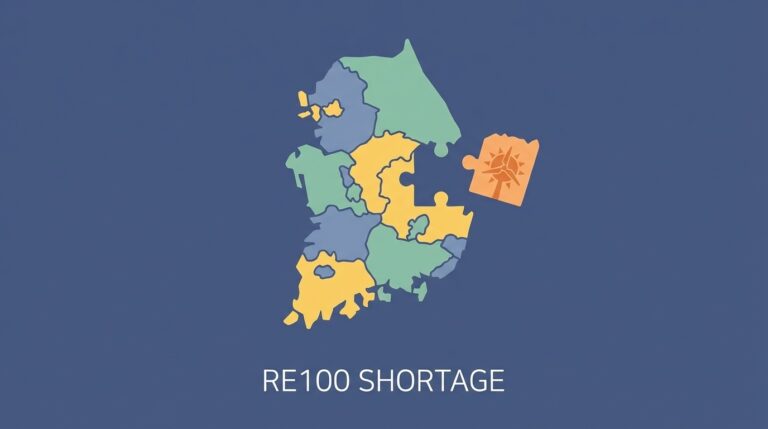
The ‘Why’: As a C2 learner, you’ve moved past ordering bibimbap. You are now navigating complex discussions about global economics, sustainability, and the unique challenges Korean industries face. Understanding the linguistic nuance of desperation, reluctance, and strategic ambiguity is crucial when discussing topics like the RE100 campaign (100% Renewable Energy) and Korea’s struggle to meet these global standards.
Transparency: This guide combines real expressions used in Yeouido (Korea’s Wall Street) and Pangyo (Korea’s Silicon Valley) to help you sound like an industry insider, not just a textbook student.
2. Phase 2: Deep Dive into Key Expressions
1. 발등에 불이 떨어지다 [Idiom]
- Pronunciation: [bal-deung-e bu-ri tteo-reo-ji-da] (Imagine the panic of dropping a hot coal on your foot!)
- Meaning:
- Literal: Fire fell on the top of the foot.
- Real Nuance: An imminent crisis that demands immediate action; the deadline is dangerously close.
- K-Culture Moment: You’ll hear this in news broadcasts discussing export regulations or in office dramas when a project deadline is moved up unexpectedly. It conveys a sense of frantic urgency that a simple “바쁘다 (busy)” cannot capture.
- Editor’s Insight: This isn’t just about being busy; it implies negligence or a sudden change in circumstances that has put you in a defensive position. It’s the perfect descriptor for Korean companies scrambling to secure renewable energy sources to satisfy clients like Apple or Google.
- Situation Spectrum:
[🚫 Formal Presentations] ———— [⚠️ Internal Meetings] ———— [✅ Colleagues/Casual]
(Note: In a very formal presentation, use ‘시급한 과제입니다 (It is an urgent task)’ instead.) - 🤔 Think About It: Why does Korean use a physical pain metaphor for urgency? Does this reflect a cultural tendency to react viscerally to deadlines?
2. 울며 겨자 먹기 [Idiom]
- Pronunciation: [ul-myeo gyeo-ja meok-gi] (Sounds like ‘ool-myeo’ + ‘gyeo-ja’ like gyoza but spicy mustard)
- Meaning:
- Literal: Eating mustard while crying.
- Real Nuance: Biting the bullet; doing something painful or expensive because you have absolutely no other choice.
- K-Culture Moment: Think of a variety show game where someone has to eat spicy food as a penalty. But in a business context, it’s used when companies invest in expensive foreign renewable energy certificates (REC) because domestic supply is insufficient.
- Editor’s Insight: This phrase perfectly captures the sentiment of Korean manufacturers. They want to support green energy, but the infrastructure isn’t there, so they are forced to pay a premium (“eating mustard”) to stay in the global supply chain.
- Situation Spectrum:
[🚫 Formal Reports] ———— [⚠️ Discussion/Debate] ———— [✅ Casual/Interviews]
3. 수급 불균형 [Advanced Sino-Korean Term]
- Pronunciation: [su-geup bul-gyun-hyeong]
- Meaning: Supply and demand imbalance.
- K-Culture Moment: The staple vocabulary of the 9 PM News anchor. When discussing why electricity rates are rising or why RE100 is hard to achieve, this phrase is inevitable.
- Editor’s Insight: As a C2 learner, mastering Sino-Korean (Hanja) words is non-negotiable for professional proficiency. ‘수(Supply)’ + ‘급(Provide)’ vs. ‘불(Not)’ + ‘균형(Balance)’. It sounds objective, analytical, and professional.
- Situation Spectrum:
[✅ All Formal Contexts]
3. Phase 3: Textbook vs. Real Life
| Situation | 📖 Textbook Korean | 🗣️ Real Korean (Business Insider) | 💡 Why the difference? |
|---|---|---|---|
| Discussing high costs | 비용이 많이 듭니다. (It costs a lot.) | 배보다 배꼽이 더 커요. (The belly button is bigger than the belly.) | Korean idioms often use body parts to express disproportionate burdens vividly. |
| Complaining about regulations | 규제가 너무 엄격합니다. (Regulations are too strict.) | 손발이 다 묶였어요. (My hands and feet are all tied.) | Emphasizes the feeling of helplessness and inability to maneuver. |
| Predicting failure | 실패할 가능성이 높습니다. (Failure is likely.) | 이대로 가면 다 죽습니다. (If we go on like this, we’re all dead.) | Koreans often use hyperbole (‘death’) to emphasize the severity of a collective crisis. |
Bottom Note: While “다 죽습니다” sounds dramatic, it is surprisingly common in heated strategy meetings to highlight the gravity of the situation.
4. Phase 4: Cultural Deep Dive
4-1. Non-verbal: The “Heavy Sigh” (한숨)
In a Western business context, sighing might be seen as unprofessional or rude. In a Korean context, especially when discussing heavy topics like the RE100 bottleneck, a deep, audible sigh often precedes the idiom “울며 겨자 먹기.” It signals shared burden and invites empathy from the listener. It says, “We are in this difficult situation together, and I am acknowledging the weight of it.”
4-2. K-Drama Connection: The “Inheritor’s Dilemma”
In corporate K-Dramas, there is often a clash between the “Old Guard” (who care about cost and efficiency) and the “New Reformer” (who cares about global standards and ESG).
- The Trope: The young reformist CEO wants to join RE100 to save the company’s stock price. The older executives argue that Korea’s geography (mountainous, distinct seasons) makes renewable energy too expensive (
수급 불균형). - Critical Perspective: Real life is messier. Unlike dramas where a genius solution appears in episode 16, real Korean companies are heavily reliant on manufacturing (chips, cars) which consumes massive power, making the energy transition a genuine structural crisis, not just a plot point.
5. Phase 5: Immersive Roleplay Scenario
Setting: A dimly lit Izakaya in Yeouido (financial district) after work. Rain is pouring outside. You are with Min-soo, a strategic planning manager at a major semiconductor firm.
Characters:
* YOU: A sustainability consultant advising Korean firms.
* Min-soo: Stressed, tie loosened, worrying about the upcoming supplier audit.
Dialogue:
Min-soo: (Pours soju) 하… 이번 달에도 재생에너지 확보율이 목표치 미달이야.
(Ha… ibeon daredo jaesaeng-eneoji hwakboyuri mokpyochi midariya.)
(Sigh… We missed the renewable energy target again this month.)
YOU: (Nods) 국내 상황이 워낙 어렵잖아요. 태양광 부지도 부족하고.
(Gungnae sanghwangi wonak eoryeopjanayo. Taeyanggwang bujido bujokhago.)
(The domestic situation is inherently difficult. There’s a shortage of land for solar too.)
Min-soo: 맞아. 그런데 해외 바이어들은 당장 RE100 달성하라고 난리네. 진짜 발등에 불이 떨어졌어.
(Maja. Geureonde hae-oe baieodeureun dangjang RE100 dalseongharago nalline. Jinjja baldeunge buri tteoreojyeosseo.)
(Right. But foreign buyers are going crazy demanding RE100 compliance right now. Fire has really fallen on our feet.)
🔀 Decision Point: How do you respond?
A) “걱정 마세요. 해결책이 있을 거예요.” (Don’t worry. There will be a solution.)
B) “어쩔 수 없죠. 울며 겨자 먹기로 해외 인증서라도 사야죠.” (No choice. You’ll have to bite the bullet and buy foreign certificates.)
C) “한국 정부가 더 노력해야 해요.” (The Korean government needs to try harder.)
✅ Best Choice: B
* Why? Option A is too generic/textbook. Option C might sound critical of his country/system (sensitive). Option B uses the perfect idiom (울며 겨자 먹기) and shows you understand the specific business reality (buying RECs as a stopgap measure). It builds solidarity.
6. Phase 6: 10-Second Shadowing Drill
Master the rhythm of frustration and urgency.
- Sentence: 솔직히 / 지금 상황에서는 / 울며 겨자 먹기로 / 따라갈 수밖에 없어요.
- Romanization: Soljiki / jigeum sanghwang-eseoneun / ulmyeo gyeo-ja meok-gi-ro / ttaragal su-bakke eopseoyo.
- Emotion: 😢 Resigned & Realistic (Shoulders slumped, slight shake of the head)
- Translation: Honestly / in the current situation / we have no choice but to follow along / biting the bullet.
7. Phase 7: K-Culture Glossary (Green Business Edition)
| Korean | Romanization | English | Context |
|---|---|---|---|
| 재생에너지 | Jaesaeng-eneoji | Renewable Energy | The core vocabulary for RE100 debates. |
| 단가 | Dan-ga | Unit Price | Used constantly when complaining that Korean green energy is too expensive. |
| 탄소국경세 | Tanso-gukgyeong-se | Carbon Border Tax | The scary global regulation (CBAM) that everyone is worried about. |
| 눈치 싸움 | Nunchi ssa-um | Battle of Wits/Nunchi | Describes the tension between companies waiting for the government to subsidize energy costs. |
| 친환경 | Chin-hwan-gyeong | Eco-friendly | A marketing buzzword, sometimes criticized as “Greenwashing.” |
8. Phase 8: Traveler’s Survival Kit (Eco-Business Version)
Even if you are traveling for leisure, you will see the physical signs of this energy battle.
🆘 Survival Expressions #1
* 🇰🇷 “여기 친환경 매장인가요?” (Yeogi chin-hwan-gyeong maejang-ingayo?)
* 🗣️ Meaning: Is this an eco-friendly store?
* 📍 Where: Cafes requiring reusable cups, Zero-waste shops in Mapo/Seongsu.
* 💡 Pro Tip: In Seoul (and Jeju), many cafes charge a deposit for disposable cups to reduce waste. Don’t be surprised by the extra 300 won!📌 Editor’s Travel Note: Jeju Island & The Wind
If you visit Jeju Island, you aren’t just seeing nature; you’re seeing Korea’s RE100 laboratory. The massive offshore wind farms (Tamra Offshore Wind Farm) are the “dream” scenario for Korean industry. Pointing this out to a Korean colleague (“Jeju’s wind power infrastructure is impressive”) shows deep cultural awareness.
9. Phase 9: Think Deeper — “Language & Geography”
Geography Shapes Idioms:
Why does Korea struggle with RE100? Because it is a small, mountainous peninsula with distinct seasons (cloudy monsoons in summer, short days in winter). This geographical reality bleeds into the language. Expressions like “산 넘어 산” (Mountains beyond mountains) perfectly describe the energy transition: solve one problem (technology), and another appears (land shortage).
💬 Your Turn: In your country, does the geography affect how you talk about environmental challenges? Do you have idioms about “sun” or “wind” that relate to power? Share in the comments!
10. Phase 10: FAQ & Troubleshooting
Q: Can I use “발등에 불이 떨어졌다” to my boss?
A: Maybe. If you made a mistake, do NOT use it (it sounds like an excuse). If the market situation changed suddenly, you can use it to report the urgency. “사장님, 지금 시장 상황이 발등에 불이 떨어졌습니다” is acceptable.
Q: Is it rude to discuss politics/environment with Korean colleagues?
A: Generally, yes, but RE100 is considered an “economic survival” issue, not just politics. It is safe to discuss it from a business perspective (competitiveness, export regulations), but avoid criticizing specific political parties’ energy policies unless you are very close.
❌ Common Mistake:
* Mistake: Saying “Korea is dirty/polluted” when seeing smog.
* Correction: Use “미세먼지가 심하네요” (The fine dust is severe). It frames it as an environmental phenomenon rather than a judgment on the country.
11. Phase 11: Wrap-up & Action Items
One-Liner Summary: When business gets tough due to regulations, remember: You’re not just busy, you have “fire on your foot” (발등에 불), and sometimes you must “eat mustard while crying” (울며 겨자 먹기).
Action Missions:
* 🥉 Bronze: Look in the mirror and practice the “Heavy Sigh” + “울며 겨자 먹기” combo.
* 🥈 Silver: Read a Korean news headline about “RE100” or “삼성전자 (Samsung Electronics)” and identify the word “수급” (supply/demand).
* 🥇 Gold: Next time you pay a high price for something necessary (like rush hour Uber), tell a Korean friend: “It was expensive, but ulmyeo gyeo-ja meok-gi-ro I paid it.”
12. Phase 12: Interactive Quiz
1. Situational Judgment:
Your team missed a crucial deadline for the carbon report. Your boss is furious. Which expression describes the situation best?
* A) 누워서 떡 먹기 (Eating rice cake while lying down – Piece of cake)
* B) 발등에 불이 떨어졌다 (Fire on the foot – Urgent crisis)
* C) 금강산도 식후경 (Even Mt. Geumgang is better after eating)
2. True or False (K-Culture):
“In a Korean business meeting, it is considered polite to directly blame the government for energy shortages.”
* [ True / False ]
Answers:
1. (B). (A) means it’s easy, (C) is about enjoying food first.
2. False. While people complain privately, in a formal meeting (especially with outsiders), it’s better to use neutral terms like “structural challenges” or “regulations” rather than direct political blame.
Frequently Asked Questions (FAQ)
Q: What does "울며 겨자 먹기 [Idiom]" mean in Korean and how do you pronounce it?
A: In Korean, "울며 겨자 먹기 [Idiom]" is pronounced [ul-myeo gyeo-ja meok-gi] and means: Literal: Eating mustard while crying.
Q: What does "수급 불균형 [Advanced Sino-Korean Term]" mean in Korean and how do you pronounce it?
A: In Korean, "수급 불균형 [Advanced Sino-Korean Term]" is pronounced [su-geup bul-gyun-hyeong] and means: Supply and demand imbalance.






