

🏛️ Lost in the Museum? How to Understand Every Word (Even If You Don’t)
Phase 1: The “K-Drama Moment” Hook 🎬
“An-nyeong-ha-se-yo!” This is your Daily Hangul editor.
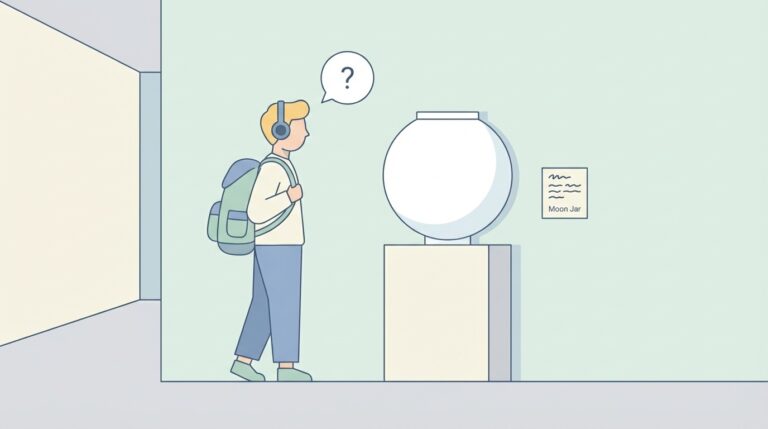
Picture this: You are at the National Museum of Korea in Seoul. You’re standing in front of a beautiful Moon Jar (Dalhangari), just like the one RM from BTS posted on his Instagram. The docent (guide) is explaining its history passionately. It feels like a scene from a historical K-Drama like The Red Sleeve.
But wait… the docent is speaking at 2x speed! 🤯
“이 백자는 조선 시대의… (This white porcelain is from the Joseon Dynasty…)”
Your brain freezes. You want to ask, “What did you say?” or “Can I take a picture for my Story?” but the words stick in your throat. You just nod and smile awkwardly (we’ve all been there!).
Don’t worry. Today, we’re not just learning vocabulary; we’re learning how to be an active audience member who gets the “Insider” treatment. Let’s unlock the secrets of Korean museums!
Phase 2: Core Expressions (Deep Dive) 🧐
Here are the top 3 phrases you need to survive a guided tour.
1. [다시 설명해 주세요]
- Pronunciation: [Da-si seol-myeong-hae ju-se-yo]
- Sound-alike: “Da-she” (like She) + “Sol-myung-heh” + “Ju-say-yo”
- Meaning: Please explain it again.
- Literal: Again + explain + please give (do for me).
- K-Culture Moment: Think of a variety show game where the idol doesn’t hear the mission clearly. They shout, “Dasi! Dasi!” (Again! Again!). Here, we add polite endings to be respectful.
- Editor’s Insight: It’s not rude to ask! Koreans appreciate it when you show interest. If “Seol-myeong-hae” (explain) is too hard, just say “다시 말해 주세요” (Please say it again).
- Situation Spectrum:
[🚫 Formal Speech] ———— [⚠️ Semi-Formal] ———— [✅ Casual/Polite]- Friend: “다시 말해봐” (Da-si mal-hae-bwa) ✅
- Docent/Stranger: “다시 설명해 주세요” ✅
- 🤔 Think About It: Korean has many specific verbs for “speaking” (saying, explaining, announcing). Why do you think accuracy in how information is delivered is important in a Confucian society?
2. [사진 찍어도 돼요?]
- Pronunciation: [Sa-jin jji-geo-do dwae-yo?]
- Sound-alike: “Sa-jin” + “Jjee-guh-do” + “Dway-yo?”
- Meaning: Is it okay to take a photo?
- K-Culture Moment: You know those strict security guards at K-Pop concerts shouting “No Photo!”? 🙅♂️ In museums, the rules vary. Always ask this before whipping out your phone.
- Editor’s Insight: The key grammar here is “-do dwae-yo?” (Is it okay if I…?). You can use this pattern for anything! “Sit here-do dwae-yo?” “Eat this-do dwae-yo?”
- Situation Spectrum:
[🚫 Boss] ———— [⚠️ Stranger] ———— [✅ Friend]- (Universal phrase, safe for almost everyone in A2 level context)
3. [이게 무슨 뜻이에요?]
- Pronunciation: [I-ge mu-seun tteu-si-e-yo?]
- Sound-alike: “E-geh” + “Moo-sun” + “Tteu-she-eh-yo?” (The ‘Tt’ is a strong, tense T sound!)
- Meaning: What does this mean?
- K-Culture Moment: When a K-Drama character receives a cryptic text message or sees a strange symbol, they whisper this to themselves. Use this when pointing at a difficult Hanja (Chinese character) or a symbol on a painting.
- Editor’s Insight: This shows you are intellectually curious. Docents love this question.
Phase 3: Textbook vs. Real Life 🗣️
| Situation | 📖 Textbook Korean | 🗣️ Real Korean (Survival) | 💡 Why different? |
|---|---|---|---|
| Asking permission | 사진 촬영이 가능합니까? (Is photography possible?) | 여기 사진 돼요? (Photos okay here?) | Koreans love efficiency (Palli-palli culture). Short and clear is best. |
| Asking for repeat | 다시 말씀해 주시겠습니까? (Could you please speak again?) | 잘 못 들었어요. (I couldn’t hear well.) | Admitting you didn’t hear is softer and less demanding than commanding them to repeat. |
| Looking for audio | 음성 안내기가 있습니까? (Is there a voice guide device?) | 오디오 가이드 있어요? (Have Audio Guide?) | “Audio Guide” is a loanword everyone uses. No need for complex native words. |
💡 Bottom Note: As an A2 learner, stick to the “Real Korean” column. It sounds more natural and less like a robot reading a script!
Phase 4: Cultural Deep Dive — The Art of “RM Tour” 🖼️
4-1. Non-verbal: The “X” Sign 🙅♀️
If a staff member makes an “X” with their arms or hands, stop immediately! It means “No.” Do not argue. In Korea, this gesture is the universal sign for “Forbidden” or “Stop.”
4-2. K-Culture Connection: The “RM Tour” (Namjooning)
Have you heard of “Namjooning”? It’s a term used by BTS fans (ARMY) to describe visiting museums, reading books, and enjoying nature, inspired by leader RM (Kim Namjoon).
* The Trend: Many galleries in Seoul (like The Leeum or Hyundae Gallery) have seen a spike in visitors because RM posted a photo there.
* The Etiquette: Even if you are excited to see the art RM saw, silence is golden. Korean museums are very quiet. Screaming “Oppa was here!” is a big No-No.
Phase 5: Immersive Roleplay 🎭
Setting: Sunday afternoon at the National Museum of Modern and Contemporary Art (MMCA). You are standing in front of a strange abstract sculpture.
Characters:
* YOU: An art-loving tourist.
* Docent: A kind but fast-talking guide (wearing a headset microphone).
Start Roleplay:
Docent: 자, 이 작품은 1980년대의 민주화 운동을 표현했습니다. (Ja, i jakpumeun 1980nyeondae-ui…)
(Okay, this work expresses the democratization movement of the 1980s…)
YOU: (It was too fast!) 저기요… [ 1. Use the phrase to ask for repetition ]
Docent: 아! 다시 설명해 드릴게요. (Ah! I will explain again.) Slows down This art is about freedom.
YOU: Ah~ Freedom! (Pointing to the art) [ 2. Ask if you can take a photo ]
Docent: 죄송합니다. 사진은 안 돼요. 눈으로만 봐주세요. (Sorry. No photos. Please look with your eyes only.)
🔀 Decision Point: What do you say?
* A) “Why? I want to post on Instagram!” (English)
* B) “아, 네. 알겠습니다.” (Ah, ne. Al-get-seum-ni-da. / Ah, okay. I understand.)
* C) Sneak a photo anyway.✅ Best Choice: B. Respecting the rules immediately shows high cultural intelligence.
⚠️ Choice C Analysis: Koreans have strict privacy and copyright norms. CCTV is everywhere. Don’t risk being kicked out!
Phase 6: 10-Second Shadowing Drill 🎧
Repeat after me! Focus on the rising intonation at the end.
- Emotion: 😊 Polite & Curious
- Sentence: 여기 / 사진 / 찍어도 / 돼요?
- Romanization: Yeogi / sa-jin / jji-geo-do / dwae-yo?
- Meaning: Is it okay to take photos here?
(Practice this 3 times until it feels smooth!)
Phase 7: K-Culture Mini Glossary 📖
| Korean | Romanization | English | Context |
|---|---|---|---|
| 도슨트 | Do-seun-teu | Docent | The guide. Not “Tour Guide,” specifically “Docent” in museums. |
| 국보 | Guk-bo | National Treasure | The most valuable artifacts (e.g., Gukbo No. 1). |
| 관람료 | Gwal-lam-nyo | Admission Fee | Often free for national museums, but paid for special exhibits. |
| 눈으로만 보세요 | Nu-neu-ro-man bo-se-yo | Eyes only | A polite sign meaning “Do Not Touch.” |
Phase 8: Traveler’s Survival Kit 🎒
Going to a museum in Korea? Don’t forget this!
🆘 Survival Expression #1: Audio Guide
* 🇰🇷 “오디오 가이드 있어요?” (O-di-o ga-i-deu i-sseo-yo?)
* 🗣️ Meaning: Do you have an audio guide?
* 💡 Pro Tip: Most major museums (National Museum of Korea, War Memorial) have excellent English Audio Guides apps for free or small rental fees. Bring your own earphones!📌 Editor’s Travel Note
* Lockers: Korean museums usually have free lockers (mule품 보관함). Put your heavy backpack there to enjoy the art lightly.
* Wifi: Free high-speed Wifi is almost guaranteed inside museums.
Phase 9: Think Deeper — “Touch” vs. “Preservation” 🧠
The Culture of “Distance”
In some Western museums, interactive exhibits are the norm. In Korea, while digital interactivity is growing, there is still a strong culture of “Preservation First” for historical artifacts. The “Do Not Touch” signs aren’t just rules; they reflect a collective desire to preserve history for future generations perfectly.
💬 Your Turn: In your country’s museums, are people allowed to get close to the art, or are the barriers strict? How does that change your experience?
Phase 10: FAQ & Troubleshooting 🛠️
- Q: Can I use a flash if I don’t touch the art?
- A: No. Flash is almost strictly forbidden (플래시 금지) as it damages old paintings and paper. Turn it off before you enter!
- Q: The docent asked me a question, but I froze. Was that rude?
- A: Not at all. Just smile and say “한국어 잘 못해요” (I don’t speak Korean well). They will likely switch to English or body language.
- ❌ Common Mistake: Touching the glass case while pointing.
- ✅ Fix: Point from a distance. Fingerprints on glass are a nightmare for staff!
Phase 11: Wrap-up & Mission 🚀
One-Liner Summary: Be curious, ask “Da-si” (again) if you miss something, and always ask permission before snapping that photo!
🏆 Your Mission:
* 🥉 Bronze: Say “Sajin jjigeodo dwaeyo?” out loud 3 times right now.
* 🥈 Silver: Watch a YouTube video of a “Korea Museum Tour” and see if you can spot the “No Photo” or “Do Not Touch” signs.
* 🥇 Gold: Go to a local museum (or any interesting place) and ask a staff member (in Korean!), “Is it okay to take a photo here?”
K-Culture Mission: Search for “RM Museum Tour” on Google. Pick one piece of art he liked. Can you describe it using one adjective?
Phase 12: Quiz — Interactive Challenge 🧩
Situation: The docent points to a painting and asks the group a question. You want to know what the painting symbolizes.
Which phrase is BEST?
- 이게 얼마예요? (How much is this?)
- 이게 무슨 뜻이에요? (What does this mean?)
- 사진 찍어도 돼요? (Can I take a photo?)
⬇️ Click for Answer
Answer: 2.
* 1 is wrong: Unless it’s an art gallery where art is for sale, don’t ask the price of a National Treasure! 🤣
* 3 is wrong: This is about permission, not meaning.
See you in the next lesson! 다음에 또 봐요! 👋
Frequently Asked Questions (FAQ)
Q: What does "[다시 설명해 주세요]" mean in Korean and how do you pronounce it?
A: In Korean, "[다시 설명해 주세요]" is pronounced [Da-si seol-myeong-hae ju-se-yo] and means: a key conversational Korean expression covered in this lesson.
Q: What does "[사진 찍어도 돼요?]" mean in Korean and how do you pronounce it?
A: In Korean, "[사진 찍어도 돼요?]" is pronounced [Sa-jin jji-geo-do dwae-yo?] and means: a key conversational Korean expression covered in this lesson.
Q: What does "[이게 무슨 뜻이에요?]" mean in Korean and how do you pronounce it?
A: In Korean, "[이게 무슨 뜻이에요?]" is pronounced [I-ge mu-seun tteu-si-e-yo?] and means: a key conversational Korean expression covered in this lesson.






