

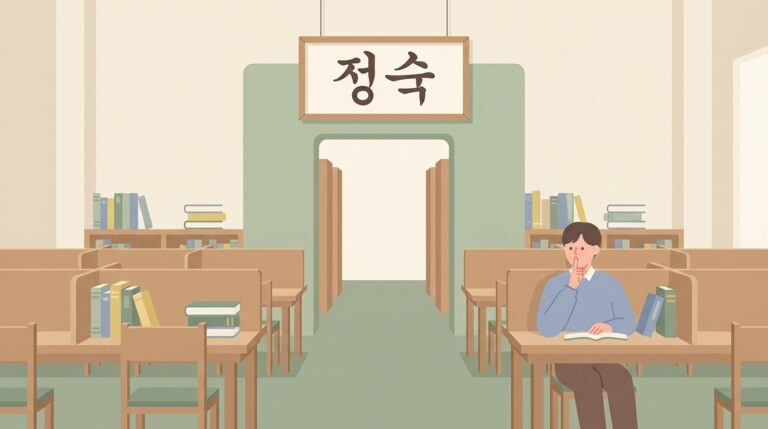
Phase 1: The ‘Sky Castle’ Vibe — Why Silence is Golden
Annyeonghaseyo! This is your Daily Hangul Editor. 👋
Have you ever watched a K-Drama like Sky Castle or Reply 1988 and seen those intense study scenes? Students are in a cubicle, the lighting is dim, and the silence is so heavy you could hear a pin drop. That is the Korean Dokseo-sil (Reading Room) culture.
Imagine you walk into a public library in Seoul to study. You accidentally drop your metal pen. Clang! Suddenly, ten pairs of eyes shoot lasers at you. You feel like the villain who just ruined the protagonist’s chances of getting into Seoul National University.
In Korea, ‘silence’ (정숙) in libraries isn’t just a rule; it’s a sacred form of consideration for others who are likely studying for life-changing exams. Today, we will learn how to express obligations and rules so you can survive the Korean library without becoming ‘Public Enemy No. 1.’
Phase 2: Deep Dive — Essential Expressions
Let’s break down the grammar of ‘rules’ using the B1 grammar point: -아야/어야 하다 (Must/Have to).
1. 도서관에서는 정숙해야 해요.
(Doseogwan-eseoneun jeongsuk-haeya haeyo.)
- Pronunciation: Jeong-sook-heh-ya-heh-yo (Focus on the sharp ‘S’ in Sook).
- Meaning: “You must be quiet in the library.”
- Grammar:
Verb stem + -아야/어야 하다= Must do X.- Editor’s Insight: 정숙 (Jeongsuk) is a formal Hanja (Sino-Korean) word for ‘silence’. You will see the sign 「정숙」 everywhere on library walls. It carries more weight than just “quiet.”
- Situation Spectrum:
[Casual] ———— [✅ Standard/Polite] ———— [Formal]- 🤔 Think About It: Why does Korean use a specific noun like Jeongsuk for public silence instead of just saying “Don’t talk”? It implies a state of mind, not just a lack of noise.
2. 음식물을 반입하면 안 됩니다.
(Eumsikmul-eul banip-hamyeon an doemnida.)
- Pronunciation: Eum-shik-mool… ban-ip… an-dwem-ni-da
- Meaning: “You must not bring in food.” (Literal: If you bring in food, it does not become/work.)
- Grammar:
Verb stem + -(으)면 안 되다= Must not / Not allowed to.- K-Culture Moment: You might see someone sneaking in an Iced Americano (Ah-Ah). Usually, covered drinks are a gray area (⚠️), but smelly food (like kimbap) is a huge “No-No” (🚫).
- Editor’s Insight: This is the standard phrase for stating prohibitions in public spaces.
3. 휴대폰은 진동으로 해 주십시오.
(Hyudaepon-eun jindong-euro hae jusipsio.)
- Pronunciation: Jin-dong (Vibration).
- Meaning: “Please set your phone to vibration mode.”
- Real Nuance: Even ‘Vibration’ can be loud on a wooden desk! Many Koreans put their phone on ‘Silent Mode’ (무음) or place it on a handkerchief to dampen the buzz.
Phase 3: Textbook vs. Real Life
| Situation | 📖 Textbook Korean | 🗣️ Real Korean (Street/Slang) | 💡 Why is it different? |
|---|---|---|---|
| Telling someone to be quiet | 조용히 해 주세요. (Please be quiet.) | (Uses body language) 🤫 Aggressive Eye Contact or a sticky note. | Direct confrontation is considered rude or aggressive. Koreans prefer non-verbal cues or indirect notes to save face. |
| Answering a phone call | 전화를 받으면 안 됩니다. (You must not answer the phone.) | “어, 나 도서관이야. 끊어.” (Uh, I’m at the library. Hang up.) Whispered in 0.5 seconds | Efficiency. You acknowledge the call briefly to show you aren’t ignoring them, then hang up immediately. |
Phase 4: Cultural Deep Dive — The Art of “Gong-bu”
4-1. The “Post-it Note” Culture (Non-verbal)
If you are clicking your mouse too loudly or sniffling constantly, a Korean person likely won’t tap your shoulder. instead, you might return from a bathroom break to find a Post-it note on your desk: “쪽지 (Note): 볼펜 소리가 너무 커요… (Your pen sound is too loud…)”. This is indirect conflict resolution. It saves you from public embarrassment while getting the message across.
4-2. K-Drama Trope: The Library Romance
In dramas like True Beauty, the library is where hands accidentally touch while reaching for the same book. The rule of silence actually amplifies the romantic tension because characters have to whisper, lean in close, or pass secret notes.
🧠 Critical Thinking: Why is the library seen as a romantic spot in media? perhaps because it’s one of the few places young students can be together outside of school or home supervision, sharing a private world of silence.
Phase 5: Immersive Roleplay — The ‘Vibrating Phone’ Crisis
Setting: A university library during mid-term exams. The air is thick with stress. Everyone is drinking ‘Monster Energy’ or coffee.
Characters:
* YOU: An exchange student trying to study for a Korean history exam.
* Ji-hoon: A serious engineering student sitting next to you.
(Scene: Your phone starts buzzing loudly on the wooden desk: ZZZZZT! ZZZZZT!)
Ji-hoon: (Stares at your phone, then looks at you with a troubled expression)
저기요… 휴대폰 진동 소리가 좀 크네요.
(Jeogiyo… hyudaepon jindong soriga jom keuneyo.)
YOU: (Startled)
🔀 Decision Point: How do you react?
- A) “아, 죄송합니다. 바로 끌게요.” (Ah, I’m sorry. I’ll turn it off right away.)
- B) “왜요? 진동인데?” (Why? It’s on vibration?)
- C) “아, 네.” (Ah, okay.) And just stares back.
✅ Best Choice: A. Acknowledging the mistake quickly and politely (
죄송합니다) dissolves the tension immediately.
⚠️ Analysis of B: This is a death wish. In Korea, causing inconvenience (민폐) to others in a shared quiet space is a major social taboo.
YOU: (Choice A selected)
아, 죄송합니다. 바로 끄겠습니다.
(Ah, joesong-hamnida. Baro kkeukess-seumnida.)
Ji-hoon: (Face softens, whispers kindly)
시험 기간이라 다들 좀 예민해요. 이해해 주세요.
(Siheom gigan-ira dadeul jom yemin-haeyo. Ihae-hae juseyo.)
(Translation: It’s exam period so everyone is a bit sensitive. Please understand.)
Phase 6: 10-Second Shadowing Drill
Let’s practice the magic phrase to apologize for noise. Say it with an apologetic face (😓)!
😓 죄송합니다. / 주의하겠습니다.
(Joe-song-ham-ni-da. / Ju-ui-ha-gess-seum-ni-da.)
I’m sorry. / I will be careful.
Phase 7: K-Culture Glossary — The Study World
| Korean | Romanization | Meaning | Context |
|---|---|---|---|
| 열공 | Yeol-gong | Studying Hard | Short for 열심히 공부 (Study hard). Used often in texts: “오늘도 열공!” |
| 독서실 | Dokseo-sil | Reading Room | A private, cubicle-style study center. Much stricter than a general library. |
| 카공족 | Kagong-jok | Cafe Study Tribe | People who study in cafes instead of libraries. (Cafe + Gongbu + Jok/Tribe). |
| 자리 맡기 | Jari mat-gi | Saving a seat | Placing a book or bag on a desk to “claim” it while you go to lunch. |
Phase 8: Traveler’s Survival Kit — Rules & Signs
Even if you aren’t a student, you will see these signs in museums, subways, and performance halls.
🆘 Survival Signs (Look for these Hangeul!)
1. ⛔ 출입 금지 (Chul-ip Geum-ji): No Entry / Do Not Enter.
2. 📷 촬영 금지 (Chwal-yeong Geum-ji): No Photography.
3. 🍔 음식물 반입 금지 (Eumsikmul Banip Geum-ji): No Food Allowed.
4. 🤫 정숙 (Jeong-suk): Silence / Quiet.📌 Editor’s Travel Note
In Korean subways, there are Priority Seats (노약자석). Even if the train is packed and your legs hurt, do not sit there unless you are elderly, pregnant, or disabled. It is an unwritten (and written) rule that is strictly followed!
Phase 9: Think Deeper — Silence & Community
🧠 Topic: Collectivism vs. Individual Comfort
In many Western cultures, a library is a public resource, and minor noises are tolerated. In Korea, the library is often viewed as a competitive battleground for future success (exams, certifications). The strict silence reflects the high-pressure society but also a deep communal consideration—the idea is, “I will endure discomfort (silence) so that you can succeed, and I expect you to do the same for me.”
💬 Your Turn: Does your country have strict rules about silence in public spaces? Or is it more relaxed? Tell us in the comments!
Phase 10: FAQ & Troubleshooting
- Q: Can I sleep in a Korean library?
- A: Actually… Yes! (😯) You will often see students taking a nap with their heads on the desk. As long as you don’t snore (very important!), sleeping is seen as a sign that you studied hard and are recharging. Just don’t drool on the books!
- Q: Can I whisper to my friend?
- A: In the general area? Maybe a little. In the Yeol-lam-sil (Reading Room/Study Hall)? No. Even whispering is considered noise. If you need to talk, go to the hallway or the ‘Rest Area’ (휴게실).
❌ Common Mistake: Answering a phone call inside the room and saying, “Wait, let me go outside.”
✅ Fix: Grab your phone and run outside while it is ringing, then answer it in the hallway.
Phase 11: Wrap-up & Mission
One-Liner Summary: In Korea, silence is a form of respect—use -아야/어야 하다 to understand rules, and keep your phone on silent!
🎯 Action Mission:
* 🥉 Bronze: Practice saying 죄송합니다 (I’m sorry) with a sincere bow in the mirror.
* 🥈 Silver: Set your phone to Korean language settings and find the 진동 (Vibration) or 무음 (Silent) mode.
* 🥇 Gold: Visit a local library or a quiet cafe. If your phone rings (or you make a noise), catch yourself and think, “Ah! I need to keep ‘Jeongsuk’!”
Phase 12: Quiz — Interactive Challenge
1. Which action is generally ACCEPTABLE in a strict Korean study room (Dokseo-sil)?
a) Eating crispy potato chips quietly.
b) Sleeping with your head on the desk.
c) Whispering to your friend for 5 minutes.
d) Answering the phone but speaking English.
2. Fill in the blank:
“Here, you must be quiet.”
= 여기서는 ________ 해야 해요.
3. True or False?
If someone is being loud in a Korean library, it is common to shout “Be quiet!” at them immediately.
🔑 Answers:
1. (b) Sleeping is okay! Chips, whispering, and phone calls are huge annoyances (Minpye).
2. 정숙 (Jeongsuk) or 조용히 (Joyong-hi).
3. False. Koreans usually use non-verbal cues (staring) or leave a polite note (Post-it) to avoid a public scene.
Frequently Asked Questions (FAQ)
Q: What does "정숙" mean in Korean and how do you pronounce it?
A: In Korean, "정숙" is pronounced [Jeongsuk] and means: is a formal Hanja (Sino-Korean) word for ‘silence’. You will see the sign
Q: What does "⛔ 출입 금지" mean in Korean and how do you pronounce it?
A: In Korean, "⛔ 출입 금지" is pronounced [Chul-ip Geum-ji] and means: No Entry / Do Not Enter.
Q: What does "📷 촬영 금지" mean in Korean and how do you pronounce it?
A: In Korean, "📷 촬영 금지" is pronounced [Chwal-yeong Geum-ji] and means: No Photography.
Q: What does "🍔 음식물 반입 금지" mean in Korean and how do you pronounce it?
A: In Korean, "🍔 음식물 반입 금지" is pronounced [Eumsikmul Banip Geum-ji] and means: No Food Allowed.







