

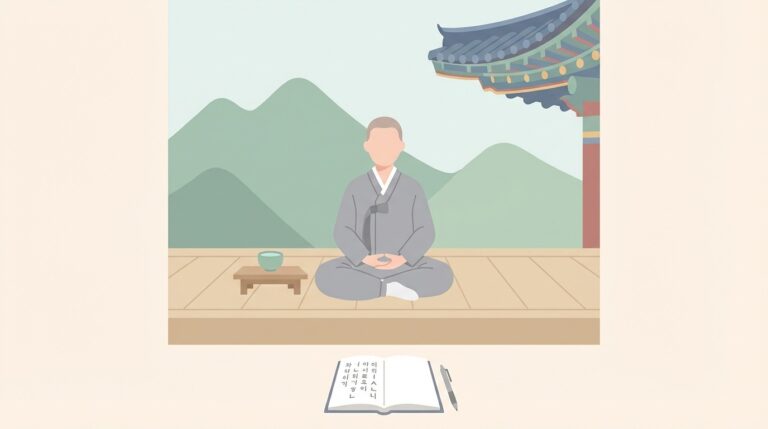
Finding Your Zen: How to Talk About Mindfulness & Yoga in Korea 🧘♀️
Phase 1: The ‘Meong’ State of Mind (Immersive Hook)
안녕하세요! This is your Daily Hangul Editor.
Picture this: You are walking by the Han River park on a Sunday afternoon. You see dozens of people sitting on the grass, staring blankly at the water. They aren’t looking at their phones. They aren’t talking. They look… zoning out.
Welcome to the “Space-out Competition” (멍 때리기 대회).
Yes, this is a real event in Korea where the person who maintains the most stable heart rate while doing absolutely nothing wins. In a society famous for its “Pali-pali” (Hurry, hurry) culture, the act of stopping has become a luxury—almost a rebellion.
Have you ever seen a K-Drama protagonist, overwhelmed by family secrets or corporate sabotage, suddenly flee to a mountain temple to bow 108 times? That’s not just for TV. Today, we are diving into the B2-level Korean you need to discuss meditation, yoga, and finding peace amidst the chaos of Seoul. Because sometimes, the most important Korean phrase isn’t about ordering food, but about emptying your mind.
Phase 2: Deep Dive into Core Expressions
Here are three expressions that go beyond simple “relaxing.”
1. 머리를 비우다 (Meori-reul biuda)
- Pronunciation: [Meori-reul bi-u-da] (Sounds like: Murray-reul be-woo-da)
- Meaning: To empty one’s head (Literal) vs. To clear one’s mind / De-clutter thoughts (Nuance)
- K-Culture Moment: In slice-of-life dramas like My Liberation Notes, characters often take a bus to nowhere just to do this. It implies your brain is full of “noise” and needs a reset.
- Editor’s Insight: This is different from “forgetting.” It’s an active process of removing stress. You go to a norebang (karaoke) or a yoga class to biuda.
- Situation Spectrum:
[🚫 Formal Report] ———— [⚠️ Semi-formal] ———— [✅ Casual/Consultation]
(Perfect for talking to friends or a yoga instructor. Avoid saying this during a business presentation unless you want to sound unprofessional!)- 🤔 Think About It: Why does Korean visualize stress as something filling up a container (the head) that needs to be “emptied”? Does your language view stress as a weight, a noise, or a substance?
2. 내려놓다 (Naeryeonoda)
- Pronunciation: [Nae-ryeo-no-ta] (Sounds like: Neh-ryuh-no-tah)
- Meaning: To put down (Literal) vs. To let go of obsession/greed/burden (Real Nuance)
- K-Culture Moment: A monk in a movie might say this to the ambitious main character: “욕심을 내려놓으세요” (Put down your greed). It’s the ultimate spiritual advice.
- Editor’s Insight: This is a B2/C1 verb. You physically put down a bag, but emotionally put down your maeum (heart/mind). It implies you were holding onto something too tightly.
- Situation Spectrum:
[🚫 Kid's Talk] ———— [⚠️ Casual] ———— [✅ Deep Conversation]
(Used in serious, emotional conversations or counseling contexts.)- 🤔 Think About It: In a competitive society like Korea, “letting go” is often harder than “holding on.” Why is this word considered a form of healing?
3. 힐링이 필요해 (Hilling-i piryohae)
- Pronunciation: [Hil-ling-i pi-ryo-hae]
- Meaning: I need healing.
- Editor’s Insight: “Healing” (힐링) is a massive loanword in Korea, but it’s used differently than in English. It doesn’t mean curing a disease. It refers to psychological comfort—eating good food, seeing a nice view, or doing yoga. It’s the antidote to “Burnout.”
- Situation Spectrum:
[✅ Everywhere!]
(You can say this to your boss, your mom, or your dog. It’s a universally accepted state of being.)
Phase 3: Textbook vs. Real Life
| Situation | 📖 Textbook Korean | 🗣️ Real Korean (Insa Style) | 💡 Why the difference? |
|---|---|---|---|
| Expressing stress | 스트레스가 많아서 쉬고 싶어요. (I have a lot of stress so I want to rest.) | 아, 멘탈 나갈 것 같아. 힐링 좀 해야돼. (Ah, my mental is leaving. I need some healing.) | Koreans use “Mental” (mentality) as a noun. When it “leaves” (nagada), you are breaking down. |
| At a Yoga Class | 몸을 편안하게 하세요. (Make your body comfortable.) | 긴장을 툭, 떨구세요. (Drop your tension with a ‘tuk’ sound.) | Instructors use onomatopoeia like ‘tuk’ to emphasize the physical sensation of dropping tension. |
| Asking for advice | 어떻게 마음을 다스리나요? (How do you manage your mind?) | 어떻게 마인드 컨트롤 하세요? (How do you do ‘Mind Control’?) | Konglish “Mind Control” is the common term for emotional regulation in daily life. |
💡 Editor’s Note: Using words like “멘탈” (mental) and “마인드 컨트롤” (mind control) immediately makes you sound like a modern Seoulite, not a textbook robot.
Phase 4: Cultural Deep Dive — The Temple Stay Phenomenon 🏯
4-1. Non-verbal: The “Hyu~” (휴~)
In a meditation or yoga setting, or just after a long day, you will hear Koreans make a deep, audible sigh: “Hyu~”. In some cultures, sighing is rude. In Korea, it’s a socially accepted signal of “I am releasing my burden.” Don’t be alarmed if your yoga teacher sighs deeply; they are demonstrating how to biuda (empty).
4-2. K-Culture Connection: Temple Stays & Digital Detox
Many foreigners visit Korea for the neon lights of K-Pop, but the Temple Stay (템플스테이) program is where the real “Mind Control” happens. You wear grey uniform pants (very comfy!), eat vegan temple food, and bow.
- The 108 Bows (108배): In dramas, you see characters sweating while bowing repeatedly. This isn’t just religious; it’s considered a full-body workout and a moving meditation. If you try this, your legs will shake, but Koreans believe this physical pain clears the mental noise.
- Tea Ceremony (다도): It’s not just drinking tea. It’s about listening to the water boil and the tea pour. It’s the ASMR of real life.
🧠 Critical Perspective: Why is the “Wellness Industry” booming in Korea? It’s the shadow of the economic miracle. The intense pressure to succeed created a market for “artificial rest.” Is paying to sit in a silent room a luxury or a necessity in the 21st century?
Phase 5: Immersive Roleplay — Checking into a Temple Stay 🌿
Setting: A serene temple in the mountains of Gangwon-do. The air is crisp. You are at the reception desk, wearing your grey uniform.
Characters:
* YOU: An office worker seeking an escape from city noise.
* Sunim (수님): A Buddhist monk (or temple volunteer), calm and soft-spoken.
Dialogue:
Sunim: 어서 오세요. 속세의 번뇌는 잠시 내려놓으셨나요? 🍵
(Eoseo oseyo. Sokse-ui beonnoeneun jamsi naeryeonoseusyeonnayo?)
(English) [Welcome. Have you put down the anguish of the secular world for a moment?]
(🎭 Stage Direction: The monk smiles benevolently with hands together)
YOU (Select your response):
🔀 Your Turn! How do you reply?
- A) “네, 머리를 좀 비우고 싶어서 왔어요.” (Yes, I came because I want to empty my head a bit.)
- B) “아니요, 와이파이 비밀번호가 뭐예요?” (No, what is the wifi password?)
- C) “죄송해요, 제가 한국말을 잘 못해요.” (Sorry, I don’t speak Korean well.)
✅ Best Choice: A — This uses the key phrase “Meori-reul biuda” perfectly in context. It shows you understand the purpose of the stay.
⚠️ Choice B Analysis: This defeats the purpose! Most temple stays ask you to surrender your phone. This is a “face-palm” moment.
Sunim: 잘 생각하셨습니다. 여기서는 ‘묵언’ 수행을 하셔야 합니다. 말을 하지 않고 자신에게 집중해 보세요.
(Jal saeng-gaka-syeot-seumnida. Yeogiseoneun ‘mugeon’ suhaeng-eul hasyeoya hamnida…)
(English) [Good thinking. Here, you must practice ‘Mugeon’ (Silence). Try focusing on yourself without speaking.]
YOU: 아, 정말요? 알겠습니다. 노력해볼게요.
(Ah, jeongmallyo? Algetseumnida. Noryeokaebolgeyo.)
(English) [Ah, really? I understand. I will try.]
Phase 6: 10-Second Shadowing Drill 🗣️
Let’s practice a sentence you might hear in a yoga class or tell yourself when stressed.
Sentence: “잠시 / 모든 걸 내려놓고 / 오로지 나에게만 / 집중해 보세요.”
Romanization: Jamsi / modeun geol naeryeonoko / oroji na-egeman / jipjunghae boseyo.
Meaning: For a moment, put everything down, and focus solely on yourself.
Emotion: 😌 Calm, soothing, slow pace.
Instruction: Take a deep breath before starting. Pause at the / marks. Elongate the vowel in “Jamsiii~” slightly to sound more relaxing.
Phase 7: K-Culture Mini Glossary
| Korean | Romanization | English | Context |
|---|---|---|---|
| 멍 때리기 | Meong ttaerigi | Spacing out | A highly valued skill in modern Korea. Often done at cafes or by the river. |
| 불멍 | Bul-meong | Fire spacing out | Staring at a campfire (or a video of one) to relax. Very popular camping term. |
| 물멍 | Mul-meong | Water spacing out | Staring at the sea or river. |
| 다도 | Dado | Tea Ceremony | The traditional way of preparing and drinking tea as a meditation. |
| 번뇌 | Beonnoe | Anguish/Worldly desires | A Buddhist term often used in dramas to describe mental struggles. |
Phase 8: Traveler’s Survival Kit (Wellness Edition) 🎒
If you visit a Korean spa (Jjimjilbang), Yoga studio, or Temple, these are essential.
🆘 Survival Phrases
1. 🇰🇷 “명상 프로그램이 있나요?” (Myeongsang peu-ro-geu-raem-i innayo?)
* 🗣️ Meaning: Do you have a meditation program?
2. 🇰🇷 “너무 뻣뻣해서 걱정이에요.” (Neomu ppeot-ppeot-haeseo geok-jeong-i-e-yo.)
* 🗣️ Meaning: I’m worried because I’m so stiff. (Useful for yoga/Pilates!)
3. 🇰🇷 “조용한 곳을 찾고 있어요.” (Joyonghan goseul chatgo isseoyo.)
* 🗣️ Meaning: I am looking for a quiet place.📌 Editor’s Travel Note
* App Tip: Use ‘Frip’ (프립) or ‘Naver Booking’ to find one-day yoga classes or meditation workshops. Many are foreigner-friendly!
* Temple Stay: The official website (eng.templestay.com) is excellent. You don’t need to be Buddhist.
Phase 9: Think Deeper — “Pali-pali” vs. “Healing”
Why is “Healing” such a buzzword in Korea?
Korea is famous for its rapid economic growth, driven by the “Pali-pali” (hurry, hurry) spirit. But every action has a reaction. The obsession with “Healing,” “Wellness,” and “Work-Life Balance” (Worabal) is the direct counter-movement to this intensity. When you learn Korean words for relaxation, notice how many imply stopping or emptying. In English, we might “recharge” (active), but in Korean, we “put down” (passive).
💬 Your Turn: Does your culture value “doing nothing”? Or is being busy considered a status symbol? How do you say “spacing out” in your language?
Phase 10: FAQ & Troubleshooting
- Q: Can I do a Temple Stay if I am Christian or Muslim?
- A: Yes! Temple Stays are cultural experiences, not forced conversion. You can opt out of the religious bowing (108 bows) if it conflicts with your faith. Just tell them: “종교적인 이유는 아니고, 문화 체험만 하고 싶어요.” (It’s not for religious reasons, I just want the cultural experience.)
- Q: Is it rude to close my eyes when someone is talking?
- A: Generally, yes. But if you are in a “Healing Cafe” (yes, these exist with massage chairs) or a meditation session, it is expected.
- ❌ Common Mistake: Don’t confuse “쉬다” (to rest) with “자다” (to sleep).
- If you say “I want to sleep” (자고 싶어요) at a yoga class, it sounds lazy. Use “잠시 쉬고 싶어요” (I want to rest for a moment).
Phase 11: Wrap-up & Action Mission
One-Liner: To find peace in Korean, you don’t add more joy; you empty (biuda) the noise and put down (naeryeonoda) the burden.
🚀 Action Mission:
* 🥉 Bronze: Say “Hyu~” followed by “Jamsi naeryeonoja” (Let’s put it down for a moment) when you feel stressed today.
* 🥈 Silver: Search “Han River Space Out Competition” on YouTube and watch a video. Leave a comment in Korean: “저도 멍 때리기 잘해요!” (I am also good at spacing out!)
* 🥇 Gold: Visit a Korean temple (or a quiet park) and try sitting for 10 minutes without your phone. If someone asks what you’re doing, say: “머리를 비우고 있어요.”
K-Culture Mission: Watch the drama “My Liberation Notes” (just the first episode). Spot how many times the characters sigh or stare into space. That is the vibe of this lesson.
Phase 12: Interactive Quiz
- Situation: Your friend is stressing out about an exam. What is the most natural, supportive thing to say?
- A) 빨리 빨리 공부해! (Study hurry hurry!)
- B) 욕심을 좀 내려놔. (Put down your greed/ambition a bit.)
- C) 밥 먹었니? (Did you eat?)
- Hint: C is the classic Korean greeting, but B is the deep ‘healing’ advice.
- Fill in the Blank: “요즘 너무 바빠서
_______ 하러 가고 싶어.”- (I’m so busy these days, I want to go do _______.)
- Choices: 힐링 (Healing) / 야근 (Overtime work)
(Scroll down for answers)
.
.
.
Answers: 1. B (Though C is also caring, B fits today’s theme of mental management), 2. 힐링 (Healing)
Frequently Asked Questions (FAQ)
Q: What does "머리를 비우다 (Meori-reul biuda)" mean in Korean and how do you pronounce it?
A: In Korean, "머리를 비우다 (Meori-reul biuda)" is pronounced [Meori-reul bi-u-da] and means: To empty one's head (Literal) vs. To clear one's mind / De-clutter thoughts (Nuance)
Q: What does "내려놓다 (Naeryeonoda)" mean in Korean and how do you pronounce it?
A: In Korean, "내려놓다 (Naeryeonoda)" is pronounced [Nae-ryeo-no-ta] and means: To put down (Literal) vs. To let go of obsession/greed/burden (Real Nuance)
Q: What does "힐링이 필요해 (Hilling-i piryohae)" mean in Korean and how do you pronounce it?
A: In Korean, "힐링이 필요해 (Hilling-i piryohae)" is pronounced [Hil-ling-i pi-ryo-hae] and means: I need healing.







