

Phase 1: The Invisible Handshake — Can You Trust a Door Handle?
Hello! This is your Daily Hangul Editor.
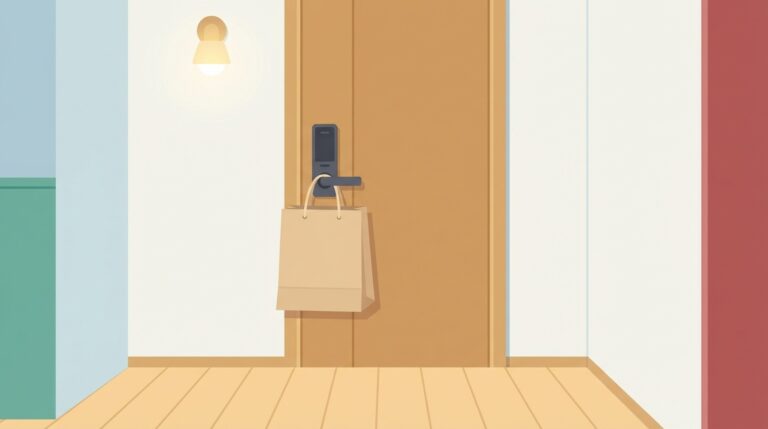
Imagine this scene from a K-Drama: The protagonist returns to their high-tech apartment complex late at night. They look tired. As they approach their front door, they don’t unlock it immediately. Instead, they reach for a small paper bag hanging quietly on the door handle. A smile spreads across their face. No words spoken, no awkward meetings, just a silent transaction completed.
This isn’t a spy movie drop-off. This is “Mungori Georae” (문고리 거래 – Door-handle Trading), the epitome of modern Korean second-hand culture.
In a country where CCTV is everywhere and social trust is surprisingly high, people trade everything from luxury bags to half-used perfumes without ever seeing each other’s faces. But here’s the catch: How do you communicate politely when you never actually speak?
In this C1-level unit, we move beyond basic greetings to master the subtle, high-context etiquette of the “Invisible Deal.” If you master this, you aren’t just a Korean learner; you are a part of the local ecosystem.
Phase 2: Deep Dive into Core Expressions
1. [비대면 문고리 거래 가능하신가요?]
- Pronunciation: [Bidaemyeon mungori georae ganeunghasingayo?] + (Think of ‘Mungori’ sounding like ‘Moon-Go-Ree’, meaning door knob/handle)
- Meaning:
- Literal: Is non-face-to-face door-handle trading possible?
- Nuance: “I prefer not to meet in person. Can I just pick it up from your door (or you from mine) without contact?”
- K-Culture Moment: You’ll see this often in apps like Danggeun Market (Karrot). It became the standard during the pandemic but stayed because Koreans love Ppalli-ppalli (efficiency) and privacy.
- Editor’s Insight: This sentence uses the honorific infix -(으)시-. Even though it’s a casual app, the request involves the other person’s home boundary, so high politeness is crucial to establish trust.
- Situation Spectrum:
[🚫 Boss/Elders] ———— [✅ Strangers on Apps] ———— [✅ Neighbors] - 🤔 Think About It: Why has this specific method survived post-pandemic? Does it reflect a desire for efficiency, or an increasing social isolation in urban Seoul?
2. [입금 확인 후상세 주소 알려드릴게요.]
- Pronunciation: [Ipgeum hwagin hu sangse juso allyeodeurilgeyo]
- Meaning:
- Literal: After confirming deposit, I will let you know the detailed address.
- Nuance: “I trust you, but business is business. Transfer the money first, then I’ll reveal my apartment number.”
- K-Culture Moment: In K-Crime thrillers, revealing an address is dangerous. In real life, Koreans protect their apartment unit numbers (ho-su) until the deal is sealed to prevent privacy invasion.
- Editor’s Insight: Notice the structure N + 후 (after). It’s more formal and transactional than ~한 다음에. It sets a professional boundary.
- Situation Spectrum:
[🚫 Friends] ———— [⚠️ Semi-formal] ———— [✅ Business/Strangers] - 🤔 Think About It: In many Western cultures, cash-in-hand is king for local pickups. Why is bank transfer (pre-payment) the norm for door pickups in Korea? What does this say about banking accessibility?
3. [수령 인증샷 부탁드려요.]
- Pronunciation: [Suryeong injeung-shot butakdeuryeoyo]
- Meaning:
- Literal: I ask for a reception proof shot.
- Nuance: “Please send me a photo once you’ve picked it up so I can stop worrying.”
- K-Culture Moment: The “Injeung-shot” (Proof shot) culture is massive. From voting to food deliveries, if there isn’t a photo, did it even happen? This closes the loop of the transaction.
- Editor’s Insight: ‘수령’ (Receipt) is a formal Hanja word. Using ‘받으시면’ (when you receive) is fine, but ‘수령’ elevates the tone to a respectful transaction level.
- Situation Spectrum:
[🚫 Close Family] ———— [✅ Online Sellers] ———— [✅ Delivery Instructions] - 🤔 Think About It: Is the “proof shot” about mistrust, or is it a digital form of a handshake?
Phase 3: Textbook vs. Real Life
| Situation | 📖 Textbook Korean | 🗣️ Real Korean (Karrot Style) | 💡 Why the difference? |
|---|---|---|---|
| Asking to buy | 저 물건을 사고 싶습니다. | 저요! 🙋♂️ or 구매 희망합니다. | Speed is key. Short, enthusiastic claims win the item. |
| Confirming pickup | 물건을 가져갔습니다. 감사합니다. | 수령 완료요! 잘 쓰겠습니다~ 🥕 | Formal sentences feel robotic. ‘Completed’ (완료) + slangy emoji tone is standard. |
| Asking for address | 주소가 어떻게 됩니까? | 위치 어디로 가면 될까요? | ‘Address’ feels like asking for ID. ‘Location’ (where to go) feels softer and less intrusive. |
Bottom Note: At C1 level, you should mix the formality of business (transaction) with the softness of social media connectivity (emojis/tildes). Too stiff = suspicious. Too casual = rude.
Phase 4: Cultural Deep Dive — The Trust Economy
4-1. Non-verbal: The Bag on the Handle
In Korea, leaving a shopping bag on a door handle implies a sacred circle of safety.
* The Etiquette: Never look inside other bags hanging there (courier packages, food delivery). Only touch what is yours.
* The Timing: Pick it up exactly when you said you would. Leaving an item hanging for days annoys the seller because it clutters their entryway.
4-2. K-Culture Connection: The “CCTV Panopticon”
Why does Mungori Georae work?
* K-Drama Context: You know those scenes where the police check the “Black Box” (Dashcam) or CCTV to solve a crime? That reality makes theft rare.
* Critical View: While safe, does this high surveillance make people complacent? Koreans often leave phones on cafe tables but lock their digital lives with complex passwords. The door-handle trade relies on this physical safety net.
Phase 5: Immersive Roleplay Scenario
Setting: It’s 9:00 PM on a Tuesday. A hallway in a quiet apartment complex in Mapo-gu. You are buying a limited edition LP from a seller named ‘Minji’.
Characters:
* YOU: An expat music collector who speaks fluent Korean.
* Minji (Seller): A meticulous seller with a high “Manner Temperature” (Karrot rating).
(📱 Chat Context)
Minji: 입금 확인했습니다. 주소는 104동 1502호입니다. 문고리에 걸어둘게요! 🛍️
(Ipgeum hwagin haetsseumnida. Juso-neun 104-dong 1502-ho-imnida. Mungorie georeodulgeyo!)
(Payment confirmed. Address is Bldg 104, Apt 1502. I’ll hang it on the door handle!)
YOU: 네, 감사합니다! 지금 출발하면 20분 정도 걸릴 것 같아요.
(Ne, gamsahamnida! Jigeum chulbalhamyeon 20-bun jeongdo geollil geot gatayo.)
(Thanks! If I leave now, it’ll take about 20 minutes.)
Minji: 천천히 오세요. 쇼핑백에 ‘LP’라고 써뒀어요.
(Cheoncheonhi oseyo. Syopingbaege ‘LP’rago sseodwosseoyo.)
(Take your time. I wrote ‘LP’ on the shopping bag.)
(20 Minutes Later – In front of Apt 1502)
YOU: (Takes a photo of the bag on the handle)
🔀 Decision Point! How do you close the deal?
A) (Send nothing. Just leave.)
B) “가져갑니다.” (I’m taking it.)
C) (Send Photo) “잘 수령했습니다! 상태 너무 좋네요, 감사합니다~ 🥕”✅ Best Choice: C.
Analysis: In non-face-to-face trades, the “Silence” after pickup creates anxiety for the seller. Did they get it? Was it stolen? Option C provides closure (photo) and satisfaction (compliment), which guarantees you a good rating.
Phase 6: 10-Second Shadowing Drill
Let’s practice the professional yet polite tone of a trusted buyer.
😊 (Polite & Clear)
입금 확인되면 / 상세 주소 / 알려주세요!
(Ipgeum hwagin-doemyeon / sangse juso / allyeojuseyo!)
“Once payment is confirmed / the detailed address / please let me know!”
Phase 7: K-Culture Mini Glossary
| Korean | Romanization | Meaning | Context |
|---|---|---|---|
| 쿨거래 | Kul-georae | Cool Deal | A quick transaction with no bargaining or unnecessary questions. Highly praised behavior. |
| 거파 | Geopa | Deal Breaker | Short for ‘Georae Pagi’ (Canceling the deal). A major sin in the community. |
| 네고 | Nego | Negotiation | Konglish for bargaining. “네고 가능?” (Is bargaining possible?) |
| 매너온도 | Maeneo Ondo | Manner Temp. | The reputation score on Karrot Market. Starts at 36.5°C. Higher is better. |
Phase 8: Traveler’s Survival Kit
Even if you aren’t living in Korea, you might buy a concert ticket or a rare camera lens via Twitter/Karrot while visiting.
🆘 Survival Expression #1
– 🇰🇷 “혹시 호텔 로비나 편의점 앞에서 거래 가능할까요?”
(Hoksi hotel robi-na pyeonuijeom apeseo georae ganeunghalkkayo?)
– Meaning: “By any chance, can we trade in front of a hotel lobby or convenience store?”
– Why: As a traveler, you don’t have a “door handle.” Use public landmarks.📌 Editor’s Travel Note
– Payment: Most sellers want bank transfers (Gyejwa Iche). As a tourist, cash is your only option. Say: “제가 외국인이라 현금 직거래만 가능한데 괜찮으실까요?” (I’m a foreigner so I can only do cash face-to-face, is that okay?)
Phase 9: Think Deeper — “Trust as a Currency”
Topic: High-Context Trust Society
Korea’s Mungori Georae phenomenon is a fascinating case study of Social Capital. In many countries, leaving an item worth $100 on a doorknob is an invitation for theft. In Korea, it is a standard logistics solution. This reflects a society where “community eyes” (and electronic eyes) act as a moral compass.
However, think about this: Does this system exclude those who don’t fit the profile? For example, foreigners often have trouble verifying their identity on these apps, effectively locking them out of this circle of trust. Is technology bridging the gap, or creating a higher wall?
💬 Your Turn: Would Mungori Georae work in your home city? Why or why not? Share in the comments!
Phase 10: FAQ & Troubleshooting
Q: Is it rude to check the item thoroughly before taking it from the handle?
A: No, but be quick. Standing in front of someone’s door for 10 minutes examining a jacket looks suspicious to neighbors. If you are that worried, ask for a face-to-face meeting instead.
Q: Can I ask for a discount (Nego) after I arrive at the door?
A: Absolutely NOT (🚫). This is the worst etiquette. In non-face-to-face deals, the price is fixed beforehand. Attempting to negotiate on-site is grounds for being reported.
❌ Common Mistake: Ringing the doorbell (Ding-dong!) when picking up.
✅ Fix: unless instructed otherwise, do not ring the bell. The whole point of this method is to avoid contact (maybe the baby is sleeping, or the dog barks). Just take it and text.
Phase 11: Wrap-up & Action Items
Summary: Non-face-to-face trading relies on clear confirmation (payment/address) and closing the loop (proof shots), underpinned by mutual trust.
🚀 Action Missions:
– 🥉 Bronze: Practice saying “문고리에 걸어주세요” (Please hang it on the door handle) three times clearly.
– 🥈 Silver: Go to a Korean convenience store and see the pile of packages sitting unguarded on tables. Observe, but don’t touch!
– 🥇 Gold: If you are in Korea, buy a small item (like a sticker or book) on Karrot using the Door-handle method!
🎬 K-Culture Mission: Watch a scene from the drama “When the Camellia Blooms”. Observe how the neighborhood ‘ajummas’ know everything happening in the town. That is the analog version of the Karrot Market community!
Phase 12: Interactive Quiz
1. Situational Judgment:
You arrived at the seller’s door, but the bag isn’t there. What is the most polite text to send?
- A) 사기꾼이세요? 신고합니다. (Are you a scammer? I’m reporting you.)
- B) 도착했는데 물건이 안 보여요. 혹시 아직 안 두셨나요? (I arrived but don’t see the item. Did you perhaps not put it out yet?)
- C) 문 앞인데 빨리 나와보세요. (I’m at the door, come out quickly.)
2. True or False:
It is good manners to ring the doorbell to let the seller know you have successfully picked up the item. (True / False)
Answers:
1. B. Always give the benefit of the doubt first. It might be inside for safety until you arrive.
2. False. Send a text or photo instead. Silence is golden in Mungori Georae.
Frequently Asked Questions (FAQ)
Q: What does "[비대면 문고리 거래 가능하신가요?]" mean in Korean and how do you pronounce it?
A: In Korean, "[비대면 문고리 거래 가능하신가요?]" is pronounced [Bidaemyeon mungori georae ganeunghasingayo?] and means: Literal: Is non-face-to-face door-handle trading possible?
Q: What does "[입금 확인 후상세 주소 알려드릴게요.]" mean in Korean and how do you pronounce it?
A: In Korean, "[입금 확인 후상세 주소 알려드릴게요.]" is pronounced [Ipgeum hwagin hu sangse juso allyeodeurilgeyo] and means: Literal: After confirming deposit, I will let you know the detailed address.
Q: What does "[수령 인증샷 부탁드려요.]" mean in Korean and how do you pronounce it?
A: In Korean, "[수령 인증샷 부탁드려요.]" is pronounced [Suryeong injeung-shot butakdeuryeoyo] and means: Literal: I ask for a reception proof shot.






