

Phase 1: The ‘No Chopsticks’ Nightmare (Immersive Hook)
Greeting: “ㅇㅇㅅㅇㅣㅇㅗ! Hello! This is your Daily Hangul Editor.”
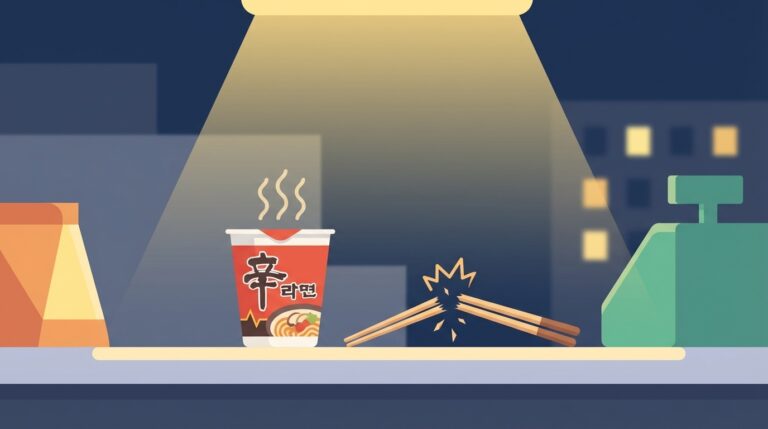
K-Culture Cold Open: Picture this. You are at the Han River Park (ㅈㅇㄷ, Hangang) at 10 PM. You just bought a steaming hot cup of Ramyeon (ㄹㅅㅕ) from the convenience store, just like in your favorite K-Drama. You sit on the grass, ready to take that first delicious slurp… and then you freeze.
You have no chopsticks.
In the drama, the lead actor coolly splits the wooden chopsticks with a satisfying snap. In reality, you are staring at your noodles, wondering if you have to drink them like a smoothie.
The ‘Why’: Korean convenience stores (CU, GS25, 7-Eleven) often keep chopsticks behind the counter or in a specific ‘self-bar’ area to reduce waste. If you don’t speak up, you don’t eat. Don’t worry! Today, I’ll teach you the magic words to save your dinner.
Phase 2: Key Expressions Deep Dive
1. ㅈㅆㄱㄹㄱ ㅈㅕ ㅈㅗㅅㅓㅗ (Jeotgarak jom juseyo)
- Pronunciation: [Jeot-ga-rak jom ju-se-yo]
- Jeot: Sounds like ‘Jut’ in ‘Jutland’ but stop the ‘t’ sound abruptly.
- Ga-rak: ‘Ga’ like ‘Garage’, ‘Rak’ like ‘Rock’.
- Jom: Rhymes with ‘Home’. It softens the request.
- Meaning: “Please give me some chopsticks.”
- K-Culture Moment: In K-Dramas, when a character buys a ton of food for a late-night talk with a friend, they might ask the cashier for extra chopsticks: “ㅈㅆㄱㄹㄱ ㄴㅇㄴㅇㅢ ㅈㅗㅅㅓㅗ” (Give me plenty of chopsticks).
- Editor’s Insight: The word ㅈㅕ (Jom) is crucial. It literally means ‘a little,’ but here it acts like “Could you please…?” Without it, “ㅈㅆㄱㄹㄱ ㅈㅗㅅㅓㅗ” can sound a tiny bit demanding, like “Give me chopsticks.” Add ‘Jom’ to sound like a polite local!
- Situation Spectrum:
[🚫 Formal Meeting] ——— [⚠️ Office] ——— [✅ Convenience Store/Restaurant] - 🤔 Think About It: Why do Koreans use metal chopsticks at home but wooden ones at convenience stores? Is it just convenience, or is there a cultural preference for the ‘cleanliness’ of disposable items outside the home?
2. ㅈㅆㄱㄹㄱ ㅇㄷㅣ ㅇㅣㅆㅓㅗ? (Jeotgarak eodi isseoyo?)
- Pronunciation: [Jeot-ga-rak uh-dee ee-ssuh-yo?]
- Meaning: “Where are the chopsticks?”
- Editor’s Insight: Sometimes the staff is busy stocking shelves. Instead of asking them to give it to you, asking where it is shows you are willing to help yourself. This is great ‘Nunchi’ (social sense)!
- Situation Spectrum:
[🚫 To your boss] ——— [✅ Store Clerk/Stranger]
Phase 3: Textbook vs. Real Life
| Situation | 📖 Textbook Korean | 🗣️ Real Street Korean | 💡 Why the difference? |
|---|---|---|---|
| Asking for chopsticks | ㅈㅆㄱㄹㄱㄹ ㅈㅗㅅㅣㄱㅆㅅㄴㅣㄲ? (Would you give me chopsticks?) |
ㅈㅆㄱㄹㄱㅔ! (Chopsticks, yo!) |
Koreans love efficiency (Pali-Pali culture). We drop particles and verbs when the context is clear. |
| Asking for location | ㅈㅆㄱㄹㄱㄹ ㅇㄷㅔㅅㅓ ㅁㄹ ㅅㅡ ㅇㅣㅆㅅㄴㅣㄲ? (Where can I find chopsticks?) |
ㅈㅆㄱㄹㄱㄷㅕ…? (As for chopsticks…?) |
Ending with a question tone implies the rest: “…where are they?” |
Bottom Note: “ㅈㅆㄱㄹㄱㅔ” (Jeotgarak-yo) is very casual but acceptable in a busy store. As an A2 learner, stick to “ㅈㅆㄱㄹㄱ ㅈㅗㅅㅓㅗ” to be safe and polite!
Phase 4: Cultural Deep Dive
4-1. Non-verbal Communication: The ‘Pointing’ Finger
When you ask “Where are the chopsticks?”, the clerk might not speak. They might just point with their chin or hand to a specific corner. This isn’t rude; it’s efficiency! Look for a microwave or a hot water dispenser. The chopsticks are usually hidden in a box right next to them.
4-2. K-Food Connection: ㄴㅁ ㄹㅅㅕ (Cup Ramyeon)
In Korea, eating cup noodles at a convenience store ‘standing table’ is a rite of passage. But did you know there are different sizes of chopsticks?
* Small Cup Noodles: Often come with mini wooden chopsticks inside or require small ones.
* Big Bowls: Need the regular wooden chopsticks.
* If you buy a ‘Dosirak’ (Bento box), chopsticks are usually taped to the side or bottom. Check before you ask!
Phase 5: Immersive Roleplay Scenario
Setting: It’s 11 PM at a ‘CU’ near Hongdae station. The store is buzzing with young people buying drinks. You just bought Fire Noodles (ㄷㄳㄷㄷㅕ). You are at the counter.
Characters:
* YOU: Hungry traveler who loves spicy food.
* Part-timer (Male, 20s): Wearing a vest, looks tired but scans items very fast.
Dialogue:
Part-timer: ㄷㅇㅈㅡ ㄴㅁㅕㄱ ㅇㅣㅆㄷㅕㅡ ㄷㄳㅓㅓㅓㅕ? 📝
(Bongtu piryo-haseyo?)
(Do you need a plastic bag?)
YOU: ㅇㅅㄴㅣㅕ, ㄳㅂㅈㄷㅅㅡㄴㄷㄹ ㅔ. 🙅♂️
(Aniyo, gwaenchana-yo.)
(No, I’m okay.)
(Stage Direction: You pay with your card. He hands you the receipt. But he forgets to give you chopsticks!)
🔀 Your Turn! How do you ask?
- Option A: (Silent) Just look around and try to find them yourself.
- Option B: “ㅈㅑㄱㅕ, ㅈㅆㄱㄹㄱ ㅈㅗ ㅈㅗㅅㅓㅗ.” (Excuse me, please give me chopsticks.)
- Option C: “ㅈㅆㄱㄹㄱ ㄴㅕㅕㅅㅗ?” (Did you put chopsticks in?)
✅ Best Choice: Option B. It is clear, polite, and direct.
⚠️ About Option A: Good for introverts, but some stores keep them behind the counter to prevent theft. You might search forever!
⚠️ About Option C: This implies he made a mistake. Polite, but slightly accusatory for a simple transaction.
Part-timer: ㅇㅅ, ㅈㅑㅅㅡㅈㅅㄴㄷㄷ! ㅇㄱㄱ ㅇㅣㅅㅓㅗ. 🥢
(Ah, joesong-hamnida! Yeogi isseoyo.)
(Ah, I’m sorry! Here you go.)
Phase 6: 10-Second Shadowing Drill
Practice this before you enter the store. Focus on the rhythm!
Sentence: ㅈㅑㄱㅕ, / ㅈㅆㄱㄹㄱ / ㅈㅗ ㅈㅗㅅㅓㅗ!
- Romanization: Jeo-gi-yo, / jeot-ga-rak / jom ju-se-yo!
- Emotion: 😊 Bright & Polite (Not annoyed!)
- Guide:
- ㅈㅑㄱㅕ (Jeo-gi-yo) ↗ [Rising intonation to get attention]
- ㅈㅆㄱㄹㄱ (Jeot-ga-rak) → [Flat, clear]
- ㅈㅗㅅㅓㅗ (Ju-se-yo) ↘ [Soft falling intonation]
Phase 7: K-Culture Mini Glossary
| Korean | Romanization | English | Context |
|---|---|---|---|
| ㄴㅁㅕㄱ | Na-mu jeot-ga-rak | Wooden Chopsticks | Specifically the disposable break-apart kind found in stores. |
| ㄹㅅㅕ | Ra-myeon | Instant Noodles | The soul food of Korean convenience stores. |
| ㅅㄹㅂ | Sel-peu | Self-Service | If you see this sign, you get the water/cutlery yourself! |
| ㅇㄹㅂ | Al-ba | Part-timer | Short for ‘Arbeit’ (German). The staff member working at the store. |
Phase 8: Traveler’s Survival Kit
Heading to a Korean convenience store (Pyeonuijeom)? Keep these handy.
🆘 Survival Phrase #1: The Spoon Dilemma
* 🇰🇷 “ㅅㄱㄹㄱㄷ ㅈㅗㅅㅓㅗ.” (Sut-ga-rak-do ju-se-yo.)
* 🗣️ Pronunciation: [Sut-ga-rak-do…]
* 📍 Use when: You bought soup or rice porridge, but they only gave you chopsticks.
* 💡 Pro Tip: In Korea, we usually drink Ramyeon broth directly from the bowl, so spoons aren’t automatically given for noodles!📌 Editor’s Travel Note
* Microwave: It’s called ㅈㄴㅈㄱㄹㄴㅉ (Jeon-ja-ren-ji). If you need to heat something up, look for the machine yourself. It’s almost always self-service.
* Trash: Separate your trash! Ramen cups go in the ‘General Waste’ or specific bin, and leftover soup goes in the ‘Liquid Waste’ bucket. Don’t just throw the whole cup in!
Phase 9: Think Deeper — “Why Plastic & Wood?”
Environment vs. Convenience in Korea
Korea is a world leader in recycling, yet you will see a massive amount of single-use wooden chopsticks and plastic cups in convenience stores. Why? It creates a fascinating conflict. The culture values ㅁㄹㄹㅁㄹㄹ (Pali-pali / Hurry-hurry) efficiency, which disposables provide. However, recently, many stores have stopped giving free plastic bags and straws to force an eco-friendly change.
🧠 Think Deeper: In your country, do convenience stores give cutlery for free? Or do you have to ask/pay? How does this reflect your culture’s view on service vs. environment?
Phase 10: FAQ & Troubleshooting
Q: Can I take extra chopsticks for later?
A: ⚠️ Maybe. Taking one extra set is usually okay (Korean ‘Jeong’/Affection culture). But grabbing a handful? No. That’s considered rude and wasteful.
Q: What if I can’t pronounce ‘Jeotgarak’?
A: Use body language! Make a V-shape with your fingers and make a motion of eating noodles. Every Korean will understand. Then say “Please” (ㅈㅗㅅㅓㅗ).
❌ Common Mistake #1: Asking for chopsticks when buying a sandwich or kimbap (triangle rice).
✅ Correction: Koreans eat Triangle Kimbap (ㅆㄱㄱㄱㅂ) with their hands (keep the plastic wrapper on!). Asking for chopsticks marks you as a confused tourist instantly!
Phase 11: Wrap-up & Action Mission
One-Liner Summary: To get utensils, use “[Item] + jom juseyo” politely, or look for the Self counter first!
Action Mission:
* 🥉 Bronze: Say “Jeotgarak jom juseyo” out loud 3 times while pretending to hold a cup noodle.
* 🥈 Silver: Watch a ‘Mukbang’ (Eating show) on YouTube and listen for when they mention utensils.
* 🥇 Gold: Go to a Korean Mart or Asian Supermarket in your city. Ask the staff “Jeotgarak isseoyo?” (Do you have chopsticks?) when buying noodles!
K-Culture Mission: Next time you watch a K-Drama, count how many times they break wooden chopsticks. Do they rub them together to remove splinters? (Many Koreans do this habit!)
Phase 12: Interactive Quiz
1. Situation Judgment:
You bought a Triangle Kimbap (ㅆㄱㄱㄱㅂ). You ask: “Jeotgarak juseyo.” The clerk looks confused. Why?
* A) Your pronunciation was bad.
* B) You should eat it with a spoon.
* C) You are supposed to eat it with your hands.
2. Fill in the Blank:
If you can’t find the utensils, you ask: “Jeotgarak ㅇㄷ ㅇㅣㅆㅓㅗ?” (Where are the chopsticks?)
* Answer: ________ (hint: eodi)
3. True or False (K-Culture):
Koreans usually use metal chopsticks for Cup Ramyeon at convenience stores.
* (True / False)
🔑 Answers:
1. C (Triangle Kimbap is finger food!)
2. ㅇㄷ (Eodi)
3. False (Metal is for home/restaurants. Wood/Plastic is for convenience stores.)
Frequently Asked Questions (FAQ)
Q: What does "ㅈㅆㄱㄹㄱ ㅈㅕ ㅈㅗㅅㅓㅗ (Jeotgarak jom juseyo)" mean in Korean and how do you pronounce it?
A: In Korean, "ㅈㅆㄱㄹㄱ ㅈㅕ ㅈㅗㅅㅓㅗ (Jeotgarak jom juseyo)" is pronounced [Jeot-ga-rak jom ju-se-yo] and means: a key conversational Korean expression covered in this lesson.
Q: What does "ㅈㅆㄱㄹㄱ ㅇㄷㅣ ㅇㅣㅆㅓㅗ? (Jeotgarak eodi isseoyo?)" mean in Korean and how do you pronounce it?
A: In Korean, "ㅈㅆㄱㄹㄱ ㅇㄷㅣ ㅇㅣㅆㅓㅗ? (Jeotgarak eodi isseoyo?)" is pronounced [Jeot-ga-rak uh-dee ee-ssuh-yo?] and means: “Where are the chopsticks?”







