

Panic at the Front Desk: “I Lost My Room Key!” 😱
Phase 1: The Immersive Hook
Hello! This is your Daily Hangul Editor.
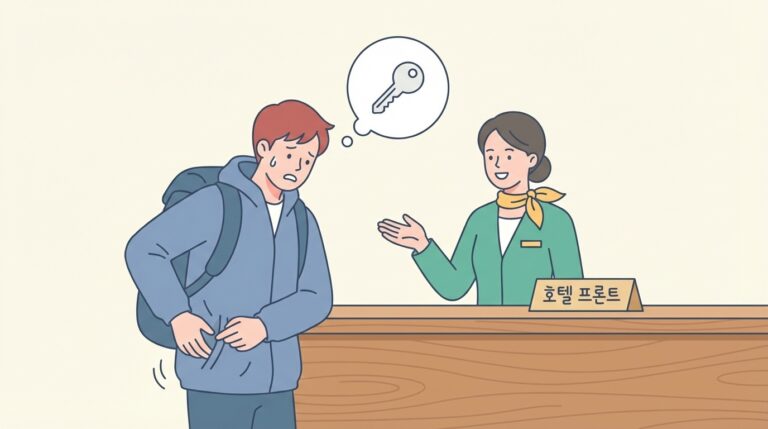
Picture this: You’ve just returned to your hotel after a long day of exploring Gyeongbokgung Palace or attending a frantic K-Pop concert. You reach into your pocket to grab your room card, imagining jumping onto that soft hotel bed… but your pocket is empty. 😨
We’ve all seen this scene in K-Dramas. The protagonist stands in the hallway, rummaging through their bag, panic rising. Sometimes, this leads to a dramatic encounter with the lead actor. But in real life? It’s just awkward!
Don’t worry. In Korea, hotel staff are incredibly helpful, but you need the right words to explain the situation without freezing up. Today, we’re going to learn how to solve this crisis with “K-Politeness.”
Phase 2: Deep Dive into Key Phrases
1. 방 키를 잃어버렸어요 (I lost my room key)
- Pronunciation: [Bang ki-reul ir-eo-beo-ryeo-sseo-yo]
- Sound-alike: “Bang” (like a gun sound) + “Key” + “rull” + “Ear-uh-buh-ryuh-saw-yo”
- Meaning:
- Literal: Room key [object marker] lost [past tense polite].
- Real Nuance: “I have unfortunately misplaced my key (please help).”
- K-Culture Moment: In K-Dramas, when a character says this, they often look down at their feet. It shows they are sorry for the trouble.
- Editor’s Insight: The word
잃어버렸어요(lost) is a bit long and tricky! If it twists your tongue, focus on the rhythm: Da-da-da-da-DA-yo. - Situation Spectrum:
[🚫 Boss] ———— [⚠️ Stranger/Staff] ———— [✅ Friend]- (Actually, this phrase is standard polite
~yostyle, so it is safe for Staff ✅ and Strangers ✅. For friends, drop theyo.)
- (Actually, this phrase is standard polite
2. 혹시… (By any chance… / Excuse me…)
- Pronunciation: [Hok-si]
- Sound-alike: “Hoke” (like poke) + “See“
- Meaning: By any chance / Perhaps.
- Editor’s Insight: This is the Magic Word of Korean manners. Before you deliver bad news (“I lost my key”), starting with “Hoksi…” softens the blow instantly. It tells the listener, “I am about to ask for a favor or admit a mistake.”
- 🤔 Think About It: Why do Koreans hesitate before speaking? In Western culture, being direct is confident. In Korea, being indirect (
Hoksi...) shows you care about the other person’s feelings.
Phase 3: Textbook vs. Real Life
| Situation | 📖 Textbook Korean | 🗣️ Real Life Korean | 💡 Why the difference? |
|---|---|---|---|
| Reporting Loss | 방 열쇠를 분실했습니다. (Bang yeol-soe-reul bun-sil-haet-seum-ni-da) |
키 잃어버렸어요. (Ki ir-eo-beo-ryeo-sseo-yo) |
“Bun-sil” is too formal, like filling out a police report. “Ki” (Konglish) is used more than “Yeol-soe” in hotels. |
| Asking for New One | 새 열쇠를 주십시오. (Sae yeol-soe-reul ju-sip-si-o) |
키 하나만 다시 주실 수 있나요? (Ki ha-na-man da-si ju-sil su innayo?) |
Direct commands feel rude. Asking “Can you give me one again?” is softer. |
💡 Editor’s Note: Even though you are the customer (King!), showing humility gets you faster service in Korea!
Phase 4: Cultural Deep Dive — The “Apologetic Bow”
Non-verbal Communication:
When you approach the front desk to say you lost something, do not stand stiffly with direct eye contact.
- The Slight Nod: Dip your head slightly as you say “Hoksi…”
- The Eyes: Look a bit worried (use your acting skills!).
- The Hands: Don’t point. Keep your hands together or by your side.
K-Drama Connection (Trope Alert):
Have you seen the scene where the rich CEO (Chaebol) loses a key? They just demand a new one. But the warm-hearted protagonist always apologizes first. Be the protagonist, not the arrogant CEO!
Phase 5: Immersive Roleplay
Setting: Hotel Lobby in Myeong-dong, 11:00 PM. You are tired after shopping for skincare products.
Characters:
* YOU: A tired tourist with too many shopping bags.
* Staff: A polite hotel receptionist in a sharp uniform.
Start Dialogue:
Staff: 어서 오세요. 도움이 필요하신가요? (Welcome. Do you need help?)
YOU: (You check your pockets… empty!)
“저기요… [ 1 ]… [ 2 ].”
(Excuse me… By any chance… I lost my room key.)
🔀 Decision Point: Fill in the blanks!
* A) 야! … 문 열어! (Hey! … Open the door!)
* B) 혹시 … 방 키를 잃어버렸어요. (Hoksi … Bang ki-reul ir-eo-beo-ryeo-sseo-yo.)
* C) 키 내놔. (Give me the key.)✅ Best Choice: B
* Why? A and C will get you kicked out or stared at. B is the perfect polite phrases we learned.
Staff: 아, 괜찮으세요? 방 번호가 어떻게 되세요? (Ah, are you okay? What is your room number?)
YOU: 1204호예요. (Cheon-i-baek-sa ho-yeyo / It’s room 1204.)
Phase 6: 10-Second Shadowing Drill
Let’s practice the “Panic & Polite” combo. Listen to the rhythm!
- Emotion: 🥺 (Apologetic and slightly worried)
- Drill:
저기요... / 혹시... / 방 키를 / 잃어버렸어요.
(Jeo-gi-yo… / Hok-si… / Bang ki-reul / ir-eo-beo-ryeo-sseo-yo.)
Tip: Drag the “Ho~~~ksi” slightly to show hesitation!
Phase 7: K-Culture Mini Glossary
| Korean | Romanization | Meaning | Context |
|---|---|---|---|
| 프런트 | Peu-reon-teu | Front Desk | Konglish. You can also say “Lob-by”. |
| 체크아웃 | Che-keu-a-ut | Checkout | Used exactly like English. |
| 호 | Ho | Room Number Marker | Unlike English (Room 304), Korean puts “Ho” after the number (304-Ho). |
| 신분증 | Sin-bun-jeung | ID Card | They might ask for this to verify it’s your room. |
Phase 8: Traveler’s Survival Kit
🆘 Survival Phrase #1: Telling your Room Number
* 🇰🇷 “제 방은 [Number]호예요.” (Je bang-eun [Number]-ho-yeyo.)
* 🗣️ Pronunciation Tip: Just use Sino-Korean numbers (Il, I, Sam, Sa…).
* Room 201: I-gong-il Ho.
* 💡 Pro Tip: If numbers are hard, just show your reservation email on your phone!
📌 Editor’s Travel Note:
Most modern Korean hotels use card keys. If you lose one, you usually don’t have to pay a fine unless it’s a physical metal key (common in older “Yeogwan” or guesthouses). But always ask: “Charge?” (Money?) just in case!
Phase 9: Think Deeper — “Why so sorry?”
Topic: The Culture of Inconvenience
Did you notice how much we apologized for a simple mistake? In Korea, causing “min-pye” (nuisance/inconvenience) to others is a big social taboo. Even if it’s the hotel staff’s job to help you, you apologize for making them work extra to replace your key. This isn’t submissiveness; it’s a social lubricant that maintains harmony.
💬 Your Turn: In your country, if you lost a hotel key, would you apologize profusely, or just ask for a new one directly?
Phase 10: FAQ & Troubleshooting
- Q: Can I use “Bang ki” for an Airbnb passcode?
- A: No! For a digital door lock (very common in Korea), say “비밀번호를 잊어버렸어요” (Bi-mil-beon-ho-reul ij-eo-beo-ryeo-sseo-yo / I forgot the password).
- Q: Can I drop the “yo” at the end?
- A: Absolutely NOT. The staff is working. Using Banmal (casual speech) to staff is considered “Gabjit” (power abuse) and is very rude.
- ❌ Common Mistake: Saying “I lost” as “Jyeosseoyo” (which means losing a game/match).
- ✅ Correct: Ir-eo-beo-ryeo-sseo-yo (Lost an object).
Phase 11: Wrap-up & Action Mission
One-Liner Summary: Start with “Hoksi…” (By any chance) and say “Bang ki-reul ir-eo-beo-ryeo-sseo-yo” with a sorry face! 🥺
🚀 Action Missions:
* 🥉 Bronze: Say “1204호” (Cheon-i-baek-sa ho) out loud 3 times. Don’t forget the “Ho”!
* 🥈 Silver: Imagine you are at a front desk. Act out the “Hoksi…” nod in the mirror.
* 🥇 Gold: Next time you are at a hotel (anywhere!), try thinking the Korean phrase in your head before speaking English.
K-Culture Mission: Watch a K-Drama episode involving a hotel or travel. Spot the moment someone bows slightly while asking for help. That’s the “Hoksi” vibe!
Phase 12: Quiz — Interactive Challenge
1. You are at the front desk. Which gesture is appropriate when asking for a new key?
* A) High-five the receptionist.
* B) Slight head bow and worried eyes.
* C) Pointing finger at the computer.
2. Fill in the blank: “Je bang-eun 305____ yeyo.”
* A) Gae (dog/counter)
* B) Myeong (people counter)
* C) Ho (room number counter)
3. True or False?
* “You should speak casually (Banmal) to hotel staff because the customer is King.”
* (Answer: FALSE! Always use polite language.)
(Scroll down for answers)
.
.
.
Answers: 1 (B), 2 (C), 3 (False)
Frequently Asked Questions (FAQ)
Q: What does "방 키를 잃어버렸어요 (I lost my room key)" mean in Korean and how do you pronounce it?
A: In Korean, "방 키를 잃어버렸어요 (I lost my room key)" is pronounced [Bang ki-reul ir-eo-beo-ryeo-sseo-yo] and means: a key conversational Korean expression covered in this lesson.
Q: What does "혹시... (By any chance... / Excuse me...)" mean in Korean and how do you pronounce it?
A: In Korean, "혹시... (By any chance... / Excuse me...)" is pronounced [Hok-si] and means: a key conversational Korean expression covered in this lesson.







